
I am more excited about companies using AI than companies selling AI.
Let me explain why…
There has been a fundamental shift in the types of companies that excite me in the last year. For a decade, I was an enterprise SaaS investor. Why? Because it was the best business model ever.
What does that mean? What even makes a great business model?
I have talked many times about how to define business value. And a great business model will drive meaningful business value - sustainably, reliably, and over a long period of time. It’s that simple.
Business Model → Business Execution → Enterprise Value
So let’s define value. To do this we will enlist my favorite tool in all of finance: the discounted cash flow (DCF) analysis. What is this? It’s a quantitative way to understand business value through the lens of long term profitability.
It has 4 key variables which we must understand. I outlined them here years ago in a post, but I will review them here simply as well:
Growth (near and mid-term): Big G
Growth (long-term): little g
Free cash flow margin: FCF%
Discount rate (risk): measured by cost of capital - r
Not one, but ALL of these variables must be strong to build a truly valuable business.
Big G: It can grow as fast as you want. It’s multi-tenant software that can scale up basically infinitely with no speed limit. And the demand for these products for ~20 years was insatiable.
little g: The market showed that it was MUCH bigger than people thought, especially as software became a layer of the economy rather than a sector.
FCF%: It costs almost nothing to deliver technically. It costs a bit more to deliver from a customer management perspective. Basically, you invested once big to build it. Then continue to spend a bit to maintain and expand it. Then your only other cost is sales and marketing, which fuels GROWTH rather than sustaining existing customers.
r: When the customers you acquired last year are expected to continue paying you next year without meaningful investment, the risk goes WAY down. Your ability to hit your numbers, especially at scale, gets WAY easier. In addition, when done right, enterprise software customers pay a year upfront. This way, even if they leave, you keep the cash. The risk to the business is very low.
Many of these characteristics are interrelated, but when they combine, they form super businesses. The amount of market cap accretion to software companies over the last 20 years is INSANE.
Just look at one example (who represents the industry pretty well):
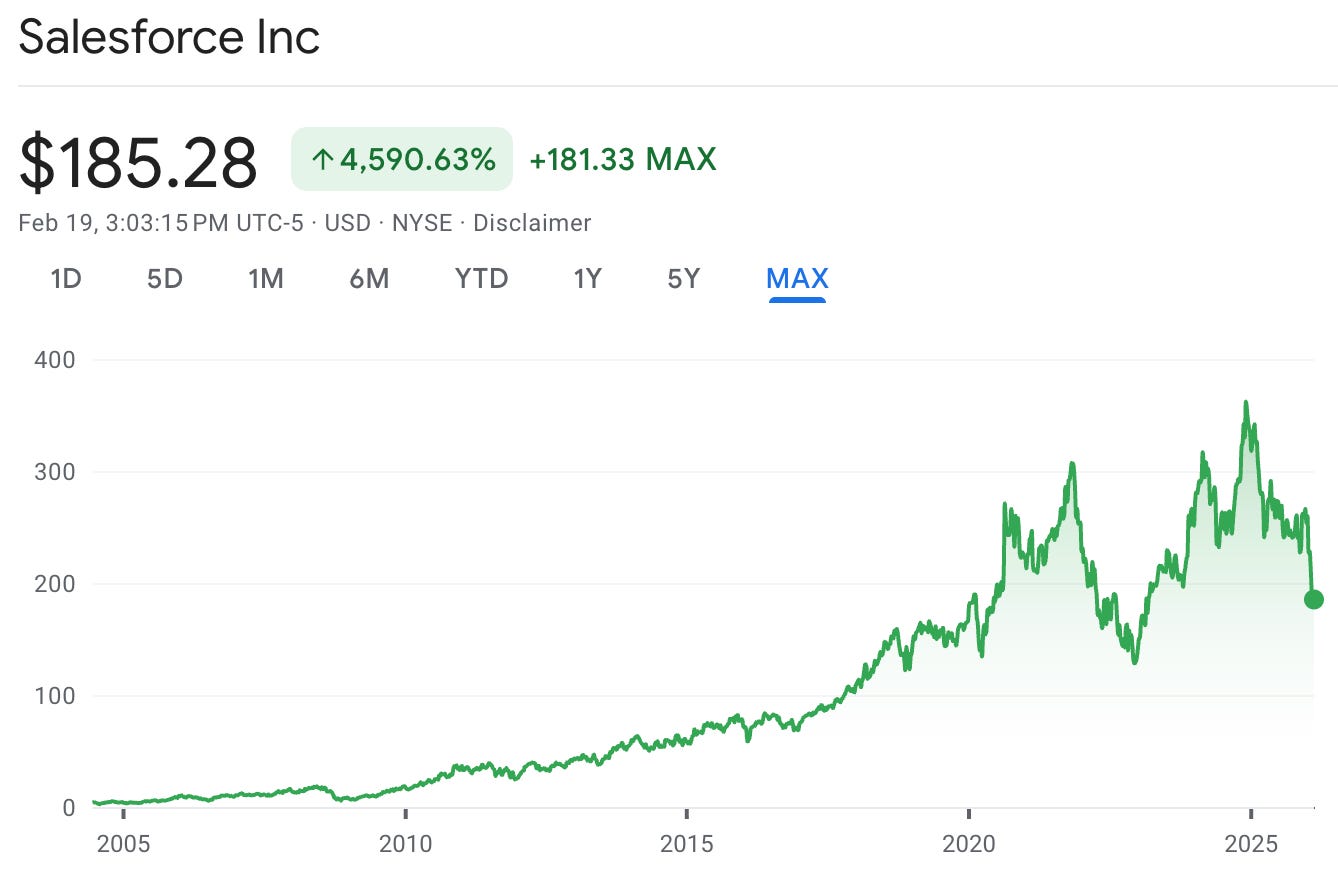
Salesforce Market Cap:
2006: ~$4Bn
Dec 2024 (Peak): ~$350Bn
Feb 2026: ~$175Bn
In addition, total spent on acquisitions by Salesforce has been ~$75Bn - and that is just on the ones where the price was disclosed!
But there were a few underlying fundamental assumptions that drove this:
High switching costs, low competition, and product worthiness
Variable costs remaining low
Economies of scale being an advantage
The removal of these assumptions from the investment thesis recently is the explanation for why SaaS stocks have cratered over the last year. (Salesforce is down 40+% over the last year.)
People can spin up custom apps to do exactly what they want almost instantly, and it’s only getting easier. The expectations around what an app will do for me is also higher than ever. These are not feature requests; there is a fundamental shift in the architecture of digital tools.
Infusing your app with AI-powered tools to try to keep up is currently a losing battle. Even if you assume AI token costs will fall sharply, they’re killing software margins for now. There has been a more fundamental shift at the architecture level that is very difficult to keep up with using legacy teams and products.
Economies of scale in SaaS is a mega power... or at least it was. The brand recognition. The compounding revenue. The contract terms. The contract scale. The cost negotiation power. The reference-able customers. Being a scaled SaaS company was like owning a bottomless gold mine.
So if we apply these changes to our DCF variables:
Big G: Churn baby churn. Companies are increasingly favoring bespoke solutions. The ability to transition and do the data mastering to make it seamless is easier than ever. Competition is fierce and pricing leverage is gone. It’s possible to keep your customers, but hard to grab new ones.
little g: This is all about future sentiment, and it is grim right now for enterprise software. The market doesn’t know where things will end up, but they’re confident that large and mid-size SaaS players are not in good shape to outpace GDP growth meaningfully for the next 10 years.
FCF%: This is probably the most interesting and most important. COGS (variable costs) have gone up. Less gross margin to play with from the top down means less margin for error. CAC is also out of control. There is just so much competition in this gold mine after 20 years that the investment required to get new customers has gotten out of hand. On a contribution margin basis, these companies are on thin ice.
r: Discount rates are super high because the foundation is being SHOOK. With churn questions, cost questions, and broader market dynamic questions, investors (justifiably) do not trust the ability of these mega software companies to adapt. (Contract terms are generally still good, but there’s a big push towards usage-based pricing - and billing - and away from standard paid-upfront seat-based pricing).
What does this come down to? OPERATIONAL INERTIA.
These companies have been built with thousands of employees with a culture underpinned by 20+ years of enterprise SaaS business model dominance. I often say it’s the best legal business model ever. The result: companies (and their shareholders) got both greedy and lazy. They dug their heels in to get the most out of these underlying assumptions just in time for them to be ripped out from under them.
You have to build a good business model. You need real differentiation. You need to find fundamental revenue resilience.
The new normal sounds an awful lot like the normal of the last 200 years of business.
Companies with too many employees, static processes, and whose economies of scale are really just corporate bloat are going to be in trouble. You just can’t hide much anymore. The emperor is wearing a speedo.
The potential savior: Some of these SaaS companies are run by some of the greatest entrepreneurs ever to walk the earth. I expect we will see several of them pull more rabbits out of more hats.
But for me, as an early-stage investor with a small fund, I am excited about founders who can build strong, resilient businesses. Get to $10M of revenue and do it in a sustainable way, because there are simply too many questions beyond that horizon to possibly answer. It’s harder than ever to know what business or markets will support massive scale, so the founder comes back into clear focus as the sole driver of exponential enterprise value growth by navigating an extremely dynamic economic landscape.
In the new game, going after legacy industries has become A LOT more attractive. Here is the math:
Margin Flipping: Gross margin is getting crushed in the pure software world. Meanwhile, gross margins in legacy industries are going up, driven technology automation. This means gross margins in what were considered low-margin industries can be higher than ever.
Opex Corrections: Opex in software has gotten lazily high. An AI-native operation today has the opportunity to scale with WAY fewer employees. Enter AI-powered super employees whose former 3 hours of meetings per day have been collapsed into 15 minutes of AI conversations. The quality of output is better and the time it takes to produce quality starts approaching zero.
CAC Opportunities: CAC in some of these legacy industries is a greenfield opportunity. There simply is not competition and noise (yet). A few conversations, a killer product, lower cost, and you’re in. The software world is extremely crowded and the CAC advantages of the 2010s are long gone.
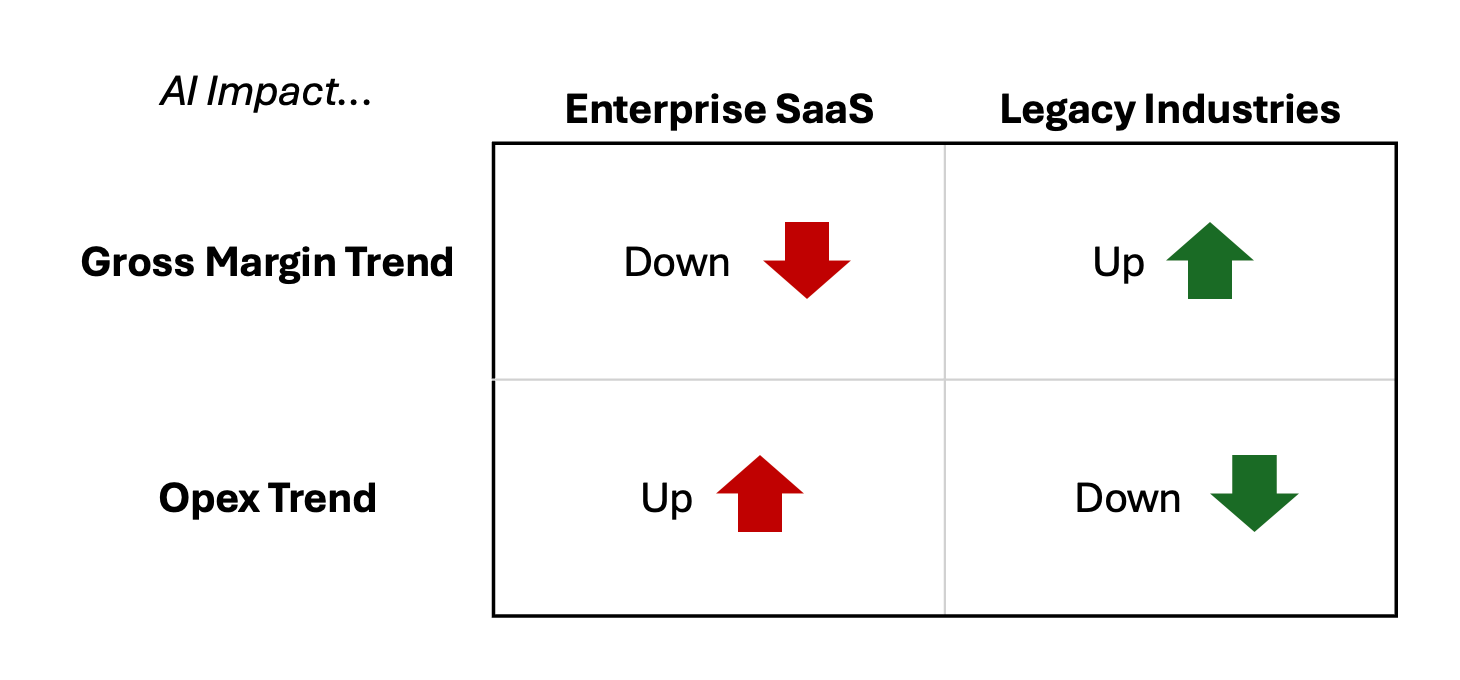
I think it will be very hard for legacy tech companies to fire 90% of their workforce, but a complete rethinking of opex is what is required right now to maintain a competitive edge. This opens the door for young, small, under-resourced companies to make real waves, and do so quickly. The advantages of the agile startup are stronger than ever.
Switch the math around. SaaS relied on high gross margin and it resulted in high opex. Now the tables have turned: gross margin is crashing while opex stays higher than ever.
New AI-powered companies can have higher gross margins than ever, while the ability to sell an innovative product at a lower price has a renewed openness that we haven’t seen before on a global level. So as always, the more things look different, when we abstract it enough, we realize that we’re actually on the same curve as we have been forever.
It’s time to get back to the fundamentals for a new era of technology-powered businesses. I am psyched.
I have changed the name of this newsletter from SaaS Engineering to Business Model Logic. It’s not because SaaS markets are down, it’s because I’ve been thinking more broadly about business models for many years. The SaaS Engineering idea started in 2014 when my boss at NEA, Harry Weller, came to me and said, “you really like finance, and you’re an engineer. Everything is going SaaS, and I want you to learn this business model inside and out.” Thus the SaaS Engineer, Alex Oppenheimer, was spawned (and my career has been guided by this conversation ever since). The work I have done since then gave me a sharp view on WHY the SaaS business model can be so powerful, and as you can see above, why I can explain its current downfall. It was never about the jargon or the hype, it was always about the calculus. I am extremely excited when new technologies open new markets, but most of all, create new business models. Looking forward to sharing more here soon.
P.S. check out the original DCF / Direction Valuation Modeling post here:
Directional Valuation
·
September 18, 2022
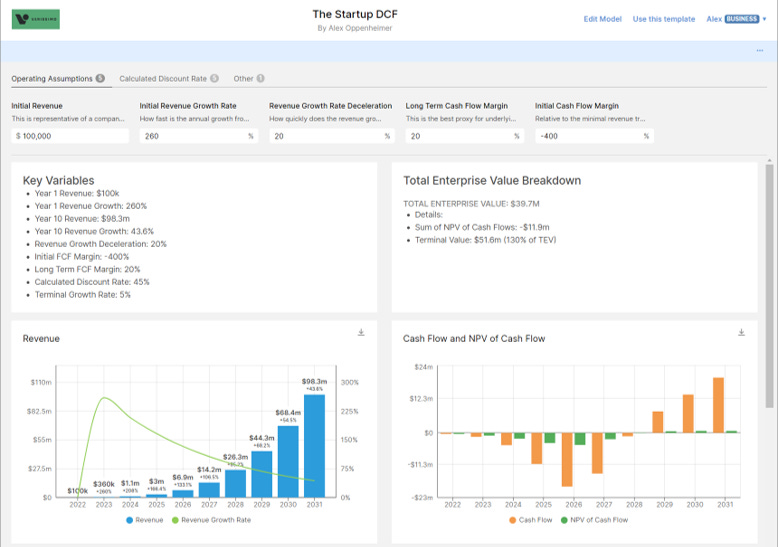
There’s no secret that valuations for nascent technology companies are more art than science. It’s extremely difficult to nail the valuation on a company with so many extreme variables, and it is made even tougher by the fact that there is no objective way to validate those valuations (even at exit!).
No posts
Comments
Nothing yet. Say the first thing.
Sign in to join the conversation.