

We live in an attention-starved world that has trained most of us to be addicted to engagement without ever realizing it. And the strangest place I’ve ever noticed it is on a mountain bike.
I’ll come back to the mountain bike. First, a confession.
As a millennial, I’d like to think I have my relationship with technology under control. I don’t. Most people don’t either, and the people who think they do are often the most captured, because they’ve stopped running the diagnostics on themselves. We’re not digital natives in the Gen Z sense, we got our first iPhones in college, and that generational lag gives us a false sense of immunity. It shouldn’t. The feeds came for us too, just a few years later and with less of a fight.
I think of the condition that this tenuous technology relationship has created as ambient restlessness, and I think it’s the most underrated variable in how we spend our days.
The trap with ambient restlessness is that it rarely shows up as a dramatic failure. It shows up as a slight inability to do the thing you sat down to do. You open the book, you read two paragraphs, you reach for your phone. You put the lecture on, you last ninety seconds, you get up to make coffee. Nothing has gone wrong in any measurable sense. You just cannot seem to stay put. And the reason you can’t stay put is that some part of your brain has been trained, over years of optimized feeds and tiny rewards, to expect a constant drip of novelty, and when it doesn’t get one, it goes looking. Of course this isn't constant. There are real moments of deep work scattered through the week, sometimes structured, sometimes discovered. But the steady state is a delicate balancing act, and it eats a good chunk of your daily discipline budget before you've even sat down to do anything hard.
One of my rabbis said something to me years ago that I didn’t fully understand at the time, but it’s been sitting in the back of my head ever since. You can’t focus if you’re not happy, and you can’t be happy if you can’t focus. Those two things are more intertwined than we give them credit for. Every time I’ve gone down an Instagram reel or YouTube short rabbit hole, I don’t just lose time, I lose capacity. I feel worse afterward. Not just tired, specifically depleted in a way that makes the next hard thing harder. Passive consumption is the tax that compounds.
Cal Newport has been writing about the consequences of all this for a long time, and I think he gets a bad rap as the “quit social media” guy. That flattens his actual argument into something much less interesting than what he’s really saying.
What he’s really saying, and what he articulated well in his recent conversation with Arthur Brooks and in the ten-year retrospective he did on Deep Work, is two things.
First, the prescription to quit was never a prescription to throw your phone in the ocean. It was a prescription to put things on an active pause and then decide, deliberately, which ones earn a place back in your life and on what terms. I did exactly this with video recently. For over a month I watched nothing. If something popped up on the screen I closed it. No sports highlights, no nerdy engineering or geography content, no biking content, nothing. What that did for me was two things. It gave me back the quiet in my head that I hadn’t noticed I was missing, and more importantly, when I started letting video back in, I got to choose the terms instead of the algorithm choosing them for me. I’ll probably have to run the same fast again in six months. These things creep.
Second, focus is not a habit you flip on or off. It’s a skill, and like any skill, it has to be trained. You get better at it by doing things that force it out of you. In Cal’s recent podcast, the example is tennis. For me it’s mountain biking. These specific sports are gym for your attention, and in the same way you can grow your VO2 max, you can grow your capacity for sustained focus. But only if you put the reps in.
Once I had that frame, a hidden variable in every endurance activity started to become obvious, and it has nothing to do with heart rate. It’s how much of your brain the activity is actually using, and therefore how much ambient restlessness it absorbs while you’re doing it. I’ve been sorting my audio and my podcasts and my language apps around this variable for years without realizing I was doing it. Once you see it, you can’t unsee it.
Here’s the rough spectrum, based on a decade of doing all of these badly and well.
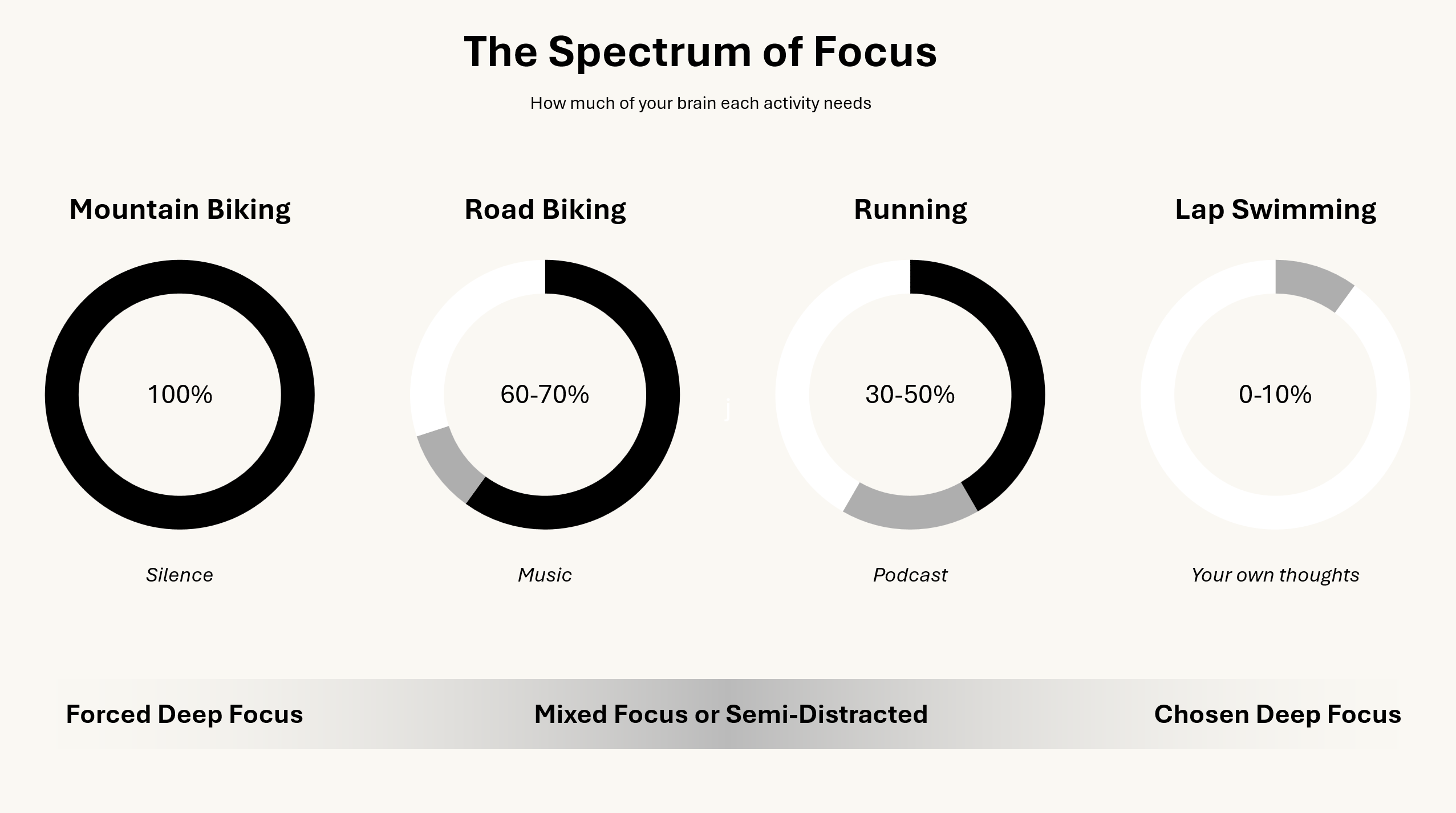
Notice that the two ends of the spectrum are both deep focus, but they're deep focus for opposite reasons. Mountain biking forces the focus on you whether you wanted it or not. Lap swimming hands you an empty room and asks what you'll do with it. The first trains you to lock in under external pressure. The second trains you to direct attention with no scaffolding to lean on. Most of life happens in the middle, but the training that makes the middle work happens at the edges.
Mountain biking sits at 100 percent.
Up or down, technical or flowing, it doesn’t matter. If your brain drifts for three seconds you’re on the ground. There is no bandwidth for audio. There is no room for a stray thought about an email. You are, in the most literal sense, present, because the alternative is a trip to the ER.
A few weeks ago I rode the Sugar Trail, one of the more famous trails in Israel, which starts in Ma’ale Adumim east of Jerusalem and drops down toward the Dead Sea to a town called Almog. You throw your bike in a truck at the bottom and get a ride back up. The ride itself is an Enduro-style descent, rocks, drops, switchbacks, running on tons of adrenaline top to bottom. At the end of it you’re physically and emotionally exhausted. It’s almost like a hangover (without the regret). But the thing I noticed afterward is that during the ride my head was completely quiet. Not managed, not suppressed, just quiet. Every email I was worried about, every small ache, every ambient piece of worry I’d been carrying around all week had been burned off by the sheer cognitive demand of not dying on a bicycle. That’s the training effect. Mountain biking doesn’t just tolerate focus, it forces focus, and when you force focus for long enough in one direction, the restlessness has nowhere to go and it leaves.
This is the Cal Newport point in physical form. An hour of mountain biking is an hour of deep work for your nervous system.
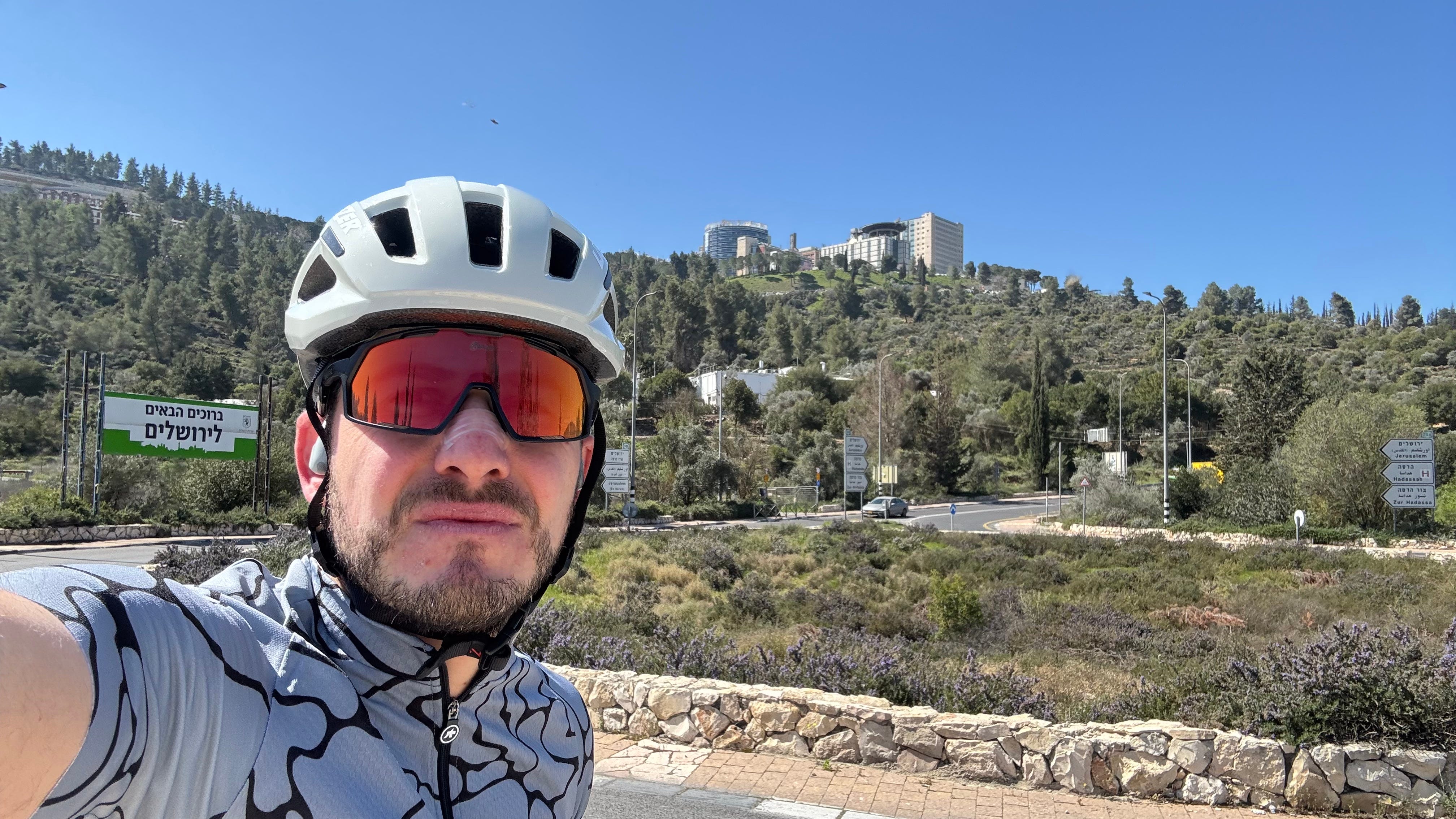
Road biking lives in the 60 to 70 percent range.
You’ve got enough processing power left for music, maybe a podcast on a long climb, but the second traffic gets sketchy or a descent opens up, the audio becomes noise and you tune it out without noticing. It’s a sport that lets you consume content, but only content you don’t need to remember. I usually ride with open-ear headphones so I can hear what’s going on around me, and that in itself tells you something about the bandwidth budget. If you have to leave a channel open for survival, you don’t have the whole brain available for the podcast either.
Running lands somewhere in 30 to 50 percent.
It’s the sweet spot for most spoken-word audio and music. Podcasts work. Audiobooks work if the plot isn’t too demanding. I do some of my best thinking on runs, and also some of my best not-thinking, which might turn out to be the same thing. The specific workflow I’ve landed on: I’ll listen to something for most of a run, and when a thought hits I’ll pause the audio without pausing the run, pull up a voice note, and talk the thought out for thirty seconds while I’m still moving. Half the posts I’ve written in the last six months started as voice notes on a run. The running occupies my body just enough to get out of the way of my brain, and the pausing ritual means the ideas don’t evaporate between the trail and the desk.

I ran my first half-marathon a couple of months ago, down at the Dead Sea. You’re running on the levy across the salt flats, which is about the most featureless running surface imaginable. Nothing to see, a few potholes to dodge, and a lot of time alone with your own effort.
I should be honest about something here, because the cleaner version of this story would be that I deliberately ran the first half in silence as some kind of test, and that’s not what happened. I hadn’t figured any of this out yet. It was my first race, I had no playbook, and I was making decisions in real time about a kind of effort I’d never sustained before. I started the race quiet, not because of a theory, but because I genuinely didn’t know what the right call was and silence felt like the safer default.
The first few kilometers, I was weaving around other runners trying to find my pace, so the silence was probably correct by accident - the focus needed to be on the people in front of me and the line I wanted to take. With the framework I have now, I’d have turned the music on around the third kilometer, once the field thinned out and the only thing I needed to do was settle into a rhythm. Instead I ran the whole first half quiet.
Somewhere around kilometer twelve the fatigue started to set in and I finally reached for a playlist I’d been building in Spotify for the last twelve years. (If you want the playlist, reach out. I’ll send it.)
The pace dropped from around 4:50 per kilometer to 4:35. The last kilometer came in around 4:15. The music wasn’t a distraction from the running, it was the scaffold that kept my brain from negotiating with my legs. Without it, my head would have started drifting to the pain in my quad, the cramp in my stomach, the question of whether I actually needed to finish this thing. With it, I had somewhere to send that drift, and the drift converted into pace.
First half: silent, mostly by accident, fine. Second half: needed the music as the driver, as the thing that absorbed the restlessness and left the running free. The framework came later. The race is where I learned what it was pointing at.
Lap swimming is 0 to 10 percent.
I’ll be honest, I don’t swim, and if you do and I’m wrong about this, let me know. But my understanding of lap swimming is that it’s close to being in a sensory deprivation tank with chlorine in it. You’re looking at the black line on the bottom of the pool. Experienced swimmers know how many strokes it takes them to reach the wall without counting. You could do it blindfolded. Which means lap swimming is the closest thing a Type A millennial is going to get to real meditation without actually having to learn how to meditate. (That’s the thing that tempts me to try it, honestly. It’s also the thing that’s probably going to push me into a triathlon eventually, which people have been asking me about for a while.)
Worth a quick shoutout here to an app called Olo, which uses high-fidelity natural sound to help people who find meditation impossible actually get there. If traditional meditation doesn’t work for you, try it.
So far, so intuitive. More physical complexity means less bandwidth for other inputs. Simple inverse relationship. You could stop reading here and you’d have a useful framework.
But there’s a twist, and it’s the part that made me actually understand what ambient restlessness was doing to me.
When I moved to Israel ten years ago, I had a wacky schedule. I was spending part of my time in yeshiva, I was working a full-time job, I had an apartment in Jerusalem and another in Tel Aviv, and I was driving back and forth constantly. This was before the fast train existed between the two cities, so driving was the default. A friend of mine, who I remain grateful to, recorded every lecture given in the yeshiva that year. Every time I got in the car, I’d put one on.
Here’s the strange part. Sitting still at a desk trying to listen to those same recordings, I could not do it. My mind would wander inside of ninety seconds and I’d find myself reaching for my phone or getting up to make a tea. Twenty years ago we might have called this ADD. Now I think it’s just the baseline condition of anyone who’s been marinating in optimized feeds for long enough. Par for the course.
But in the same room, live, with the rabbi in front of me, the exact same content was effortless to absorb. The live experience is a four-dimensional thing. There’s the sound, there’s the physical presence of the teacher, there’s the body language, there’s the energy of the other people in the room, there’s the slight social pressure of being seen listening. All of that additional sensory load takes up the slack in your attention that would otherwise be colonized by restlessness. You don’t have to focus, exactly. You are physically pinned in place by the richness of the experience.
A recording strips all of that away. It’s one channel of audio into an empty room. For a brain already primed to expect constant stimulation, one channel is not enough. The restlessness floods in and takes over.
But in the car? I could absorb an hour-long class without breaking a sweat. I could do Pimsleur language lessons, the ones where the recording asks you to respond out loud and you’re essentially having a conversation with a robot in a language you don’t speak. I could retain things. I could focus. The driving was occupying just enough of me, physically and visually and proprioceptively, to substitute for the four-dimensional richness of a live lecture. It was adding back the sensory load that the recording had stripped out. The fidgety part of my brain had been given a job, and the listening part was finally free to listen.
Sometimes you need two channels.
This isn’t actually a new observation, by the way. Netflix figured it out years ago. They now engineer shows on the assumption that viewers are on their phones for much of the runtime. Scripts get written so you can miss half a scene and still follow the plot. Dialogue repeats key information. Big reveals are telegraphed. They’re not stupid, they’re responding to what people actually do. One screen is not enough anymore for a brain that’s been trained on fifteen-second vertical clips. And the question isn’t whether to fight this, because fighting it is exhausting. The question is how to use it.
Most productivity writing treats focus as a monolith. A single resource you protect and deploy. Deep work good, distraction bad. And Cal is completely right that for certain kinds of work you need to protect the room. When I’m writing, or working through a complicated analysis, I need silence. Every interruption is a tax, and the tax compounds.
But not every kind of work lives in that mode. Some kinds of focus actually require a baseline of physical occupation to unlock, and fighting that fact is a losing game. The right move isn’t to brute-force yourself into stillness you can’t hold. The right move is to recognize the level of ambient restlessness you’re walking around with, and then deliberately match the activity to the input. Instead of fighting the digitally-integrated life, you use the texture of it, the movement and noise and mild physical demand, as a scaffold for the things you want to absorb.
The two failure modes are symmetric.
Failure mode one: your activity demands more than you have, and you try to consume something anyway. You listen to an emotional audiobook on a technical descent. You play a podcast while debugging something hard. You try to have a real conversation during an interval. The consumption fails, the activity suffers, and on a mountain bike you actually increase your risk of getting hurt. Noise in, nothing out.
Failure mode two: your activity demands almost nothing, and you try to consume something demanding. You sit on the couch and try to absorb a dense lecture. You lie in bed and try to learn a language. Your brain, unoccupied and marinated in years of ambient restlessness, eats itself. The content bounces off. You blame yourself for not having enough discipline, when really you just picked the wrong configuration.
The sweet spot for most learning lives in the middle. Enough physical engagement to quiet the restless part of the mind, not so much that there’s no room left for anything else. Running with a podcast. Driving with Pimsleur. Walking with an audiobook. Easy spin on the road with a long-form interview. And then, periodically, the focus training sessions: the mountain bike ride, the tennis match, the swim, the walk without headphones, the sit-down deep work block with no inputs at all. The activities that don’t just tolerate focus but force it, and leave you calmer on the other side because they’ve burned off the restlessness directly.
Both configurations work because both are deliberate. The failure modes show up when you stop choosing the match and start letting the activity and the input collide by accident.
The framework isn’t prescriptive. It doesn’t tell you to do less of anything or more of anything. It just asks you to notice, before you press play, what your hands and legs and eyes are already doing, and to be honest about how much brain that leaves on the table.
Most people are running the wrong audio for the wrong activity, and wondering why nothing sticks. A week of paying attention to the match will tell you more about your own attention than a year of reading about it.
And if it turns out your mountain biking isn’t a sport at all, if it’s coding or cooking or a specific conversation with a specific person, I’d love to hear about it. Send me a note. Tell me what forces your focus, and what absorbs your restlessness, and what the configuration looks like when you get it right.
No posts
Comments
Nothing yet. Say the first thing.
Sign in to join the conversation.