

There’s an old parable about a businessman who meets a fisherman on a dock.
The businessman tells him he should work harder. Scale his operation. Buy a fleet. Build the corporate infrastructure. Take it public.
The fisherman hears him out and asks, “and then what?”
“You retire a rich man,” the businessman says. “What will you do with all that spare time?”
The fisherman replies: “Sit on the dock and go fishing every day. Exactly what I’m doing right now.”
I love this parable because it captures the hidden cost of an idea that’s run our economy for the last hundred years: the long short path. It looks like the most direct route to what you want - but the route around (the short long path) is shorter when you measure what actually matters. The fisherman skipped the empire and went straight to the destination. That's the short long path. The businessman wanted him to take the long short one.
The classic image: climbing a mountain straight up the cliff face is technically shortest. The snaking switchback path takes longer on the map but gets you there faster, with less suffering. Both reach the top. But you’d better know which one you’re on and have the right equipment.
In business: someone sets a goal of being a CEO. Option one - start a company from scratch right now. Goal achieved. But is it actually what they wanted? Or is it a lot of annoying, risky, exhausting things that take them away from the reasons behind the goal? Option two - join a company, work their way up, move diagonally if needed, until they’re promoted or hired as a CEO. Same destination. Completely different journey.
For the last hundred years, the global economy has been the businessman on the dock, pushing everyone toward the long short path. We invented increasingly complex corporate structures, management layers, and workflows largely to solve problems our own complexity created. We built massive, exhausting fleets when all we really needed was the fish to eat and all we really wanted was to enjoy our days.
Here’s why this matters right now: AI just deleted the need for the fleet.
The path that looked safe for a century - build skills, climb the ladder, scale headcount, accumulate prestige - has quietly become the long short path for almost everyone. The path that looked slow - deep relationships, judgment, taste, contemplation - is now the short long path. If we do it right, I think we can have the best of both worlds, and more importantly stay in control of our own unique path.
This piece is about how we got here, why the rules are flipping right now, and what to do about it. It’s about a 250-year contract between employers and employees that’s being rewritten in front of us, with major case studies already on the public record. And it’s about why the most valuable thing you can do this decade is also the simplest thing: take the suit off.
Let’s walk through it.
Every era of work is defined by a simple question: what does the employee bring, and what does the employer control?
(This is textbook people leverage, as I outlined in my 2020 piece “Leverage Frameworks”)
The answer to that question determines who holds the leverage. And the leverage has shifted - dramatically - five times in the last 250 years.
There’s a pattern across these eras that I want you to watch for. Each one teaches a surface lesson at the time - “learn this, do this, you’ll be fine.” And in every era, the surface lesson eventually misses the mark. But the side effect of having learned it - the second-order skill or dynamic people picked up almost by accident - is what actually carries forward. History doesn’t repeat, but it rhymes. The rhyme is the side effect. The further back you look, the more obvious the side effect is. The closer you get to today, the more it’s a working hypothesis.
The employee brought specialized physical skill - craftsmanship, agriculture, localized customer relationships. The employer (really the patron or guild master) provided sustenance, tools, and trade access. If you were a skilled artisan, you had real leverage because your craft was scarce and your reputation and brand was local currency. If you were unskilled labor, you had nothing.
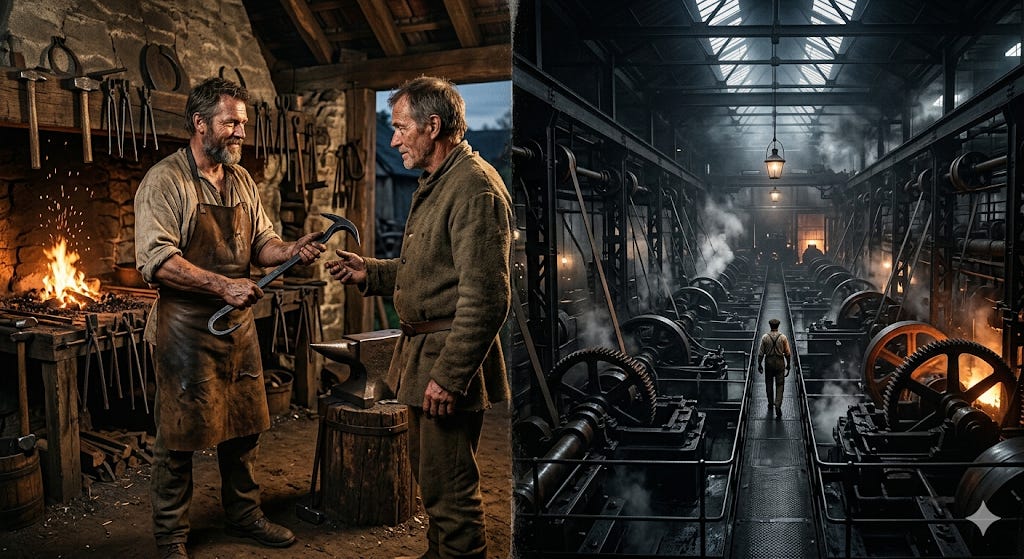
The side effect: The literal craft skills depreciated - nobody needs a blacksmith now. But the underlying dynamic - your reputation and brand in your community as the actual asset - never went away. Mass scale temporarily made it look irrelevant, but it was always the substrate. AI is bringing it back, full circle.
The employee brought muscle and time. The employer brought the capital for the million-dollar factories, supplier networks and customer lists. This is where the power dynamic got brutal - and where the structural change was most violent. In 1900, 41% of Americans worked on a farm. By 1970, that number was 4%. An entire way of life was absorbed by the factory in 70 years. The employer owned the means of production - full stop. Employees had to unionize just to create any collective leverage. Compensation was hourly cash. You were a unit of output. People were cogs in a machine and worked in factories with easily measurable productivity metrics.
The side effect: The lesson everyone took home was “show up, work hard, the system rewards muscle.” But the people who actually captured the era’s wage premium were the ones who understood the machines - the mechanics, the foremen, the engineers - not the ones who just operated them. The pattern: learn the system, not just the surface.
Desk-filled offices similar to what we have today with one very notable difference: no computers. People used slide rules to close accounting books. Reviewed handwritten notes and contracts. Typed dictated letters. An analog world but on steroids. Think about Don Draper’s office in Madmen. The secretary became a communication enabling staple. Pan-am flights across the country to close big deals. It was faster and more connected than anything anyone had ever seen.
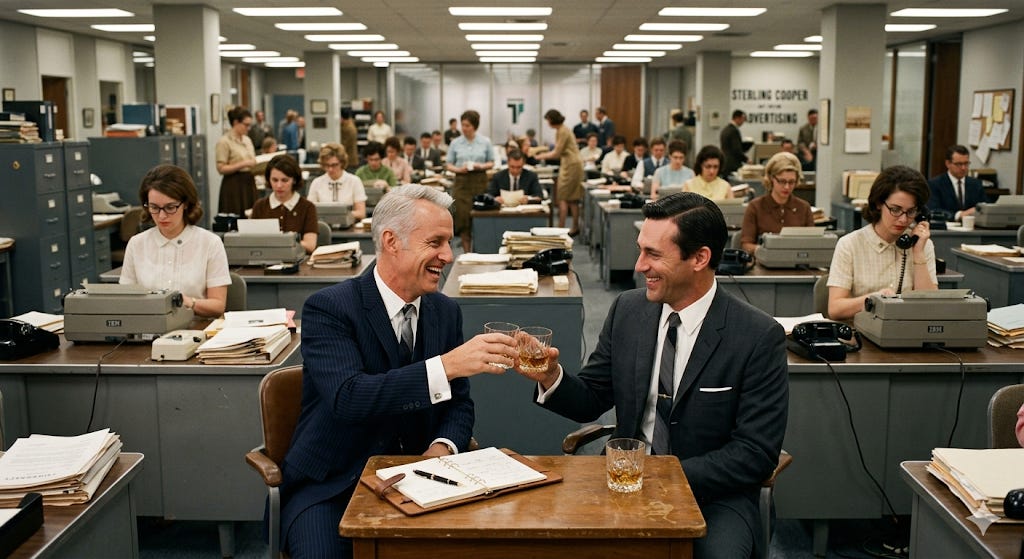
The side effect: The promise was “the company is family, give them 30 years and they’ll take care of you.” That promise died with pensions and the 80s-era restructurings. But the relationships built inside those offices outlasted the promise. The Don Draper / Roger Sterling friendship was worth more across a career than any title or benefits package. Titles are temporary. Relationships compound.
The employee became the “knowledge worker.” Cognitive labor, specialized technical skills, middle management, information routing. The employer provided the software infrastructure, salaries, benefits packages, and early stock options. Capital was still expensive, but companies couldn’t scale without specialized human brains. Leverage started shifting toward talent. Everyone got a laptop and a cell phone. Connectivity abounded but the office dynamic stayed strong. Similar specialization, but increasingly at light speed.
The side effect: “Learn to code” and “learn to use Excel” were the slogans. What it likely taught, for those who really took the classes, was structured problem decomposition and how to navigate large swaths of data. The skill of breaking a fuzzy real-world problem into pieces a machine can execute against. We thought we were learning syntax, but we were learning to communicate with machines and solve previously unsolvable problems as a team.
The employee brought niche expertise, personal brand, and networked relationships. The employer countered with equity, platform access, and flexible work models. This is where the split first appeared: massive leverage for “10x” talent who could demand RSUs and remote work, near-zero leverage for gig workers who were algorithmically managed and completely commoditized. The new path to getting rich became 20 years at a FAANG company. New business models, deeper technology reach, instant connectivity.
The side effect (still emerging): The advice was “get a job at FAANG, vest your RSUs, build your resume.” The actual side effect was surviving in the fast lane. The mechanisms to separate the wheat from the chaff became ruthless. It was much harder to hide if you couldn’t keep up. Payroll mistakes didn’t allow the “digital collator” to keep his job, even by accident. Influence, audiences, thought leadership spread quickly and accrued tremendous value - even more than $250k+ average salaries.
The employee brings abstract problem-solving, personal networks, strategic taste, empathy, and the ability to direct autonomous agents. The employer provides compute, proprietary data, and what I’ll call the “suit” - more on that in a minute. Enter the era of the 100x employee.
The side effect (predicted): The slogan today is “learn to prompt, master the AI tools.” If the last five eras are any guide, that’s the surface lesson that won’t carry. The thing that will carry is judgment, taste, and trust. Bet on the side effect.
When you zoom out across 250 years, the trajectory is clear. The core unit of human work evolved from Muscle → Mind → Machine Orchestration → Whatever comes next. And compensation evolved from sustenance → hourly wages → salary → retirement plans → equity → something we haven’t fully defined yet.
But here’s where it gets interesting.
In the Tech 1.0 and 2.0 eras, companies relied on a massive middle layer. These were the human routers. They synthesized data, moved projects between departments, wrote boilerplate code, formatted slide decks, and summarized meetings. They were the connective tissue of the organization. Massively inefficient but also somehow highly functional (we’ve seen this movie before).
AI doesn’t just do this work instantly. It does it at near-zero marginal cost.
I remember the first time I heard the term “product manager.” We all know that a great one makes all the difference, but most are paper pushers. They’re the “people person” from Office Space who handles the requests between the clients and the engineers. And then it really started to creep back in: the layers that exist just to interface with the other layers. Peak inefficiency. We say it now as a joke but “I’ll have my people talk to your people and coordinate” was a real thing, and one we certainly don’t need in the age of phone-based calendar invites and text messaging.
And here's the part I want to make sure people sit with: we have watched this exact movie before.
While the product manager as paper pusher reference may have triggered some of you, remember that for most of the 20th century, the largest single occupational category in America was office and administrative support: typists, secretaries, clerks, coordinators, filing staff. The connective tissue. By the time the personal computer started landing on every desk in the early 1990s, this category was the spine of corporate America. Then word processors arrived, and managers started typing their own letters. Calendars went digital. Spreadsheets replaced the bookkeeping clerks. The typing pool (a fixture of office life for 80 years) simply dissolved over a generation. The Bureau of Labor Statistics has tracked office and administrative support employment falling steadily ever since, and they project the decline to continue through at least 2034.
The middle layer didn’t disappear all at once. It transformed while quietly halving over a generation.
We are now watching the same pattern start with the analyst pool, the coordinator pool, the synthesizer pool. Different category. Identical structural dynamic.
The result is that the middle layer is structurally collapsing. And it’s forcing a rapid, brutal bifurcation of the knowledge workforce into two very different paths.
The middle layer always collapses. The low level jobs are an obvious cost cutting target and the senior ones are high-risk, high-reward (and not for everybody). It’s those people in the middle who “play it safe” who are at the biggest risk. The ones whose parents tell them “just do this and you’ll always have a job… after all, every company needs a typist or a scheduler or a bookkeeper or a lawyer.” The safe bet from last generation is just that: a thing of the past. Winning yesterday’s game is losing today’s.
This is micro economics followed by innovation economics:
A functional need across all industries grows. Salaries are great. Many people flock to that job function. It becomes a major cost center. Innovation cannot ignore it any longer and comes after this tax on the economy. Prices get driven down by competition and then ultimately to zero when the innovation takes its place in one fell swoop. Capitalism.
If your job can be mapped into a standard operating procedure, your leverage is evaporating. Your previous output - writing, basic analysis, routine code - is now automated. Your residual value to the employer is generating edge-case data that the AI can’t yet produce on its own. You’re wearing sensors. You’re doing RLHF (reinforcement learning for human feedback). You’re capturing video and labeling images. You’ve become a biological API. And your compensation will look a lot like factory floor labor in the 1800s: piece-rate, low-wage, no equity, no upside. And then it will be gone - as soon as it starts becoming too big of a cost center, the innovation cannons will fix their aim, and then it’s only a matter of time. This is actually capitalism doing its best work.
This isn’t theoretical. Time magazine reported in early 2023 that OpenAI used Kenyan workers, paid between $1.32 and $2 per hour through an outsourcing firm called Sama, to label graphic content (child abuse, torture, self-harm) that ChatGPT needed to learn what to filter out. Multiple workers reported lasting psychological damage. The total contract OpenAI paid for the work was around $150,000. That’s the new piece-rate factory floor: traumatic, invisible, low-wage, and entirely upstream of a product that now generates billions. The model feeders aren’t a future risk. They already exist.
This group absorbs the leverage that the middle layer left behind. They don’t do the work, they direct it. From 5 direct reports to 0. They define the problem, navigate ambiguity, and apply strategic taste to AI output. The headcount-to-output ratios in the orchestrator class are unlike anything we’ve seen in the modern economy. Their compensation reflects it: significant equity, profit-sharing, high base, and real ownership of outcomes.
Many of you reading this hope or believe you’re in this layer, and you very well might be. But think hard about the linear progress of AI and make an argument for why you matter. It’s a bit harder to do than you may feel comfortable with.
But even the highest level ADHD orchestrator needs a break. Slowing down is starting to become the superpower. You can have 20 AI agents performing tasks for you at the same time, but if you can’t keep track of what is going on and why it matters, then it just becomes a slop train. It’s always obvious when this is happening right now. In a year? Maybe it will only be obvious half the time. Having your interns do your work for you never worked out well if you weren’t over their shoulder double checking to make sure that the right dose of judgment was sprinkled into the grunt.
The economic ethos around work that I grew up with: get rich by getting as much operating leverage as possible and then never sleeping. I think this breaks now. I saw people trying to do this in investment banking: a team of VPs, associates and analysts below you. Access to the world’s data. As many clients as possible. 1-2% fee chunks out of multi billion dollar deals. Leverage in almost every capacity. But if you look at their faces, their bodies and then judge their work on what really mattered, you could see something different: misery, middling wealth, and no body or time to get the most of it. Then there was the legendary banker who spent a day a week in the office. The rest of the time he was on the golf course building relationships. But he was also doing something else: giving himself the mental, emotional and physical space to contemplate what actually mattered most in his job. And having run the compensation model, I can assure you that his approach paid better. He had leverage where it mattered most.
The bottom layer was already gone, the Industrial Revolution took care of that. The top layer still matters. But the middle is where the action is right now. The middle is splitting, and every person in it is facing a choice: get elevated, or get pushed down.
If you want to see this thesis play out in a single corporate case study, look at Klarna.
In February 2024, Klarna announced that its AI customer service assistant (built with OpenAI) was doing the equivalent work of 700 full-time agents. The numbers were stunning. 2.3 million customer conversations handled. Two-thirds of all customer service chats automated. Resolution time dropped from 11 minutes to under 2. Projected profit improvement of $40 million in a single year. The company froze customer service hiring. Workforce went from 5,500 to 3,400 over the period.
This was, for a moment, the canonical proof point of the AI workforce transition.
Eighteen months later, Klarna quietly walked it back.
CEO Sebastian Siemiatkowski’s public admission, reported by Bloomberg in 2025: “We focused too much on efficiency and cost. The result was lower quality, and that’s not sustainable.”
What happened? The AI was excellent at routine work. It still handles two-thirds of customer chats. The 82% reduction in resolution time held. But on the cases that actually mattered - disputes, fraud claims, hardship situations, anything requiring empathy or judgment - customer satisfaction cratered. The AI couldn’t carry the trust load. Klarna started rehiring humans, specifically for cases that needed empathy, expertise, and real conversation. New positioning from the company: “in a world of automation, nothing is more valuable than a truly great human interaction.” And the skills they screened for also shifted. The jobs are shaped by the technology very soon after the technology is shaped by the jobs. Functional output is the metric that matters: capitalism 101.

Read that arc carefully. This is not a story about AI failing. It’s a story about AI succeeding at the routine middle and then hitting a wall at the trust and empathy layer. The most aggressive customer-service AI deployment on record validated the framework I’m describing in real time, with real money, in front of public markets. AI ate the middle. Trust stayed human. The CEO admitted it on the record.
Here’s where most people and most companies are missing the mark.
The corporate world is panicking. Their instinct is to pour money into “AI Upskilling,” teaching employees how to write prompts, connect APIs, build workflows. Every Fortune 500 company is buying some version of an AI training program right now.
This is a trap. And it’s a specific kind of trap we’ve watched play out before.
I went to Stanford 2007-2011. During that time computer science became the #1 major and CS106a became the most well-attended class. “Learn to code” they said. “You’ll always have a job” they said. And that was true (especially for Stanford alumni) for a while. But then Claude Code came and ate every “coder’s” lunch in 2025.
With one small but absolutely critical caveat: what they said (”learn to code”) was a thinly veiled version of “learn to solve complex problems by thinking like an engineer.” And what is an engineer? A well-trained creative puzzle solver. And that is why those people still have jobs. If you actually took the classes, you would know that the core competence coming out of Eric Roberts’ book on Java was to solve puzzles using language that computers can understand. Well now we have the greatest translators in human history at our fingertips, but the puzzle solving part - the real puzzles - the ones that require creativity - that is the part that’s left. And it turns out that’s what mattered all along.
AI skills are the same thing. Technical prompt engineering is a commodity racing to zero. The models are explicitly designed to remove the need for you to know how to talk to them. In two years, knowing how to prompt an AI will be as irrelevant as knowing how to write command-line code to use an iPhone today.
There’s a frame I keep coming back to that I picked up from Pat Grady: compelling vs. unique. Compelling technologies are easy to sell. There’s real demand, real revenue, real growth. They IPO. They get hyped. They’re real businesses. But they don’t have pricing leverage, because anyone can build the same thing. Unique technologies have the missing piece. Often harder to sell at first. But once you’ve proven they work, you have pricing power, because nobody else can replicate them. To be a great company, you need to maintain both.
Compelling and unique might look the same in the early days. Both have growth. Both have customers. Both feel important. The difference only shows up later: when the thing that was unique stays unique and the thing that was merely compelling gets eaten by competition. AI didn’t kill SaaS, SaaS killed SaaS.
Quick history lesson. Nobody remembers the companies that got rich helping enterprises “move to the cloud” in the mid-2010s. The systems integrators that defined that era were intensely compelling. They got hyped. They IPO’d. And then the multiples compressed. Cloud became infrastructure. The integration layer a commoditized service. The cloud migration darlings of 2014 are mostly still around, they just don’t trade at growth multiples anymore. They became utilities. Important. Critical even. Unloved.
Same pattern is starting with AI integration today. AI integration companies are doing genuinely useful work: wiring AI into enterprise workflows. That’s compelling. But is it unique? Ten competitors will appear in the next two years. The integration patterns will standardize. And the multiples will compress, exactly the way they did in every prior wave of integration plays.
Here’s the part that should worry every founder, every operator, every employee: things are becoming not-unique faster than ever. What used to take a decade to commoditize now takes 18 months. The half-life of “unique” is shrinking. Truly compelling things won’t stay unique for long. That’s a feature of capitalism, not a bug, but it changes how you think about what to bet your career on. The compelling skill you’re learning today might already be a commodity by the time you’re paid for knowing it.
Cal Newport has been making a related argument I think is right: instead of rushing to learn AI tools, people should go read the literature. Become a deeper, more thoughtful person. Build real judgment. Because that’s what will drive value when the tools are commoditized.
Companies are spending billions trying to teach humans to act like software at the exact moment that software no longer needs our help. That money is going to the wrong side of the ledger.
The example we use in both finance and engineering is “garbage in - garbage out.” This describes any system or model and says that the quality of outputs is defined by the quality of the inputs. For many years, that meant clean, accurate, formatted data. Now it means something different: the information inside the data is the cornerstone. The formatting doesn’t matter any more. But today there is an odd expectation that putting nothing into AI will somehow magically result in good outputs when the AI is good enough. That my friends is how we define AI hallucination. You have to give it something. Then it can go to work. I have said before “If the AI could read your mind, the output wouldn’t be any better… because there’s nothing going on up there. Clarify the idea for yourself first, then ask AI to do something.” There is a valuable skill in typing a prompt, it just may not be the one you think it is.
If execution is infinite and practically free, what is the most expensive asset left on the board?
It’s not orchestration. Even that will commoditize as agents get better at managing other agents. The “technical” skill of directing AI will flatten, just like coding, just like prompting.
What’s left is the thing that can’t be automated, can’t be replicated, and can’t be compressed into a model weight.
Human trust. Real relationships. The energy between people.
Judgment to know on a knife’s edge what is right and what is wrong. Not to get too religious, but that divine spark that makes us uniquely human. Unique from animals and unique from each other.
Think about it this way: in a world where every company’s AI can pitch a client flawlessly, write perfect copy, build a flawless financial model, and spin up a product demo in minutes, who does the client actually buy from?
The human they trust. Klarna learned this at scale, in public, with their CEO on the record.
We are completing a 250-year circle. We’re going right back to the pre-industrial village dynamic where your value was entirely based on your reputation, your handshake, and your relationships. Where trust was earned on judgment and through judgment.
I think of it as going back to sticks and stones. Back to man-to-man combat. Back to the fisherman on the dock, who understood all along that the fleet was never the point. No more easy fall backs. No more “if I learn this, I’ll earn this.”
But there is one massive difference between then and now.
We move at light speed.
The sticks and stones of human connection are now powered by a supercomputer exoskeleton. Think Iron Man. Every individual now has access to a suit that gives them the productive output of an entire department. Midjourney is reportedly running at around $500 million in annual revenue with somewhere between 40 and 100 employees, depending on whose estimate you believe. The company has never taken a dollar of outside capital and reportedly spends nothing on marketing. Even at the high end of headcount estimates, that’s roughly $5 million in revenue per employee - a ratio that simply did not exist in the modern economy a decade ago. And Midjourney is not a one-off. There’s a growing class of AI-native companies operating at headcount-to-revenue ratios that would have looked mathematically impossible in 2015.
The question isn’t whether you have the suit, everyone will have the suit. The question is what you do with it and if you have the judgment to know when to put it on and when to take it off.
And what you should do with it is stop trying to out-compute the machine. Use the suit to handle the execution and accelerate your known workflows. Free yourself to spend 100% of your time on the thing that actually creates and holds value: unique human thought and human-to-human connection.
Let me steelman the opposing view, because it’s the strongest argument against everything I just wrote.
The bear case is that AI agents will eventually develop persistent identities, durable reputations, and long-term relationships at scale, and that the “trust capital” I’m calling a moat will itself be eaten the way every prior moat has been eaten. Agents will remember you, learn your preferences, build track records, recover from failures, and become trusted entities in their own right. It will know you better than you know you.
I think this is the strongest counterargument and it deserves to be acknowledged.
Here’s why I still don’t buy it. Trust between humans isn’t just track record. It’s embodiment, consequence, mutual vulnerability, shared time. When an agent fails you, there’s no human to call, no relationship to repair, no ongoing reputation that suffers in any way that matters to anyone. The agent is replaceable, ephemeral. The human standing behind it is not. As long as economic transactions ultimately involve humans on at least one end, the human-to-human trust layer holds value.
The day that stops being true, this entire essay needs to be rewritten, and so do most other essays about how the economy actually works.
My best proof against this: cryptocurrency. The promise of trust-less transactions. Humans want trust. Put another way, they want someone to call and yell at or to personally verify their identity to approve moving their money for a down payment on a house. The extreme case doesn’t work. (Though I am still waiting for the true smart contract for everything in between.)
Here’s where I think this is going.
The Employee Side:
The people who win the next decade won’t be the ones who mastered the most AI tools. They’ll be the ones who built the deepest trust networks and developed the sharpest judgment. They’ll read more, think harder, understand people better, and leverage AI as pure infrastructure, the way we use electricity today. Nobody brags about being good at electricity. The people who matter are the ones doing something meaningful with the power.
The Employer Side:
Companies are going to stop being defined by the size of their workforce and start being defined by the leverage of their workforce. Look at the Midjourneys, Ramps, and Perplexitys of the world, micro-enterprises where tiny teams of orchestrators serve millions of users, generating massive revenue per head. They automated the middle layer internally, equipped their top people with the best possible tools, and trusted them to drive outcomes, not output. That’s the model. (Sorry junior VCs with LinkedIn Sales Navigator… headcount growth or open job recs are no longer a proxy for the kind of growth that actually matters.)
The employers who win will be the ones who understand that their new moat isn’t their software, their data, or their org chart. Their moat is the trust capital of their best people. Their job is to arm those people, buy them the best suit they can find, and get out of the way. I heard a great line today in an interview with Brian Chesky: spend more time recruiting so you can spend less time managing.
The Compensation Side:
We’ve been trying to map value to compensation for a hundred years and everyone knows it doesn’t work. Annual reviews are theater. Salary bands are political. People game the system in both directions. AI for the first time gives us the telemetry to actually align value creation with economic reward in something close to real time. The companies that figure out this alignment will attract the orchestrators. The ones that don’t will be left managing an army of model feeders wondering where their talent went. Scary enough, this probably means fortunes will be gained and lost faster than ever before.
The Big Picture:
We don’t need the fleet anymore. The 100-year cat-and-mouse game of creating problems and then building departments to solve them is over. The fisherman was right all along.
We can now bring our metaphor back to the fisherman. The businessman wants the fisherman to put on an Iron Man suit. The fisherman has found human contentment in the singular activity of fishing. We now have the tools to explain precisely where their outlooks are completely at odds. And neither one is wrong or right. It’s about knowing which mode is the right one for that situation.
The dangerous mistake of this era is going to be the people who put on the suit and never take it off. They’ll mistake constant orchestration for constant value creation. They’ll have 20 agents running, three Slack channels, two AI meeting summarizers, one personalized newsfeed, and zero quiet hours. They’ll be efficient and irrelevant. The output will be enormous. The judgment will be threadbare.
The deepest competitive advantage of the next decade is going to be the willingness to take the suit off.
Sit on the dock without a goal. Take walks without earbuds. Have dinners where the phones stay in coats. Read books that have nothing to do with your job. Have conversations with people who can’t help you with anything. Be still long enough that judgment can actually form. Stop running away from your thoughts and dive into them.
Trust is built in those moments. Taste is built in those moments. The judgment that the AI cannot replicate, the divine spark that makes you uniquely you, is built in those moments. The orchestrator who never unplugs becomes a routing layer with a name. The orchestrator who knows when to unplug becomes irreplaceable.
That’s the real Iron Man lesson. Tony Stark wasn’t impressive because he had the suit. Plenty of people had suits in that universe. He was impressive because of the man inside it, and because he knew the man mattered more.
Sticks and stones. But at light speed. And critically, at human speed too.
That’s the future of work.

No posts
Comments
Nothing yet. Say the first thing.
Sign in to join the conversation.