

Every client you’ll ever win decides fast — usually in the first few minutes of the first real call — whether you actually get their world or you’re reading from a script.
The ghostwriter who already knows what the founder posted last month beats the one who asks “so, tell me about your business.” The person selling AI systems who walks in knowing the company just opened three new locations beats the one pitching automation in the abstract.
That’s the whole game on a discovery call: everyone’s roughly as talented on paper, and the one who did the homework sounds like a partner while everyone else sounds like a vendor.
And almost nobody does the homework, because real prospect research takes time searching, skimming their site, digging through their posts, and re-reading an email thread you half remember. When you’re chasing several leads a week, it’s the first thing that slips.
So here’s what this guide gives you: a prospect brief-builder inside Claude Code.
You set it up once. Then it runs for every prospect, every discovery call, every pitch, forever.
Where to run it
This runs in Claude Code, the desktop app. If you don’t have it yet, download it at claude.com/download, open it, and sign in. That’s the whole setup.
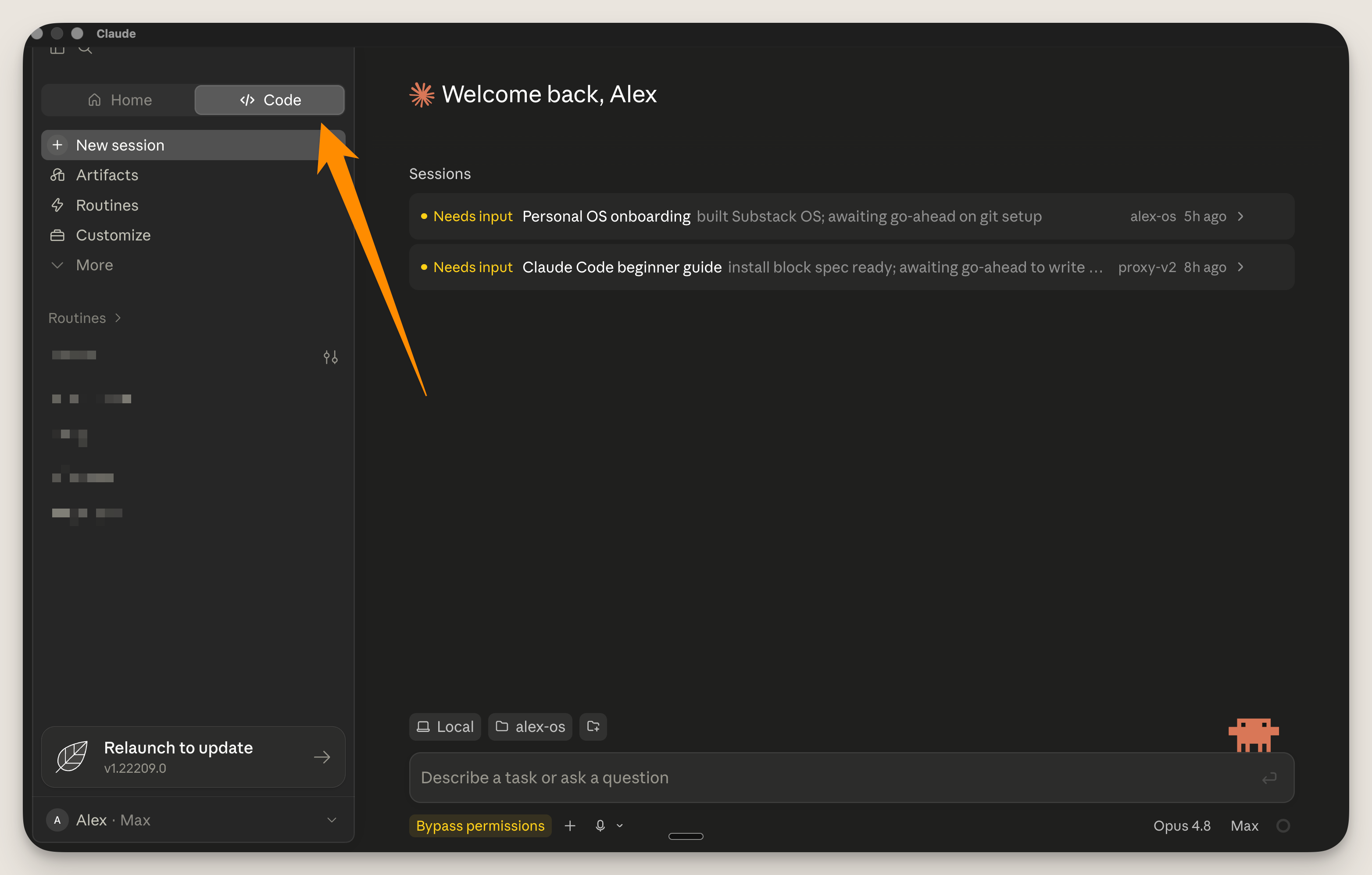
You can run this from any of three starting points:
The folder you already work in. Best option, because Claude can read the proposals and notes already sitting there.
A brand-new empty folder. Works fine, but you’ll need to paste in whatever context you have.
My free Co-Operating System setup. It drops right in — and it already knows what you sell, which makes the briefs sharper. You can grab it here.
If you’ve never used Claude Code to work before, I highly recommend you choose #3 over #2.
How it works
Four steps, and you only do the first one.
Step 1: you say who the call is with and what you’re going for.
One sentence. “Prep me for my discovery call with [name], founder of [company] — I ghostwrite LinkedIn content for founders.” Paste the email thread underneath if there is one. Or provide the social URLs of the individual.
Step 2: it confirms it has the right person.
Common names are where prospect research goes wrong — search one and you can read up on the wrong person entirely. So the skill pins identity first: it needs two public facts that match (the company plus the role, the email domain plus the profile) before it attributes anything. If it can’t pin the person, it says so instead of guessing.
Step 3: it researches.
The person: background, recent posts, anything they’ve published.
The business: what they sell, who they sell to, recent news — launches, funding, hiring, new locations.
And it specifically looks for openings: signals that connect what’s happening in their world to what you offer. A founder posting inconsistently is an opening for a ghostwriter. A company hiring three ops people is an opening for someone selling automation. Those connections get marked as inference, because that’s what they are — but they’re the part of the brief that wins calls.
Step 4: it writes the brief.
As long as the findings deserve, organized so the top gives you the fast read and the depth sits underneath.
A consultant gets what matters before a strategy conversation, a ghostwriter gets the founder’s voice and posting history, an agency owner gets the company’s stack and struggles. It ends with the questions the public record can’t answer, because those are the ones worth asking live.
Now, the honest note. This is only as good as the prospect’s public footprint. A founder with a real online presence gets a rich brief. A quiet local business gets a short brief that says the footprint is thin — and that’s the correct answer.
The skill is built to never invent a detail to fill space. A thin brief you can trust beats a full page you can’t.
Copy and paste this skill into Claude:
Skill name:
client-brief
Comments
Nothing yet. Say the first thing.
Sign in to join the conversation.