
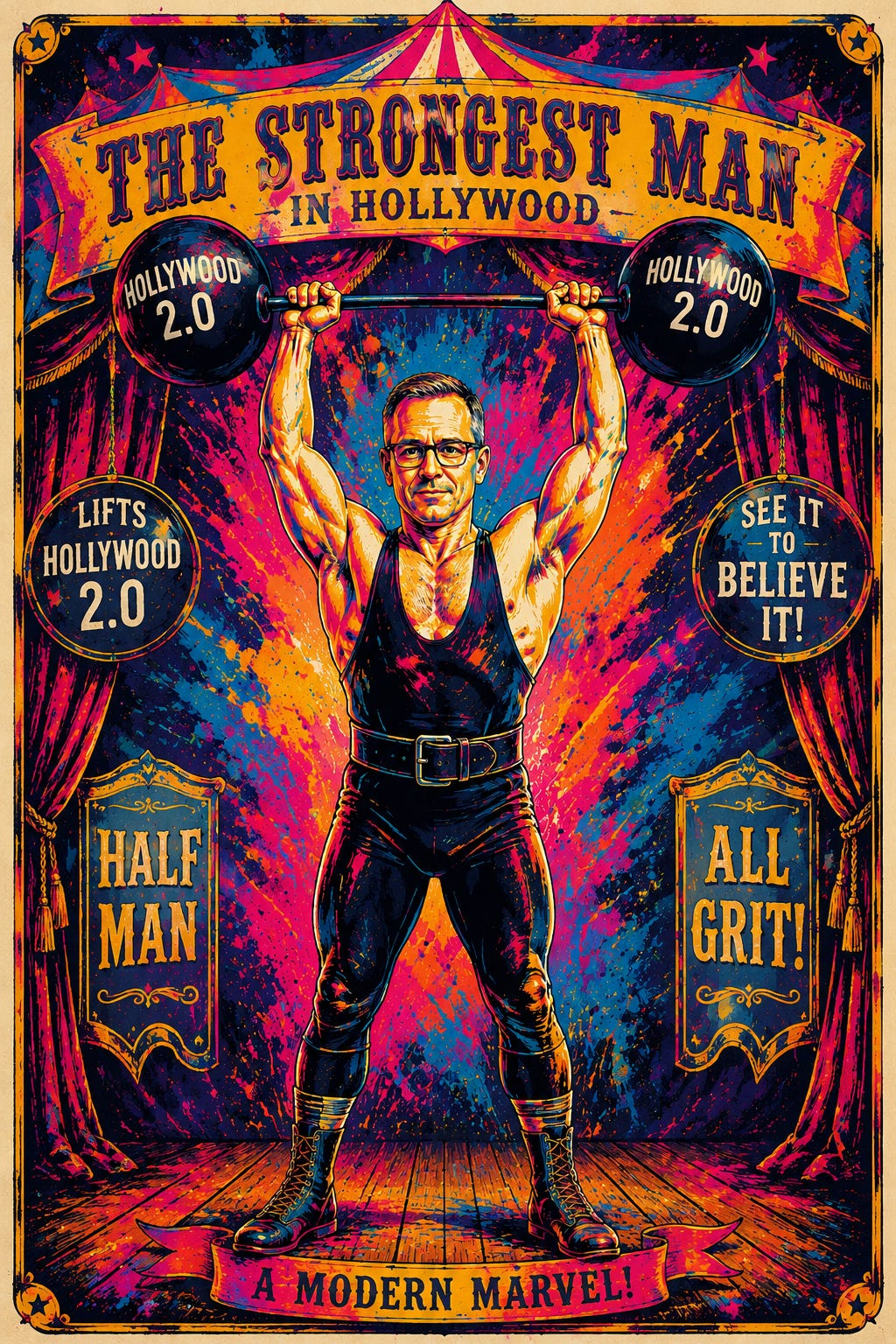
Ted Hope just wrote something that stopped me mid-coffee.
Not because it was surprising. Because it was true in the specific, earned, costly way that only people who have actually been inside the machine can write true things.
He talked about being at Cannes without accreditation. About having 23 films in official selection and still getting dropped in the protocol rankings the moment he stopped being useful to the people doing the ranking. About doing meetings not to transact but just to connect. About wondering, after thirty-five years, whether any of it matters.
I read it twice.
Then a third time.
Because what Ted is describing — with the grace and self-awareness of someone who has genuinely loved this thing his whole life — is what it feels like when the system you helped build decides it’s done with you. Not dramatically. Not with a speech. Certainly no cake at an office party. Just quietly, efficiently, the way systems dispose of people who no longer serve their primary function or who bucked their silly system.
Which is not making great films btw.
It never was.
Alex LeMay is a filmmaker, journalist, and most recently a showrunner/supervising producer at Endemol/Shine NA. PitchCraft publishes from the intersection of storytelling, sales strategy, and the work of building things that matter. It’s like business school for filmmakers. Subscribe if this works for you. Share with a filmmaker you love.
I started this year at CES in Las Vegas and came home with a very clear picture of exactly what that primary function is.
If you want to understand where Hollywood’s head actually is — not where it says it is in the trades, not the panel discussions about the future of storytelling, but where it actually is — spend forty-eight hours watching studio executives try to talk about AI.
It was the most expensive display of compliance I have ever witnessed.
Room after room of people with VP after their names who have spent their careers learning to say yes to the right things at the right time, now learning to say yes to a new set of right things. The language was different. The posture was identical. Acquiescence dressed as innovation. Compliance wearing a lanyard that said FUTURE OF CONTENT (and again, with that fucking quilted Patagonia vest and white sole dress shoes.).
I sat in a session where a Warner executive explained, with genuine enthusiasm, how they were going to undertake a 3-year experiment in one of their smaller ad teams. AI was going to transform how they advertised to people. They came right out and said it, “Our priority as a movie studio is advertising”. Not that you don’t need to get the word out, but you make fucking movies you wankers.
But sure. AI will fix that.
Thanks for reading PitchCraft: Unlocking Success in the Hollywood Chaos! By sharing this post, you guarantee I can keep providing you with insider insight and playbooks for selling your films.
The same week I got back from Vegas I was doing some recovery work — the kind you do when you finally admit that the pace and the weight of building things inside a broken system has extracted more than it was supposed to. And a member of the clinical team said something that reframed everything I had just watched at CES in four seconds flat.
The system that got you here, into this current situation, can’t be the system that gets you well.
That’s the whole argument. Right there.
Not just for personal recovery. For the film industry. For every movement that has tried to fix Hollywood and found itself, eighteen months later, having become a slightly more articulate, more considerate version of the thing it set out to replace.
United Artists. The Directors Company. The digital distribution revolution. The audience-first financing wave. When influencers got too much juice, the industry made MCNs to corral them in one place and take their share along the way. Every iteration of the same idea — creators taking ownership, bypassing the gatekeepers, building something new — eventually hit the same wall. Not because the people were wrong. Because they kept using the old system’s as a kind of reference point for the new.
Ted knows this and is the reason NonDe exists. He’s been hitting that wall longer than most people have been in the industry. And the cracks are real. What isn’t clear yet is whether the wall comes down or the people cracking it do.
Which brings me back to Ted and NonDe and the question underneath all of this.
Ted’s answer— build outside, build new, stop asking permission from the institution that was never designed to give it — is right. Absolutely, completely right. The clinical team was right too. You cannot use the broken system to fix the broken system and I’m not sure Ted is even saying that, it’s just human nature. The thing one is most familiar with becomes the point of departure for new ideas.
And this is where things het thorny. Building outside requires money. Serious money. Lots and lots of it. It just does. They have tons of it and we don’t. It’s all they think about. Its how they attempt to make problem children like Ted Hope go away.
It can’r be crowdfunding money. Not community goodwill money. Capital. The kind that has expectations attached to it and lawyers and governance structures and the slow grinding machinery of institutional decision-making. The moment that machinery arrives, the movement is at risk of becoming what it replaced. A selection committee is still a selection committee regardless of whose values inform it. A gatekeeper with better politics is still a gatekeeper.
So the model has to be different from the ground up.
Not reformed. Different. Completely. No old institutional DNA to defend. Build the new, nowhere near the fetid carcass of the old.
Spanish fenom chef, Ferran Adrià didn’t just raid the best kitchens in the world and try to deprogram their best chefs. He did something that made far less sense on paper and far more sense in practice. He built a think tank. Staffed it with architects and welders and airline pilots and postal workers. Gave them the language and tools of food, a budget, a kitchen, and a mandate that basically amounted to: try it, see what happens, we’ll pay for you to find out. No institutional habits to unlearn. No sacred techniques to protect. No internal voice whispering that this isn’t how it’s done because nobody in the room had ever been told how it’s done.
That’s how you build the best restaurant in the world.
Not by reforming the people the old system already made.
By finding the people it never bothered to notice. That’s most of us in NonDe.
That is the model NonDe may need. Not a reformation of what exists. A reinvention built by people the old system never saw coming.
And yes — El Bulli closed when its founder lost his mojo. Maybe that’s the cautionary tale. Maybe it was never supposed to survive that. Maybe some things are meant to burn bright and end on their own terms by rebelling against the “Man” the whole way.
NonDe gets to choose which kind of thing it is.
In closing this thought, I turn sixty in July.
I’ll be honest with you the way Ted was honest with us. I have spent real time this year asking whether I keep doing this. Whether the wall is worth hitting. Whether there is a version of my life that involves designing minimalist furniture — and I say that with complete sincerity because I think about it constantly and have absolutely no idea where that impulse came from. Maybe it’s the part of me that wants to build something that doesn’t require a greenlight. Something you can touch. Something without a development process or a Friday night email from an assistant.
But there’s a scene in The Bourne Identity that won’t leave me alone.
Bourne has shot the assassin. They both know how it ends. And just before the he dies the assassin looks up and says:
Look what they make us give.
That’s the real cost. Not the projects that didn’t get made. Not the deals that fell apart. Not the markets where the buyers couldn’t get away fast enough. The cost is what you surrender of yourself to a system that was never going to give it back. The years. The energy. The furniture you never designed.
There’s a speech in Moneyball (this is third time I’ve mentioned this quote on Substack, because it’s so appropriate for this movement — First, I shared it with a subscriber who was going through some stuff, then when the regime said she was homeless and now to our over caffinate and and road-weary friend, Ted.
Anyway, the Red Sox owner talking to Billy Beane — about how the first person through the wall always gets bloody. That it’s a certainty. That the pioneers are the ones the system makes an example of before it quietly adopts everything they built.
Ted Hope is bloody.
So am I. So are most of you, I imagine.
That is the model NonDe may need. Not a reformation of what exists. A reinvention built by people the old system never thought to invite in the first place. But here’s what the Bourne scene and the Moneyball speech are both actually about, underneath the blood and the certainty of loss.
They’re about people who knew the cost and went anyway.
That’s not tragedy.
That’s the only way walls come down.
The system that got us here can’t be the system that gets us out. Ted said it without saying it. The clinical team said it plainly. El Bulli proved it with food.
Now it’s our turn to prove it with film.
Alex LeMay is a filmmaker, journalist, and founder of Shadowfile.Press . Creative Force is streaming at Cannes International Film Week through May 31 at cannesfilmweek.com. PitchCraft publishes from the intersection of storytelling, strategy, and the work of building things that matter.
Comments
Nothing yet. Say the first thing.
Sign in to join the conversation.