
Welcome to Small Wins: The Fundamentals — a series of single-subject primers with foundational recipes, exclusive to paid subscribers. Each one covers the principles and techniques that actually matter, nothing that doesn’t.
Is the U.K. now a legit holiday destination, then? I feel like I’ve been holidaying in the south of France for the last month.
Has it been too hot at times? For sure. But am I, overall, happy with this turn in the weather? Emphatically yes (though, needless to say, I am not happy about what it means for our planet).
Still, if this is to become our new normal, some adjustments will need to be made. Air con may become the norm. Perhaps we’ll start adopting the culture of the siesta. Most certainly, our transport system is going to need some upgrades.
Personally speaking, I’m already seeing a significant issue with this hot weather, and it’s the complete disappearance of my appetite. I don’t think I’ve eaten properly in a few weeks now and, as someone who cares about nutrition, it’s mildly concerning. This primer on no-heat cooking, then, is as much for me as it is for you. I need to work out what cooking looks like now that it is persistently this hot.
No-heat cooking isn’t lazy cooking, though — nor is it cooking with an absence of technique. If anything, it’s about harnessing technique. How do you cook proteins without heat? How do you concentrate flavours without reduction? What can be gained, from a flavour perspective, by going cold rather than hot? Today’s primer will answer some of these questions, and share a set of recipes that will help you to rustle up something delicious and nutritious with minimal effort. It is split into two sections — the first focused around cooking for yourself, the second around cooking for others. Cool vibes only around here.
-Alexina
P.S. This is no-heat cooking in spirit, not by strict rule — one or two recipes use a brief spell of heat where it earns its place.
In this primer: how temperature affects flavour; 18 pantry staples for cold cooking; how to "cook" with acid; what the Japanese can teach us about eating in the heat; the art of effortless French hosting; 3 no-cook summer hosting formulas; plus 7 recipes ranging from the perfect summer breakfast to the chicest way to end a dinner party.

Getting flavour out of an ingredient means liberating the flavour compounds trapped inside its tissues. You can do this mechanically — grinding a spice down to a powder to expose more surface area, for example — and you can do it with heat, e.g. blooming whole spices in hot oil.
Heat is generous at this job: it speeds up flavour extraction and, past a certain temperature, starts generating new flavour compounds as well. The Maillard reaction — and the pyrazines, furanones and thiophenes1 that it creates — is why a seared steak tastes so good. But this same heat has the power to destroy, too: delicate, volatile flavour compounds simply can’t survive it.
No-heat cooking is a different trade: you mostly give up the powerful aromas and deep, savoury flavours that only heat can build, but you gain what heat might otherwise burn away: bright colour, fresh flavour and, in the scorching summer months, the sensorial luxury of something cold on the tongue.
Cold dulls our perception of flavour — although, in truth, very high temperatures can do the same — and so no-heat cooking relies not only on the freshest ingredients but also on salt and acid. These two elements are important tools for sharpening and intensifying flavour, and when heat is absent they become even more crucial.
That said, there is a cheat code and they’re known as CONDIMENTS. These are typically produced with heat, which means they carry depth of flavour and umami, whilst now sitting pretty in your fridge or pantry, cold or at room temp. And this brings us nicely onto…
There are six building blocks worth keeping in mind for no-heat cooking: protein, acid, umami, plant-based fats (animal fats are just too heavy during the summer months!), extras and cold/quick carbs. The visual below captures some of the workhorse ingredients that sit within each.
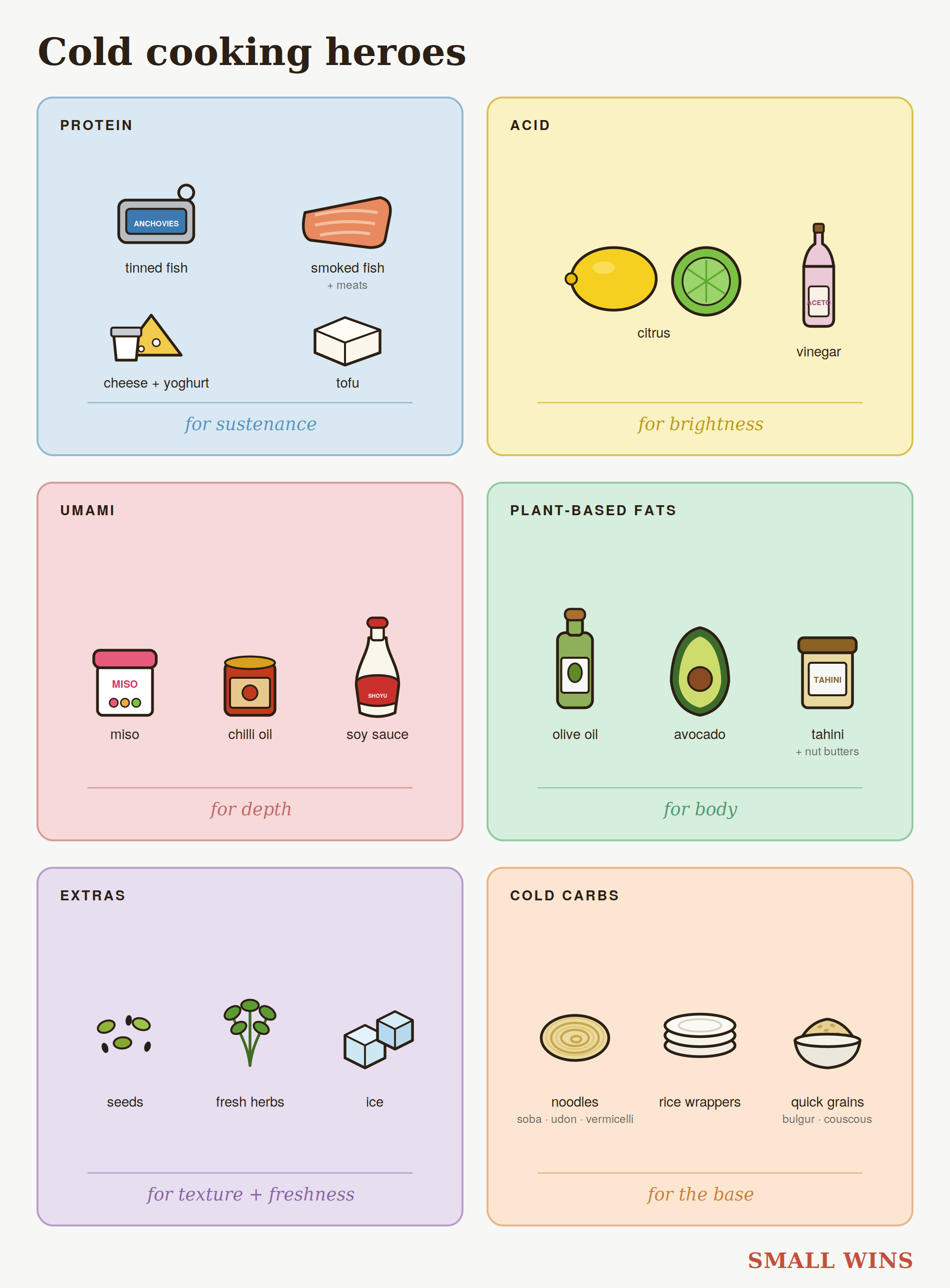
I have shared specific product recommendations in the footnotes.
In this section:
Recipe 1: The perfect summer breakfast
Acid as a cooking medium
Recipe 2: Bream, ginger root aguachile, cucumber + celery
Taking inspiration from Japanese shokibarai
Recipe 3: Iced peanut noodles with marinated tofu
Recipe 4: Coconut sago pudding with mango
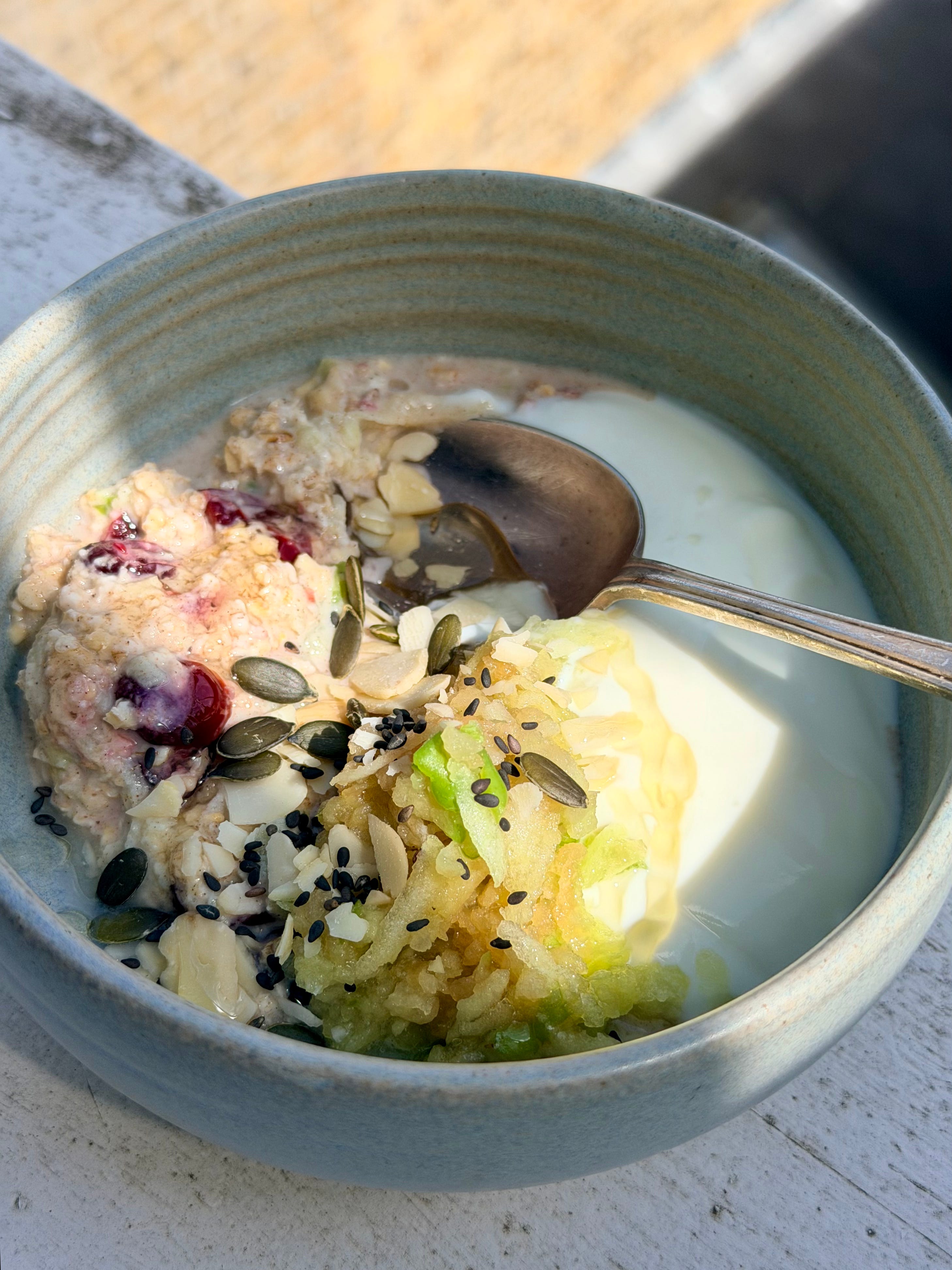
Bircher muesli — the OG overnight oats — is, quite simply, the most refreshing way to start the day. And it’s nutritionally balanced too: 7g fibre, a source of protein, 25% of your magnesium RDA, slow-release energy from the oats and an antioxidant boost from the sour cherries.
Comments
Nothing yet. Say the first thing.
Sign in to join the conversation.