
Do you believe in synchronicity?
I grew up with Oprah.
After high school, every weekday at 4:00 p.m., I watched The Oprah Winfrey Show. When I graduated it was the final season of a show that had literally been alongside me through my teenage years, almost like an after-school ritual.
I know this dates me, and I’m okay with that.
I’m an older woman now, and I embrace it.
People interact with me differently now. The invisible woman is a real thing. More than once, I’ve watched people bustle all around me while I sat or stood there, almost unseen, even after we’d had a conversation or exchanged an order. It happens. I simply say, Selah, and keep moving.
Something I remember vividly from those teenage years, those Oprah years, the literal 1980s with the big hair and bright colors, was Oprah talking about her own experience with childhood sexual abuse.
We didn’t have cable television. The phone was attached to the wall. Cable was still new in our neighborhood, and by 1988 we were still watching the three public channels because my late father gave us a choice.
A VCR or cable.
We chose the VCR.
“Don’t forget to rewind or you’ll be charged.”
Thank you, Blockbuster.
Those memories make me smile.
Looking back now, I realize Oprah was revolutionary because she created psychological safety before many of us even had language for it.
People sometimes dismiss her by saying, “I don’t like Oprah.”
I simply smile and think, I have memories.
She changed what people were willing to talk about because she was willing to be vulnerable herself.
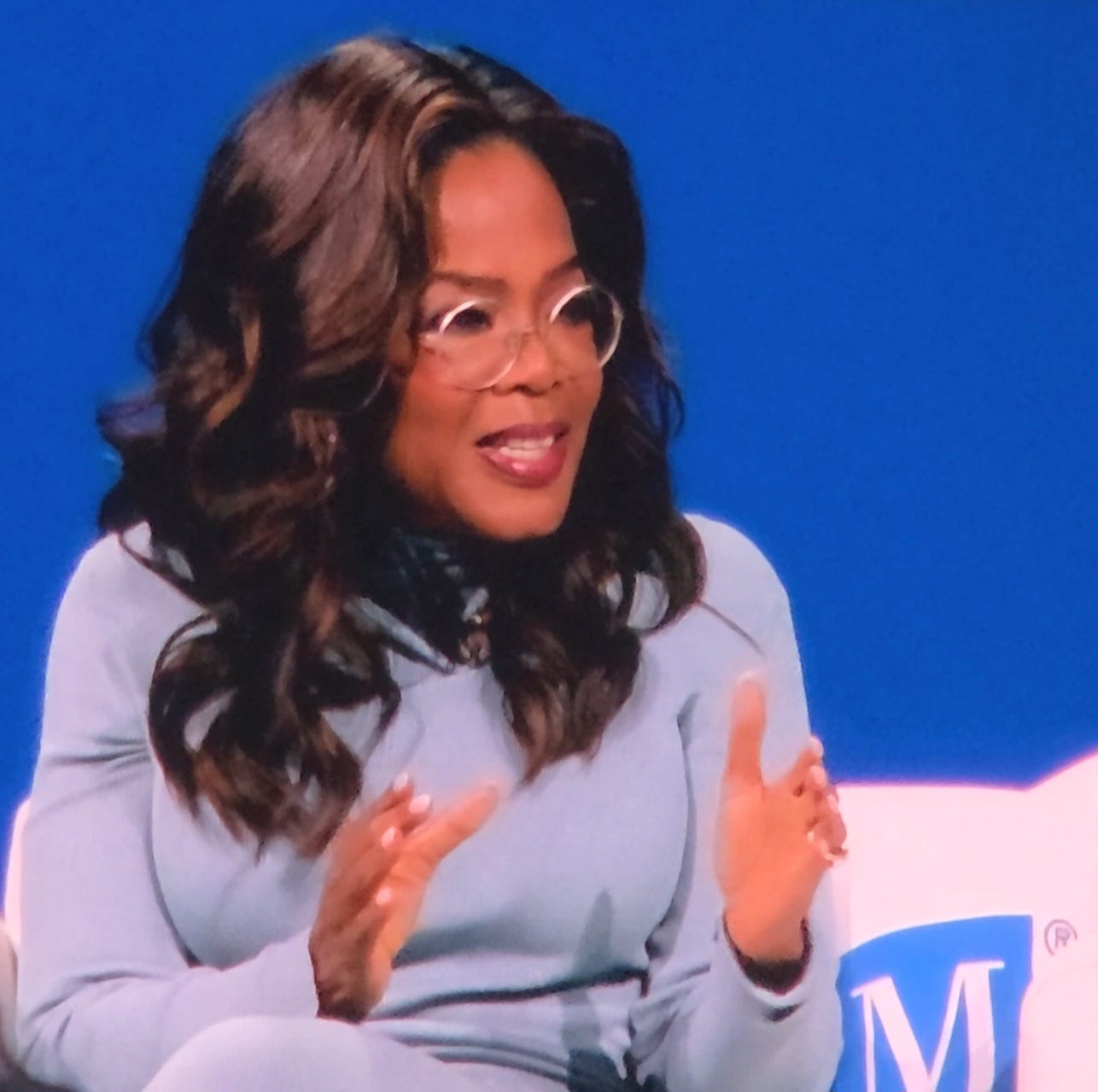
During SHRM26, I listened carefully to every word Oprah spoke. Then I saw photos of people who got to meet her and take photographs with her.
Not me.
I wanted one thing.
I wanted to ask her one question.
I wanted her to help me get people to take menopause seriously, especially here in Tennessee. She had recently produced a menopause special, and to me, that felt like synchronicity.
No, she never mentioned menopause during her keynote.
I probably would have cried if she had.
Instead, she said something else that stopped me in my tracks.
“People come to work with their childhood trauma.”
Did anyone else hear that?
Because I did.
And I haven’t stopped thinking about it.
For decades, I was a mental health therapist. I worked across populations and across the lifespan. I often found myself serving as both therapist and program coordinator because I had developed a skill that administrators valued.
I could tell someone’s story.
I could explain, through utilization reviews with insurance companies, why someone genuinely needed additional treatment. Again and again, regardless of age or diagnosis, trauma was often at the center of the story.
Sometimes childhood trauma.
Sometimes more recent trauma.
When I completed my master’s degree in counseling in the mid-1990s, we were trained to recognize and treat post-traumatic stress disorder.
Years later, around 2010, the conversation evolved.
We learned about Adverse Childhood Experiences, or ACEs. We learned that childhood adversity could actually be measured and that those experiences shaped physical health, emotional regulation, relationships, and workplace behavior decades later.
By 2019, when I started my company, people asked me why I had left therapy and moved into coaching.
The answer was simple.
I still believe deeply in therapy.
After decades of treating trauma, however, I wanted to help people build happiness.
I no longer wanted trauma to define my professional identity.
As I immersed myself in positive psychology and the science of happiness, I encountered another concept that fascinated me.
Post-traumatic growth.
Psychologists now understand something we didn’t fully appreciate back in 1996.
Human beings can grow after trauma.
We develop strengths we never imagined because we are forced to use abilities we never needed before.
Most people want to live.
Sometimes living takes extraordinary effort.
Sometimes it means digging your heels into the dirt and saying, “I’m going to make this work.”
“I’m going to understand.”
“I’m going to forgive.”
“I’m going to move forward.”
Not because anyone who hurt us deserves a free pass.
Absolutely not.
We do it because our own happiness deserves protecting.
I understand the desire for justice.
Sometimes justice is beyond our reach.
Wisdom is knowing when and how to let go.
That is resilience.
That takes courage.
So when Oprah said people bring childhood trauma to work, I thought to myself...
Did everyone hear what she just said?
Because she was right.
During the pandemic, trauma coaches appeared everywhere.
Almost as quickly, many disappeared.
I’ll tell you why.
Trauma is extraordinarily complex.
A short certification simply cannot replace the depth of training required to become a therapist.
Think about it.
Four years of undergraduate education.
Two years earning a master’s degree.
Thousands of supervised clinical hours.
Years of consultation before independent licensure.
Compare that with a weekend certificate.
They are not the same.
They cannot be the same.
Trauma deserves far more respect than that.
Yes, Oprah was right.
People carry trauma into the workplace.
Many don’t even realize it.
Sometimes another person’s words don’t cause the reaction.
They simply trigger an old memory.
The conflict isn’t really about the conversation happening in front of them.
It’s about something much older.
Understanding that changes everything.
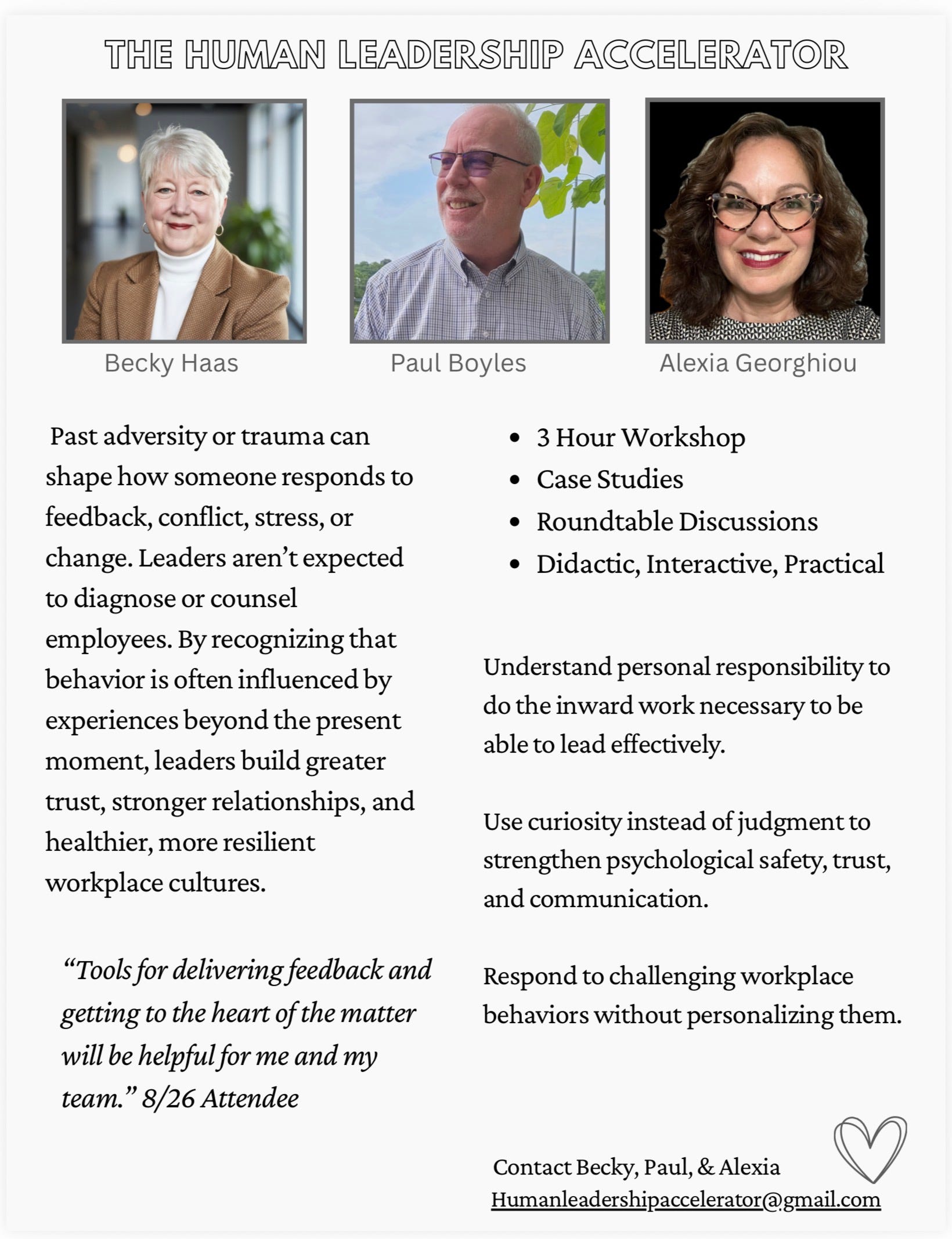
Before SHRM26, I began talking with colleagues about developing a leadership program around exactly this topic.
One is a retired HR director who openly admits he never received trauma training, yet has countless stories from decades in human resources.
Another colleague has dedicated her work to educating leaders about ACEs.
Two Boomers.
One Gen X.
Different paths.
One shared purpose.
Since 2019, I’ve spent much of my time teaching listening.
At the University of Tennessee.
In keynote presentations.
In webinars.
In workshops.
The power of listening.
People often underestimate listening.
But what if I told you that simply feeling heard begins to help someone heal?
What if I told you that being genuinely listened to reduces defensiveness?
Research published in recent years shows that feeling heard activates the brain’s reward system.
That fascinated me.
As I sit here writing this, I can see the evolution of my own career.
This is why we created the Human Leadership Accelerator.
Even though many of you reading this won’t be in East Tennessee for our live event, I wanted to share the “why.”
Understanding people matters.
Human behavior matters.
If you’re a recruiter, add one more competency to your hiring process.
How well does this person understand human behavior?
How well do they listen?
Not simply how well do they speak.
Because leadership begins with understanding people.
I still give keynote presentations on happiness because happiness is ultimately about brain health.
Without a positive brain state, we cannot consistently access our most complex thinking.
When the amygdala takes over, the prefrontal cortex becomes less available.
Reasoning suffers.
Memory suffers.
Problem solving suffers.
Fight, flight, or self-preservation becomes the priority.
Ask yourself something.
How often are you living there?
How often are you suspicious?
Protective?
Waiting for the next threat?
That isn’t where any of us were designed to live.
Happiness Habits help us return to a positive brain state.
A place of balance.
A place where we can think, connect, create, and lead.
We need that now more than ever.
Especially during a time when people wish death upon one another simply because of differing beliefs.
Thank you for reading.
This is my why.
The Human Leadership Accelerator
Get in touch: humanleadershipaccelerator@gmail.com
Talk a Dot Reviews August 7, 2026 inaugural event sponsored by ADP https://www.talkadot.com/leadership/events/the-human-leadership-accelerator
Comments
Nothing yet. Say the first thing.
Sign in to join the conversation.