

This is my personal mission and process of learning in public to solve chronic pain. Always open to feedback, discussion, collabs, etc. Please, never hesitate to reach out.
“Why quantify pain, when I can just ask the patient right in front of me?” - my doctor
For a long time, the neuroscience community mostly scoffed at the idea of objective markers of pain. Pain, by definition, is subjective. It is what the patient says it is. For decades the field treated attempts to quantify pain as somewhere between misguided and dangerous—an opportunity to dismiss the very patients we’re supposed to treat.
That scepticism was reasonable. It was also, in hindsight, incomplete.
Today chronic pain costs the United States an estimated $722 billion per year in medical care and lost productivity. It affects more than one in five adults, and we still measure it the same way we did forty years ago: by asking patients to rate their pain on a scale from 0 to 10.
Patient-reported outcomes should not be replaced, and they are not the problem. The problem is that they are the only tool we have, and for certain critical questions—Why does this patient still hurt after successful surgery? Will this drug work for this particular person? What kind of pain is this, mechanistically?—a number between 0 and 10 simply cannot answer such nuanced questions.
Biomarkers are tools that help quantify complex health symptoms and even predict medical events. From cholesterol levels to heart attack risk, biomarkers are everyday tools that have many use cases. So where are they for chronic pain?
There have been many efforts to quantify chronic pain and create biomarkers for them, each with varying levels of success. This piece overviews the suite of promising chronic pain biomarkers, their strengths and weaknesses, and the approach I believe is critically under-valued.
The most intuitive way to measure pain “objectively” is to look at what the body does when it’s in pain. When experiencing pain, your pupils dilate, skin conductance rises, and blood pressures spike. A handful of companies have built devices around these signals that monitor nociception by tracking pupil dilation, skin conductance, or heart rate variability. These have been developed almost exclusively for intraoperative use in anaesthetised patients who can’t self-report their pain, and several have regulatory clearance for narrow indications (e.g., Medasense PMD-200, PhysioDoloris ANI).
These tools have been useful in specific contexts like real-time feedback to reduce opioid overshoot during surgery, but they don’t work very well in awake patients. These sensors that measure autonomic stress response related to nociception also pick up effects of anxiety, fear, and medications, confounding the “true pain” signal.
In late 2024, ARPA-H funded several projects within their Sprint for Women’s Health portfolio to measure chronic pain, funding an exciting suite of hardware methods to measure pain. Though the performers’ output is not public, the crux of these projects is likely to separate that “true signal” of pain from the natural biological “noise” from stress and medications. On top of this, it’s likely even more difficult in chronic pain patients, since women with chronic conditions like endometriosis may have entirely normal autonomic responses during a painful flare-up because their nervous system has slowly adapted from the years of pain.
Autonomic approaches are useful in specific contexts, but they are usually intensity measures that tell you the magnitude of that nociceptive signal, not about what kind of pain is driving it. And for awake chronic pain patients, they often have too much noise to be used on their own.
This idea gained momentum in 2013 when Tor Wager and colleagues published a landmark study in the New England Journal of Medicine describing what they called the Neurologic Pain Signature, or NPS—a machine-learning-derived pattern of fMRI brain activity that could predict whether someone was experiencing heat-induced pain with roughly 93% accuracy. The NPS was specific enough to distinguish physical pain from social rejection, from the anticipation of pain, even from the memory of pain, while being sensitive enough to analgesic drugs.
But the NPS was developed and validated on healthy volunteers experiencing acute thermal pain in a scanner. In acute pain, nociceptive input drives a relatively predictable pattern of brain activation. In chronic pain, many of the same regions are still involved, but the dominant signals shift toward areas of the brain associated with emotion, memory, and reward.
Hashmi and colleagues showed that as back pain transitions from acute to chronic over a year, its brain signature migrates from sensory circuits to emotional ones, making signals of chronic pain difficult to tell apart from emotional distress. That migration is a problem for specificity, but it is also an intriguing observation about pain type—it suggests that neuroimaging may soon distinguish pain mechanisms, not just pain intensity. The field, however, has mostly pursued the question of how much pain a patient is in.
This is then the crux for neuroimaging-based biomarkers: the brain regions most active in chronic pain overlap substantially with those involved in depression or anxiety—conditions that commonly co-occur in chronic pain patients. Traditional machine learning methods have tried to distinguish chronic pain patients from healthy controls with reasonable accuracy (70–92%, depending on condition and method), but distinguishing one chronic pain condition from another, or separating pain from its common comorbidities, is also incredibly difficult.
There are also practical barriers. fMRI is expensive, needs a controlled environment, and a cooperative patient lying still in a scanner, generally unsuitable for a standard clinical workflow. EEG is cheaper, portable, and has shown altered oscillatory patterns in chronic pain patients, including recent EEG work in endometriosis-related pelvic pain, but signals are noisier and harder to localise.
The general consensus after two decades of pain neuroimaging is that neuroimaging alone will not produce a viable pain biomarker. It is the only approach that can directly see the central nervous system process pain in real time, but poor specificity for chronic pain versus its psychiatric comorbidities, plus the cost and infrastructure burden of fMRI, make it nearly impossible to deploy clinically on its own. But neuroimaging combined with other modalities might close that gap.
Chronic pain involves sustained neuroinflammation, shifts in circulating cytokines, and metabolites that should be detectable in blood or other biofluids. If it worked, a blood-based pain signature could plug straight into existing diagnostic infrastructure—clinical lab tests, companion diagnostics for drug selection, even direct-to-consumer panels.
Early efforts looking at individual markers like CGRP and interleukins were rather disappointing. After over a decade of searching, the field acknowledged that no single molecule reliably separates chronic pain patients from controls, let alone distinguishes one type of pain from another. The signal-to-noise ratio was too low and the biology just too heterogeneous.
More recent work using high-throughput proteomic and multi-omic platforms has been more promising. Rather than looking for one molecule, these approaches look for patterns across hundreds to thousands of analytes simultaneously. Circulating miRNAs, epigenetic methylation signatures, and multi-protein panels have shown early ability to profile chronic pain conditions and predict treatment responses.
In endometriosis specifically, multi-omic profiling has begun to identify molecular subtypes that may correspond to different pain phenotypes—a finding that echoes the broader emerging insight that pain heterogeneity, not pain severity, is where molecular tools can add the most value.
But these tools are still discovery-stage. Most studies are small, cross-sectional, and lack independent validation. The road from “we found a multi-marker signature that separates diseased from healthy” to “this test works reliably in a clinical setting across multiple sites” is long and expensive, with a large graveyard across many fields. The critical question is whether peripheral biofluid signals, which are far removed from central pain processing, are really measuring pain or just the inflammatory disease that happens to cause it.
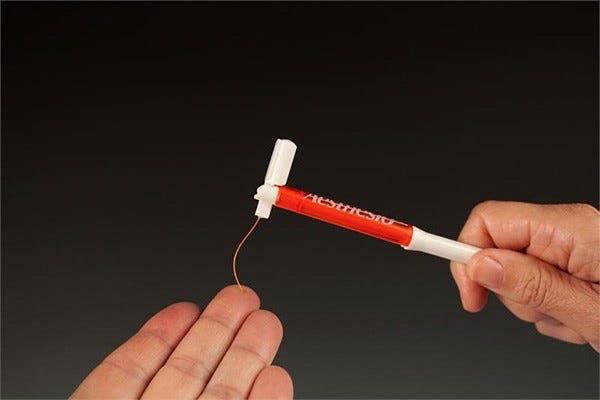
Rather than looking at the brain or the blood, quantitative sensory testing (QST) applies controlled stimuli like heat, cold, or pressure, to measure how the patient’s nervous system responds. The pattern of responses can reveal different pain phenomena from hyperalgesia to allodynia to understand nerve damage and treatment direction. Today QST lives mostly in academic pain centres and specialty clinics, but it’s increasingly being explored as a stratification tool in clinical trials.
QST has been particularly informative in understanding central sensitisation—the phenomenon where the central nervous system amplifies pain signals, producing widespread pain sensitivity that is out of proportion to the damage to your body. The Translational Research in Pelvic Pain (TRiPP) study, for example, used comprehensive QST to show that women with chronic pelvic pain have widespread central sensitisation beyond the pelvis.
But it has significant limitations as a clinical biomarker. For anyone that has done a Von Frey filament test, including myself, the protocol requires well-trained operators, specialised equipment, patient cooperation, and it still depends on the patient’s subjective report of when a stimulus becomes painful. It is “quantitative” in its stimulus delivery but ultimately subjective in its endpoint.
There’s a pattern across these approaches. Autonomic sensing and neuroimaging have overwhelmingly focused on quantifying pain severity, asking: “How much pain is this person in?” Molecular and QST approaches have begun to ask a different, and arguably more important, question: “What kind of pain is this person experiencing?” Though objectively measuring pain severity is important, the use of such devices is most attractive when self-reporting is unavailable (e.g. non-verbal or sedated patients), while deploying this tool to verbal adults comes with immense ethical risks.
Objective measures of pain type however, remain under-developed, despite their cross-cutting relevance across nearly all chronic pain conditions.
There is an emerging consensus in pain neuroscience that most chronic pain can be roughly categorised into three mechanistic types:
Nociceptive pain: caused by tissue damage or inflammation. Happens in diseases like arthritis, where the degrading joint cartilage produces inflammatory signals, making you feel pain. NSAIDs and surgery often address this.
Neuropathic pain: damage to or dysfunction of the nerves themselves. This happens in diabetic neuropathy for example, where years of high blood sugar damages the small blood vessels around your nerves, damaging the nerves themselves and causing that numbing, burning or electric pain.
Nociplastic pain: a relatively new concept that’s becoming accepted. It occurs when the central nervous system itself becomes molded like plastic, amplifying and distorting pain signals even when there’s no physical damage to your body anymore. This is the “everything else” bucket for conditions with no clear physical cause, from fibromyalgia to lasting pain after “successful surgery.”
Chronic pain treatment is hard because these three types can coexist in the same patient. A patient with knee arthritis might have inflammatory lesions causing nociceptive pain, nerve involvement producing neuropathic pain, and years of unmanaged pain that has produced central sensitization and nociplastic pain—all at once. Three patients with the same medical condition could have three entirely different pain mechanisms. This kind of heterogeneity is well accepted in oncology and other chronic diseases, but pain medicine has lacked the tools to do it.
This is where the real promise of objective measurement lies. Not in replacing the 0-to-10 scale, but in identifying dimensions of pain that subjective reports cannot reliably capture. A patient can tell you that her pain is an 8 out of 10. She cannot tell you whether that 8 is driven by persistent inflammation versus central sensitisation, despite that difference completely changing her treatment course.
For decades, the field has been trying to create a better pain meter. What we need is pain typing.
Osteoarthritis, fibromyalgia, migraines, inflammatory bowel disease, endometriosis—these conditions are studied in isolation by different medical specialties in siloed research communities.
But diseases that cause chronic pain are more similar than they are different. Inflammation from arthritic joints causes pain similar to endometriosis, just like how endometriosis nociplastic pain can look similar to that of IBD. This overlap suggests that a biomarker that can reliably distinguish pain types in even just one disease would unlock our understanding of chronic pain across all diseases.
The specificity here is not solely to the disease, but to the mechanism of pain itself.
There are now many tools to measure and quantify pain in different ways. Multiple modalities from neuroimaging, molecular assays, sensory testing, and patient-reported outcomes each capture different dimensions of underlying biology that can now conceivably be processed with AI/ML methods. The pieces of the solution exist, but assembling them into a single, validated, clinically deployable tool has proven to be a very different kind of problem—one that is not only about the science but also about the structure of how biomarkers are brought into this world.
That is the subject of the next essay.
No posts
Comments
Nothing yet. Say the first thing.
Sign in to join the conversation.