

Within the next year, thousands of young millionaires (25–40 yo) will be minted in essentially one zip code, collectively holding over $1T in new assets.
In San Francisco, these engineers describe their future lives as “post-economic,” where the question is now what to do once money becomes no object. Today, they’re being hounded by wealth managers, having financial products forced down their throats before they’ve even thought about relationships or kids.
Philanthropies are scrambling to capture this wealth too, generally betting that AI-adjacent programs on safety and truth-seeking will resonate.
But philanthropy as it exists today is built for a donor profile that doesn’t match these people. Valley philanthropy wants to be founder-led, risk-tolerant, and willing to fund unproven institutions. Most orgs outside SF don’t understand this, and the strategies they’re defaulting to are both presumptuous and unscalable.
I’ll first explain how frontier lab engineers are distinct from techies and why it’s consequential for philanthropic thesis design and partnership strategy.
Techies are like the dude from Cluely–the B2B SaaS company with the thesis “cheat on everything“. Launch videos, X crash outs, usually in their late teens to early twenties from either Waterloo or New Jersey. They embody the general archetypes you’ve seen in the Silicon Valley sitcom, chasing the glory of attending the next TPOT party and DM’ing that Asian girl introducing herself on X.
Though there will still be many techies who give generously, especially those at xAI post-IPO, proportionally there will be fewer of them giving to ambitious philanthropic initiatives compared to the employees at Anthropic or OpenAI.
In contrast to the average techie, Anthropic/OAI engineers come from a much more intellectual and diverse background. They can be PhDs/postdocs, YouTube-viral lecturers, seasoned ML engineers from competitors like DeepMind, all the way to Effective Altruism (EA) forum posters/lurkers and ex-Leverage Research affiliates. These people are therefore not just older than the stereotypical techies, but tend to be more philosophical, “worldly,” and perhaps have already given or have friends who have given to EA-adjacent charities like Shrimp Welfare Project1 or new initiatives like Nan Ransohoff’s Intercept Fund.
At Anthropic in particular, giving is woven into the company thesis and culture. Co-founders Daniela and Dario Amodei have been involved in EA for years, with Daniela being married to Holden Karnofsky, former CEO of GiveWell and Coefficient Giving (fka Open Philanthropy). All seven co-founders of Anthropic have committed to giving at least 80% of their wealth, setting a strong culture and tone around giving from Day 0.
Lastly, Anthropic employees are encouraged to give even further through the company donation match program (up to 25% of their equity matched to any charity) which also acts as a selection filter for employees who already want to give. They also frequently internally discuss non-profits they can give to, and regularly host non-profits to present their work, help host informal happy hours, and more.
Post-2026 donors, especially those that come out of the frontier labs, are therefore emerging with a pre-trained world model of philanthropic orgs and their various levels of effectiveness.
This matters for many reasons, but primarily because it compresses the traditional donor conversion cycle. Most organizations spend months to years cultivating donors who arrive with vague ideas and limited knowledge of the giving landscape. Post-2026 donors, on the other hand, are likely to show up with opinions on cost-effectiveness methodology, existing relationships with grantmakers, and a working mental model of which cause areas have been (in)effective in the past.
Thus, for philanthropies seeking gifts, the challenge is no longer in convincing donors to give, but in conveying why your specific programs absorb capital better than the alternatives they already know about.
Looking closely, the wealth follows a relatively simple power law.
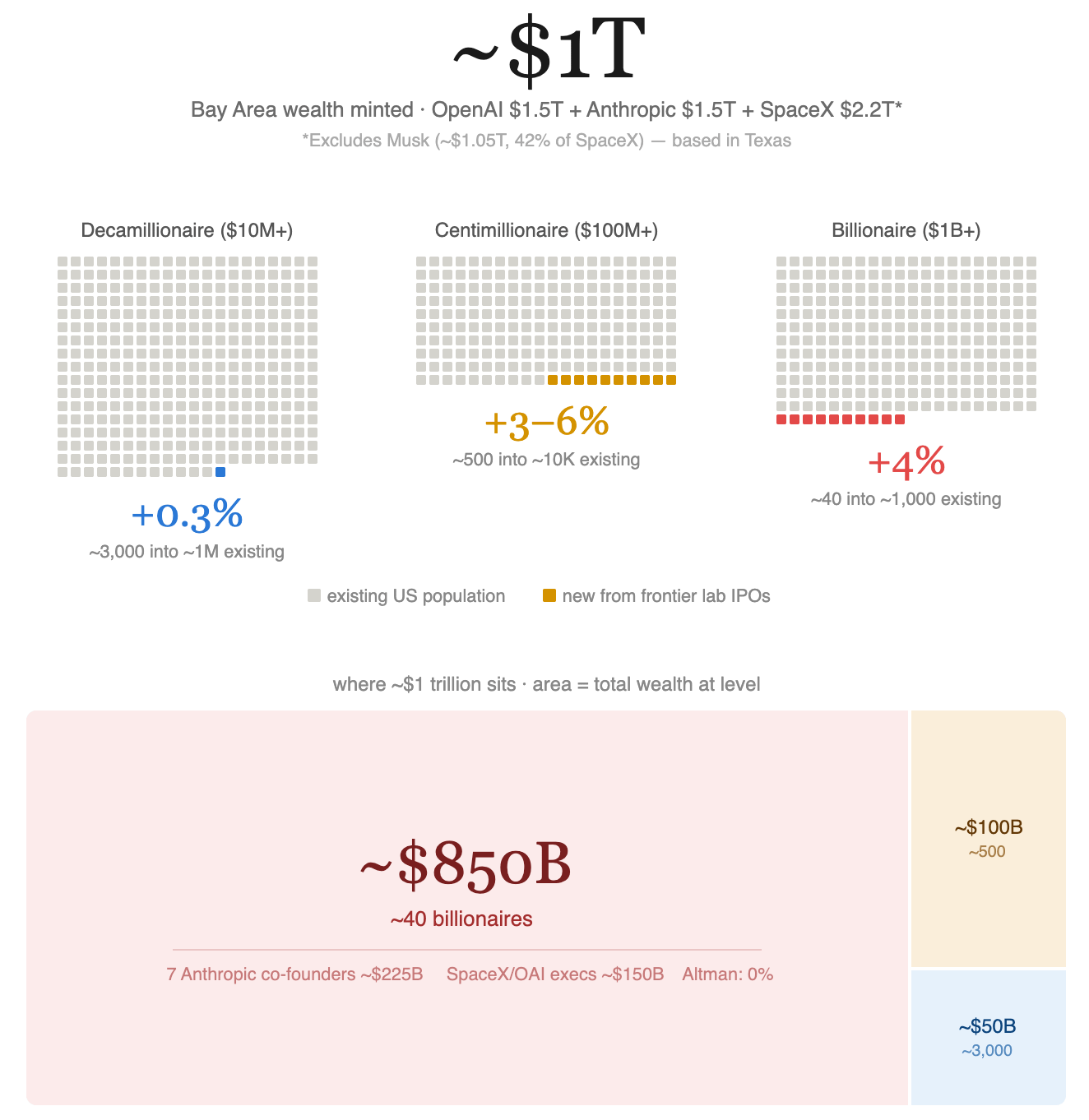
Between SpaceX (~22,000), OpenAI (~8,000) and Anthropic (~5,000), assume there are ~35,000 employees. Let’s then take the ~$2.2T SpaceX IPO valuation and Anthropic’s recent $965M post-money Series H valuation (+154% in 3mo) as a benchmark to assume a generous $1.5T IPO valuation for both OAI and Anthropic. With that valuation, around 10%, or ~4,000 individuals between the three companies, will become decamillionaires ($10 million or more in equity) or above.
Decamillionaires will be the most populous, with roughly 3,000 individuals holding ~$50B in total assets. These individuals will be the “ordinary” Members of Technical Staff and managers across many levels and seniority.
The centi-millionaire bracket drops the total number by roughly an order of magnitude at around 500 total individuals (~1% of employees) holding another ~$100B in assets. This group leans towards very early or senior hires. The headcount here is much less sensitive to the valuation, as their holdings sit far enough above the $100M threshold that small valuation swings don’t change who qualifies.
Finally, at the very top will be a few dozen individuals who become overnight billionaires. Combining the founders and a few dozen first-employee and executives, the total ~40 individuals will hold around $850B in wealth.
The majority of this wealth will be of course concentrated amongst the founders, with the 7 co-founders of Anthropic expected to hold ~15% of all shares, putting their combined net-worth at around $225 billion.
So the big question remains: where will all this wealth go?
The first are Donor Advised Funds (DAFs), a tax relief instrument that gives individuals immediate tax relief. DAFs allow a donor to put money inside the account (fund), and advise that money to be given out to any charity they want.
DAFs are essentially financial products. Just like 401ks and HSAs. They’re offered by financial institutions like Vanguard and Merrill Lynch, with Fidelity Charitable (DAF) being the largest nonprofit by donations, receiving $16B in 2024.
Over the past ~decade, DAFs have exploded into a full-on industry. As of 2024, DAFs collectively hold over $326 billion in assets–up 37% in a single year–with some expecting the total amount to surpass $450 billion after a late-2025 surge in new accounts. I think it will hit >$700B by EoY 2026.
As you can guess by the numbers, DAFs today act more as an instrument to carry money rather than deploy it.
In an ideal world, donors receive a tax break by putting money in the DAF, then give that money away to nonprofits through the DAF. In reality, there is no tax incentive for the parked money to go anywhere–most of it just sits there, as it’s already achieved its tax-deducting purpose when it was deposited into the account.2
DAFs are one of the most established and easiest places to park money with immediate tax breaks, with most frontier lab employees having already allocated large amounts of capital there. I believe a non-significant number of frontier lab employees will either indefinitely park their capital in their DAFs, or give it ~immediately to their preferred (perhaps EA-adjacent) initiatives. I estimate >25% of all philanthropic capital from the frontier labs will be allocated to DAFs.
The second are the Effective Altruism allocators (Longview, Coefficient Giving), where money goes to be deployed with specific, often pre-scoped, theses. Coefficient Giving is one of the most established organizations in this space, now operating like a traditional grantmaker. It houses program directors who lead “departments” focused on specific themes, from Farm Animal Welfare to Global Health and Wellbeing funding LMIC interventions. Some of their work, especially around Farm Animal Welfare, is strongly associated with EA philosophies and is by far one of the most influential initiatives to emerge from the movement, at times exceeding the visibility of its parent organization.
EA allocators have been enormously successful and the world is better off because of it. But the same philosophies that have made them so successful may limit the variety of new programs they may create in the future. DALY/QALY calculations are effective, but they will not rationalize spending $50M on precision psychiatry tools to predict suicidality, or allocating $100M for projects to delay menopause by one year.
These problems are just as worthy as preventing lead exposure in developing countries or safeguarding our world against global catastrophic risks. But they generally fall outside the theses of EA allocators. This is not a bad thing, since philanthropies that understand these dynamics will allow them to sufficiently differentiate from being perceived as “just another org on the AI Safety bandwagon.”
But given the decade-plus institutional standing of EA allocators in the Valley, I believe up to 25% of all philanthropic capital will be plausibly allocated to these orgs. Combined with DAFs, up to 50% of all philanthropic capital may be allocated within the next year.
Most foundations today are working backwards. They’re projecting into the post-AGI, post-economic era, identifying 3-5x AI-adjacent program themes, designing funds around them, and hoping the new donors’ interests happen to land there.
This is both presumptuous and unscalable. Each level of wealth needs a fundamentally different engagement model, and the causes fundable to each vary dramatically based on cash volume alone. I therefore break down the engagement strategies for each level and the causes they can be suitable for below:
The ~40 individuals at this level (founders, first employees, executives) are unlike most mega-donors of the past, and given the sheer size of their minimum check sizes, they require a tailored approach rather than a scaled one.
Pre-2026 billionaire philanthropists were typically older financiers who arrived at giving through self-actualization or financial obligation later in life. Frontier lab founders have been steeped in EA-adjacent and many other giving frameworks since before they were wealthy, making them far more engaged and opinionated about where their money goes.
The standard philanthropic advisory model of extensive due diligence, curated shortlists of causes, and quarterly check-ins will underwhelm them. Instead of being engaged as customers to sell a product to, they will want to feel like co-developers of a shared mission.
Foundations should therefore invite them into the thesis-building process itself, walking through the “idea maze” for a cause area the way a Program Officer would internally. That requires partnership leads who are either domain experts in the donor’s field or technical enough to learn fast, and who have deep context on what adjacent efforts have already been funded and where they succeeded or failed across EA and broader SF philanthropy.
The harder problem, though, is absorptive capacity. Most cause areas like biosecurity or AI governance simply are not talent-dense enough to have individual projects that can hold $100M, let alone $1B. “Microgrants” could work at the ~$5M scale x20, but those are just normal grants at that point. The real opportunity at this level is endowing entirely new institutions: research institutes (e.g. Arc or Buck Institute), X-Lab-like orgs, even larger FROs.
Given there will be between 300-600 centimillionaires, the individual bespoke advising approach will not scale and even the classic multi-family office model may fail to capture a significant amount of wealth. I therefore propose two scalable approaches as examples:
Philanthropic “angel syndicates”
Angel syndicates are a fun, proven vehicle that gives passive investor-types startup exposure while making members feel like “insiders” with “FOMO” to act quickly. These syndicates are often just WhatsApp group chats with 10-100 people, moderated with rules around chat activity, minimum annual investment amount, and value-add to the syndicate and ultimately the startups.
Adapting this model for philanthropic startups/initiatives is quite simple in theory. From standing up new companies like an “AngelList for Philanthropy” all the way to individually-led syndicates like future.bio, it’s likely that mini-groups have already been formed organically through CivIV groupchats and social circles.
Charity Entrepreneurship’s AIM program hosts Funding Circles for example, which operate in a very similar way. In an ideal world where this is executed correctly, the syndicate members, each worth $100M+, can bring in or be presented “deals” for philanthropic initiatives, just like venture syndicates. The initiatives, led by ambitious founders, then can pitch for single digit millions all the way to nine-figure-checks for mega-projects.
Philanthropy Studios
Venture studios like Flagship Pioneering to classic “Entrepreneur in Residence” models are established ways for private investment funds to make outsized bets with individuals or internal teams. These studios often have institutional funding that allows for hypothesis testing and de-risking some experiments, with deep connections and the stamp of approval to help raise subsequent venture rounds.
This studio model has been attempted at some level in philanthropy, but the success cases are not very visible to most. The Audacious Project by TED is probably one of the best examples of successful philanthropic studios. Simply stated, Audacious Project identifies a select group of ambitious nonprofit projects annually and matches them with their large coalition of philanthropists for funding and public visibility through the larger TED network. In the past, Audacious Project has supported many effective philanthropic projects from the Arc Institute and GiveDirectly, all the way to METR and COVID-19 Fast Grants.
It will only take between 3-10x post-2026 centimillionaires to anchor one new ~$100M studio, with a larger network of donors readily accessible through word of mouth for crowdfunding. Effectively operating these studios is difficult, and will require agentic and technical capital allocators. But the counterfactual impact is enormous–even just connecting 1-2x Arc Institute or GiveDirectly-level orgs to $100M+ can create new scientific fields, create dozens of new companies, all while making philanthropy high-status. It’s a bet worth taking.
Given there will be 3,000-5,000 decamillionaires to be printed, effective methods at this level require true scale. There are inevitably many ways to approach this, so I will propose three examples based on established tech-adjacent ideas.
The Everything Store model
Given the individual check sizes will be at the $0.5-50M range, “high touch” approaches will no longer be scalable. Thus, frictionless methods with significant optionality baked into the “giving UI/UX” must be developed.
Amazon created a near-limitless products marketplace–an Everything Store that’s a single open platform for pre-vetted products. We can plausibly do this for philanthropic ideas. Theoretically, a single open platform of high-quality ideas, with strong recommendation algorithms, can be created with top tier UI/UX spending and word of mouth.
I imagine this as Amazon x Giving What We Can, an incredible org that has created a large movement with thousands of individuals donating 10% or more of their salary/wealth towards effective causes. This can even go a step further via peer recommendation engines and transparency on who gave to what, similar to existing platforms like Manifund, grantmaking.ai, and Catalyze R&D funding platform.
One thousand true fans
In 2008, the great Kevin Kelly proposed that the internet would create a new economy that democratizes wealth by letting individual “creators” earn a living from just 1,000 true fans. These fans would be people willing to spend ~$100/year to support someone else. If you have 1,000 people giving you $100, that’s $100k, a liveable wage at the time in Silicon Valley, probably.
In the coming years, we may see a similar trend within the philanthropy economy where individual “creators” can be supported through multiple large grants. Nadia Asparouhova is one great example of researchers who have long been supported through gifts from wealthy individuals, all the way to nonprofit orgs like Basis that conduct deeply technical math & AI research. While only a few dozen individuals give this way, it is indeed very Valley-coded with significant potential.
Even if finding one thousand true fans (aka donors) is too difficult, one hundred may be feasible, especially as more Everything Store-like platforms evolve. It’s essentially “democratized philanthropy”, similar to how venture capital is becoming democratized today. In October 2025, Siren Biotechnology, a cancer gene therapy startup in SF, raised over $4M in an unconventional crowd-sourced funding round on Wefunder. It was one of the largest in the platform’s history, and showed how large the non-accredited investor appetite was to engage in relatively niche and technical products like glioblastoma AAV gene therapy companies.
In this next wave of philanthropy, I believe we can see hundreds to thousands of philanthropic donors giving ambitiously and visibly to cool efforts like this. But this will all quickly collapse as a supply-side problem.
There will be over $1T in newly fungible assets. Even if just 25% of that is liquidated and redirected towards philanthropy, there are simply not enough legible philanthropy-shaped problems today to absorb $250B. If ~50% of philanthropic capital will be heavily allocated to DAFs and EA allocators, whether the remaining 50% goes to new initiatives or not depends almost entirely on whether the right people exist to identify, scope, and steward those projects.
Talent is the moat. Finding great capital allocators, founders, and “General Managers” is the crux of the next 1-2 years. These individuals need to have the technical depth to make sense of the increasingly complex world while having their distinct “taste” in what should be done.
Abhishaike Mahajan of OwlPosting is one recent example of a great capital allocator candidate: an ML x Bio engineer turned allocator, now deploying capital at OpenAI Foundation, with the domain fluency to evaluate what he funds. Another example would be Cate Hall, previously the CEO of Astera Institute, one of SF’s largest foundations that funded several ambitious philanthropic founders.
The problem is, there are perhaps five to ten other people like this visible today, and we will need dozens to hundreds within the next one to two years.
Nan Ransohoff proposed several ideas to address this problem in her recent piece, “The Third wave of American Philanthropy”. Some of these ideas include improving the legibility of philanthropy-shaped problems, paying philanthropic capital allocators well, starting philanthropic VCs, and more.
Indeed, programs like Renaissance Philanthropy’s “Big if True Science” accelerators have been a powerful on-ramp for well-scoped, eight-figure ideas ready to become philanthropic initiatives. Mentored by renowned DARPA Program Directors and philanthropic advisors, the program has nurtured dozens of potential GMs, many of whom will take ARPA Program Manager positions, have received millions in follow-on non-dilutive funding, or now lead teams at frontier labs. We need even more of these programs, perhaps incubated by well-resourced orgs like Open Philanthropy or Coefficient Giving.
Whether it be to find philanthropic founders, funders, create incubators or studios, Silicon Valley’s 1-2 year trajectory will be shaped by effective philanthropic matchmakers who can match ambitious founders to funders.
I call this “bending entropy”. It’s incredibly difficult, because this person needs to have the technical depth in one or more completely different subjects (e.g. biology & ML) to vet projects, “taste” for founders, deep context on trad & SF philanthropy, and the tacit knowledge on what’s been tried by whom and why some projects failed. I believe more philanthropies should identify these matchmakers who can effectively become “nodes” for the Silicon Valley for Public Goods.
But in the end, I’m afraid of philanthropies going up against each other. Today, there are dozens of philanthropies, wealth advisors, and salespeople running around SF to capture the emerging wealth. Like VCs, they’re competing–so they might share some information, discuss some donors, but can’t share too much!
There is no playbook for such dynamic and unprecedented times, but we know how Silicon Valley has flourished to this point. We have a choice to collectively obsess over the founders and educate them. We have a choice to guide emerging funders towards ambitious, transformational programs beyond what’s been funded in the past.
If we get this right, we can all flourish into an abundant, post-AGI world. But the window is closing.
Thank you to Alex Kesin, Oscar Sykes, Zoe Hoare, Abhishaike Mahajan, Seyi Oluwasanmi, Prapthi Agarwala, Rhys Lindmark, Niko McCarty & Christian Larsen for thoughts and comments.
Shrimp are smart, proportional to their weight.
No posts
Comments
Nothing yet. Say the first thing.
Sign in to join the conversation.