
This is my personal mission and process of learning in public to solve chronic pain. Always open to feedback, discussion, collabs, etc. Please, never hesitate to reach out.
Chronic pain is incredibly common. It affects over 1 in 4 adults globally, and costs the US alone over $700 billion a year — more than heart disease ($309B), cancer ($243B), and diabetes ($188B).[1] Yet it’s largely invisible.
Relative to the burden, there is surprisingly little funding in chronic pain outside the context of addiction. This piece describes the state of funding for chronic pain, the framing problem of it, and the narrative shift I believe we need to fix it.
Despite the massive economic burden of chronic pain, most of “chronic pain funding” in the US is really addiction funding.
The NIH’s HEAL Initiative was a flagship pain program launched in 2018 explicitly borne out of the opioid crisis. In 2023, HEAL alone directed over $600 million towards pain and addiction research. To date, HEAL has been massively influential in chronic pain research, funding thousands of publications and making chronic pain — specifically chronic lower back pain — one of the most well-published areas of pain research.
This makes a lot of sense. One of the most common causes of chronic pain in Americans, and reasons for opioid use, was chronic lower back pain. But the generous funding towards lower back pain research was contrasted by many other conditions seeing comparatively little increase in funding.
To date, NIH funding for other chronic pain conditions remains strikingly low: fibromyalgia (~$16M), endometriosis (~$29M), osteoarthritis (~$84M), and IBD (~$225M).[2] [3] Though there is significant overlap in funding from adjacent fields like musculoskeletal, aging, or immunology, many chronic pain conditions are still massively underfunded proportional to the annual $700+ billion national burden. This gap becomes increasingly obvious when we calculate annual funding proportional to the actual number of patients who suffer from it.
Take endometriosis. The NIH allocated ~$29 million to endometriosis research in 2024 — just 0.067% of the budget — which works out to about $4.00 per patient per year, for a condition that affects an estimated 6.5 million women in the US alone.
Migraine tells a similar story: ~$59 million in NIH funding for a condition affecting 40 million Americans,[4] costing $78 billion annually.[5] That works out to about $1.00 per patient per year.
Today, we still don’t really understand chronic pain. Though our general understanding improved dramatically through initiatives like HEAL, much of that learning hasn’t effectively transferred beyond the lower back.
Epistemically, many of us see chronic pain as a symptom of disease like arthritis or migraine, instead of a disease in and of itself. Pain itself has a distinctly complex biology that we still know very little about. But once we accept chronic pain as a condition and examine the biology of it, we start to see where the avalanche of impact can start.
We’ve begun to realise pain is not merely a symptom of another condition, but a biological process in its own right.
Historically, chronic pain was thought to be just a symptom of disease. Take arthritis for example, a disease of joint cartilage damage and degeneration. If chronic pain from your damaged knee cartilage is causing pain, then fixing that damaged knee should get rid of the pain. This intuitive and simple logic led many scientists and funders to explore the biology of cartilage degeneration and how we can resolve pain through restoring healthy joint structure.
But around ten years ago, the arthritis field realized that fixing your broken body doesn’t always fix your pain. Over the past decade, other fields from pain neuroscience to uterine biology had come to the same conclusion: fixing the damage in your body doesn’t always fix your pain.
The causal relationship we assumed between Damage vs. Pain turned out to be much more complex, and our understanding of pain shallower, than we originally thought.
Two examples across two very different body parts illustrate this:
Sprifermin was a new Fgf18 osteoarthritis drug that entered a Phase 2 clinical trial (FORWARD) in 2013. In the Phase 2 that tested drug efficacy, the drug successfully preserved knee cartilage in patients who received the highest dose compared to placebo. [6] A great success! But the drug failed.
Why? Though Sprifermin improved cartilage thickness, it did not improve the patient’s pain. The FDA sided with the patients, who wanted their pain to go away, not just their knees to “look better”.
What was particularly striking was that post-hoc analysis identified specific patient subgroups that responded to the drug and those who didn’t respond at all. Digging deeper, researchers found that the patients who responded to the drug were those with severe structural damage and moderate-to-high baseline pain. On the other hand, for those with (centrally sensitized) pain uncorrelated with structural damage, the drug was not very effective.
The Sprifermin trial is canon in the osteoarthritis field today and is a cautionary tale of the importance of patient stratification: sorting patients based on subtypes beyond just the umbrella label of the disease.
This is a classical example of how clinical trials fail not because the drug doesn’t work at all, but because the drug doesn’t work on enough people. Had the field better understood the biology of pain itself— not just the biology of how cartilage breaks down — the outcome may have been very different, and millions of patients today could have been living with manageable arthritis.
The standard treatment for endometriosis has long been surgical excision—find the lesions, cut them out. For many patients, surgery can be very successful at resolving pain.
But pain recurrence after surgery can be between 20%-40% within just five years. [7] Even among patients whose lesions are fully removed, a significant fraction experience chronic pelvic pain that persists or returns—often without any new lesions visible on imaging.
The other front-line treatment, hormonal therapies, only work for roughly half of cases, with the other half reporting persisting pelvic pain, usually recurring after coming off medication. Existing treatments, especially drugs, today work for some patients and do nothing for others, suggesting that there are subtypes of chronic pain in endometriosis that go beyond the number or location of the lesions we see.
The relationship between disease and pain severity is weaker than most of us assume. Pain severity in endometriosis does not reliably correlate with lesion number, location, or disease stage. Some patients with minimal visible lesions report debilitating pain. Others with extensive disease report very little. A 2021 systematic review of the clinical evidence found that pain severity rarely correlates with endometriosis stage. [8] We see similar patterns in many osteoarthritis patients too.
Neuroimaging studies have shown that women with endometriosis-associated chronic pelvic pain have distinct brain patterns that suggest central sensitization, a phenomenon where the nervous system itself has been molded like plastic to signal for pain without any stimulus. [9] This is called nociplastic pain, and we see this in many, many diseases from osteoarthritis to fibromyalgia.
In nociplastic pain, once that rewiring takes hold, removing the lesion doesn’t undo the problem. The pain has become its own condition. Trials for many chronic pain conditions today do not accurately sort (stratify) patients by what’s actually driving their pain — tissue damage vs nerve damage vs nociplastic — and end up averaging across fundamentally different conditions wearing the same diagnostic label.
We’ve treated chronic pain as a symptom for too long. Medicine’s attempt to reduce pain to a downstream consequence of structural disease has produced a generation of trials that were, in hindsight, designed to fail.
Now is the time to fix that.
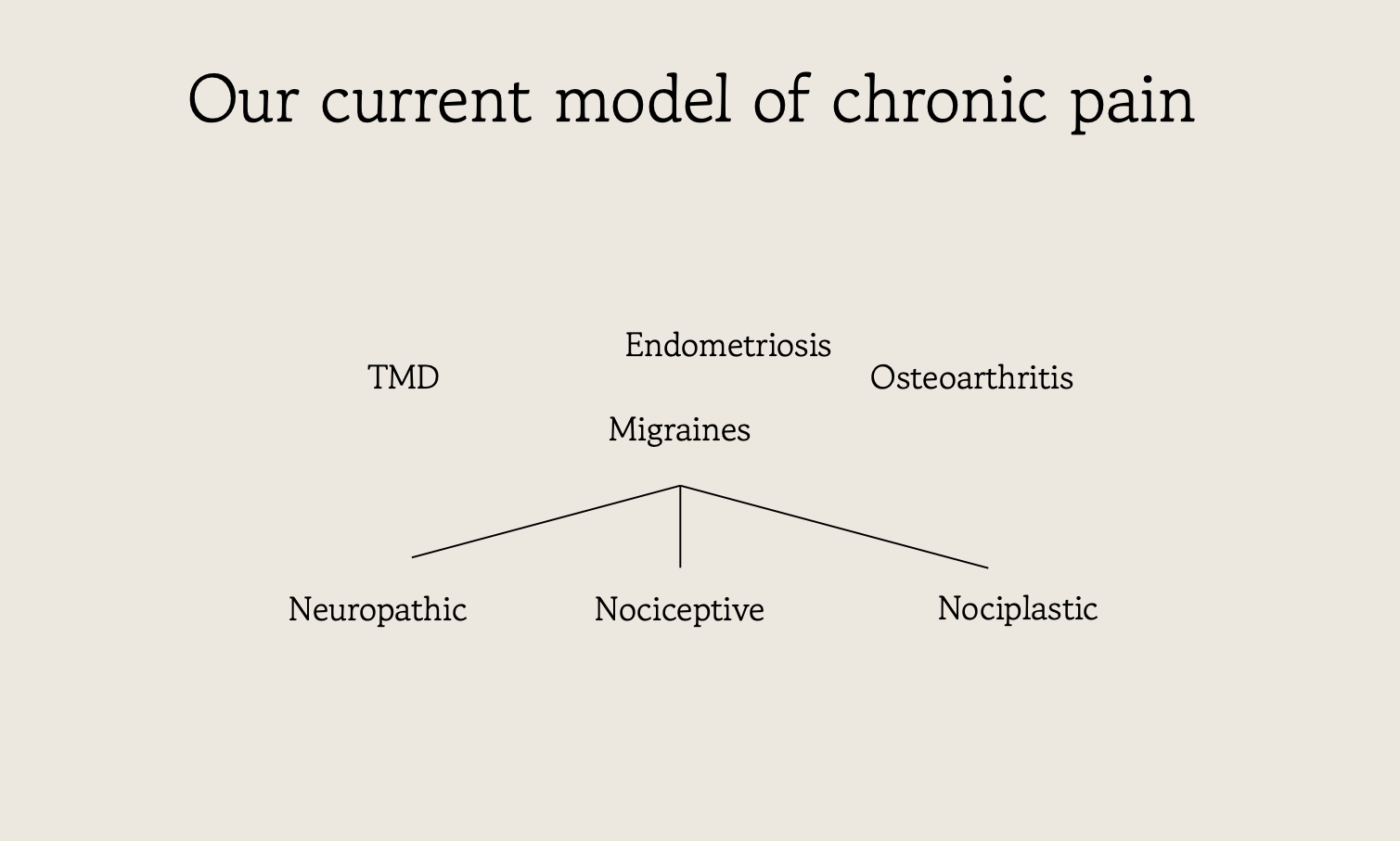
Chronic pain is a biological process that manifests as disease in different parts of the body, following the same three conserved mechanistic types:
Nociceptive pain (from tissue damage)
Neuropathic pain (from nerve damage)
Nociplastic pain (from a sensitised nervous system that amplifies normal signals into pain)
Right now, osteoarthritis pain is studied by rheumatologists, endometriosis pain is studied by gynecologists, and neuropathic pain is studied by neurologists—each in their own silo. But if we accept that many chronic pain conditions share very similar underlying neurophysiological mechanisms regardless of the disease label, then we can imagine how understanding pain very deeply in even one disease context can start unraveling the mysteries of all chronic pain conditions.
A breakthrough in understanding how the nervous system becomes sensitised in fibromyalgia could change how we design osteoarthritis trials and drugs. Better pain biomarkers developed for endometriosis could transform how we stratify and treat back pain patients.
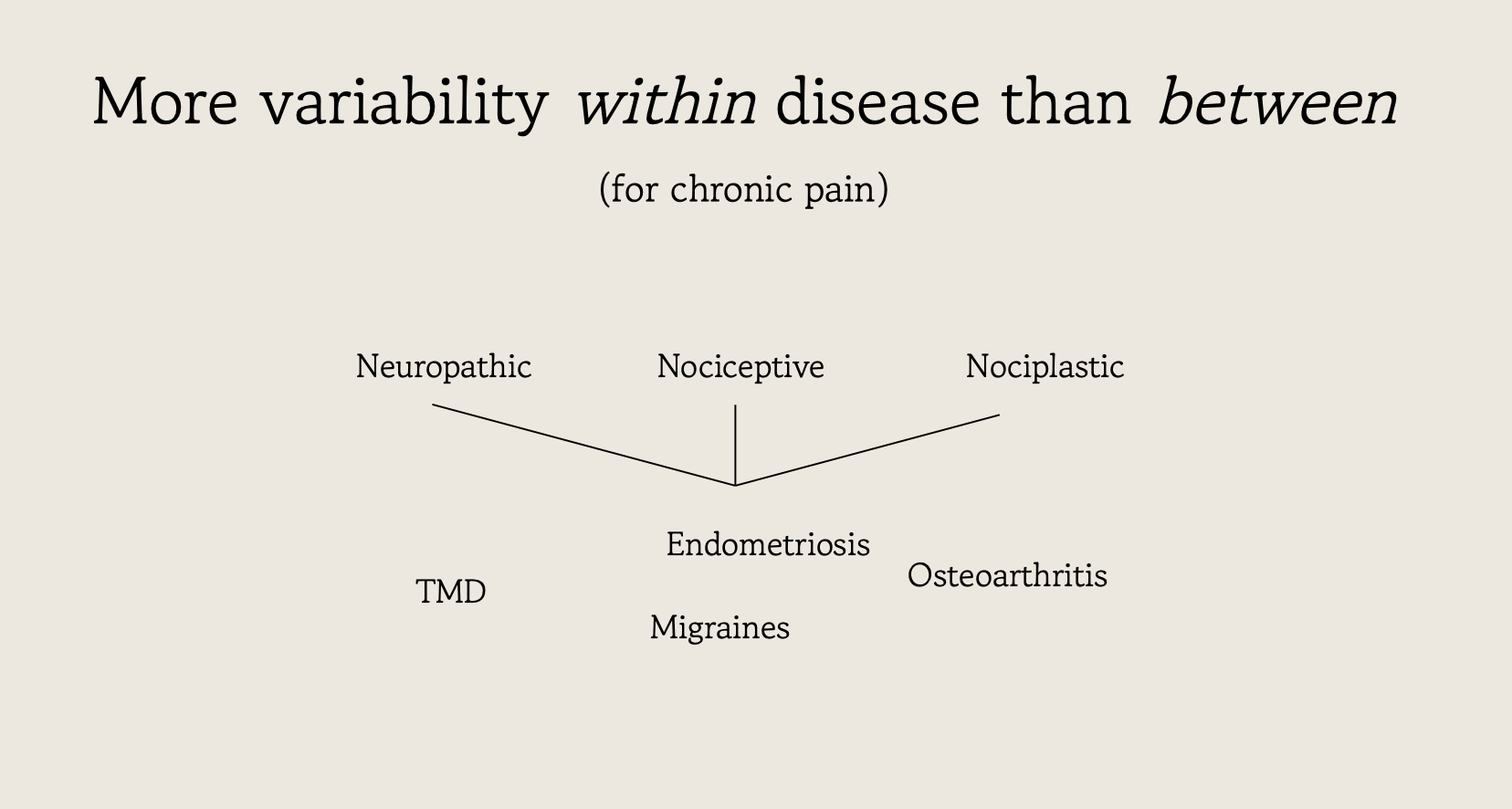
But none of that happens if we keep treating pain as an effect of disease. We need dedicated funding for pain as pain—because it’s what matters at the end for patients, regulators, and trials. Understanding the structural problem of a disease is necessary. But it’s not sufficient. We also need to understand how pain behaves independently of the disease that triggered it—how it persists, how it sensitizes, how it rewires the body.
This is what we must understand to begin the transformation of chronic disease to deliver the vision of precision medicine we were promised so many years ago.
[1] Gaskin, D. J., & Richard, P. (2012). The economic costs of pain in the United States. The Journal of Pain. Source
[2] National Institutes of Health (NIH). (2025). Estimates of Funding for Various Research, Condition, and Disease Categories (RCDC). NIH RePORT. Source
[3] World Economic Forum. (2026). Women’s Health Investment Outlook: Closing the Research and Funding Gap. Source
[4] Migraine Collaborative. (2024). New US Government Policies Hit the Migraine Field. Source
[5] GBD 2021 Diseases and Injuries Collaborators. (2024). Global incidence, prevalence, and years lived with disability for 371 diseases and injuries. The Lancet. Source
[6] Hochberg, M. C., et al. (2019). Effect of Intra-Articular Sprifermin vs Placebo on Femorotibial Joint Cartilage Thickness in Patients With Osteoarthritis: The FORWARD Randomized Clinical Trial. JAMA. Source
[7] Zakhari, A., et al. (2021). Endometriosis recurrence following post-operative hormonal suppression: a systematic review and meta-analysis. Human Reproduction Update. Source
[8] Vermeulen, N., et al. (2021). Endometriosis Classification, Staging and Reporting Systems: A Review on the Road to a Universally Accepted Endometriosis Classification. Journal of Minimally Invasive Gynecology. Source
[9] As-Sanie, S., et al. (2013). Increased pressure pain sensitivity in women with chronic pelvic pain. Obstetrics & Gynecology. Source
No posts
Comments
Nothing yet. Say the first thing.
Sign in to join the conversation.