
Hi, it’s Alex from 20VC. I’m investing in seed & series A European vertical solutions (vSol) which are industry specific solutions aiming to become industry OS and combining dynamics from SaaS, marketplaces and fintechs. Overlooked is a weekly newsletter about venture capital and vSol. Today, I’m sharing the most insightful tech news of June.
I curated updates and insights around three themes:
Vertical Software
General Venture Capital
Entropy - other news and personal topics of interest
Schneider Electric is acquiring Cognite for $3.1bn in cash. Cognite is a Norwegian based vertical software for the manufacturing industry. At the core, it integrates and contextualizes messy engineering, operational, and enterprise data into a unified data model and knowledge graph. Cognite generated $170m in revenues in 2025. It started in 2017 as a spin-off of a Norwegian industrial group called Aker. With the acquisition, Schneider is strengthening its industrial-intelligence platform called Aveva. - Cognite
**EliseAI crossed $200m in ARR growing 100%+ YoY**. It’s an AI automation platform for real estate automating leasing, resident communications, maintenance requests and payments with conversational AI agents. It’s starting to expand in the healthcare sector. It previously raised a $250m series E led by a16z in Aug. 2025 at a $2.2bn valuation. - BusinessWire
“One in six apartments in the U.S. now runs on EliseAI”
“Cofounders bootstrapped EliseAI for two years before raising a single dollar of outside capital.”
“EliseAI is the AI automation layer for most of the largest apartment owners and operators in the country, running the customer experience end-to-end across one in six apartments - handling everything from leasing inquiries to maintenance requests and renewals.”
Collate raised a $95m series B led by Redpoint at a valuation close to $1bn. It builds AI tools to automate life sciences paperwork. - Fortune
“Collate is an AI document generation platform for life sciences. We automate paperwork with AI, helping our customers get life-saving innovations to patients years faster. Collate is an end-to-end solution, powering every step of drug, diagnostic, and medical device development—from concept to market.”
“Since signing its first customer in May 2025, the San Francisco-based startup has signed on some 50 more, including big pharmaceutical companies, major medical device manufacturers and publicly traded biotech firms.”
“The paperwork in life sciences is both tedious and staggering. Some regulatory submissions can run to 10,000 pages, for example, including an amount of clinical data that AI can parse faster than any human being possibly could. Sarna says that Collate is seeing time savings of 50% to 90%, and that a document that might have taken seven months previously may now be able to be completed in a month or less. That’s critical in an industry where the paperwork for clinical trials and regulatory filings is a bottleneck in bringing new therapies to market.”
Toast is a $12bn EV company generating $2bn of recurring gross profit at 35% EBITDA margins. It trades at 18x 2027 GAAP earnings for a 20%+ revenue and 30%+ EPS compounder.
In recent years, Toast’s management has unlocked five TAMs: core SMB restaurants, enterprise, grocery/liquor/gas, hotels (Marriott), and international (UK, Ireland, Australia, Canada).
c.2/3 of gross profit is payments and 1/3 software. On payments, Toast under monetise vs. peers (c.50 bps vs. 100 bps for Square).
Local data shows market share acceleration past a c.10% market share “flywheel” threshold. Most mature cities are already at 25–30% market share.
“AI is the best thing to happen to Toast since their founding probably.” It increases the product gap with on-premise competitors as Toast is cloud native and can easily push its new AI features. “If you’re an on-premise platform and you have to send a technician out to a restaurant to update the server every couple weeks, good luck.”
Toast is actually winning c.50% of all new restaurant openings in the US.
Toast has a net promoter score of roughly 50, with 95% of respondents indicating they would recommend Toast.
Massive operating leverage: margins went from -16% (2022) to ~35% today, heading to 40%+. Leverage came from S&M, G&A, but als R&D, where dollar spend stayed roughly flat while the business doubled, thanks to internal AI adoption.
Toast has two main AI products:
Toast IQ: conversational AI + system of action: menu changes across locations in real time, custom analytics, agentic real-time inventory (auto-orders produce from Instacart Business). ~50% of customers use it weekly.
Toast Grow: automated AI marketing engine (~$500/month) that targets historically slow nights with SMS/web/Instagram promos.
“Invisible companies” generate significant profits through competitive neglect. By operating in boring, low-status, or obscure niches, these firms evade competition because potential rivals fail to notice the opportunities. - Colossus
“Others, like HVAC, trailer parks, and candle retailing, were much more fragmented businesses until someone realized they were invisible sources of profit and rolled them up. Hindsight suggests we are currently surrounded by highly profitable companies that we never even think about, while common sense suggests this is impossible.”
“Competitive neglect is upstream of the entire economic and strategy machinery.”
“Invisible companies persist for a different reason: the missing information is itself invisible. Would-be competitors do not know that they do not know, so they don’t think to search. And the invisible companies have no reason to tell them. No one searches, so no one competes; no one competes, so the profits persist. The reward for being overlooked is, paradoxically, the opportunity for supranormal profits.”
“Companies are invisible primarily because no one is paying attention to them. There are four main reasons this happens: No. 1, they are unknown; No. 2, data about their existence or profitability is private, missing, or obscure; No. 3, they are misunderstood because their markets are assumed to be mature, shrinking, or too small to matter; or No. 4, they are disdained, because the work is low-status, unpleasant, parochial, or socially stigmatized.”
“Take Constellation Software. The best-performing software investor of the last 20 years, Constellation has compounded shareholder returns at roughly 34% a year since its 2006 IPO. (Berkshire Hathaway, by contrast, managed about 11% over the same stretch.) It did this by buying tech businesses. Not exciting ones, but small ones—deal sizes often under $5 million—in niche markets: marina management and ski-lift ticketing software, funeral home record-keeping, library cataloging, oil-and-gas pipeline scheduling. It bought them after the companies’ management or their venture capital backers had thrown in the towel because they were too small and growing too slowly. Constellation is good at picking companies and helping them succeed, but some of its outsized returns come from a different source. The industries it buys into were profitable but boring to everyone else, leaving Constellation to buy cheap and build something big by putting them all under one roof.”
Harry interviewed Matan Grinberg who is CEO & cofounder at Factory. - 20VC
Factory is a model-agnostic AI coding platform selling into large enterprises.
c.80-90% of coding tasks can run on open models while the frontier earns its keep on the 10-20% that are planning and decision-making.
Models, applications, and infra are all trying to commoditize each other.
3 phases in AI adoption in big companies: (1) board demands an AI strategy, (2) AI-at-all-costs token-maxing, (3) hangover of opening the bill with no ROI case.
In AI coding, the best outcome for buyers is models decoupled from applications, because a model provider selling you its own coding tool has no real incentive to be token-efficient.
Agency over credentials is becoming the only durable talent signal once AI commoditizes raw output.
Harry recorded a show with Nikesh Arora, CEO at Palo Alto Networks. - 20VC
Breadth vs depth at the AI frontier.
Frontier models keep leapfrogging on breadth because consumers are highly tolerant of false positives as there’s always a human in the middle exercising judgment.
Enterprises have zero tolerance for false positives once an agent acts independently, so enterprise revenue comes from depth use cases that need heavy context and edge-case training.
c.50% of people in G&A and marketing functions will be gone in three years, because their work is process management that can be automated with AI.
More than half of compute feeds consumer use that loses money (ChatGPT, Claude, Gemini), so the pressure lands on the paying half (coding, enterprise) until the labs build transaction or ad models for consumers.
The moat is per-user context: the more a model knows about you, the easier it answers and the stickier it gets. Frontier labs understand this and will spend the next 12-24 months building memory around consumption.
FDEs are needed short-term because enterprise AI products aren’t fully built. A real FDE brings customer-built code back into the product, not just helps adoption following Palantir’s playbook.
“About six months ago, we acquired an agentic AI gateway company [Portkey]. It wasn’t an expensive acquisition, but the rationale was straightforward. If every enterprise is going to deploy AI agents, organizations will need a way to monitor, govern, and secure them. The only practical way to achieve that is to aggregate agent traffic through a common control point, whether that’s a gateway, firewall, or router. Once all agent traffic flows through that layer, you can observe agent behavior, enforce policies, and, if necessary, stop an agent from taking action. That led us to conclude that effective agentic security starts with a gateway layer. Today, we’re seeing the market converge on the same idea. Companies increasingly recognize that all agent traffic needs to pass through some form of router or gateway, not only for security and governance, but also for optimization, routing, and token-efficiency reasons.”
Harry interviewed Roman Chernin who is co-founder & chief business officer at Nebius. - 20VC
“We’re at the very beginning of “useful AI.” Only one use case (coding) really works at scale today, and it only started working a few months ago. Look at virtually any company in the world, even technologically advanced ones, and AI penetration is in the “first percent” of volume and use cases.”
“The shift toward tunable open-source and specialized models is “not the future, it’s the present”, but it doesn’t damage OpenAI or Anthropic. Builders start on frontier models for best-in-class capability, then, once they crack a use case and have a data loop, move to cheaper or higher-quality specialized models.”
Revenue concentration is the main question for neo-cloud providers. Serving only mega-players makes you a concentrated, vertically-exposed capacity provider. They’ll make “a ton of money” while you stay brittle. Nebius deliberately built its software stack from day zero to serve a diversified portfolio.
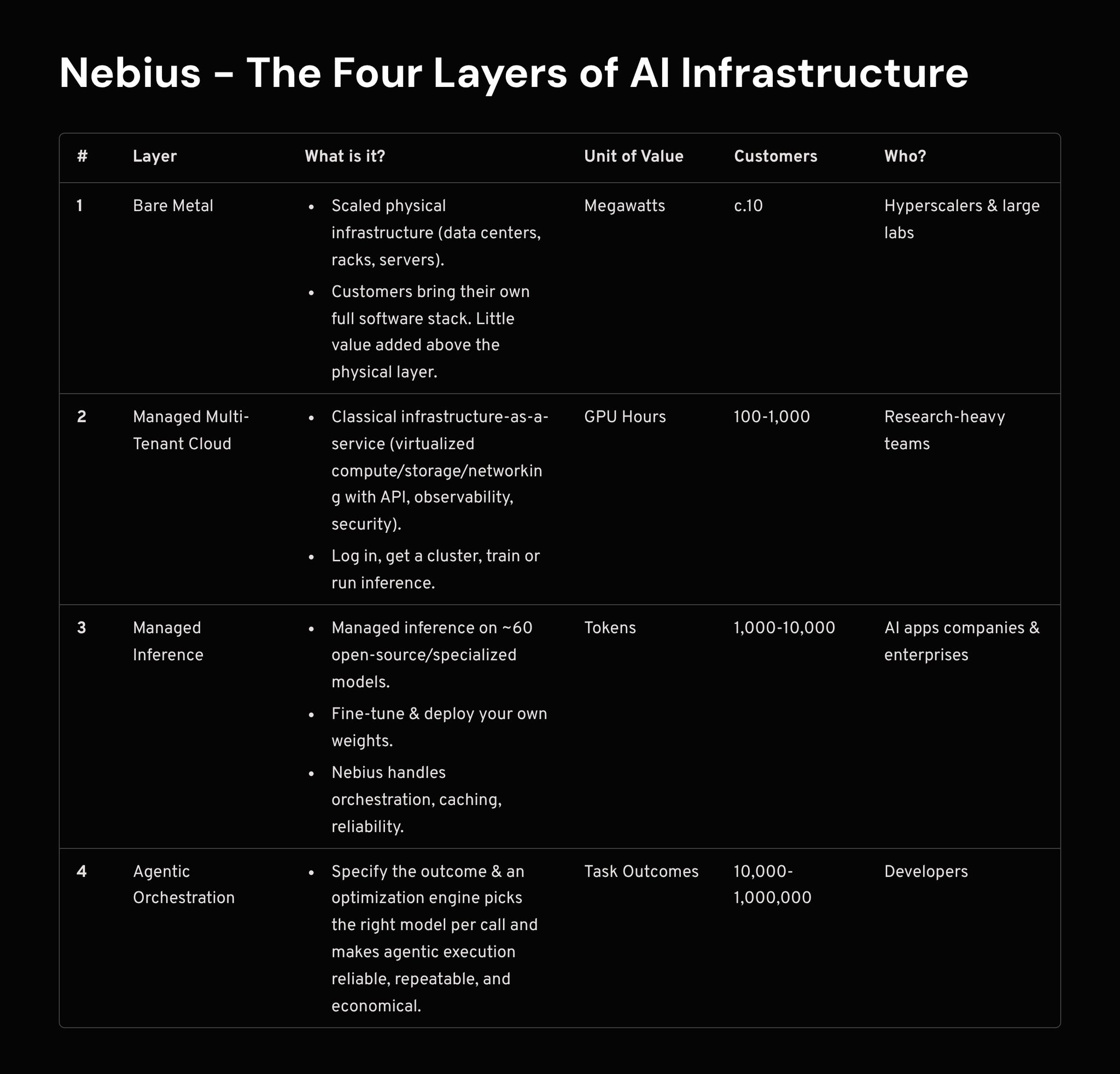
Nebius is built in four layers, each speaking a different unit and serving a wider population of customers:
Layer 1 — Bare metal / capacity (speaks in megawatts; ~dozens of customers like Meta, Microsoft, OpenAI).
Layer 2 — Managed multi-tenant cloud (speaks in GPU hours; hundreds/thousands of research-heavy teams).
Layer 3 — Managed inference / “Token Factory” (speaks in tokens; thousands of vertical-AI companies and enterprises).
Layer 4 — Agentic orchestration (speaks in end-to-end task outcomes; tens of thousands of developers — a direct competitor to OpenRouter).
Token Factory, the managed-inference layer, runs ~60 open-source models and can cut inference cost up to ~70% via distillation, smaller same-quality models, speculative decoding, and caching.
The biggest threat to Nebius is not competition but consolidation: a world of 3–5 super-empires would relegate Nebius to serving their physical layer, whereas a democratized, diversified world is exactly where companies like Nebius are most needed.
“There will be a market for the smartest models of the world, the fastest models of the world, and the in-between models — smart enough but cheap enough.”
“Nothing is commodity when it comes to real scale.”
Daniel Koss interviewed Tom Blackwell who is Chief Commercial Officer at Nebius. - Daniel Koss
Every GPU that comes online sees 4x-plus demand, so newly-built capacity is usually sold already. Where Nebius can go faster on capacity it does, because there’s no real question of whether it sells.
The hyperscaler deals are a financing instrument as much as a revenue line: a Meta contract underwrites capacity Nebius can then borrow against at credit ratings otherwise unattainable, which is how you fund the buildout efficiently rather than by loading the balance sheet.
2026 ARR splits roughly 50/50 between big long-term contracts and shorter-term capacity.
“The contracted power gets us to maybe, let’s say, 1 to 2% of the total Capex... Building out into actually constructed power... takes you to maybe 20% of the Capex. And then the remaining 80% is when you come in with the GPUs.”
Jack Altman interviewed Mike Volpi who left Index to build Hanabi Capital. - Uncapped
You can only break into venture when something macro is breaking. AI is such a wave and Hanabi must be deadly focused on being one of the most relevant AI investors.
When AI collapses the foundational assumption of software venture (software is expensive and slow to build, so amortize across many customers), every downstream assumption (GTM, fundraising, product vs. service) blows up with it.
The frontier-lab game is over. We have five winners: OpenAI, Anthropic, Google, Meta, and xAI. They spend $50–100bn a year on compute. A new lab with $2bn is an order of magnitude behind, and even a cleverer architecture gets buried by compute.
Neolabs only make sense where proprietary data exists outside the internet: Periodic Labs in healthcare generating its own experimental data, or robotics where generalization requires in-house pre-training data tied to the robot’s specific embodiment.
Durable AI applications capture the two proprietary things in any business (data and workflows). Best is to build them in verticals the labs won’t care about (e.g. construction).
Compute supply. Demand is skyrocketing (training + inference) and supply is capped. OpenAI smartly pre-bought compute giving them the lowest compute cost outside Google’s TPUs.
Selling labeled data to labs is a tough, low-barrier business. As a longtime Scale investor: every contract renewal is a dogfight (Scale, Surge, Mercor, Handshake, Turing) decided largely by lowest bid. The same will hold for robotics data sold to labs.
Shaun Maguire and Sonya Huang at Sequoia interviewed Dylan Patel who founded SemiAnalysis. - Sequoia
The biggest AI gains don’t come from faster chips. They come from co-designing the model, the kernels, and the silicon together. A 2x on the model, a 2x on the software, a 2x on the hardware compound to much more than 8x when you optimize across all three layers at once, because you can reshape each layer for the others. Nvidia does not have a moat because of its software platform CUDA but because everyone in the industry is building models and inference specifically designed for Nvidia’s chips.
Inference will end up being a bigger market than oil, many points of GDP. The compute crunch persists not because supply isn’t growing but because models expand the value of useful work faster than compute grows.
Anthropic is around Q2 net-income profitable ex-SBC (maybe incl. SBC by Q3), with per-token Opus margins north of 80% on API price, so it can rent every incremental GPU above market rate and still make money reselling tokens.
Jensen is bankrolling neo-clouds and neo-labs to engineer a multipolar world, because a world where only the hyperscalers build compute, and only OpenAI/Anthropic/Google ship models, squeezes Nvidia.
Brad Gerstner at Altimeter went on TBPN. - TBPN
Anthropic (fastest growing company in the history of capitalism, now at high gross margins and possibly free-cash-flow positive in Q2) was the fundamental driver of AI outperformance in the public market.
Across 300 enterprises Altimeter surveyed, companies actively optimizing still expect >50% AI-revenue growth over 12 months, and those planning to optimize expect ~90%. The reconciliation: we’re absurdly early: coding is barely penetrated, knowledge work almost untouched, and most global enterprises don’t use AI at all. So Anthropic and OpenAI keep growing through optimization because the penetration curve is so steep.
The SaaS bifurcation. Rather than a uniform “SaaS apocalypse,” Brad sees a split by token-flow. Snowflake, Databricks, and Clickhouse are in the token flow. Salesforce, whose front-facing solutions compete more directly with the models, faces a harder path.
Striking contrast: Nvidia is trading at ~13x earnings for ~70% growth (cheapest in a decade) versus software at ~22–23x.
Altimeter invests where it’s in or benefiting from the token flow: semiconductors, compute/data-center businesses, military modernization adjacent to AI. It avoided “inflection-stage growth” ($5–15bn companies), instead making their biggest-ever bets in OpenAI and Anthropic.
Ramp raised a $750m round at a $44bn valuation led by Iconiq, GIC and OTPP. - Ramp, Techcrunch
“For as long as we’ve sold sacks of grain, business ran on two pilars. People and Vendors. Then in the space of 24 months, it all changed. Work was no longer constrained by headcount or contracts — intelligence could do it too. And you’d pay for it by the meter with something called Tokens.”
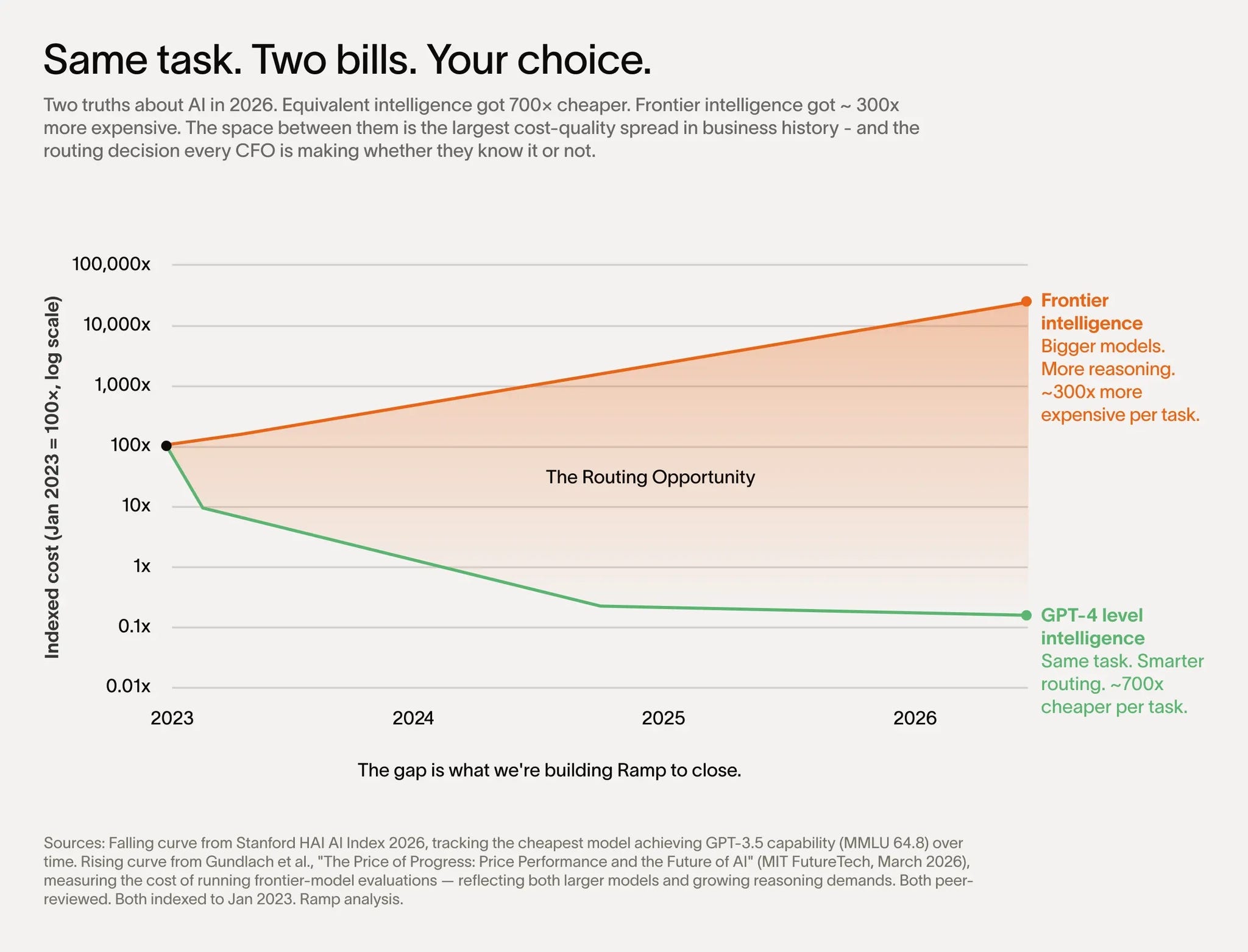
“It is better to be directionally right than precisely wrong. AI will keep getting cheaper: In 2023, matching GPT-4-level intelligence cost $60 per million tokens. Today, about 40 cents. AI will keep getting smarter: In 2023, GPT-4 solved 2 out of every 100 software bugs. Today’s leading models: 94.”
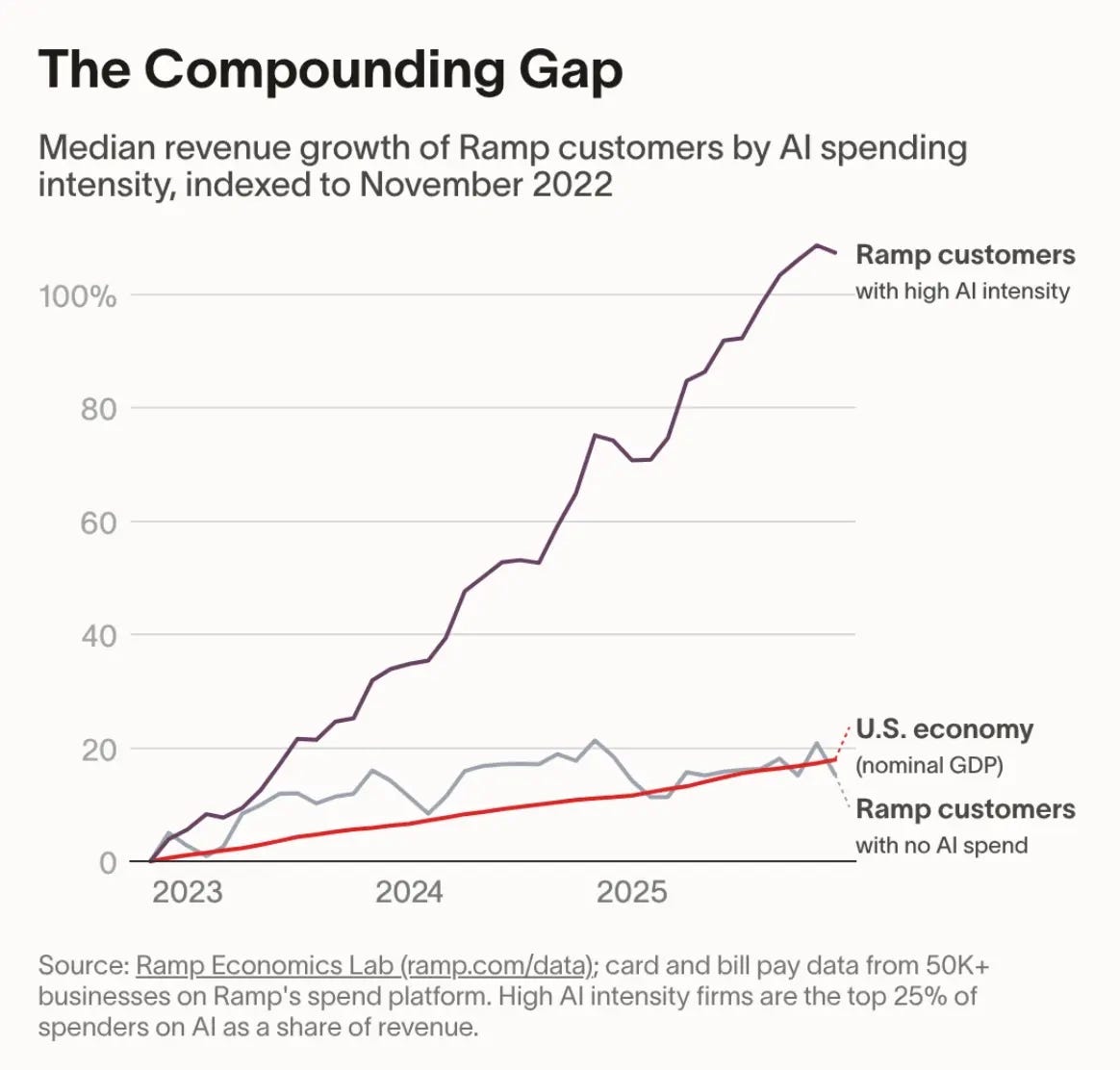
“Since 2023, the top quartile of our AI spenders doubled their revenue. The bottom quartile? Flat.”
“At Ramp, we like to say, “see it, understand it, control it”.
See it: You can’t manage what you can’t measure. So, we pull token-level usage and costs directly from Anthropic, OpenAI, Gemini, and Cursor into one dashboard.
Understand it: A token is just a unit until you know what it bought. For the first time finance can see them as dollars attributed to teams, projects, and, crucially, use cases. This is how CFOs measure ROI.
Control it: Intelligence is baked in. Running ahead of forecast? We’ll recommend which workflows could switch to a less expensive model. Cost spiked overnight? We’ll create an alert and set a limit.”
“Ramp said its annualized revenue is currently more than $1 billion, though it said it had crossed that milestone last September (Bloomberg reports its run-rate revenue is now more than $1.5 billion). The company said it has also reached positive free cash flow, and that it has over 70,000 customers (up from 50,000 last November), which include Visa, Uber, Shopify, Anduril, and Figma.”
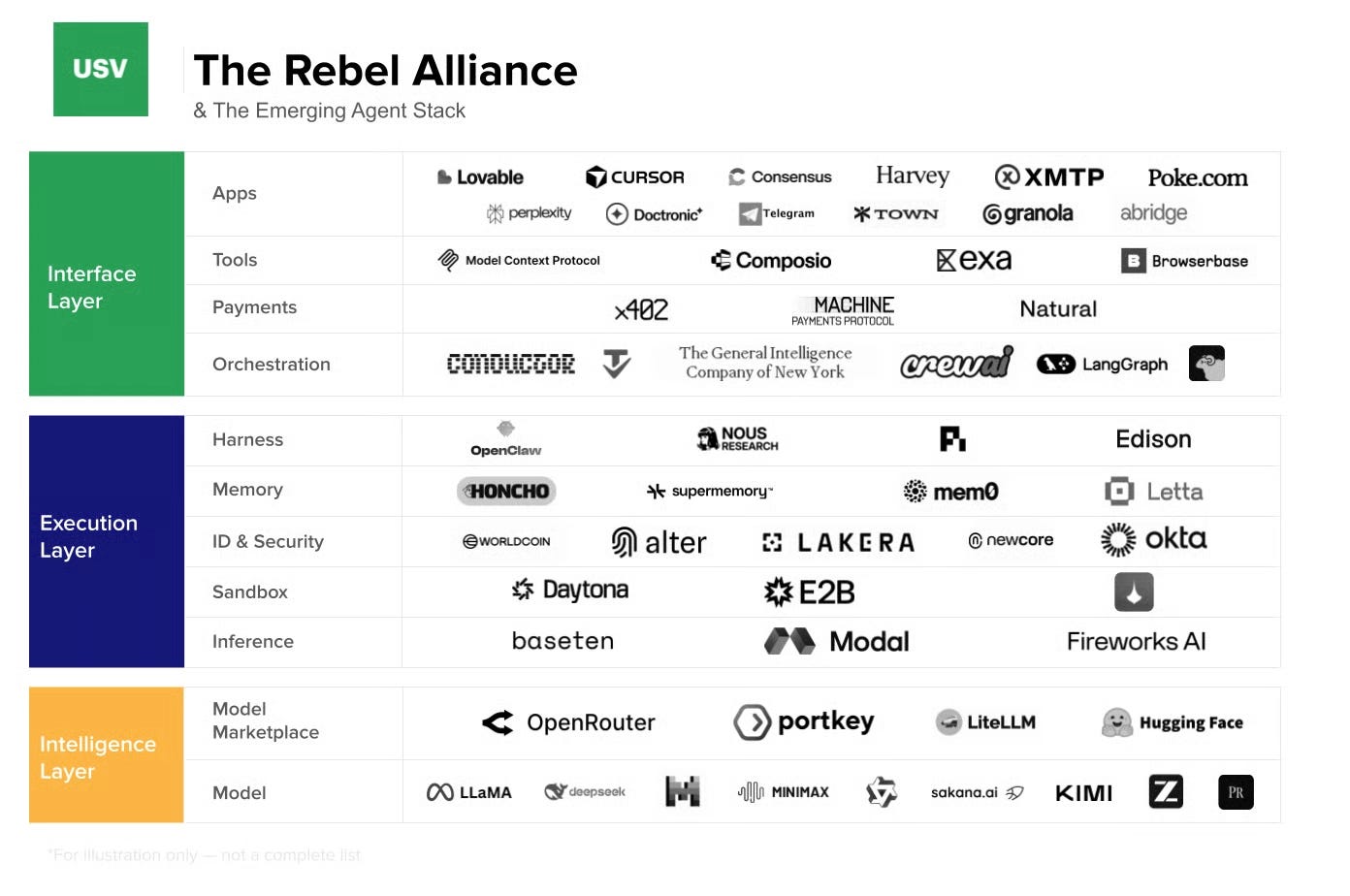
Nick Grossman at USV wrote about the rise of specialised layers in the AI stack competing with end-to-end players like Anthropic, OpenAI and Google. - USV
As AI matures from mere conversational chatbots into agentic infrastructure, its architecture is becoming fundamentally modular.
History suggests a recurring pattern: when a powerful technology emerges, it is inevitably unbundled. Just as the PC decentralized the mainframe, the next era of value will likely accrue to the specialized layers of the AI stack (memory, orchestration, and identity) rather than the models alone.
“We believe that the AI opportunity is too big and too important to be owned by any one company.”
USV is focusing on the following layers: orchestration, harnesses, memory, browser, routing & model marketplaces, identity and payments.
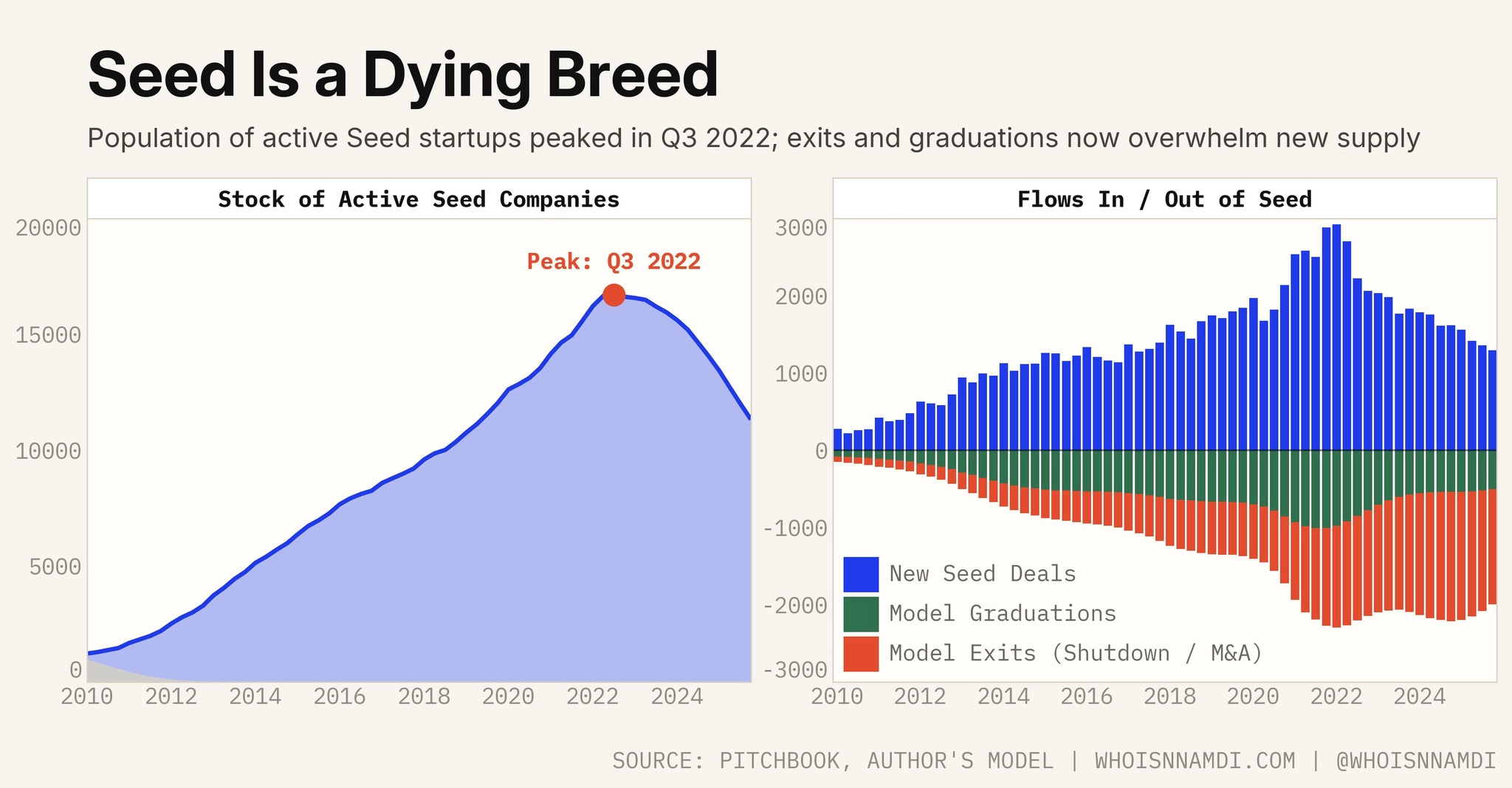
The number of active seed stage companies has been shrinking since Q3-2022. - Nnamdi Iregbulem
“The population of active Seed-stage startups is shrinking. Not necessarily the funding (in aggregate dollars or the average round size) but rather the number of active Seed companies.”
“It’s hard to believe today, but at some point in the not-too-distant past over 50% of Seed stage companies “graduated” to Series A. That’s unthinkable these days, as most recent Seed cohorts are trending well below that.”
“Seeds rose, they peaked, then they fell. The peak is roughly Q3 2022, and the live population has been in free-fall ever since.”
Enterprises are discovering that AI agents can generate enormous and unpredictable computing costs. Companies are now replacing “tokenmaxxing” with tighter controls, cheaper models, spending caps, and cost-management tools. - The Economist
“AI agents—bots that can read, interpret and act—use masses of processing power and have started to run up huge bills. As they proliferate, the problem will grow.”
“Token-heavy applications, such as reasoning models and agents, are growing more popular. In some cases agents build their own agents, sending costs higher still. Ramp, a corporate-credit-card provider, analyses its clients’ transaction data to shed light on how they use AI. It reckons their overall spending has risen 13-fold in the past year. In April Uber said that it had already spent its annual AI budget in four months.”
“Ramp reckons that the 1% of clients that spend the most on AI per employee are racking up bills of about $7,450 per person per month on average. That compares with just $11 for the median Ramp customer.”
Bain is building AI-generated replicas of software targets during its due diligence for private equity funds to assess defensibility and AI disruption risks. - FT
“Bain & Company, one of the world’s leading advisers on dealmaking, is “vibecoding” — using prompts and AI to write code — to rapidly recreate pieces of target companies’ software.”
“Bain staff have vibecoded hundreds of rough prototypes as part of the firm’s AI diligence work. What began in 2023 as the preserve of a dedicated team of software engineers is becoming a tool used by rank-and-file consultants.”
“Gene Rapoport, who leads Bain’s generative AI work for PE, said a big part of using generative coding in due diligence was forward-looking, mapping out how acquisition targets’ software products could be reshaped by AI.”
Thoma Bravo will lose its entire $5bn equity investment in Medallia after a Blackstone-led lender group takes control of the software company and injects $150m. Medallia sells chatbots to automate customer support. It’s one of the largest tech private-equity backed losses due to a combination of factors: overpaid acquisition, increasing debt prices and AI disruption. - FT
“In June 2025, Thoma wrote down its investment to virtually zero, according to people briefed on the matter. The move cut into returns of its 2021-era buyout fund, which has earned a net return of just over 6 per cent, well below private equity industry standards.”
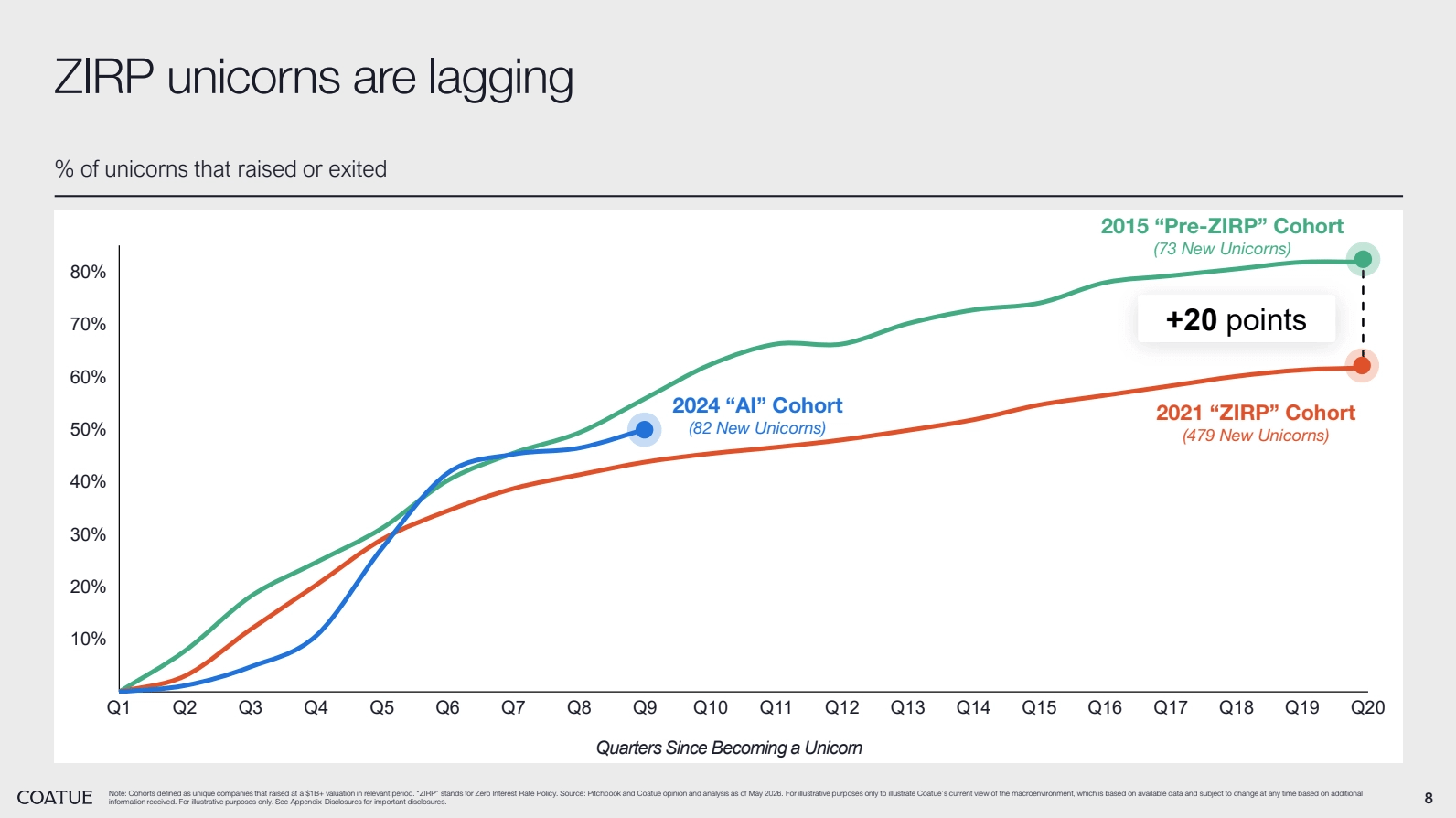
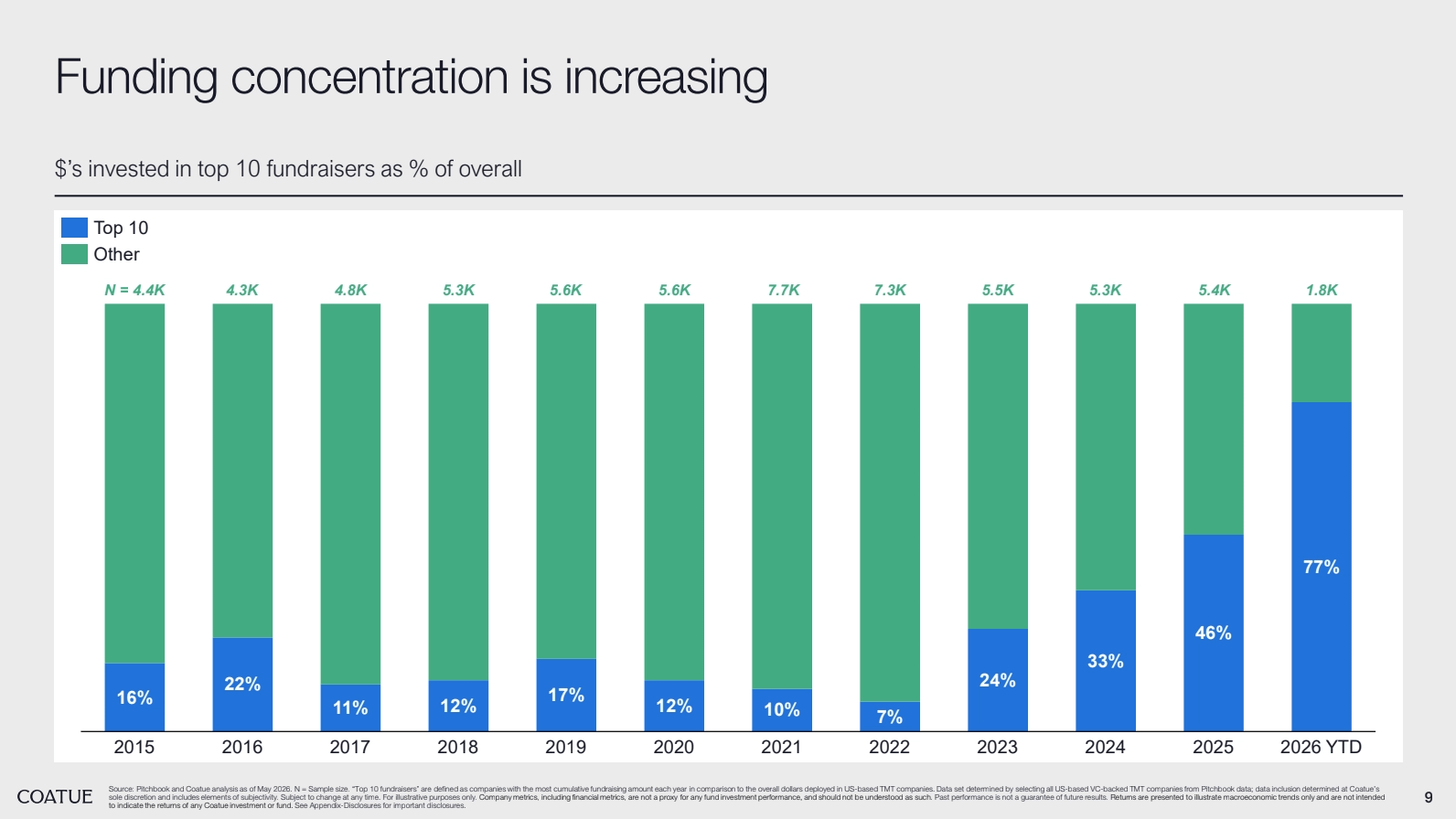
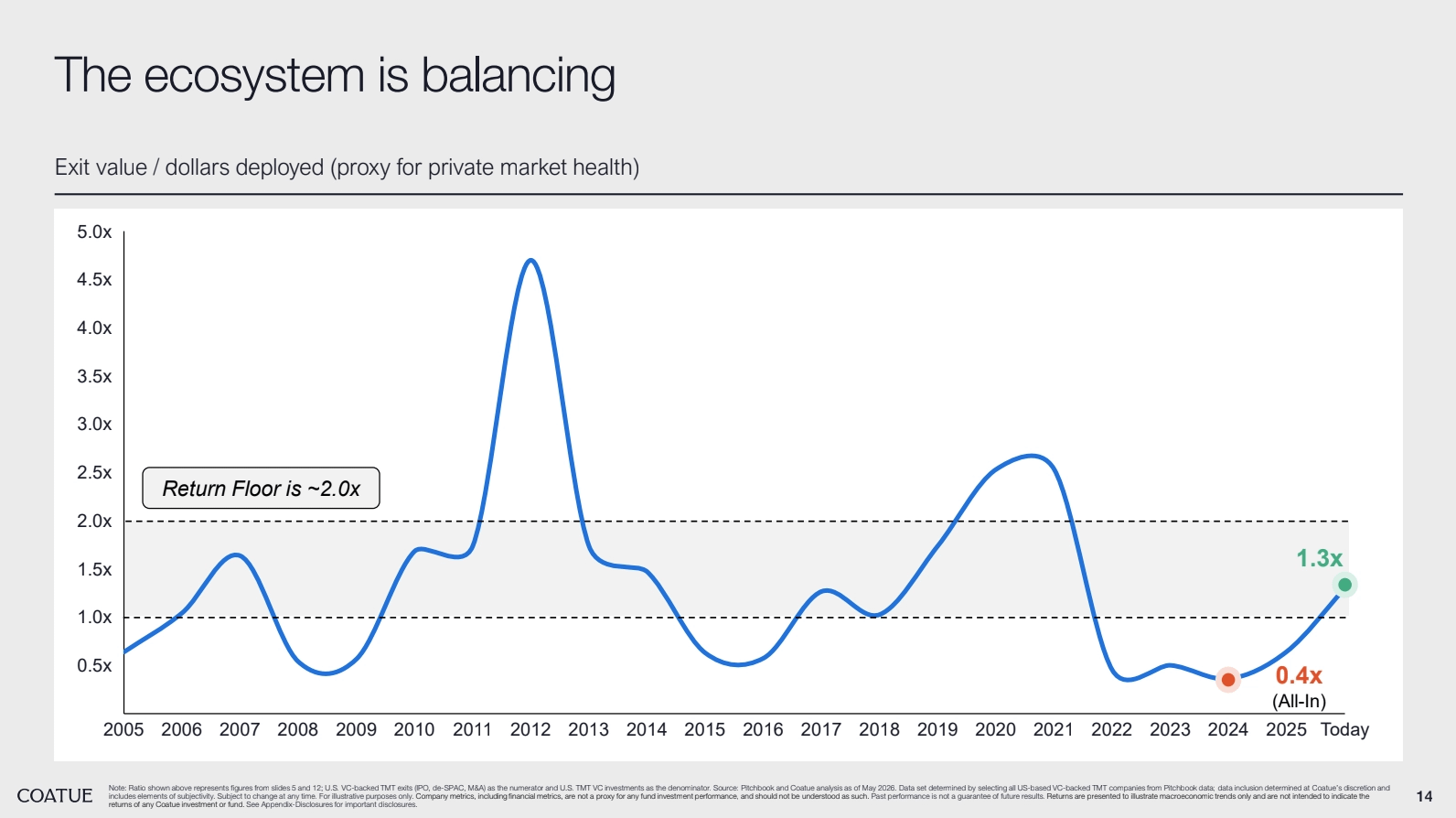
Thomas Laffont from Coatue shared a presentation on the state of the unicorn economy. - All-In-Podcast
Fewer unicorns, each raising far more, with a small number of AI names (Anthropic, OpenAI) capturing the lion’s share.
c.80% of the pre-ZIRP cohort (73 companies) had raised or exited within 20 quarters, versus under 20% of the much larger 2021 cohort (479).
There is a private “Magnificent 8” (SpaceX, Stripe, Anthropic, Databricks, OpenAI, Revolut, ByteDance, Anduril) worth c.$4tn, spanning internet, AI, fintech, and space, that has crushed the public Mag 7.
Starlink’s core business addresses a $200–400bn global telco/broadband/wireless profit pool with a structurally better product (no towers, works everywhere).
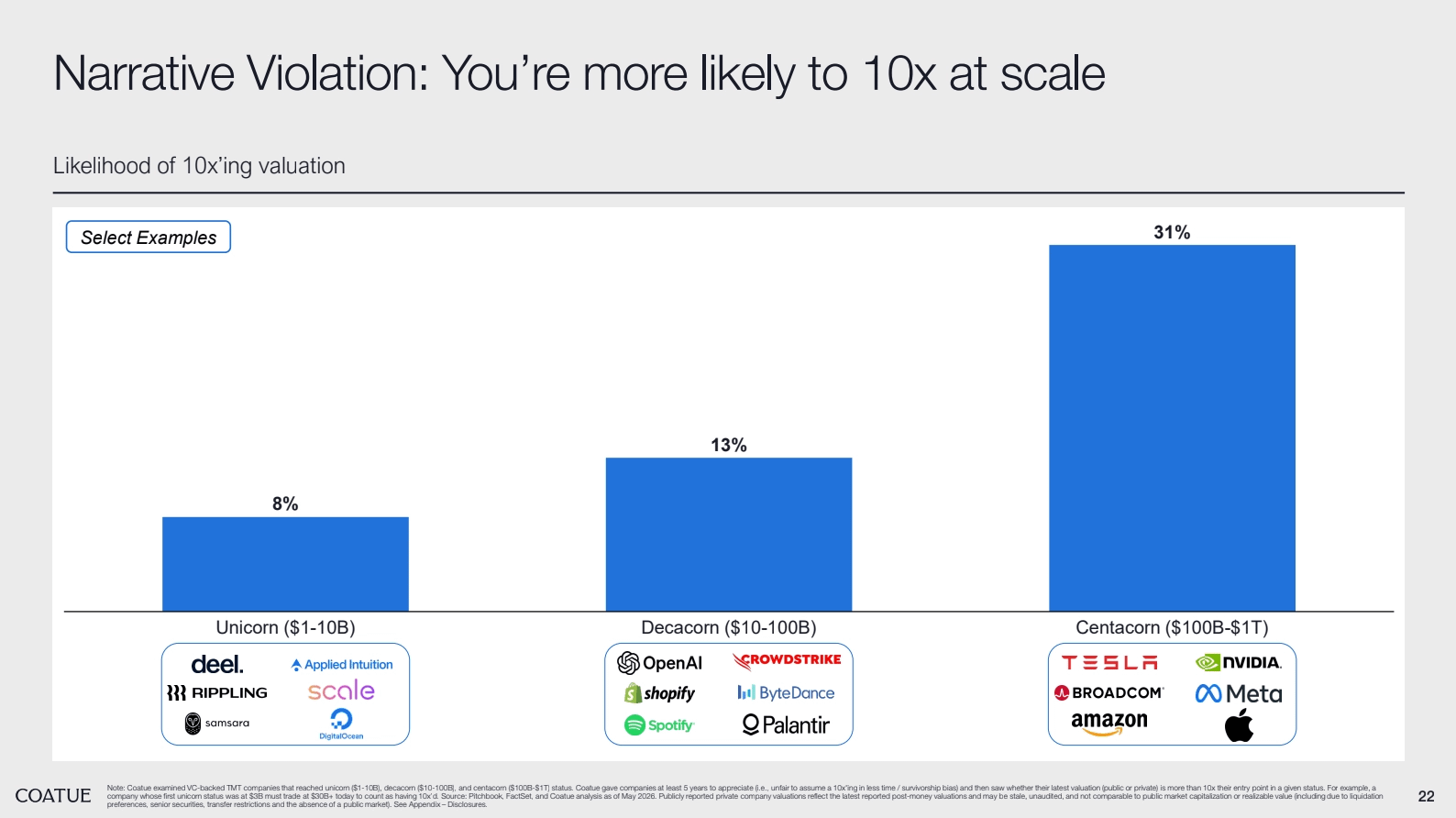
Counterintuitively, scale increases the odds of a 10x: unicorn → decacorn ~8%, decacorn → $100B ~8–13%, but a centicorn has a ~31% chance of another 10x.
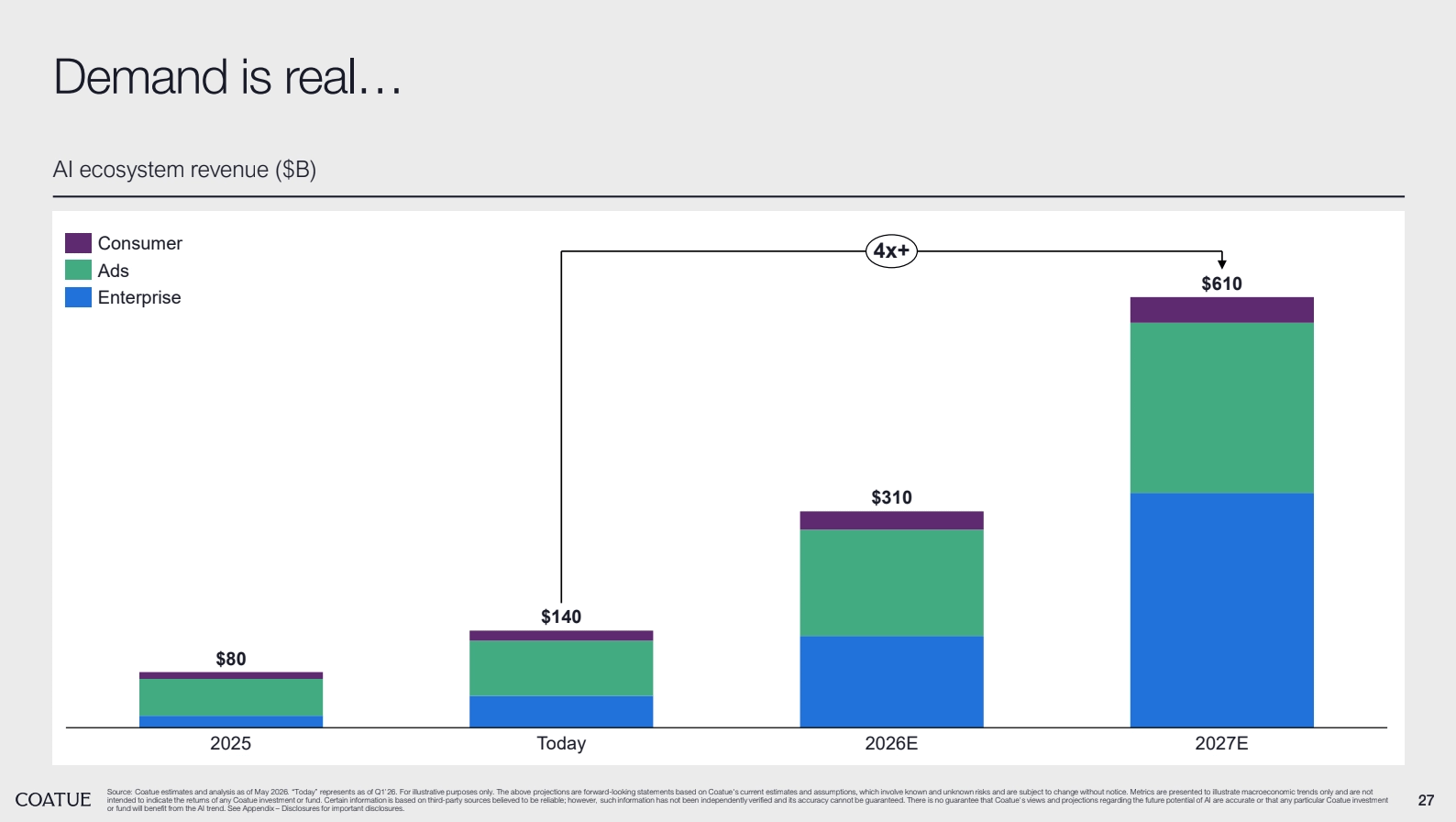
Thomas sizes the AI ecosystem at ~$140bn in revenues today, ~$300bn EoY 2026 year, doubling in 2027, across three pillars: consumer, ads and enterprise.
The Economist wrote on the growing backlash against data-centres in the US. - The Economist
“An estimated $3trn will go into AI data centres globally between 2026 and 2030. Much of that is earmarked for America. The money will expand total AI computing capacity, measured in the amount of power consumed by major data centres, from just under 12GW in America currently to as much as five times that amount by the end of the decade.”
“There is plenty to dislike: the ugliness of the buildings; the roar of generators and cooling systems; the skeleton army of new transmission towers criss-crossing the landscape; the fear of contaminated water. Surveys suggest that Americans would sooner live next to a nuclear plant than a data centre.”
“At least 20 data-centre projects worth $42bn, which would have used 3.5GW of power, were cancelled in the first three months of 2026 after local pushback.”
“Perhaps 1-2GW of America’s current data-centre capacity is dedicated to training frontier models across the major providers—Anthropic, Openai and Google—as well as those trying to keep up with them, including Meta and xAI. It follows that perhaps 10GW should be available for inference—allowing customers to use the models to ask questions, write code or perform other tasks. Yet after demand for AI tools soared in early 2026, the available “compute” proved woefully inadequate.”
“In a white paper published last year Anthropic argued that as much as 5GW would be required to train a single frontier model by 2028. According to Epoch ai, a research firm, that figure could rise to as much as 16GW by 2030.”
Oura and Whoop have both reached $10bn+ valuation but could experience a trajectory similar to Fitbit which reached a similar market cap. in the public market before being acquired for $2.1bn by Google in 2021. - WSJ
“For investors, it is tempting to bet wearable companies like Oura and Whoop have cracked the code on turning self-optimization into a durable, fast-growing business. The history of consumer health hardware suggests otherwise.”
“Both companies are growing quickly and are seeking to go public in the near future. Both have recently raised capital at private-market valuations of roughly $10 billion to $11 billion, around 10 times revenue.”
“For investors, however, the shadow of Fitbit looms large. A decade ago, the pioneering fitness-tracker maker went public and soared to a market capitalization near $10 billion, eerily close to where Oura and Whoop now sit. Growth eventually stalled as single-purpose trackers were eclipsed by all-in-one smartwatches like the Apple Watch. In 2021, Fitbit was acquired by Google for about $2.1 billion, less than two times revenue.”
“Oura and Whoop do have advantages. Rather than selling mass-market step counters, they market premium products that synthesize biometrics like heart rate variability and skin temperature into actionable outputs: early illness warnings, recovery scores and training recommendations. Both benefit from sticky subscription revenue and, notably, lack screens.”
“The pattern is familiar: A company rides a genuine cultural trend, gets valued on growth rather than steady-state profitability, and eventually runs into a ceiling.”
“The biggest issue is the growth ceiling. Smart rings are one of the few wearable categories still expanding, but the adoption curve could weaken sooner than an $11 billion valuation implies.”
Cycling star Tadej Pogacar earns €12m+ per year but lacks the blue-chip sponsors of peers in other sports (e.g. Alcaraz or Verstappen) for several reasons: cycling is a niche sports, TV exposure is limited, cycling teams have strict exclusivity rules, cycling agents are not good at bringing non cycling brands as sponsors. - The Athletic
“Instead, alongside a few cycling brands, he was promoting a Croatian bottled-water company as recently as last year, and at the start of the 2026 season became an ambassador for KuCoin, a cryptocurrency. With the exception of Richard Mille — the world’s sixth-biggest watch brand by revenue — Pogačar isn’t achieving the sort of private sponsorship deals other leading athletes are.”
“Pogačar has five private sponsors: DMT, a cycling shoe brand; Richard Mille, which sponsors fellow rider Mathieu van der Poel; the ‘I feel Slovenia’ tourism board; KuCoin; and Continental tyres.”
“The reason there are no more than five is because each sponsor “wants Tadej for two days a year, and our priority is that Tadej trains, recovers and stays with his family,” Carera says. “Maximum 10 days for sponsors, no more, is the agreement with his team.” That is standard protocol at other WorldTour cycling outfits, too.”
“There’s one very important rule in cycling — you cannot be sponsored by a company that is in competition with the team’s sponsors.”
“To date, everything Pogačar has earned from additional sponsors has not found its way to his bank account: five to 10 percent is given to Carera’s agency in commission, and the rest is sent to the Tadej Pogačar Foundation and the eponymous junior Pogi Team in Slovenia, as well as the Pika Team that focuses on the development of young female riders.”
“Outside the three to four weeks of the Tour de France, there aren’t a great number of eyeballs on the sport.”
Semianalysis wrote on Unitree which manufactures affordable humanoid and quadruped robots. - Semianalysis
“We are witnessing the birth of another Chinese hardware giant. Three years ago, Unitree was a quadruped company. By last year, they parlayed quadruped dominance into creating and leading the humanoid market. This year, their G1 humanoids are finally entering into viable deployments, and three new designs are on the way, including their most-direct Western humanoid competitor.”
“While it and other Western players are now producing early humanoids that remain works in progress, we hear Unitree may ship its 10,000th in the coming weeks.”
“Now, Unitree is tripling revenues YoY on 60% gross margin product lines, planning almost $300M of AI R&D spend, increasingly in-housing portions of manufacturing, all while pricing the cheapest humanoids on the market by far.”
“We believe Unitree’s cost structure is one of its greatest advantages over competitors. Unitree has slashed pre-tax pricing from $50K+ to $27.3K over the past 12-18 months. Even at that price, we estimate they still hit 67% gross margins on their flagship G1. With their BoM set to plummet as manufacturing scales, we’ve already heard pricing well under $20K in some deals.”
“Despite countless dismissive comments against the company, we argue their G1 humanoids are crossing the viability threshold of real-world deployments.”
“We present the history of Unitree mimicking the BYD and DJI strategy, by generating their own ecosystem, spawning new markets, and then eating said markets. This strategy is in process as we speak. New markets on the horizon means that Unitree’s explosive growth should continue.”
“Notably, Unitree has made it this far on the back of the small hobbyist/researcher market. Should Unitree unlock viable deployments and hit critical mass, they may accelerate at unreal speed.”
Businesses are starting to use prediction markets to hedge their business risks. - NYT
“Small businesses, including a New York City beer bar and a specialist sports insurer, have already used Kalshi for hedging their business risks.”
“Kalshi has already become the biggest prediction market in the United States, processing $17.9 billion in trading volume last month, largely from individual bettors.”
“Building up a way for companies to hedge their risks, a vital business operation normally done in the huge, if usually opaque, global derivatives markets.”
“Ahead of Game 1 of the N.B.A. finals this month, the Jeffrey, a New York City bar, said it would comp many of its customers’ tabs that evening if the Knicks won. As a hedge, it bet $5,000 on a Knicks victory, which netted the bar just under $8,000, helping pay for $9,500 worth of patrons’ tabs that evening.”
“This year, Game Point Capital, an insurance company that helps college athletics departments, sports teams and sponsors manage the financial risks of performance incentives in athletes’ and coaches’ contracts, began hedging through Kalshi as well.”
“Perps essentially allow bettors to track whether the price of something goes up or down, with no expiration date. Kalshi has also allowed perps to be traded on margin, while setting up safeguards like restricting them only to deep-pocketed traders. Since perps were unveiled on May 29, trading in those contracts has reached $5.5 billion in notional volume, Mr. Mansour said on Tuesday. For now, Kalshi is offering only perps tied to cryptocurrencies. But the company expects to announce more such contracts tied to a much wider array of assets.”
Thanks to Julia for the feedback! 🦒 Thanks for reading! See you next week for another issue! 👋
No posts
Comments
Nothing yet. Say the first thing.
Sign in to join the conversation.