
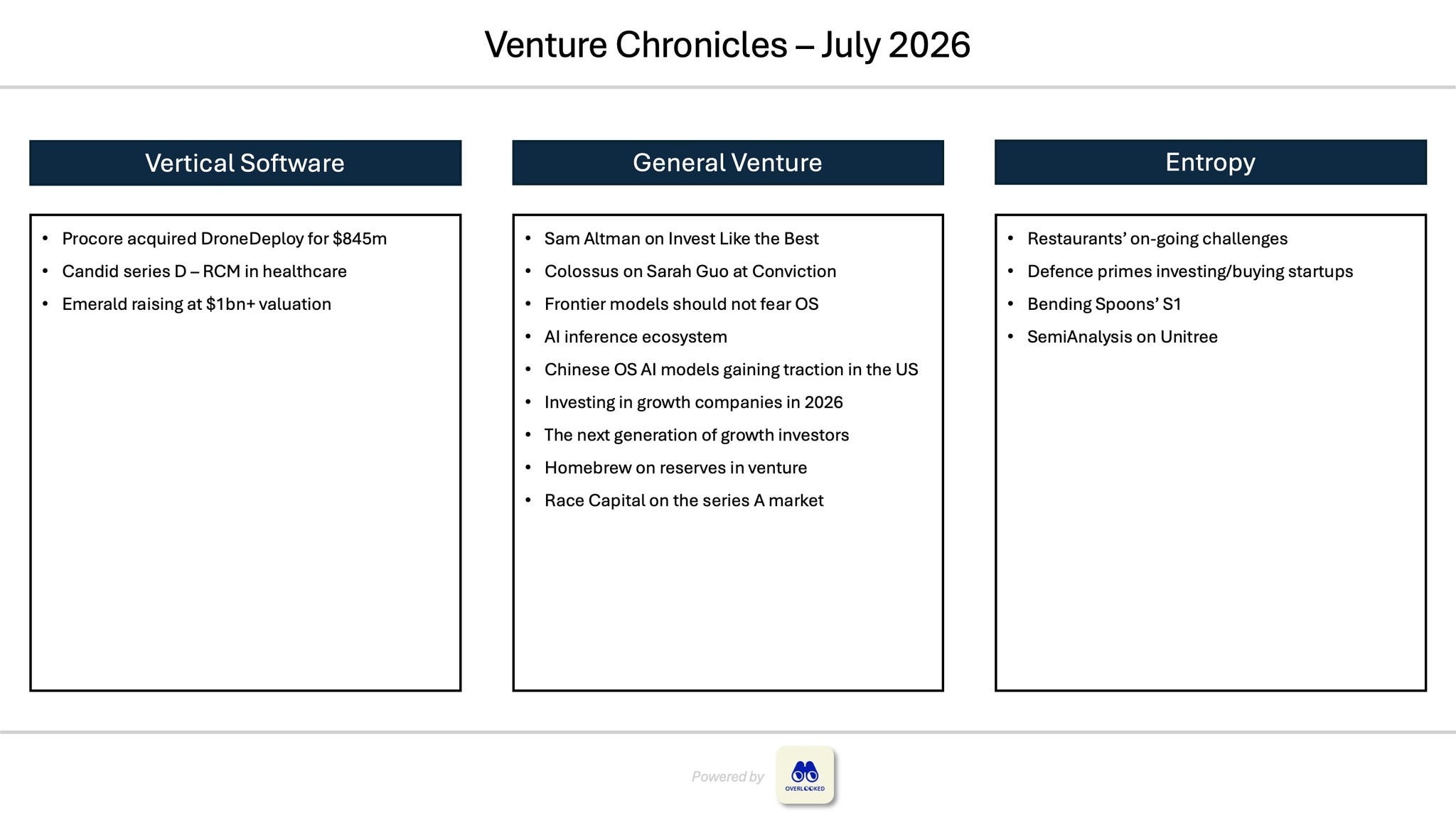
Hi, it’s Alex from 20VC. I’m investing in seed & series A European vertical solutions (vSol) which are industry specific solutions aiming to become industry OS and combining dynamics from SaaS, marketplaces and fintechs. Overlooked is a weekly newsletter about venture capital and vSol. Today, I’m sharing the most insightful tech news of July.
I curated updates and insights around three themes:
Vertical Software
General Venture Capital
Entropy - other news and personal topics of interest
Procore acquired DroneDeploy for $845m in cash. - FT, Emergence
DroneDeploy provides software for capturing and analysing physical-site data using drones, ground robots, 360-degree cameras, fixed cameras and mobile devices. It has been used across 3m+ sites in 180+ countries.
The acquisition enables Procore to compare plans, drawings and schedules with continuously captured visual evidence from the field. DroneDeploy will act as perception layer for Procore’s AI products.
“DroneDeploy delivers the visual intelligence that bridges the built world—from active construction sites to operational assets—and the digital world, providing critical, real-time visibility into daily operations.”
“By pairing DroneDeploy’s technology with Procore, manual jobsite inspections and observations will be replaced by multi-modal perception capabilities. A range of cameras, drones, and robots will regularly evaluate the construction site and automatically initiate appropriate responses securely, compliantly, and in context. Amid the acute labor shortage in the construction industry, this practical automation helps support overscheduled field teams.”
Candid raised a $120m series D led by Sixth Street to reinvent revenue cycle management with AI agents running billing operations for doctors in the US. - Fortune
Candid reported 190% YoY growth in contracted ARR and 180% NDR during 2025. It now serves more than 200 healthcare organisations.
“Candid runs the billing operation for doctors so they don’t have to. Every insurer has its own rulebook for how a claim must be filled out, and most providers still rely on billing software built in the early 2000s to navigate over 1,000 different insurers’ rules. When something’s off (like a misplaced comma or wrong code), the claim gets kicked back, and either the patient or the doctor eats the cost. Candid replaces that process with AI agents and a rules engine trained on the submission quirks of more than 1,000 payers, so claims go out correctly the first time.”
“Proctor frames Candid’s mission as shrinking the billing industry itself, stripping out the manual, offshore labor that props up older vendors and keeping those savings for the business instead.”
Emerald AI is raising $100m at a $1bn+ valuation. It’s a data-center-flexibility software. It sits between the power grid and the data center to orchestrate AI workloads in real time. The vision is that grid-flexible AI data-centers can unlock c.100GW of latent grid capacity and jump the interconnection queue, since utilities can approve flexible loads faster than firm ones. - Fortune, Axios
Sam Altman recorded a podcast on Invest Like the Best. - Invest Like the Best
OpenAI’s core business is: (1) train great models (coding, knowledge work, science), (2) produce or partner on chips & racks, (3) secure land/power/data-center shells. The plan isn’t to build every vertical application that could run on top of these models.
Backlash on data-centers is not justified. Bottlenecks are being solved one by one. Water is solved by moving from evaporative to closed-loop cooling. A modern data center uses about as much water as an office building’s kitchens and bathrooms. Energy is next, moving to solar and nuclear.
OpenAI wants to be the best option at every point on the Pareto frontier of intelligence versus price, and that includes open source.
To advance its models, OpenAI is balancing three bottlenecks whose relative importance changes over time: research ideas, compute, and data.
OpenAI stands against concentration of power in AI. “I am terrified of a world where the very real fears of AI are used as a way to say only this small group of people can have it.”
Colossus wrote a portrait of Sarah Guo who cofounded Conviction. - Colossus
“Until 2022 she had been the youngest general partner in the history of Greylock Partners, one of the oldest venture firms in Silicon Valley. Then she left to start her own fund, duly named Conviction. She built it on a lone premise, that artificial intelligence would be as big as the Industrial Revolution.”
“Before ChatGPT came out, before the world had reason to believe that artificial intelligence was about to become anything in particular, Guo had written seed checks into Baseten and Harvey. Each company is now valued at more than $11 billion. Her investments in them have multiplied more than a hundredfold. In Conviction’s first year, she wrote early checks into Sierra, Cognition, and Mistral; those three companies are now worth, together, $54 billion. Of the 21 AI-native companies that have so far crossed $10 billion in valuation on revenue run rates above $100 million, Conviction has backed six.”
“The first fund was $100 million. There are three now, nearly a billion dollars in all, and some of the checks go into companies well past the idea stage. But the labs were already too big by the time the firm launched.”
“The future I want is not a single company with an all-powerful model that consumes society faster than we know what to do with.”
The panic over Kimi K3 and Chinese open-weights models misreads the economics: AI’s return of real marginal costs favors the frontier labs. - Stratecherry
Open weights aren’t free to run. R&D is a fixed cost you pay once, but inference is cost of goods that scales with revenue, so serving Kimi still burns money on every query.
A token from one model isn’t a token from another. Reasoning and agents make models spend wildly different token counts to reach the same answer, so Kimi’s lower per-token price means little if it needs far more of them. What’s fungible is the intelligence, not the tokens.
Commodity markets reward the lowest-cost supplier, and that’s Anthropic and OpenAI. They serve frontier capability months ahead of anyone else and use their best models to cut their own serving costs, so the non-frontier market is just the frontier a few months later.
Today’s high prices come from a compute shortage, not from Chinese models being cheaper to serve. Once supply catches up, the frontier labs can make it back on volume instead of defending fat inference margins.
China is commoditizing its complements. Xi’s open-weights push ties AI to China’s lead in robotics and the physical world, so the US answer should be to make training count as fair use, bar terms of service that block distillation, and loosen the Fable and Sol cyber restrictions that now force defenders onto Chinese models.
“Running inference on a model — whether that model be Kimi or Fable — costs money, and the amount of money an AI provider spends on inference is, at least in most business models, directly correlated to revenue.”
“Reasoning entails an explosion in chain-of-thought tokens, and different models need different amounts of reasoning tokens to arrive at the right answer. Kimi, for example, reportedly uses significantly more tokens than Sol [OpenAI’s frontier model], rendering its price advantage moot. Agents introduce a similar dynamic: some models are more efficient than others in terms of the number of tokens they need to execute agentic workflows.”
“Anthropic and OpenAI likely have among the lowest costs per unit of frontier-quality intelligence, thanks to model capability, serving scale, and token efficiency.”
“In the long run, however, whoever is on the frontier is the best placed to dominate non-frontier markets as well, which are just the frontier minus n-months, i.e. months in which the frontier model makers have been optimizing their cost of serving.”
“I highly doubt that Chinese models are cheaper to serve on a marginal cost basis, they just seem cheaper because Anthropic and OpenAI are so supply constrained that they are charging far more than they would if there were sufficient supply to meet the demand for intelligence.”
“Open weight models are good for innovation (and, per the above, I think that labs on the frontier will be fine), but it’s a problem to be dependent on China. The U.S. should pass a law that (1) makes explicit that collecting data for training models is fair use, and (2) bars terms of service that forbid distillation, for U.S. companies at a minimum.”
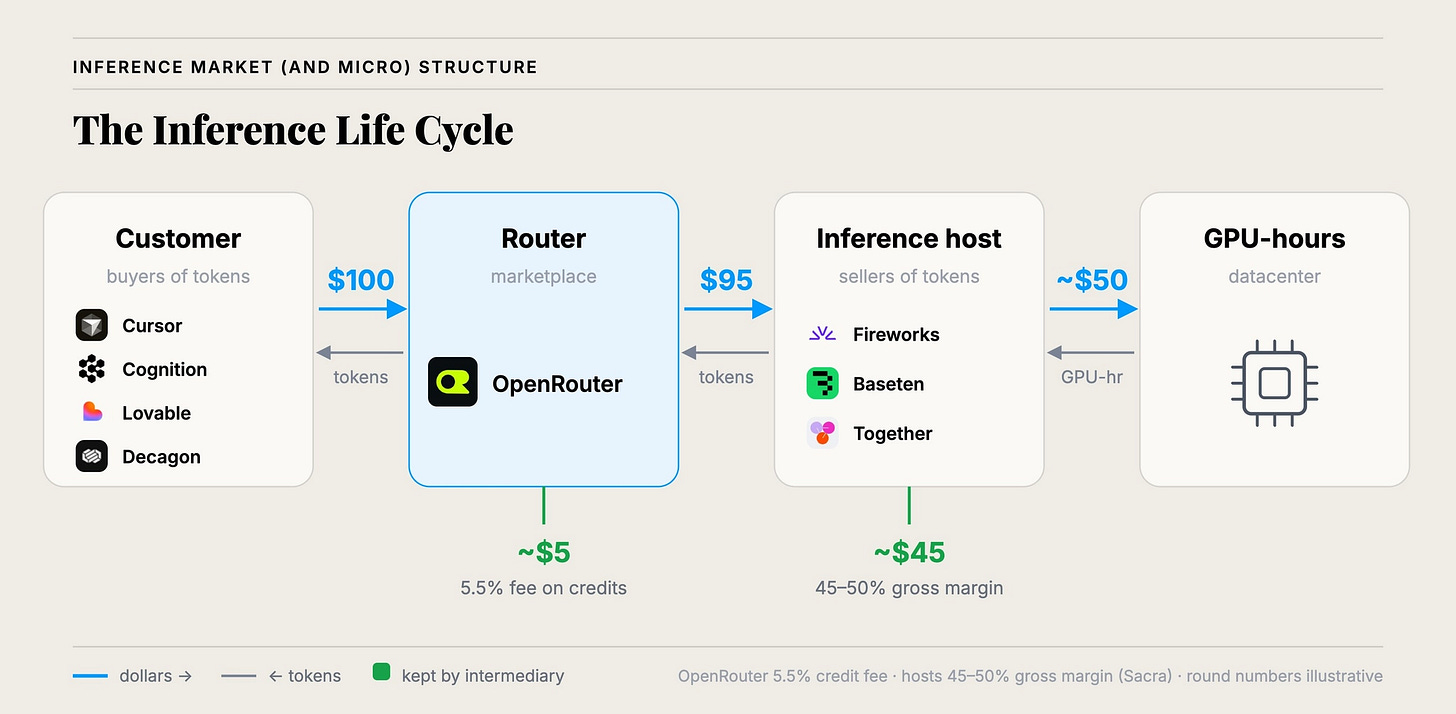
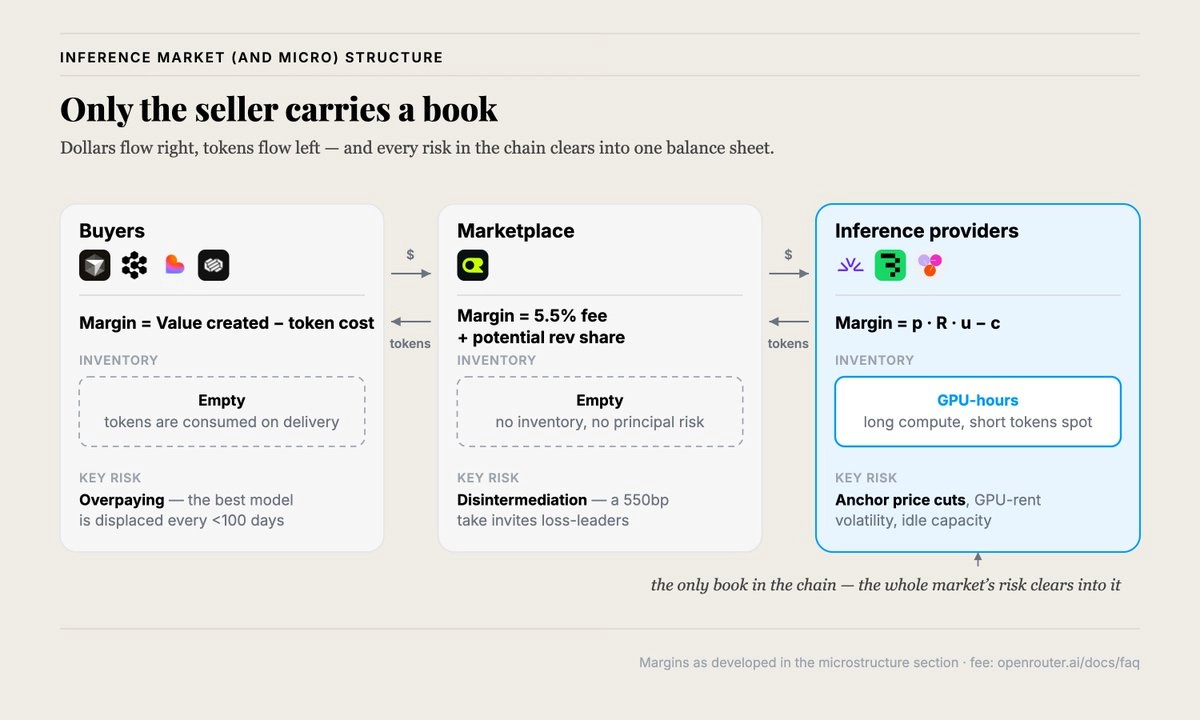
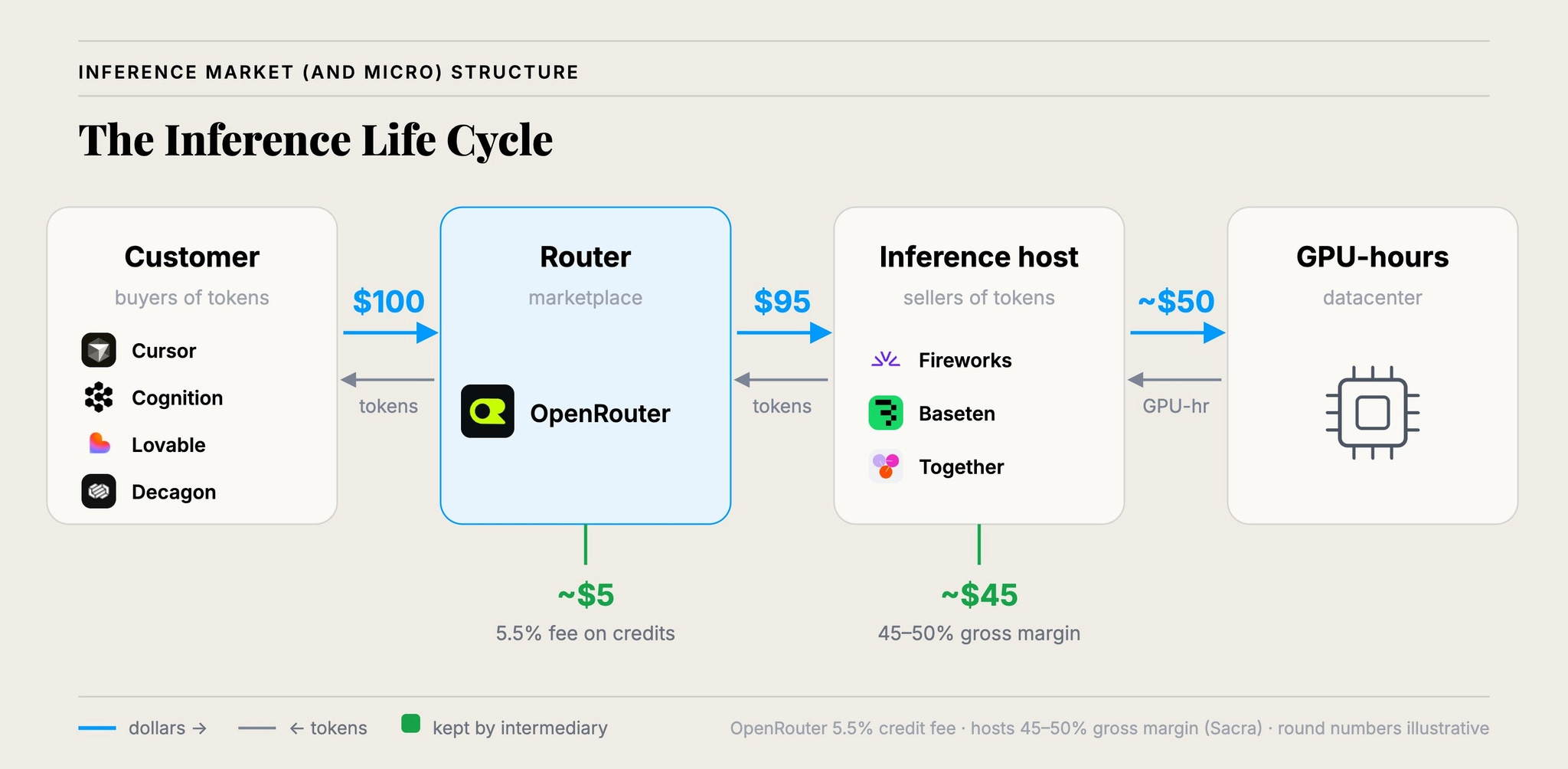
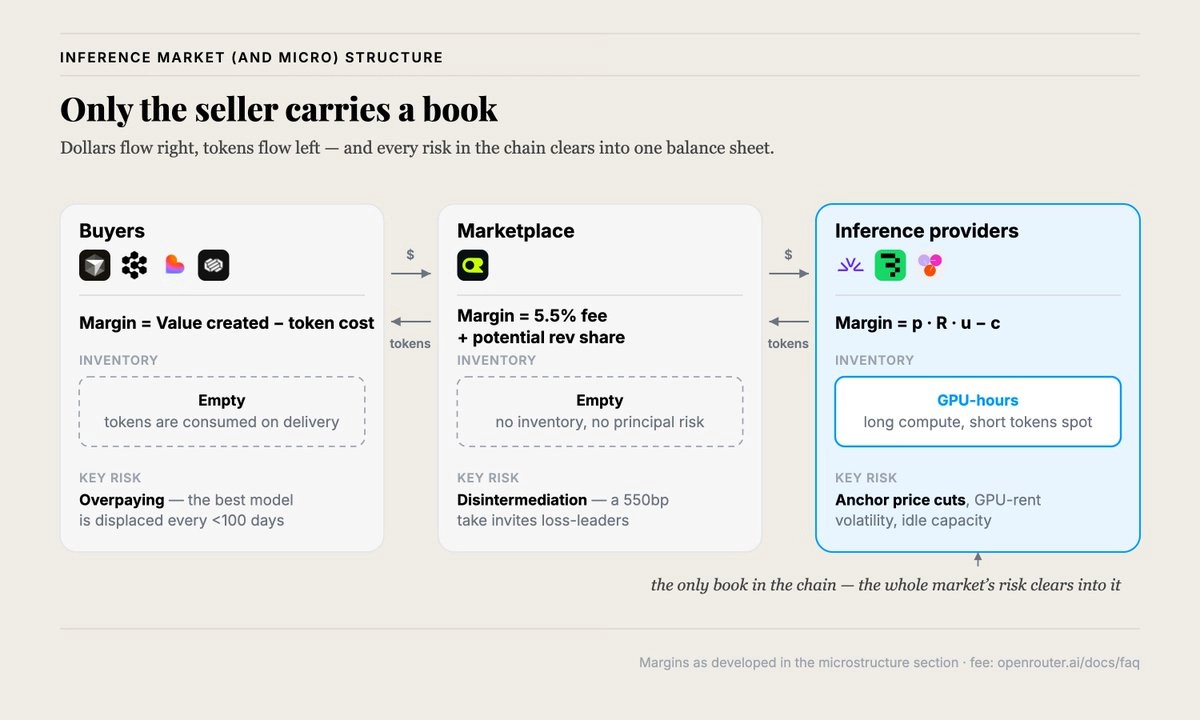
Inference has matured into a trading-like ecosystem with buyers, sellers (inference providers), and marketplaces (e.g. OpenRouter) connecting the supply and demand for token compute. Inference provider margins are earned by efficiently managing the underlying GPU-hour cost, utilizing techniques like quantization and speculative decoding to boost yield. - Vikram Singh
“Intelligence is commoditizing through open-source models. Open source models are almost at parity with the frontier and usage is up 350× since January 2025. Since serving inference for open-source models is permissionless, a competitive market for inference is emerging.”
“The inference “market structure” is somewhat like a trading venue. There are buyers of tokens (Cursor, Lovable, enterprises), a marketplace (OpenRouter), and sellers of tokens (Fireworks, Baseten, Together AI) quoting a one-sided order book on a model’s tokens.”
“Inference providers are like market makers: they quote continuously, hold inventory in the form of compute, earn a spread, and vie for token flow. The marketplace is like an exchange: OpenRouter earns a “matching” fee (5.5% take rate) with potentially room to charge the “market makers” for token flow PFOF.”
“Open source models are catching up to the best frontier lab models within months vs years. This changes frontier labs economics substantially since they only have 4 months to amortize training capex before spend migrates towards open source models.”
“Jevons’ Paradox is playing out in real time. Cost savings achieved by switching from frontier models to open-source models are being reinvested into more token spend. Thus, token consumption compounds even if budgets stay flat.”
“These are your sellers of tokens (Fireworks, Baseten, Together AI, and so forth). They burn GPU-hours to produce tokens and quote their token prices on the marketplace. Inference providers can differ on several price-based and performance-based axes.”
“OpenRouter offers model aggregation (sign up for one account, use 400+ models), easier billing, failover guarantees, good UI/UX, and most recently it introduced intelligent model selection through openrouter/auto (similar to the model router Coinbase built internally). One of the core premise of using OpenRouter is because as a user you get all capacity available. Fallback is a big value proposition. Even if an app or company builds internal routing or aggregation themselves, providers would prioritize flow from OpenRouter.”
“Some open source labs work closely with inference clouds and let them access model weights pre-open launch in exchange for 15-30% of lifetime serverless revenue from that model.”
The cost of compute (GPU-hours) experiences extreme spot market volatility, necessitating financial instruments like futures contracts for providers to manage risk.
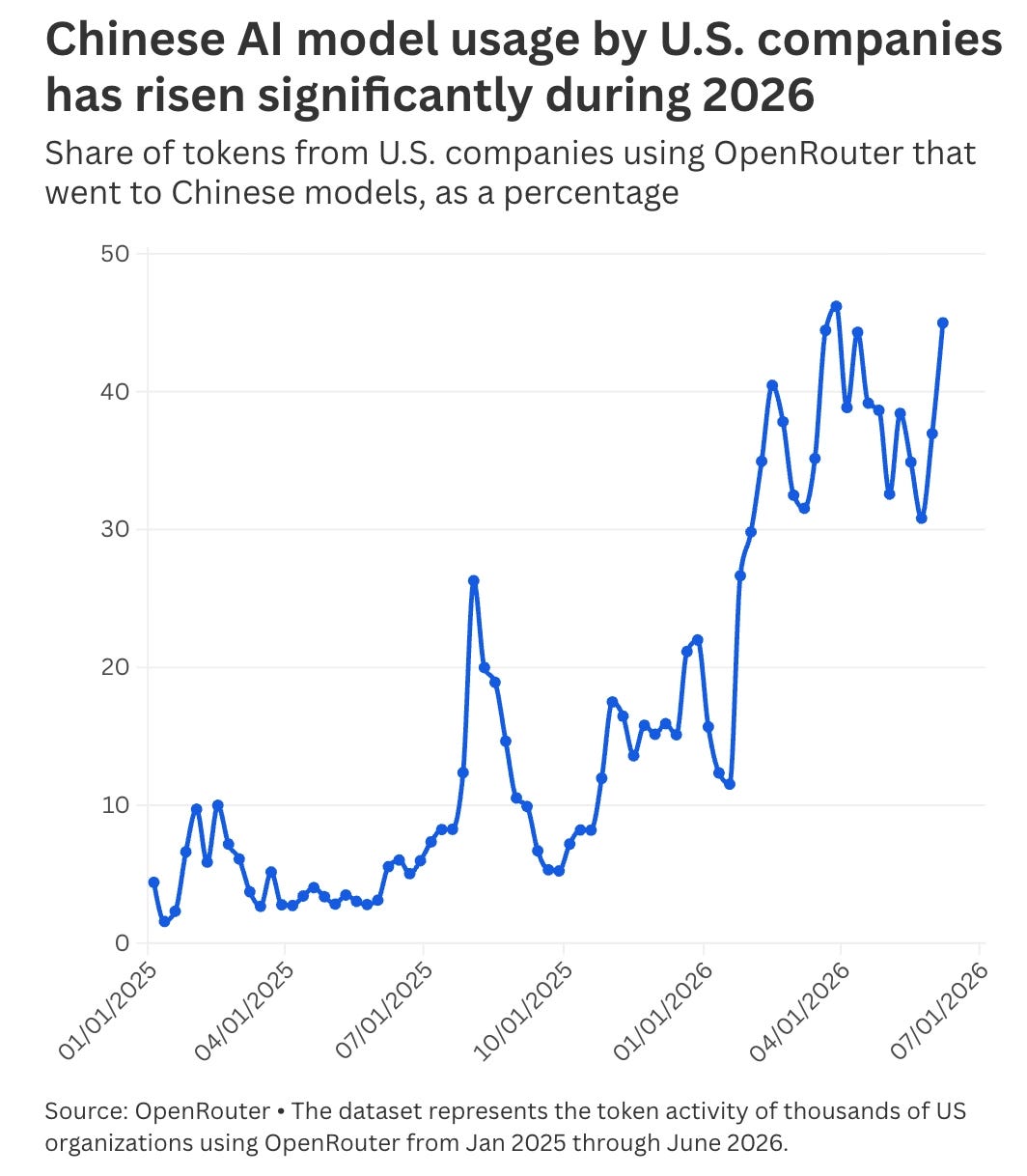
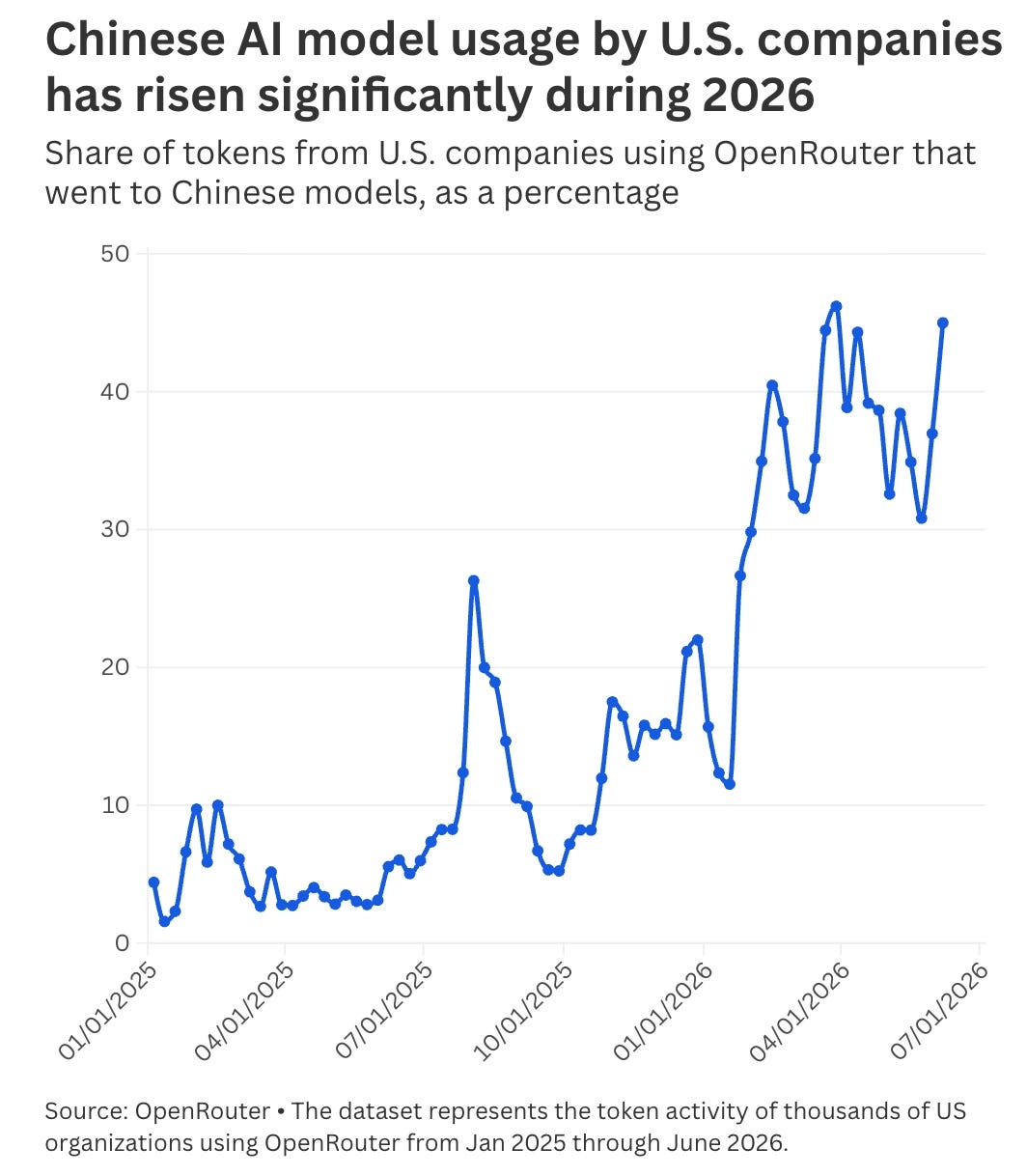
Chinese AI models (DeepSeek, Z.ai) are rapidly gaining traction among US companies as they narrow the performance gap with American rivals. By offering high-quality capabilities at 60% to 90% lower costs, they provide a cost-conscious alternative for businesses balancing technical requirements with shrinking operational budgets. - CNBC
“The share of tokens used by U.S. companies on Chinese AI models via OpenRouter — a platform that enables developers to access a range of AI models — has sat above 30% each week since Feb. 8, with that figure rising as high at 46%. The average across the previous 12 months was just 11%, falling to 4.5% in the first half of 2025.”
“The rise of Chinese open source and open weight models comes as the U.S. administration increasingly looks to regulate its most powerful AI models and considers how to halt the rapid adoption of alternatives from overseas.”
“There is a real risk that users get stuck having to choose between performant but expensive US proprietary models whose price and accessibility can quickly fluctuate, or using Chinese models as the only feasible alternative whenever they want to control costs or own their AI stack.”
In fast-changing AI markets, terminal structures and moats are unknowable, so traditional growth investing frameworks cause paralysis. Instead, you should back companies with “Outlier Components”: top-0.1% growth, hard-to-penetrate customer access, or extraordinary teams. - Arsham Memarzadeh
“If a company has at least one Outlier Component, engage seriously. If a company has two or more, lean in. Outlier components are defined as:
(1) Outlier growth: They are in the top 0.1% growth of their cohort.
(2) Outlier customer access: There is a captive or hard-to-penetrate set of relationships.
(3) Outlier team: Not just a “great” or “persuasive” team. Not even a “technical prodigy” - there are plenty of those in Silicon Valley. The filter is: have they accomplished something that puts them in the top 0.1% of the industry?”
“The outlier framework can at times be in opposition to traditional growth technology investing, in which one filters for tailwinds, poignant value props, and top-quartile metrics. In today’s markets, a company could score well on each of those dimensions yet lack an Outlier Component, and thus never break out.”
“One component missing from the above is “outlier technical moat”, largely because that is increasingly hard to come by these days. Short of SpaceX, Waymo, and Tesla, outlier technical moats are hard to find in early growth investing.”
WSJ wrote about the new generation of growth tech investors who are building new investing playbooks: going all-in on AI, extreme concentration, high valuation, passive investing in private companies, etc. - WSJ
“What many of the new winners have in common: they’ve embraced a new model of investing. Today, high-growth companies remain private for much longer—often well over a decade—locking the public out of key, wealth-creation phases of their growth. Many of these investors are investing patiently in private companies and writing check after check, helping the companies scale and establish an edge over rivals.”
“Today’s venture-capital investments often resemble IPOs, says Michael Moritz, who co-ran Sequoia Capital for 16 years, with investors buying stakes without seeking influence.”
“In early 2023, Spark made its $75 million investment, the largest check it had ever written to a company at the time. Today, Spark’s stake is worth about $7 billion at Anthropic’s latest $965 billion valuation, people familiar with the matter said.”
“As venture capital has evolved, one investing truism remains: Home runs usually result from contrarian bets, rather than from diversifying a portfolio or chasing a hot sector. SpaceX, Anthropic and OpenAI all faced serious skepticism, when many of the investors wrote their first big checks.”
For smaller early-stage venture funds, the conventional practice of holding large follow-on reserves is outdated. Instead, they should minimise committed capital and treat subsequent rounds as net new opportunities to maintain flexibility and maximize chances of finding true outliers. - Homebrew
“Follow-on financings are often done weeks or months after an early stage round, with not that many ‘cards turned over.’ The increased velocity means you have less durable information to suggest something is a true outlier vs just quick out of the gate.”
“I’m saying you should minimize reserves so that you are not thinking about it as a second pool of dollars to only use for second checks. Instead evaluate any pro rata opportunity vs a net new investment, and assume you will not use a significant amount of your fund capital for follow-on. Get more shots on goal, so to speak, and see if you can catch more true outliers.”
Chris McCann at Race Capital wrote about the series A market. - Race Capital
“[Series A] investors have changed the first question. It used to be: Is this a strong company at the right price? Now it is: Could this company become an extreme outlier?”
“There is no longer one milestone that unlocks a Series A. More revenue and growth always help, but none of it guarantees a term sheet.”
“What I tell founders: you are on “go time” immediately after the seed. Build momentum fast and become the clear winner in a category investors believe is massive. You need a credible story for why your startup can become an outlier success. At the same time, build as if the Series A never comes: extend runway, do more with less, and keep a path to profitability.”
“Capital hasn’t disappeared, but its concentrating around a smaller set of perceived breakouts. Series A used to behave more like a curve, where strong companies could find a price, now it is becoming binary”
Restaurants are currently facing multiple challenges: (i) high inflation, (ii) post-pandemic consumer preference for home dining/delivery, and (iii) acute competition from low barriers to entry. - The Economist
“Toast is toying with adding transcription software to the hand-held gadgets that waiters use to record orders and take payments, so that they can keep buttering up customers with fewer distractions. She thinks cameras around the dining room could help alert workers to customers’ needs. Automated records and face recognition might allow front-of-house staff to offer regulars their favourite table or drink as soon as they enter.”
“[Post covid], OpenTable, a reservations site, reported last year that Thursday had overtaken Friday as the peak dining night in both London and New York.”
“Ordering in rather than eating out is a pandemic habit that has stuck: almost three of every four restaurant meals in America were consumed off-site in 2025.”
“Some big British chains, including Wagamama and Wasabi, are moving some of their food preparation from branches in city centres to more remote locations, where rent and other overheads are cheaper. Karma Kitchen runs six sites in the suburbs of London, where it rents out dozens of commercial kitchen units.”
Global defence primes are committing record capital to invest and acquire military startups. - FT
“Defence primes, with longstanding ties to western governments and militaries including Lockheed Martin and BAE Systems, have participated in a record $4.1bn in venture capital rounds so far this year.”
“French defence technology group Thales plans to buy Paris-listed Exail Technologies in a deal valuing the maritime robotics and navigation company at €3.9bn. Thales beat fellow French group Safran to clinch the deal. That same day, Lockheed Martin outbid rivals including Thales to buy naval technology group Ultra Maritime from private equity firm Advent for $3.45bn.”
“Britain’s BAE recently committed €50mn towards two funds headed by Lakestar and Expeditions, two of Europe’s best-known backers of defence start-ups.”
Tanay Jaipuria broke down Bending Spoons’ S1. Bending Spoons acquires and optimises consumer subscription businesses. - Tanay Jaipuria
“Finding product-market fit, in their view, has a high amount of luck. Operating a business well is mostly skill. So the strategy became buying businesses that already have product-market fit, and putting the operating skill into growing them. In their words, they decided product-market fit “won’t be an issue again.””
“Bending Spoons has acquired over 50 businesses and products so far, and their portfolio reaches over 500 million monthly active users with over 9 million paying customers.”
“They [acquire] B2C businesses that have established brands, loyal users, subscription or advertising revenue, and no services-heavy businesses.”
“When they acquire a business, its general and administrative functions get absorbed into shared teams, so a lot of that cost simply goes away. Operating at portfolio scale also lets them negotiate cloud infrastructure and advertising costs across every business, and reuse tooling no single app could justify.”
“The revenue playbook is fairly consistent across deals: (1) shift monetization toward subscriptions, (2) grow revenue per user (often through price increases), (3) rely on organic channels rather than paid marketing.
“Remini is one clear example of this. After acquiring it in 2021, they shifted monetization from one-time purchases to subscriptions, which went from 43% of Remini’s revenue in 2021 to 85% in 2023. They ran over 1,000 monetization experiments on the product. Average revenue per monthly active user ended up around 50% higher in 2025 than in 2021, while monthly actives grew more than 5x.”
“A loyal, under-monetized base is worth more than new logos. Nearly half of subscription revenue comes from customers of 5-plus years, and a lot of the growth is just charging them appropriately for something they already rely on other than chasing new customer acquisition.”
SemiAnalysis wrote on Unitree. It’s a Chinese company about to go public building affordable quadruped and humanoid robots. - Semianalysis
“We are witnessing the birth of another Chinese hardware giant. Three years ago, Unitree was a quadruped company. By last year, they parlayed quadruped dominance into creating and leading the humanoid market. This year, their G1 humanoids are finally entering into viable deployments, and three new designs are on the way, including their most-direct Western humanoid competitor.”
“While it and other Western players are now producing early humanoids that remain works in progress, we hear Unitree may ship its 10,000th in the coming weeks.”
“Now, Unitree is tripling revenues YoY on 60% gross margin product lines, planning almost $300M of AI R&D spend, increasingly in-housing portions of manufacturing, all while pricing the cheapest humanoids on the market by far.”
“We believe Unitree’s cost structure is one of its greatest advantages over competitors. Unitree has slashed pre-tax pricing from $50K+ to $27.3K over the past 12-18 months. Even at that price, we estimate they still hit 67% gross margins on their flagship G1. With their BoM set to plummet as manufacturing scales, we’ve already heard pricing well under $20K in some deals.”
“Despite countless dismissive comments against the company, we argue their G1 humanoids are crossing the viability threshold of real-world deployments.”
“We present the history of Unitree mimicking the BYD and DJI strategy, by generating their own ecosystem, spawning new markets, and then eating said markets. This strategy is in process as we speak. New markets on the horizon means that Unitree’s explosive growth should continue.”
“Notably, Unitree has made it this far on the back of the small hobbyist/researcher market. Should Unitree unlock viable deployments and hit critical mass, they may accelerate at unreal speed.”
Thanks to Julia for the feedback! 🦒 Thanks for reading! See you next week for another issue! 👋
No posts
Comments
Nothing yet. Say the first thing.
Sign in to join the conversation.