
Hi, it’s Alex from 20VC. I’m investing in seed & series A European vertical solutions (vSol) which are industry specific solutions aiming to become industry OS and combining dynamics from SaaS, marketplaces and fintechs. Overlooked is a weekly newsletter about venture capital and vSol. Today, I’m sharing the most insightful tech news of December.
I curated updates and insights around three themes:
Vertical Software
General Venture Capital
Entropy - other news and personal topics of interest
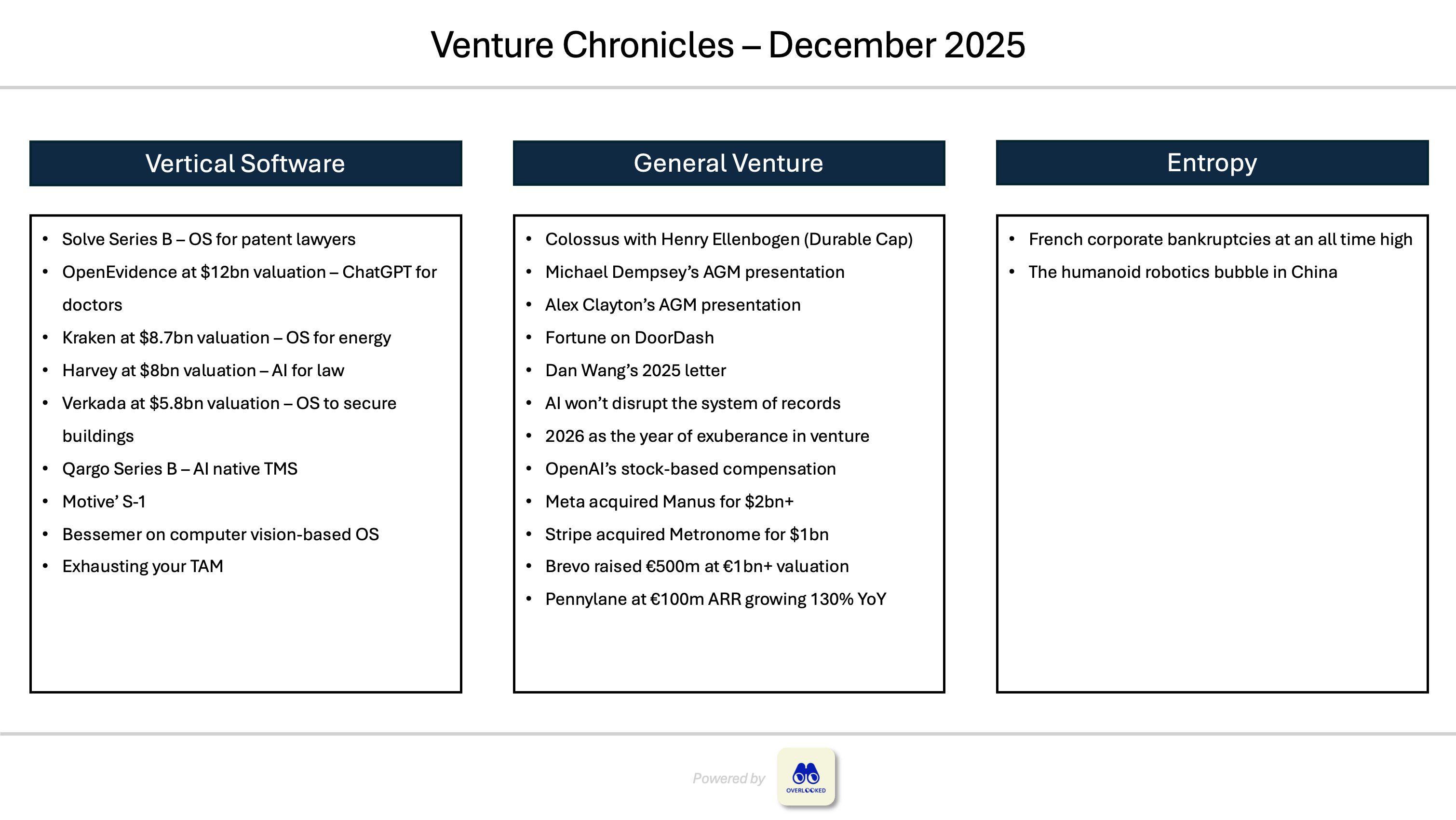
Vertical Software
Solve raised a $40m Series B co-led by 20VC and Visionaries. It’s an AI native operating system for patent work, used both by law firms and in-house IP teams. It makes lawyers much more productive across the entire patent lifecycle from invention harvesting, drafting, prosecution, office action responses as well as collaboration between outside and in-house counsel. Solve is used by 400+ IP teams (60% law firms & 40% corporate IP departments) with customers including Siemens, DLA Piper and Perkins Coie. Its ARR grew over 10x since last year to 8 figures. Solve will use the funding to broaden its product scope as well as to accelerate hiring in tech & GTM. It’s one of the best teams building in London. If you’re looking for your next challenge, you should think about joining them. - Solve, Sifted

OpenEvidence is raising $250m at a $12bn valuation. It’s a ChatGPT-like product for doctors to find evidence-based answers on medical questions. It generates $150m in run-rate from ads (3x growth since August) at a 90% gross margin and competes directly with Doximity. - The Information
OpenEvidence raised four different rounds in 2025 starting with a $75m Series A led by Sequoia at a $1bn valuation back in February 2025.
“It makes money by selling advertising space on its chatbot to pharmaceutical companies, similar to the way Google sells ads on its search engine.”
“OpenEvidence has told potential investors that it’s only selling one-tenth of its ad inventory, suggesting it could generate more than $1 billion in annualized revenue if it sold the rest.”
“The company’s gross profit margin is currently higher than 90%, putting it above many other AI startups in that regard.”
“The company has said its chatbot is more accurate than general chatbots such as ChatGPT because it was developed using information from medical journals whose content it licensed, such as the New England Journal of Medicine.”
Kraken raised a $1bn round at a $8.65bn valuation led by D1 Capital with the participation from OTPP, Fidelity and GC. It’s a spin-off from Octopus Energy. It’s a cloud-native operating system for energy utilities that integrates customer billing, CRM, and AI-powered grid optimization. As of Sep. 2025, it generated $500m in contracted ARR managing over 70m customers accounts for big utilities (e.g. EDF, EON, Tokyo Gas, National Grid). Kraken is targeting an IPO in the next 12-24 months. - Reuters
Harvey raised a $160m series F led by a16z at a $8bn valuation. It’s an AI operating system for law firms helping them on tasks like contract analysis, drafting, research and compliance checks. - Harvey, FleetingBits
It’s Harvey third round in 2025. It previously raised $300m at $3bn valuation in February and $300m at a $5bn valuation in June.
Harvey has best in class metrics for an AI company: $150m ARR (60x EV/ARR multiple) growing 300% YoY (also 300% YoY growth in 2024), 98% GDR and 168% NDR.
It is competing head to head with Legora ($40m ARR, 10x YoY growth) which claims to have an easier product to set-up and use.
Verkada raised at a $5.8bn valuation in a round led by Capital G. It’s a computer vision based system combining hardware, software and AI to secure buildings bringing together video security, access control, sensors, intercoms and alarms. It generates $1bn in annualised bookings from 30k customers and has deployed 2m devices. - Verkada
Cloud-based transport management system Qargo raised a $33m series B led by Sofina. - Tech.eu, Qargo
“Founded in 2020, Qargo is a cloud-based transport management platform designed for carriers, freight forwarders, and 3PLs. It helps logistics companies digitise operations and automate manual tasks across the transport cycle, from order entry and planning to load building, invoicing, and reporting. The platform integrates with existing tools to support more efficient and profitable operations, reduce environmental impact, and enable scalable growth.”
“Since its Series A in May 2024, Qargo’s growth has accelerated, with annual customer invoicing processed through the platform increasing from £420 million to more than £1.9 billion, and its customer base expanding from around 100 to more than 400.” It has also grown revenues 5x.
Motive filed to go public. It’s a vertical SaaS competing with Samsara in fleet management in sectors like trucking, construction, energy and manufacturing. It combines hardware (telematics) and software. - CJ Gustafson
Metrics: $501m ARR (+28% YoY), 70% gross margin, 100k customers, 110% NDR retention (for customers with $7.5k+ ACV), not profitable (will burn $100m in cash in 2025), <10% in rule of 40.
“Motive is a vertical software company for the physical economy (people out in the field, driving trucks and keeping track of their employees and machines). They install hardware to generate first-party operational data, and then monetize that data through high-retention software subscriptions.”
“Their platform connects four things that historically lived in separate systems (or on a piece of paper stuck to a bulletin board in a warehouse): (i) Vehicles – dashcams, GPS, fuel usage, (ii) People – drivers, operators, safety managers, (iii) Equipment – trailers, heavy machinery, assets in the field and (iv) Spend – fuel, maintenance, repairs, insurance, and downtime.”
“Most customers adopt Motive to solve a narrowly defined, operationally mandatory problem: staying compliant with regulations and reducing safety risk across a fleet (i.e., are drivers falling asleep, stop texting while driving, and where is my shit?). What’s nice is driver monitoring and incident visibility are non discretionary budgeted line items.”
“For Motive, hardware serves a specific economic function: it is the mechanism by which first-party operational data is created. Cameras, sensors, and in-vehicle devices are how Motive establishes a persistent data stream tied directly to physical activity.”
“Once installed, the hardware does three things simultaneously: (i) It makes Motive the system of record for safety and compliance. (ii) It creates continuous, proprietary operational data. (iii) It raises switching costs meaningfully, both technically and operationally.”
“The most direct and unavoidable comparison for Motive is Samsara, the largest and most established platform in fleet telematics and connected operations. And that’s a tough comp, because Samsara is the cream of the crop, growing at ~30% y/y, with revenue eclipsing $1B and 18% EBITDA margins. They’re battling a rule of ~50 company who’s growing faster and actually profitable (at +2x their scale).”
Bessemer wrote a post on companies leveraging computer vision to digitise a given sector like construction, field services, public infrastructure, healthcare and logistics. - Bessemer
“[Recent Vision Language Models] now work right out of the box: can learn new visual tasks from just a few examples in the prompt, requiring no retraining, and is deployable at the edge with 2 billion parameters.”
“Today’s most penetrated form factors remain mobile devices and CCTV cameras, which dominate because they’re already deployed at scale. But there’s massive surface area for proliferation across existing form factors: smart glasses like Meta Ray-Ban are crossing into mainstream adoption, body cameras are expanding beyond law enforcement into healthcare and utilities, and AR/VR headsets are finding enterprise niches.”
“The newest opportunity is in mobile visual inspectors, such as quadruped robots from companies like and that navigate complex industrial environments, climbing stairs, and traversing rough terrain. These will become increasingly common for inspections that are dangerous or impossible for humans.”
“We’re looking for founders building novel experiences that leverage computer vision to enhance real-world processes” with the following characteristics: (i) direct revenue driver / massive cost saver, (ii) integrate easily with existing / off the shelf cameras, and (iii) automating manual visual workflows.
A known TAM can quickly be exhausted if you scale aggressively. It’s a key advice for vertical software companies especially when they operate in smaller markets. - CJ Gustafson
“When your market is finite and findable, it’s also burnable.”
“The first piece of advice is to know where the wall is before you hit it.”
There are two common paths to expand your market. “The first is to move into a tangential market. If you serve gyms, maybe you start making your software applicable to salons. The second is you find new products to sell into the customers you already have. If you sell them software for keeping track of customers, maybe you add payments to get a piece of each customer’s transaction.”
“It’s so crucial to keep track of your rep productivity metrics when you are operating in a TAM constrained market. You want to make sure you are not spraying and praying, burning potential customers because of a poor and haphazard initial experience.”

General Venture
I listened to an Invest Like the Best’s podcast episode with Henry Ellenbogen who is the founder and managing partner at Durable Capital. - Colossus 1, Colossus 2
“Great investing is about understanding people and change.”
Durable likes to invest in “Act 2 Entrepreneurs” who have already built and won in a specific business area and are now doing it again (e.g. Workday and Affirm).
They begin with “total clarity,” knowing the edge cases and exceptions management required.
They can align the organization, investors, and product strategy perfectly from day one.
They are often exceptionally resilient.
At any given time, the portfolio holds approximately 10-15% of its capital in private markets, with the remainder in public markets, aligning capital with the lifecycle of compounding companies.
“Over the nine years [Henry] ran New Horizons [at T. Rowe], he turned $8 billion into $40 billion. His investments returned 19% annually. He beat the index by 5% a year.” He invested in Netflix at $4.5bn valuation, Amazon at a $10bn valuation and Priceline/Booking at $1bn.
“From 1976 through to 1997, the median age of a company going public was eight years. By the mid-2000s it had crept to 11, nearly 40% older. A significant part of a young company’s growth was happening before the IPO.”
“Workday came in 2011, and this time, it fit Ellenbogen and Shull’s developing framework. They had met the company when it was doing $100 million in revenue, growing 80%, valued at $2 billion. Respected investors thought the valuation was crazy but Ellenbogen and Shull saw two founders in Aneel Bhusri and Dave Duffield who’d already built a business in this space, having pioneered HR systems at PeopleSoft. They understood how the industry worked and they could see how cloud infrastructure would make everything better.”
“Across 50 years and thousands of investments, across multiple market cycles and different managers with different styles, only 20 stocks had mattered. Every cent the fund had made came from 20 companies identified early and held long enough to turn modest positions into transformative outcomes. The rest amounted to nothing.”
“The data told him that in any 10-year period, about 40 stocks compound wealth at 20% a year. 40 out of 4,000. 1% of public companies turn out to be great, and roughly 80% of those started as small companies.”
“Given how rare compounders were and how hard it was to separate the Netflixes from the Rackspaces before they went through a transition, Ellenbogen would cast a wide net at the start. Then he would watch, and if the company proved itself during the transition, he would buy more. Sometimes that meant buying at lower prices during volatility. Often it meant buying as the stock rose.”
“One approach was backing entrepreneurs who already knew what it took to build a scaled business. Act 2 entrepreneurs, like PayPal’s Max Levchin. When Google had acquired his second company Slide in 2010, Levchin was deflated. Ellenbogen told him not to give up on himself. Two years later, Levchin started Affirm, the buy-now-pay-later business. It was too young for New Horizons to invest, but Ellenbogen stayed close. They talked before every round Levchin raised over eight years. In 2020, when COVID hit and Affirm needed capital, Ellenbogen led its last fundraising round as a private business.”
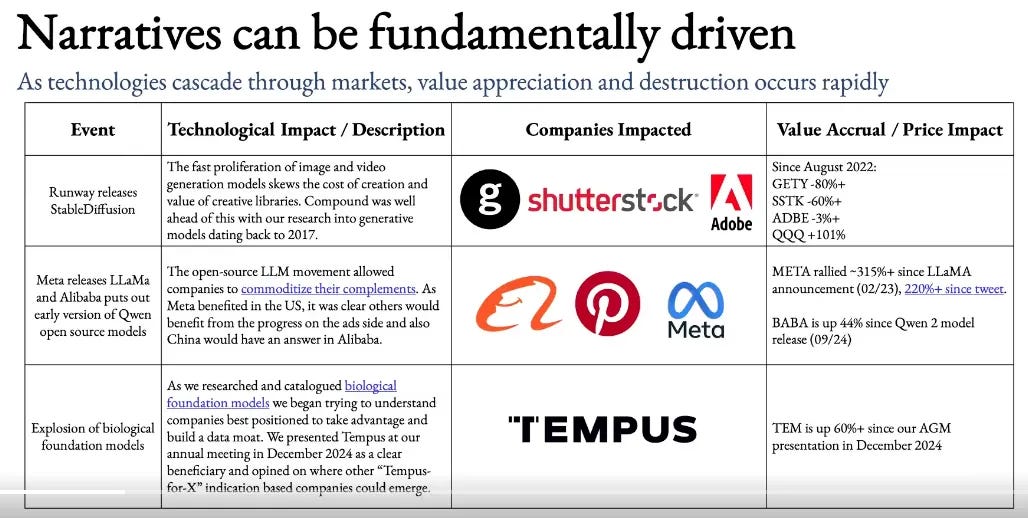
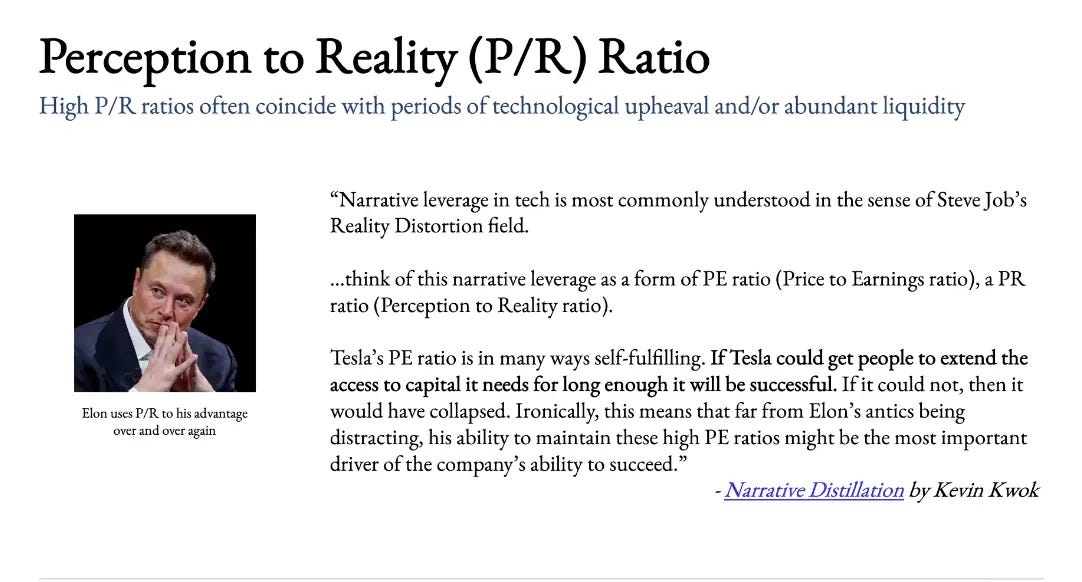
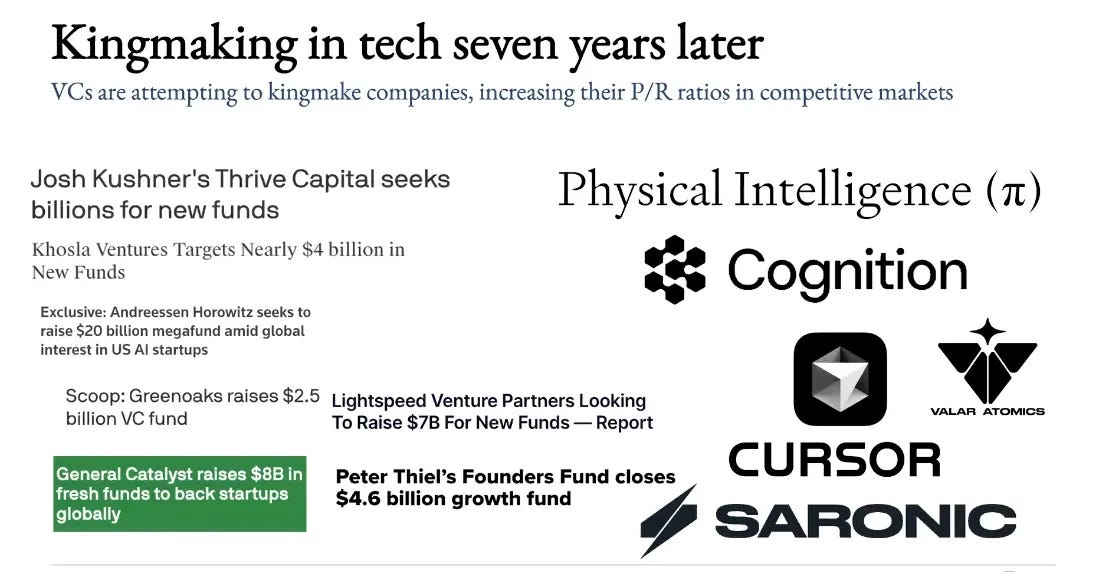
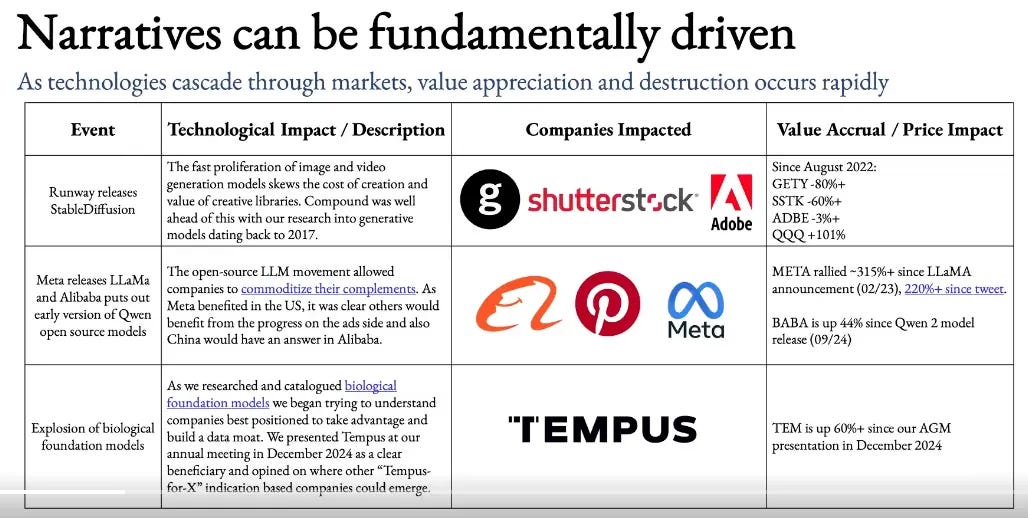
I watched Michael Dempsey’s overview of the venture market shared during his AGM. - Compound
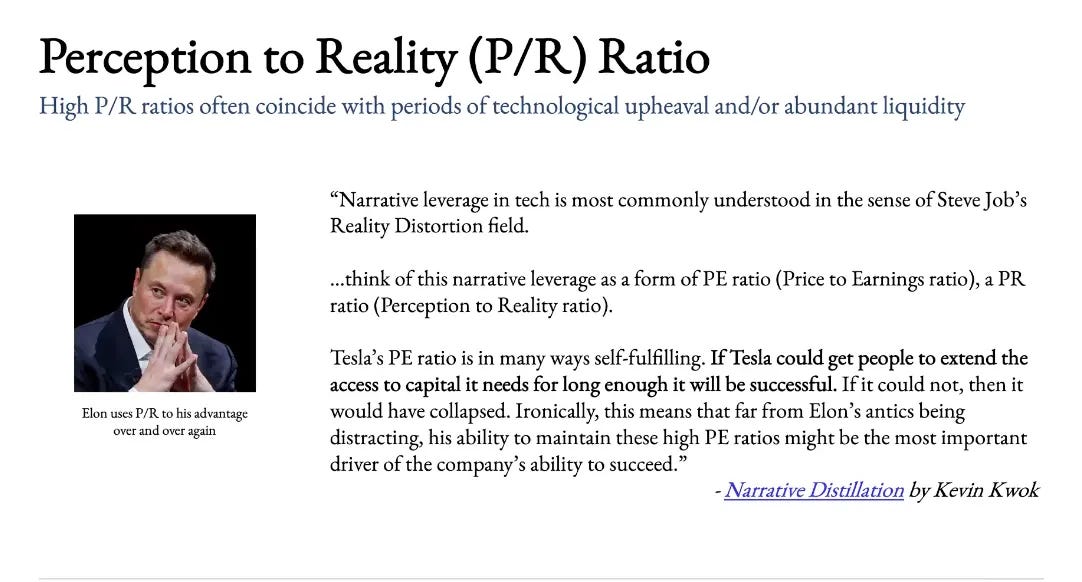
Markets are more narrative driven than ever (e.g. Nvidia for the AI narrative). Narrative shifts first and fundamentals follow. Narratives have multiple waves (e.g. Nvidia → Mag 7 → Chips, Energy, AI-powered SaaS). Narratives can also collapse very quickly.
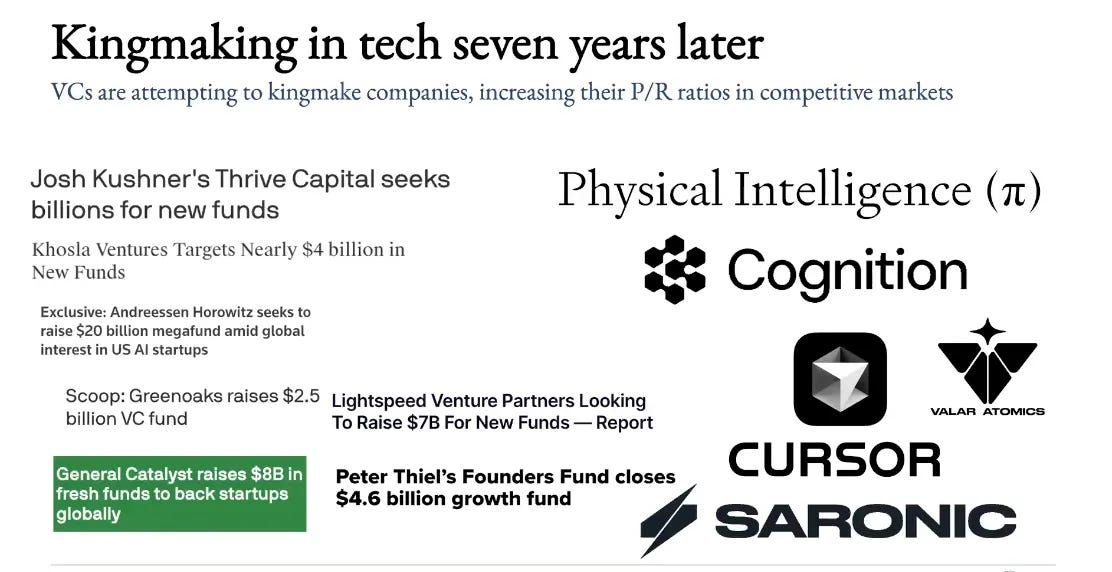
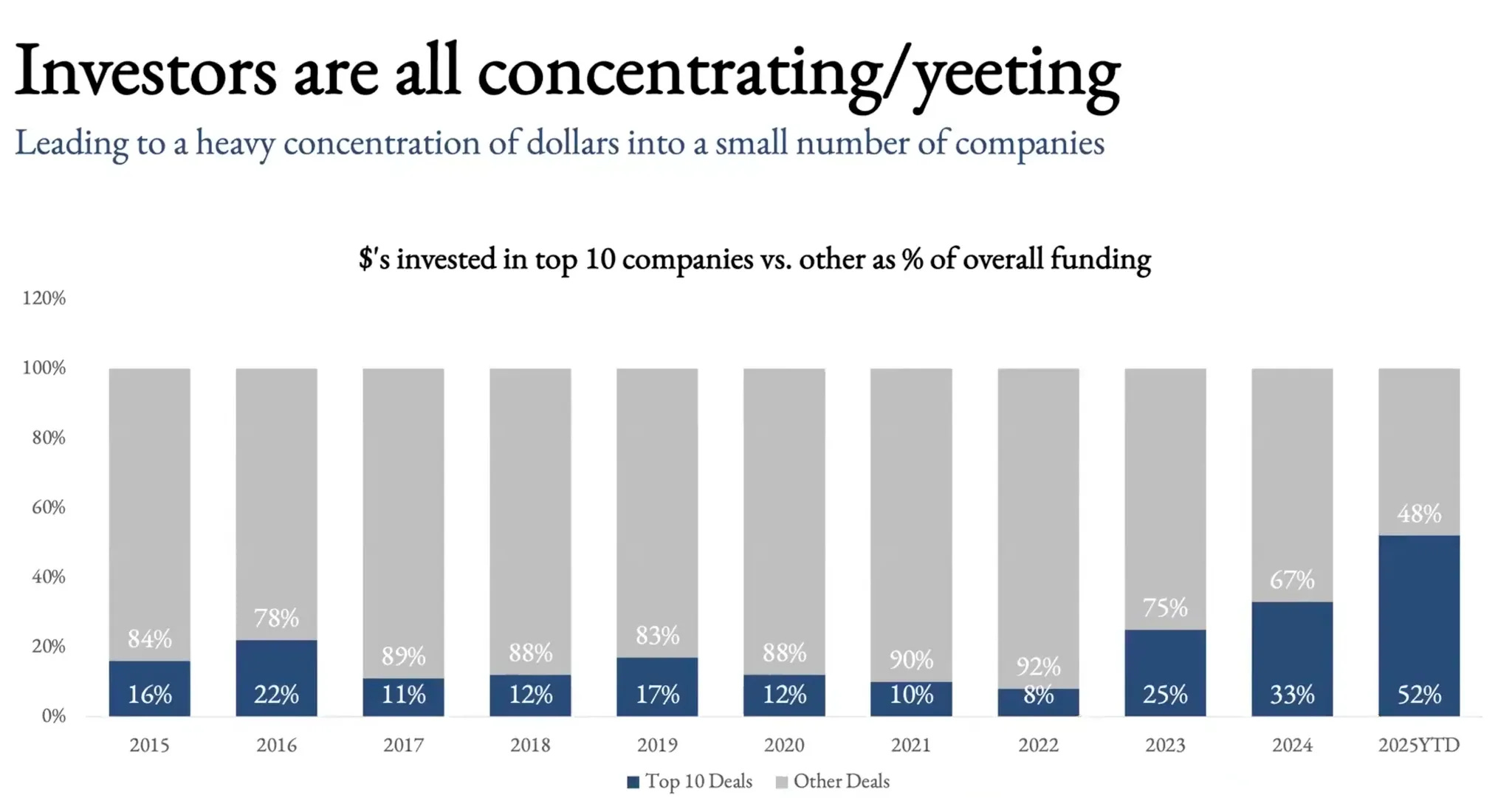
Kingmaking is more important than ever in venture for companies that need to accumulate capital and talents to be successful (e.g. maritime defense, AI code-gen, etc.). You see this in the percentage of capital raised by the top 10 companies.
VC has become like investment banking. Nobody gets fired from investing into a16z.
AI is still the hottest part of the market capturing close to 50% of capital invested in venture. A lot of funding is also going into deep-tech as an investors are trying to rotate away from software.
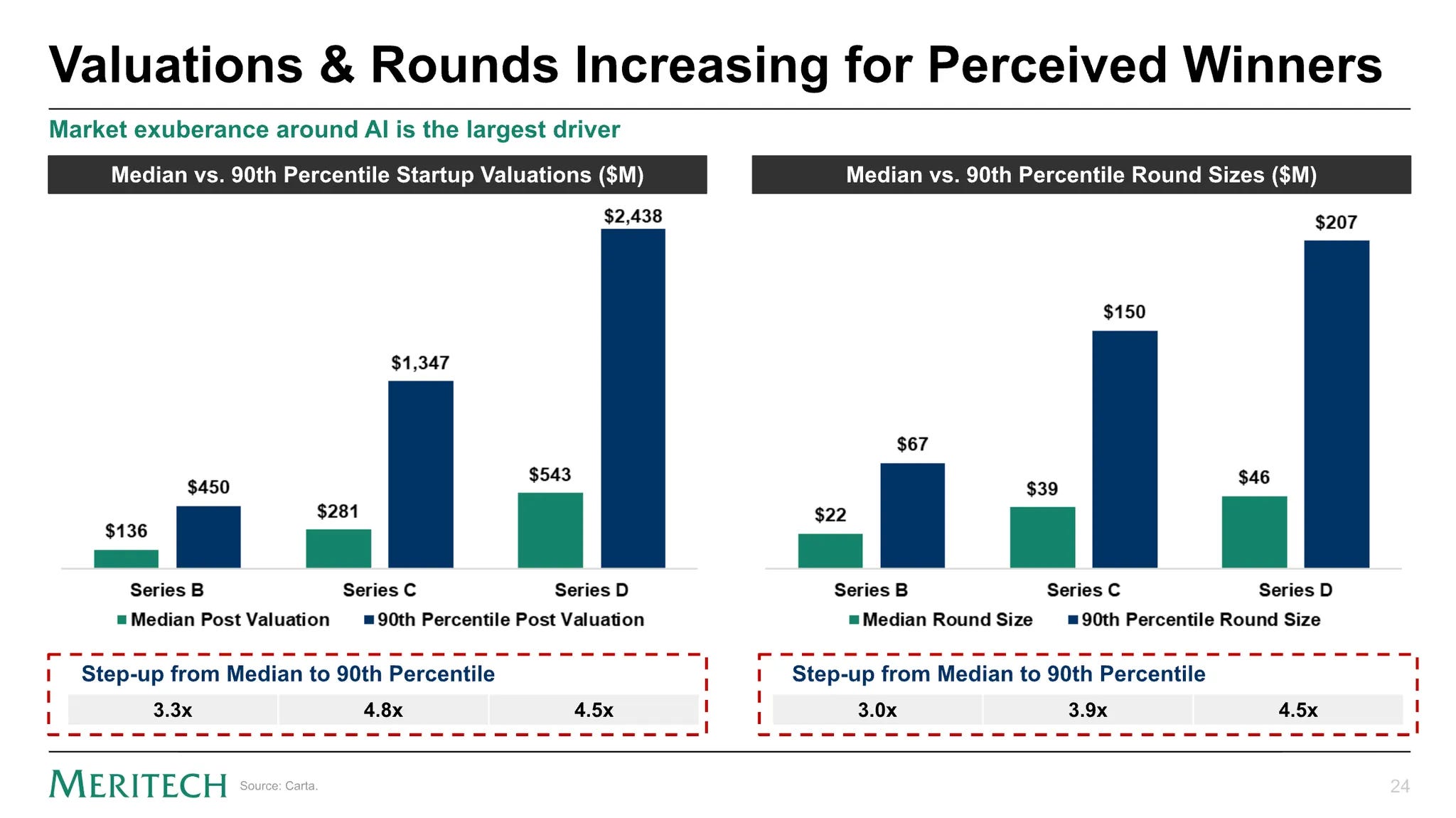
Momentum and consensus investing is in vogue. Consensus creates pricing dislocations in the market even at seed where deals at the 95th percentile are 4x more expensive than deals in the 50th percentile.
Compound is trying to stay at the edge of technology researching and backing unconventional ideas on the very high end of the risk curve. When we invest in a company, we work very hard to make their narrative mainstream to accumulate talents and capital.
It’s key to remain disciplined on prices especially since there is very little correlation between seed prices and outcomes.

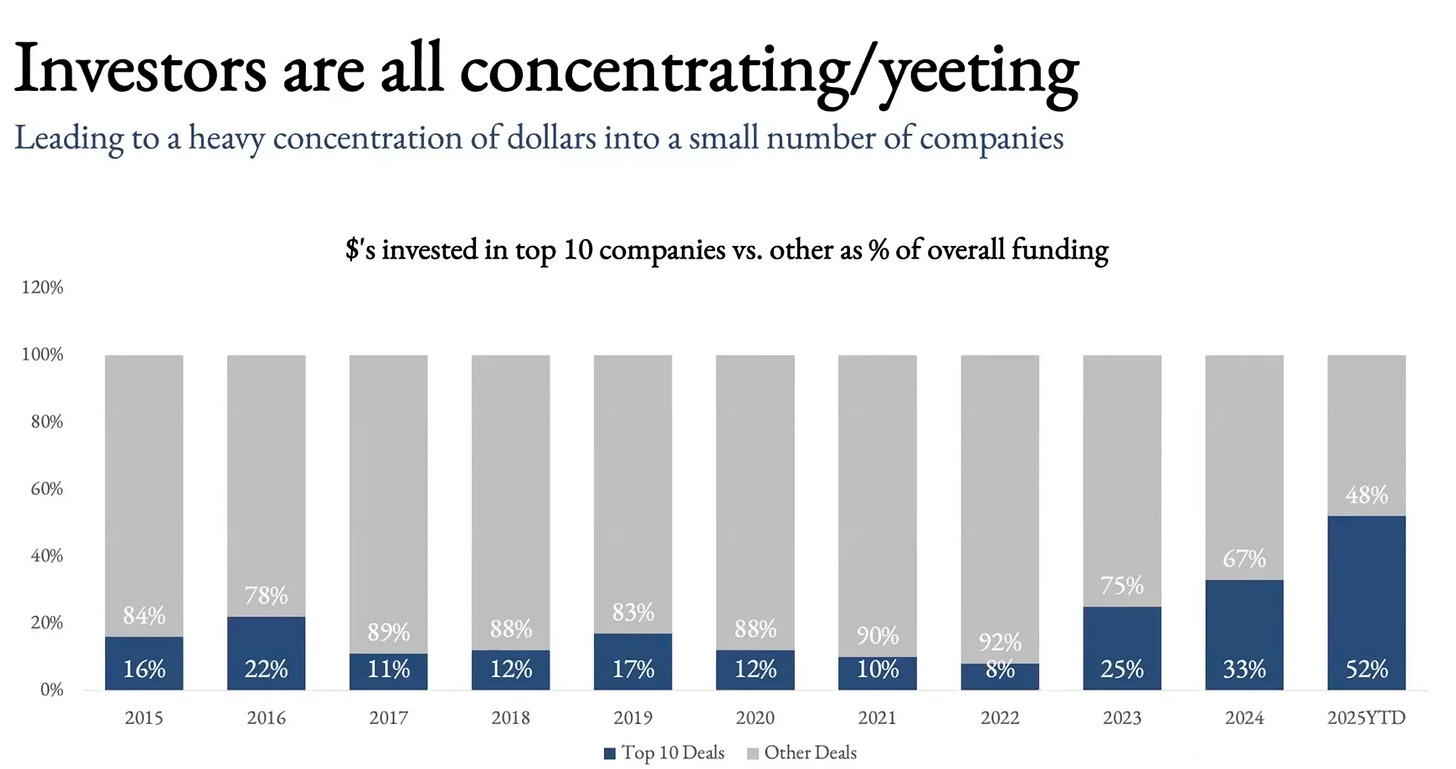
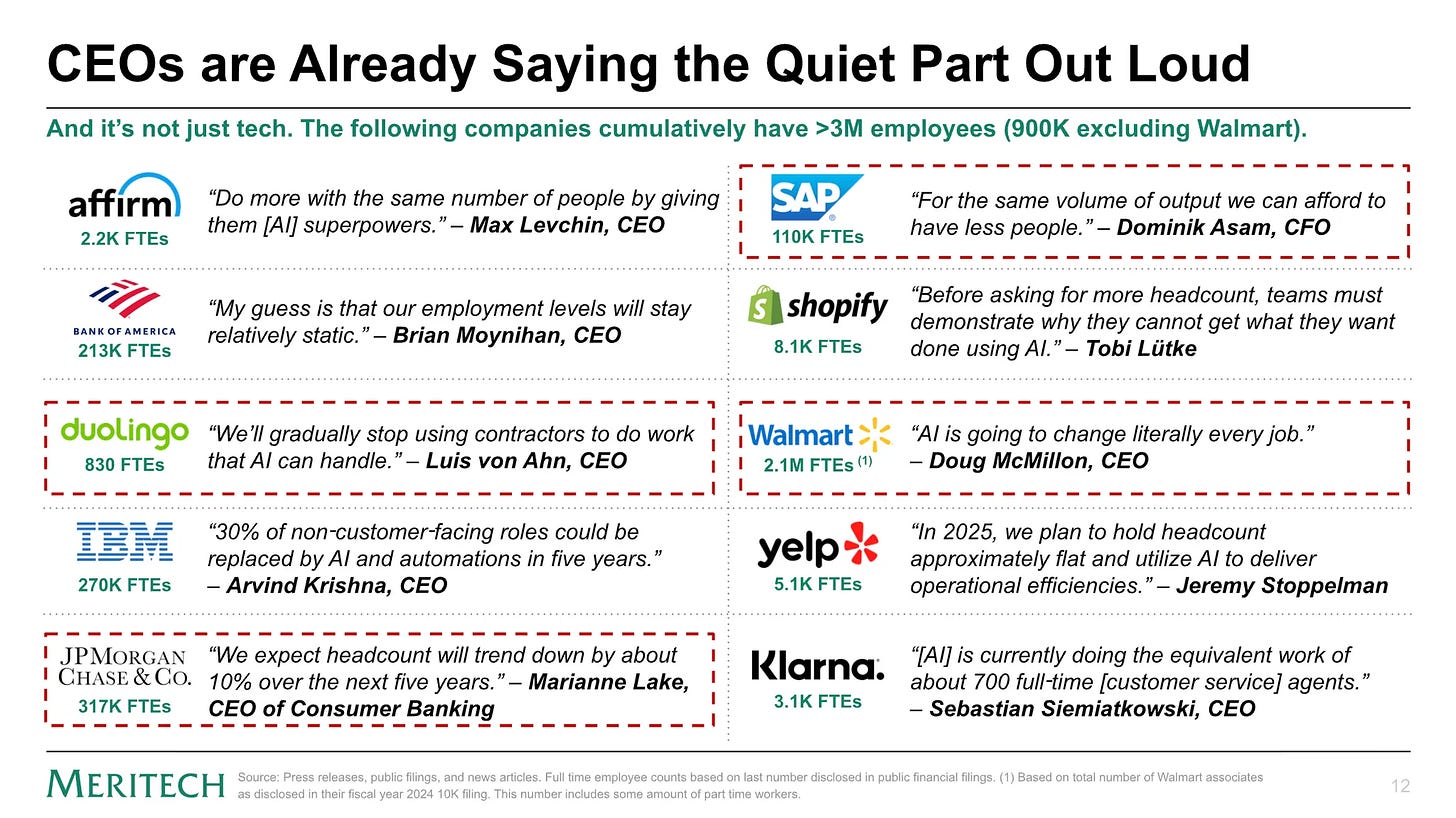
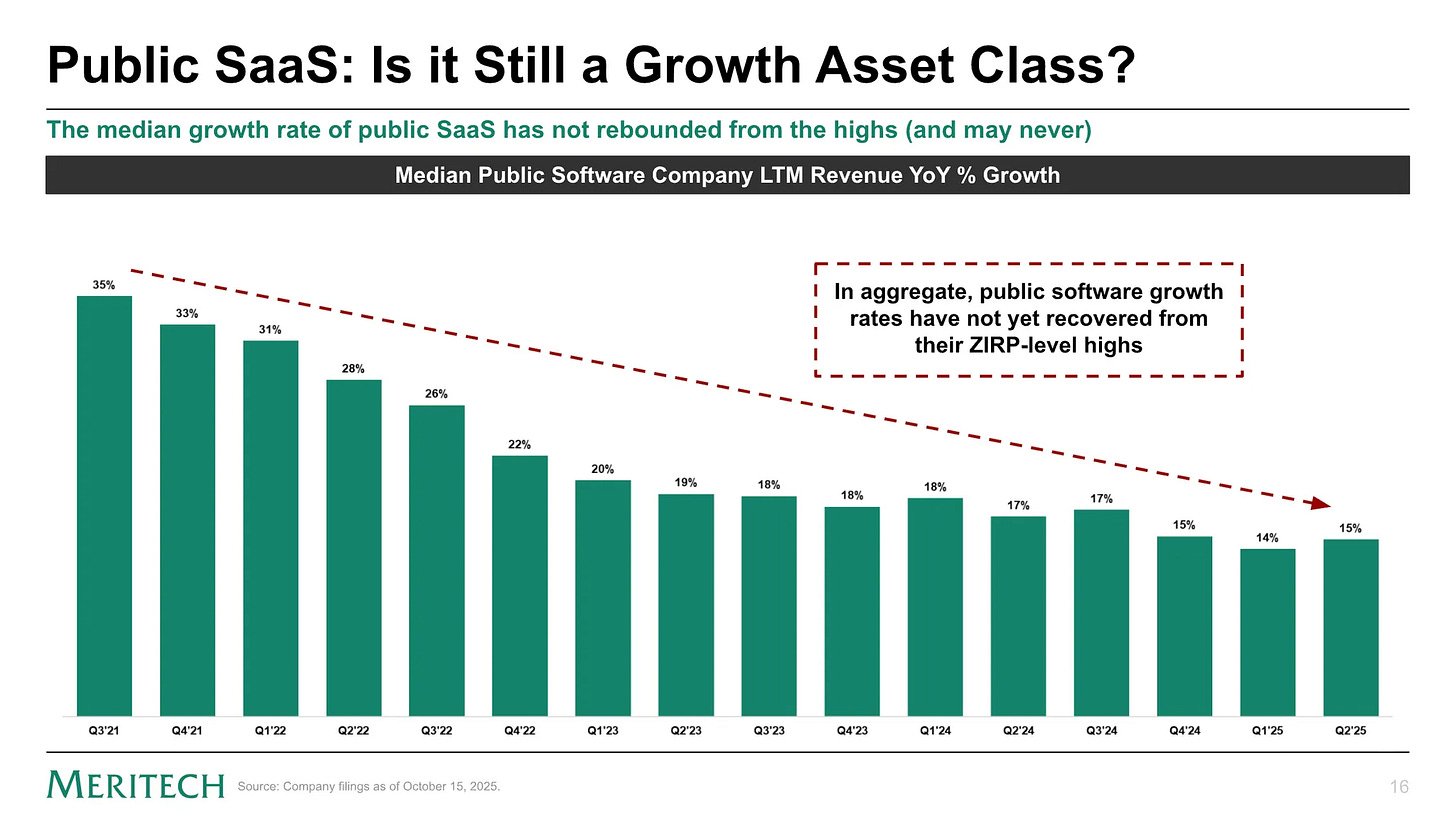
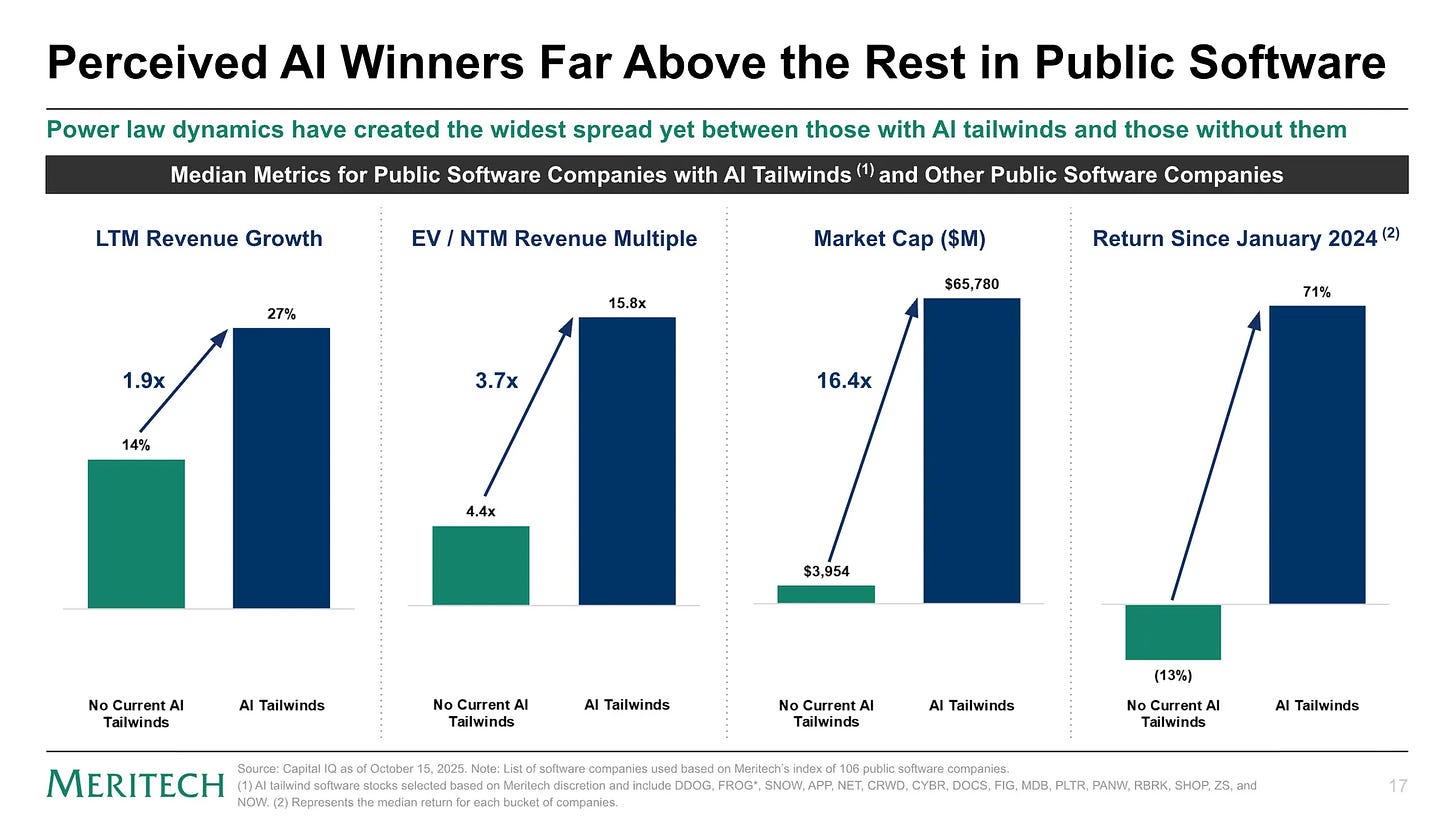
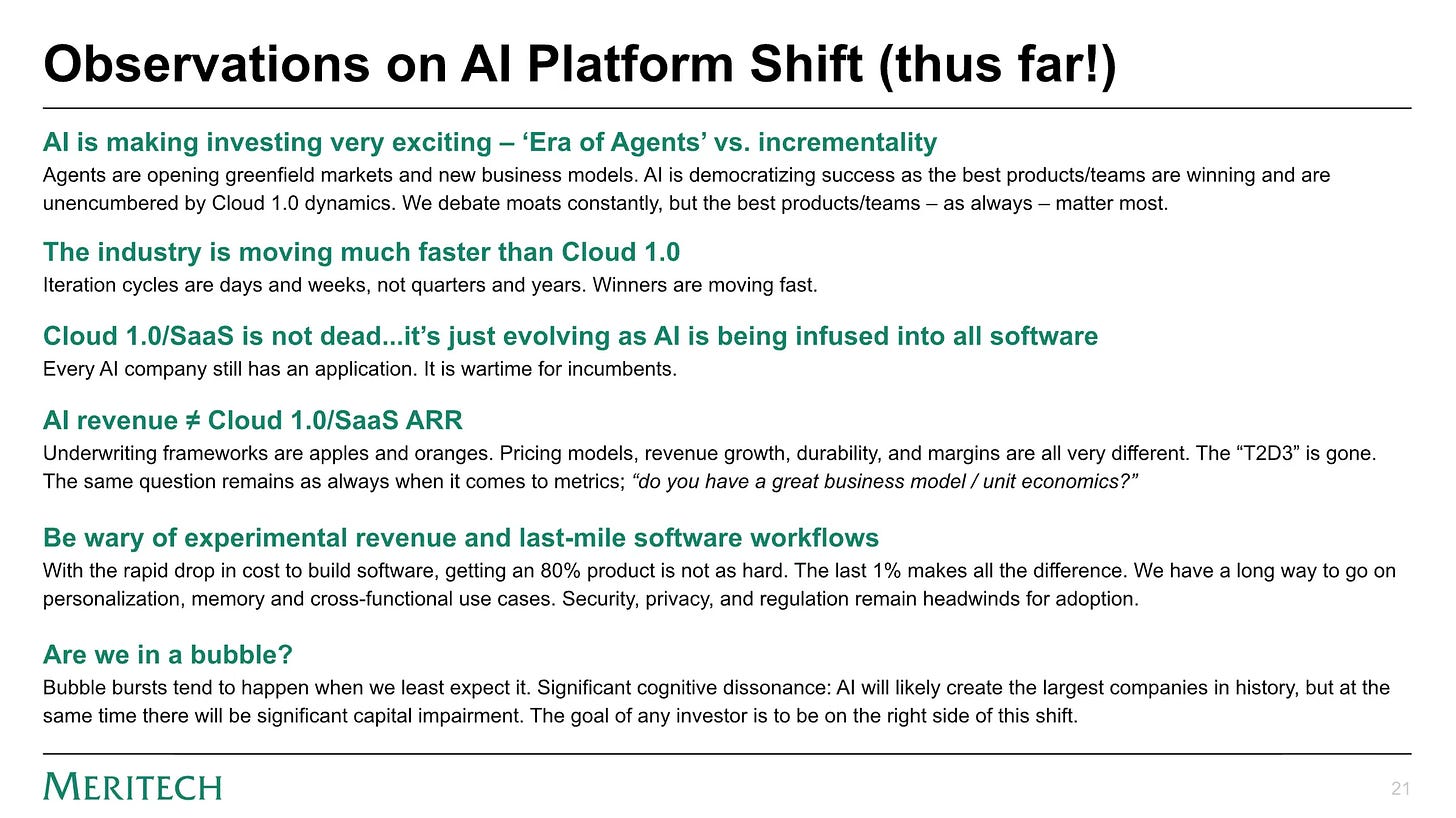
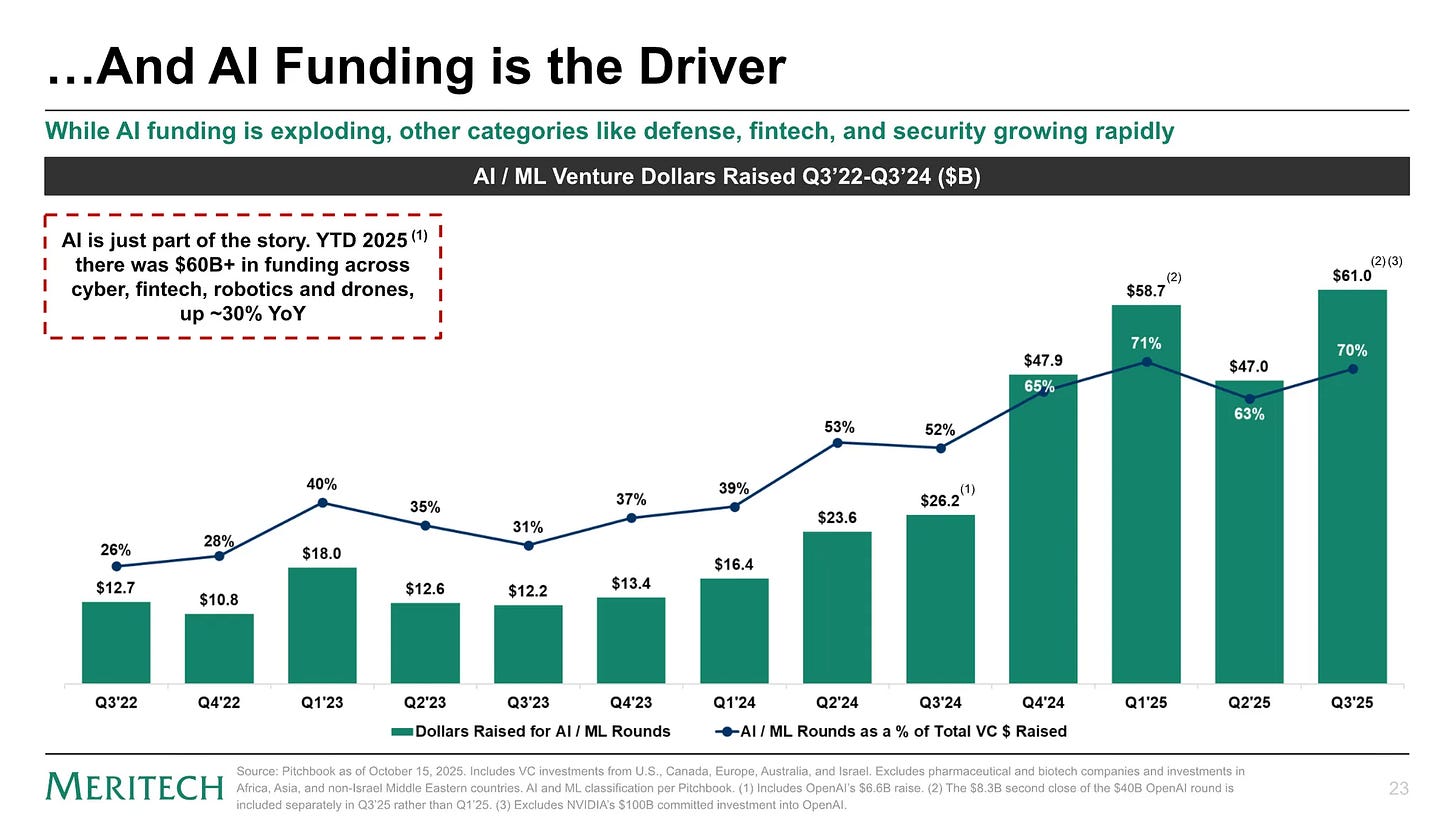
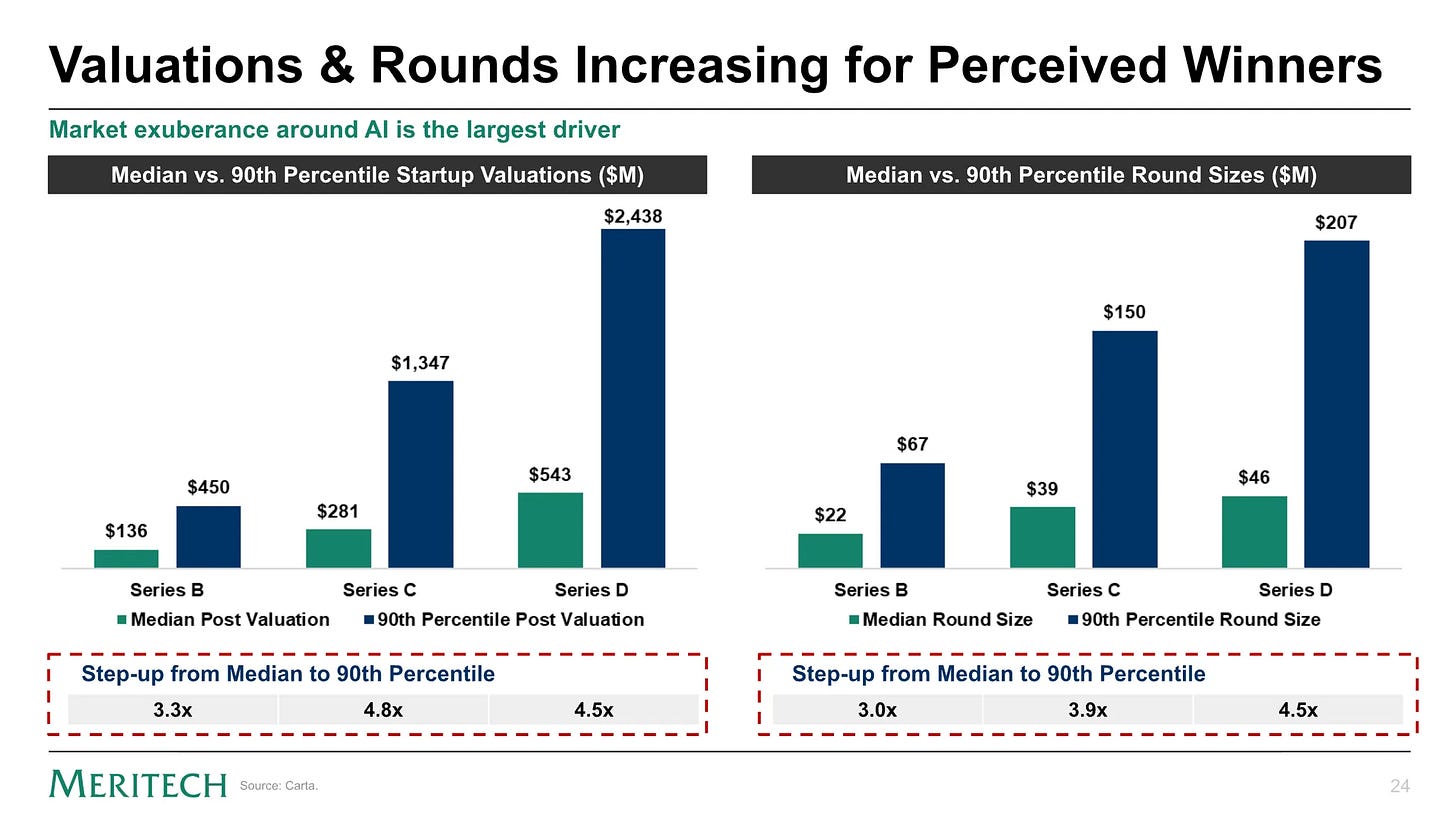
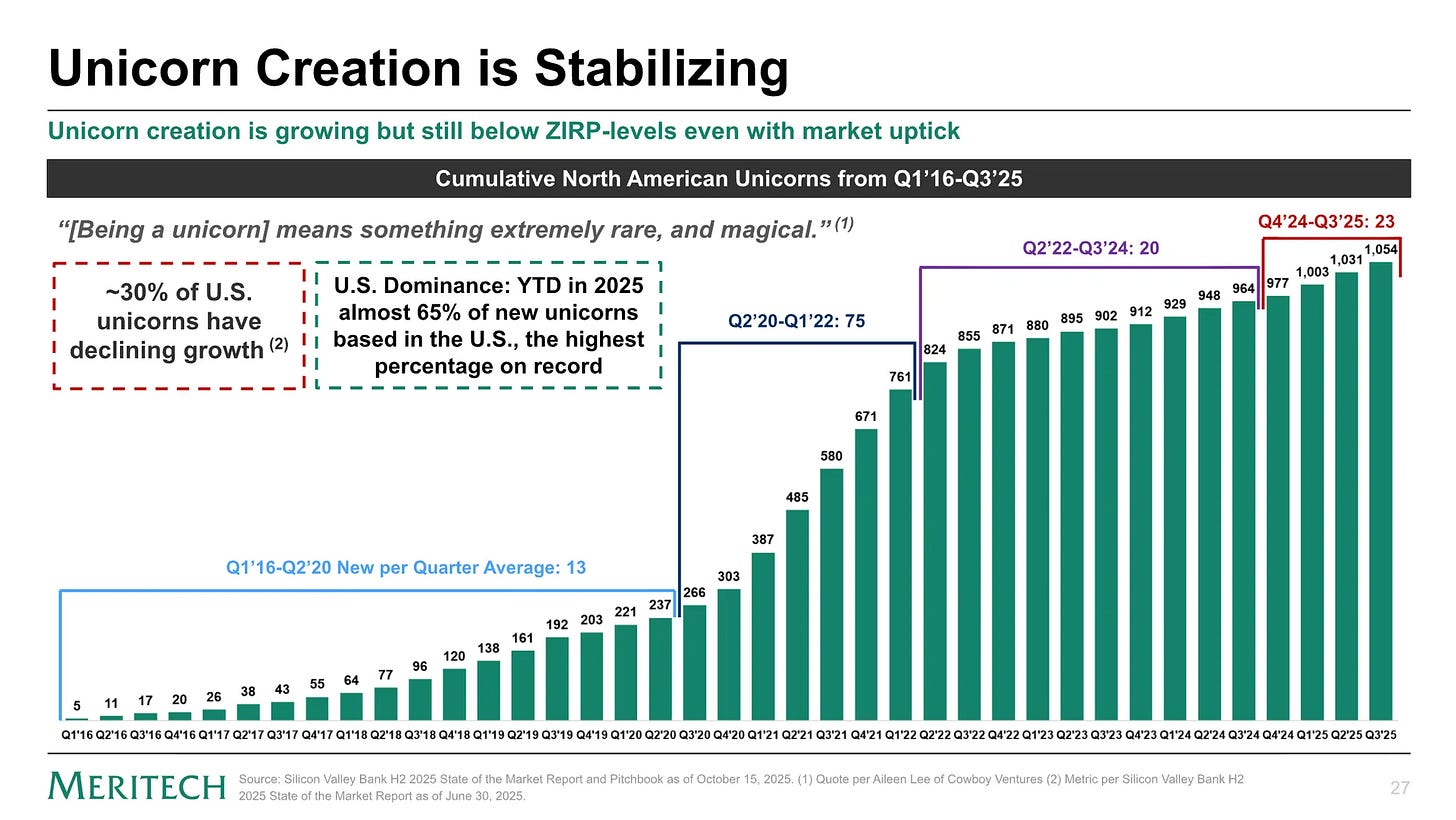
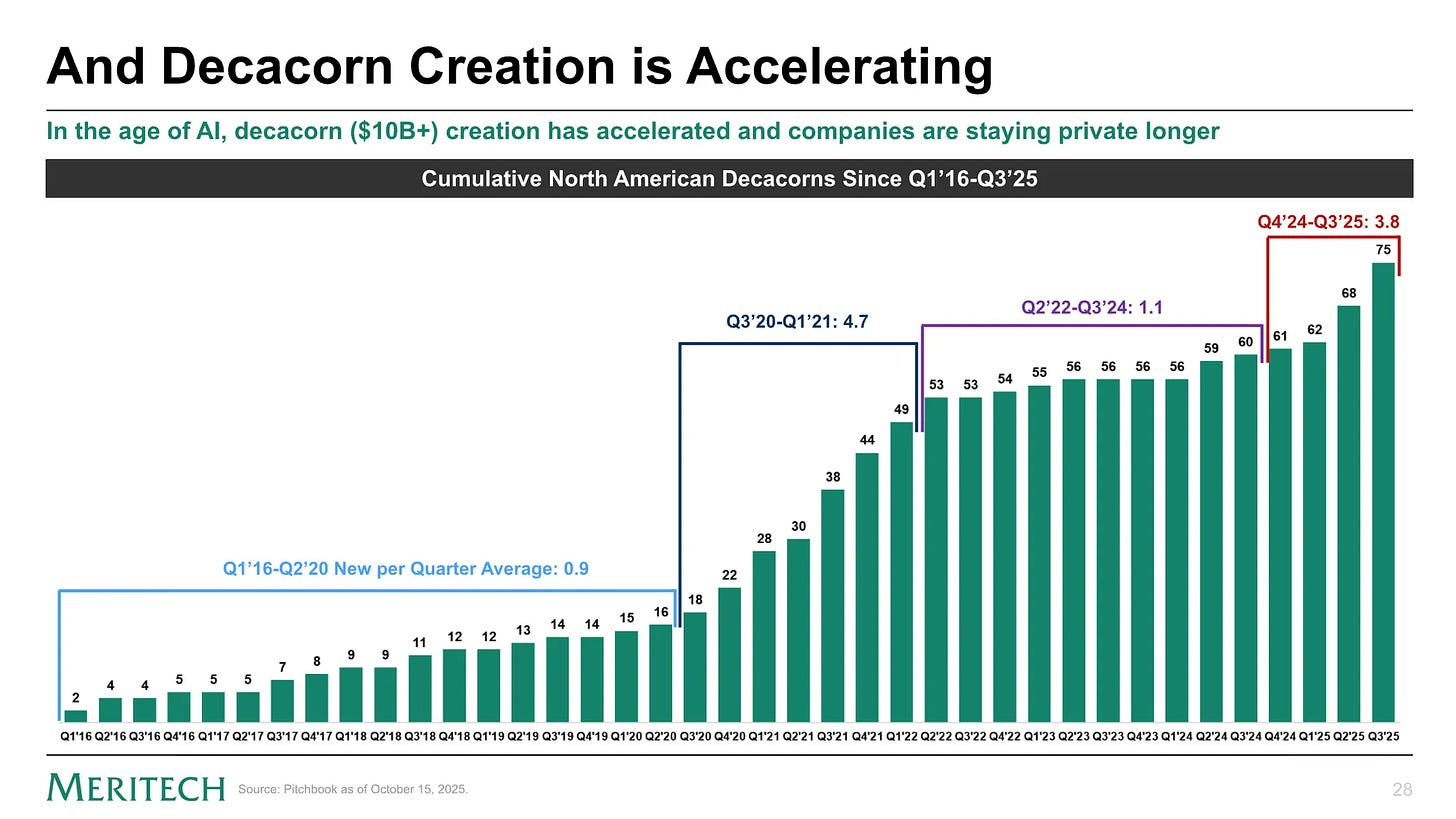
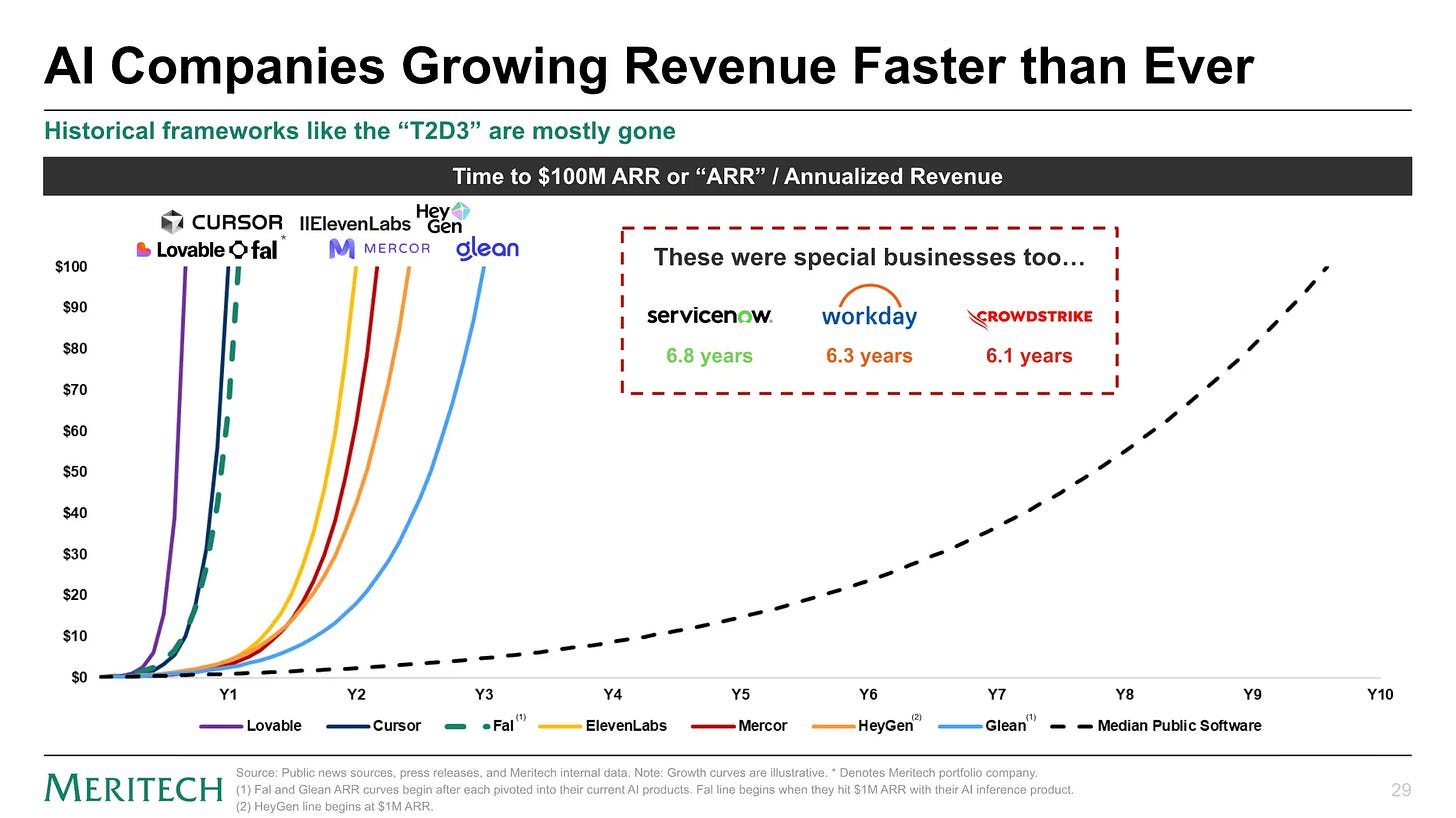
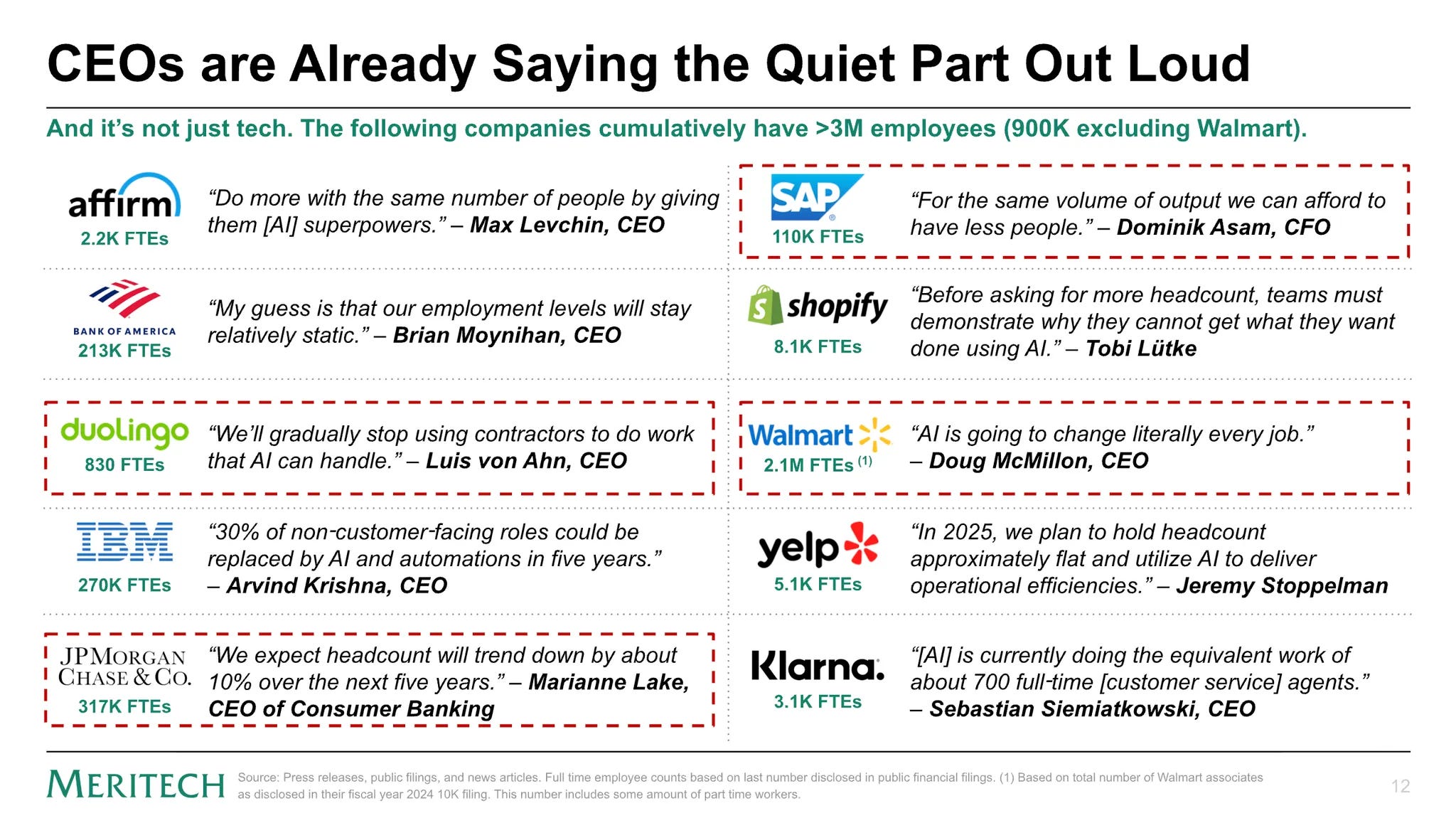
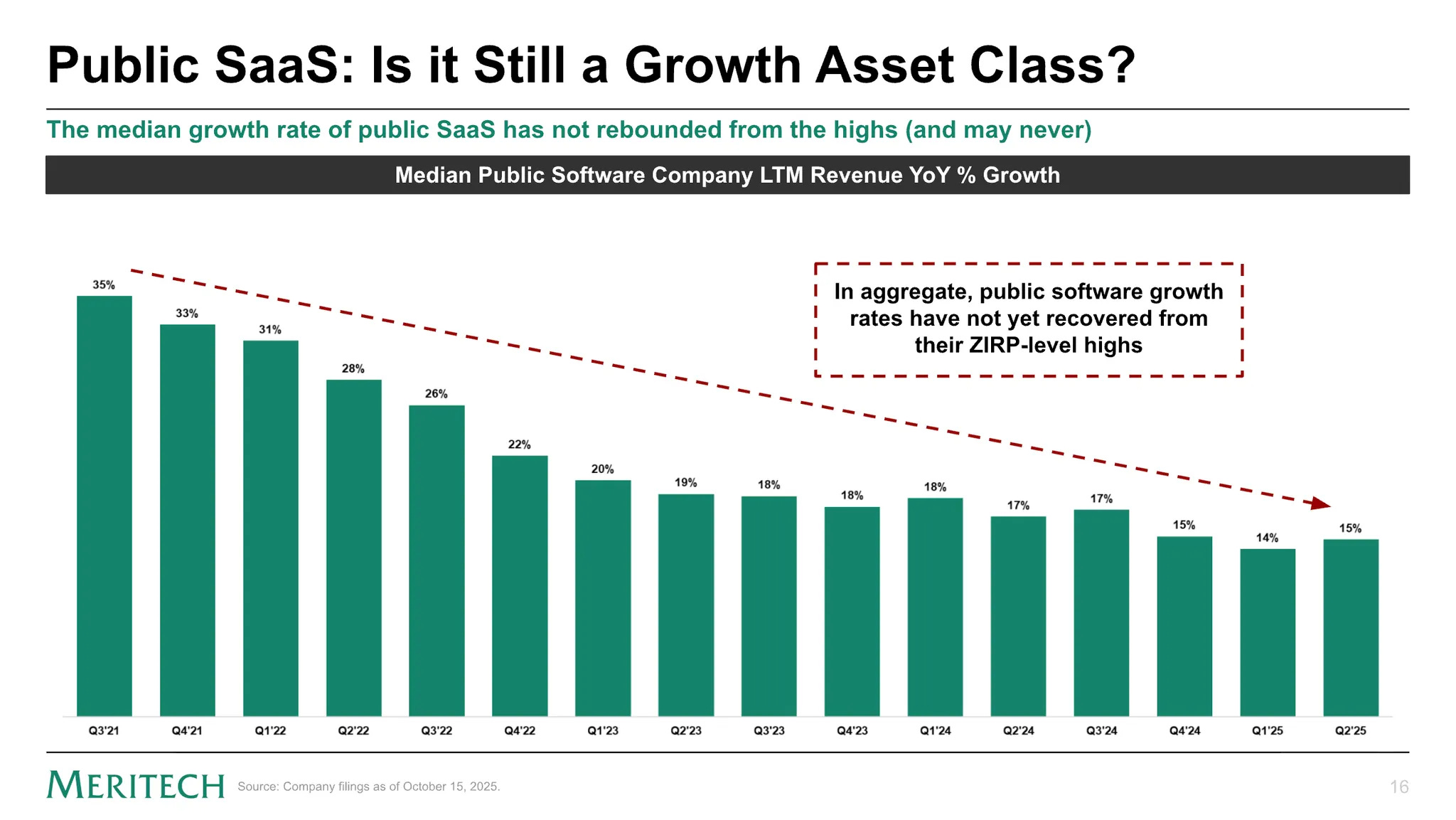
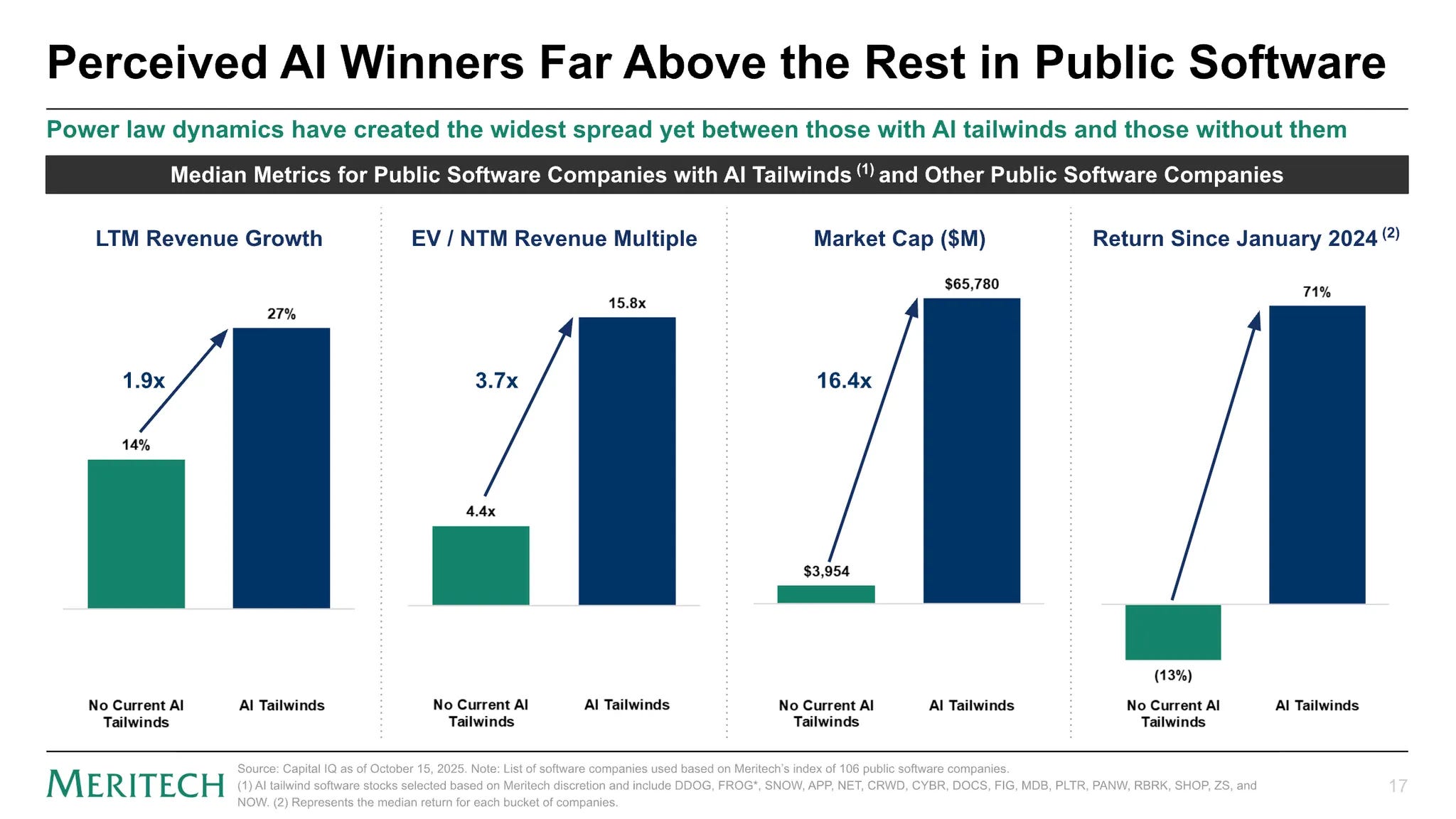
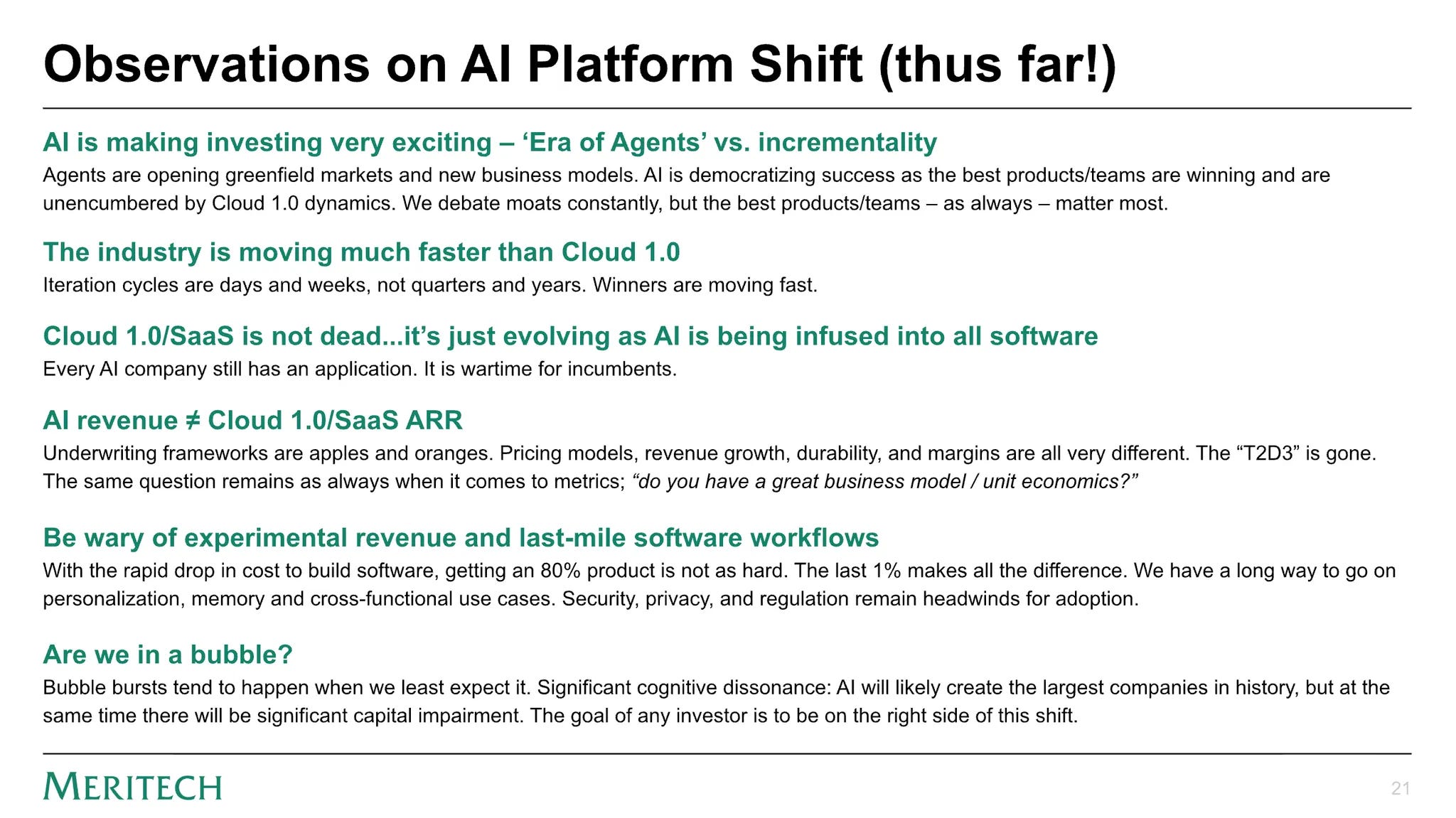
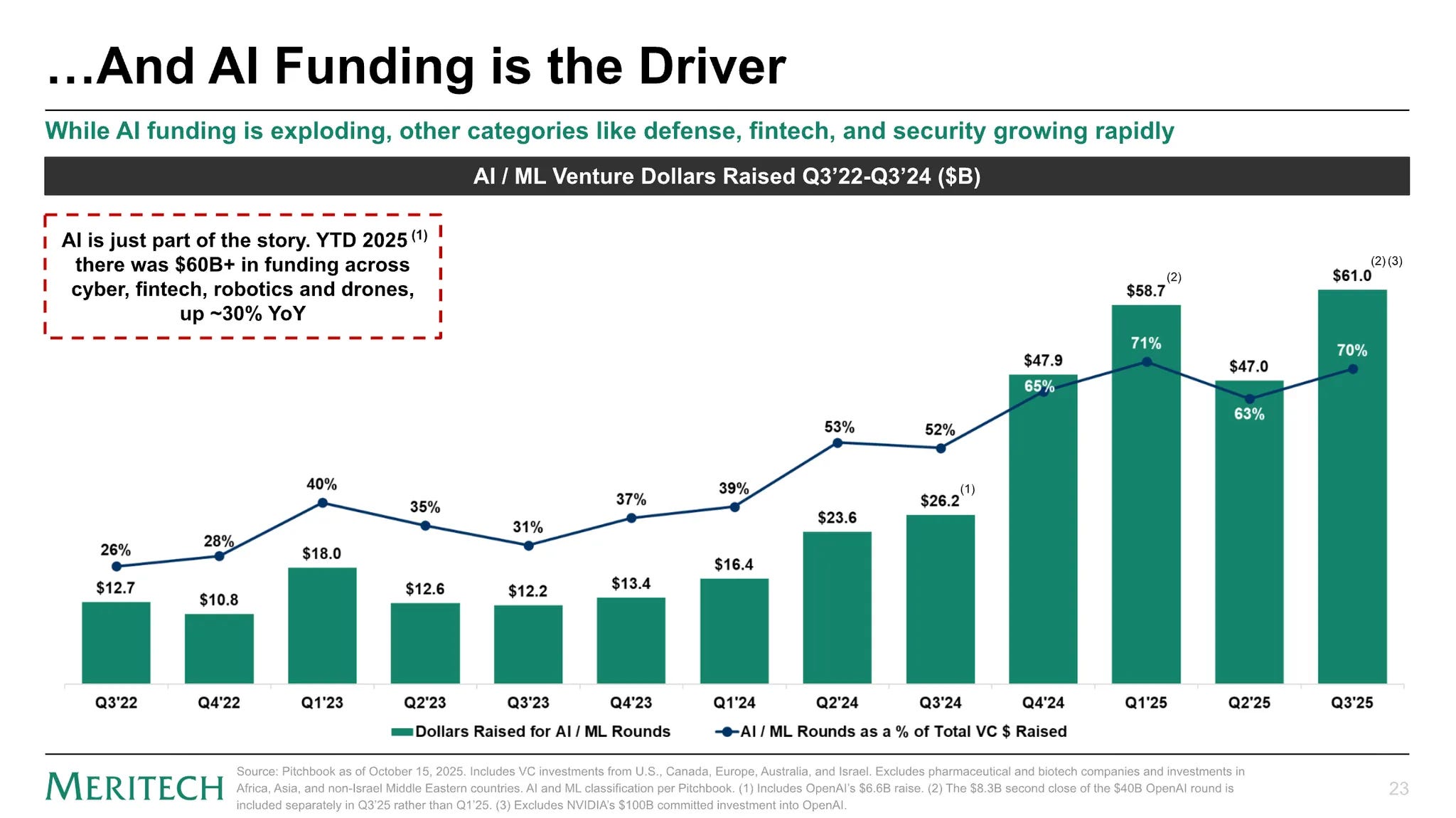
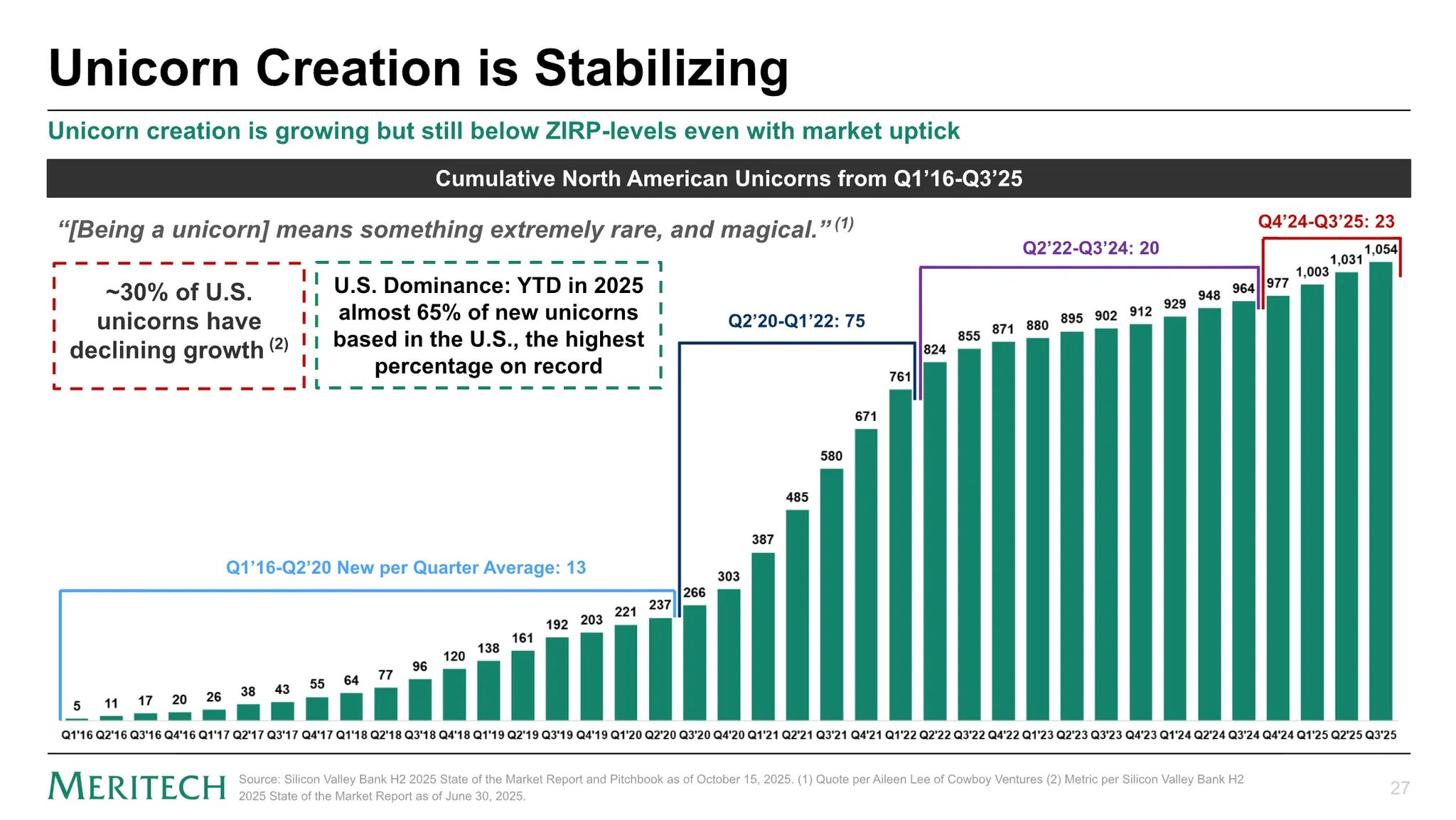
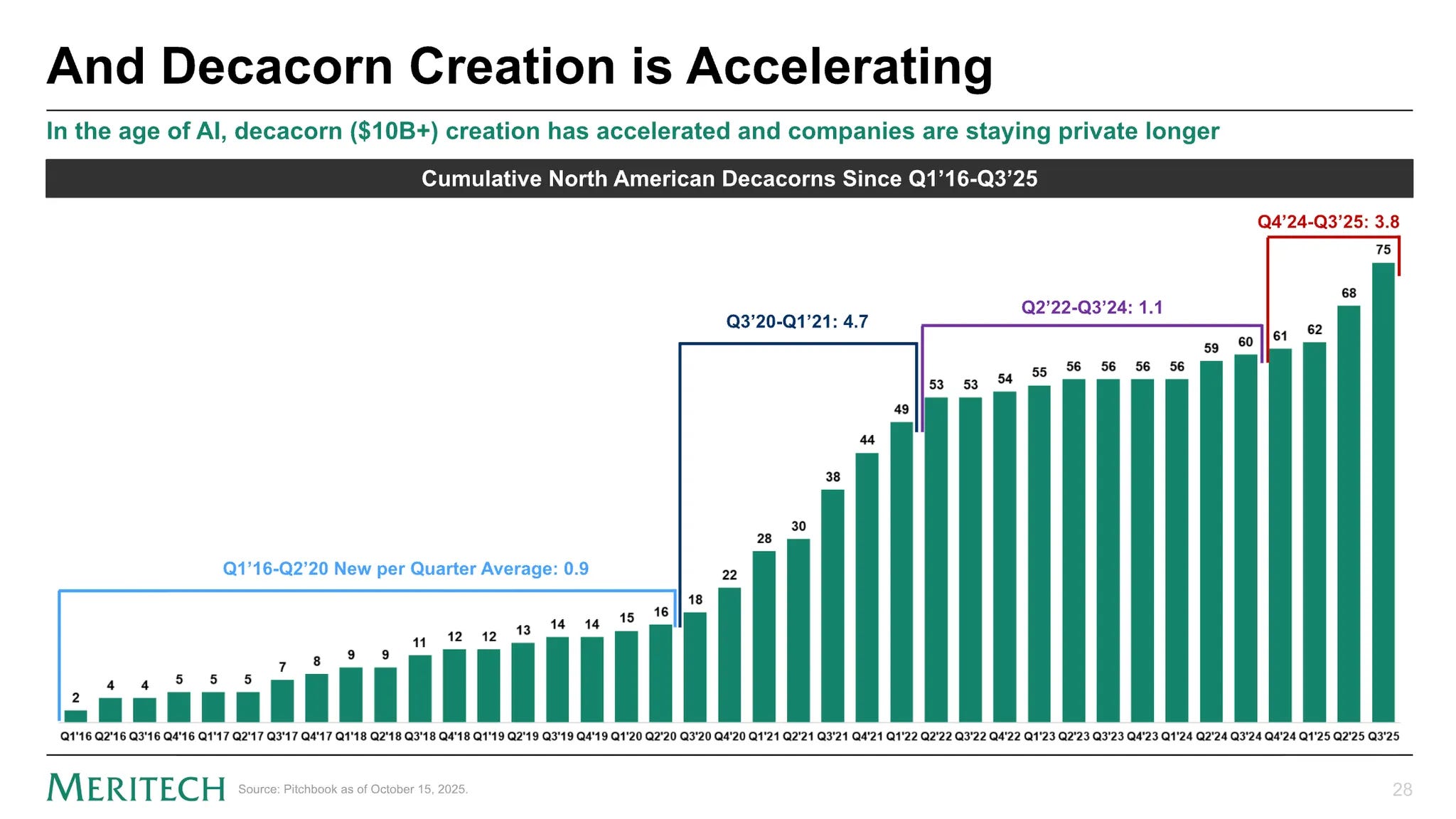
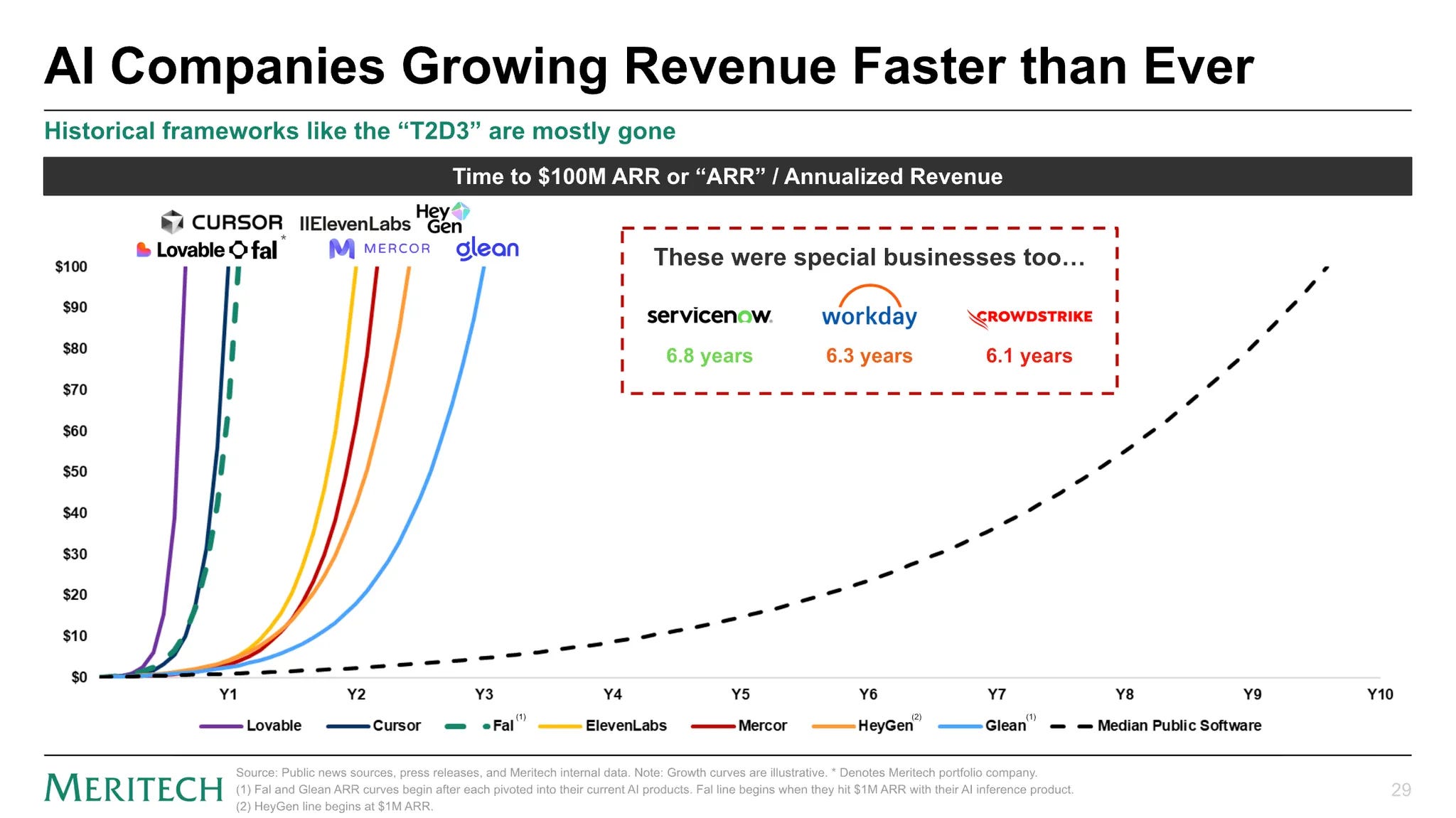
Alex Clayton at Meritech shared the presentation he prepared for its AGM on public and private markets. - Meritech
DoorDash grew into an $85bn delivery leader by focusing on suburban expansion, operational detail, and aggressive market spending. It now dominates U.S. restaurant delivery, is expanding into groceries, ads, and international markets. - Fortune
“As a cofounder of the company, he was one of the company’s first Dashers—and all U.S. salaried employees must do four delivery shifts a year.”
“Sounding now like a geekedout startup entrepreneur, Xu rattled off other seemingly tiny operational improvements that DoorDash has rolled out, including desserts being highlighted for Dashers because they are most likely to be forgotten. He showed me how DoorDash’s mapping technology, built in-house, advises Dashers on everything from the best location to park near a customer’s door, to the specific entrance they should use in large corporate or residential buildings. These are details that might save only minutes or seconds on a delivery run like ours—but company leaders believe that together they add up to the key difference between success and failure in the most intensely fought battle in the on-demand economy: the delivery app war.”
““[With] all of this data, we are trying to build the catalog for the physical world,” Xu told me. “This repository of information does not exist on Google Maps. It doesn’t exist on ChatGPT. We are compiling it all for the first time. DoorDash is striving to go a layer deeper. It wants to, in Xu’s words, “master the last 100 feet.”
“Twelve years after its founding, DoorDash has separated itself from the pack in the U.S. restaurant delivery industry, on track to generate more than $13 billion in annual revenue in 2025 while owning around 60% market share—more than double the size of its nearest competitor, Uber Eats.”
“Doordash saw that by creating a network of contract delivery people who worked on-demand, not only would the company avoid the overhead costs of full-time staff, but it also would drastically expand the number of restaurants that could offer delivery even if they didn’t employ their own delivery staff.”
“DoorDash’s business more than tripled in 2020 alone.”
“DoorDash’s ambition has grown well beyond U.S. restaurant delivery. Xu has been talking since the early years about his vision of creating a modern-day FedEx.”
“The company is aggressively expanding into grocery delivery, the most frequent and consistent type of purchase by consumers everywhere.”
“In June the company spent $175 million to purchase the advertising tech startup Symbiosys, which helps brands and retailers who advertise on the DoorDash app also market to DoorDash customers on other platforms around the web. DoorDash’s in-app ad business crossed $1 billion in annualized revenue in 2024.”
“DoorDash also spent $1.2 billion for the hospitality company SevenRooms, which makes software products to help restaurants, hotels, and others manage bookings, reservations, and customer relationships. Some of those features have now been integrated into the DoorDash app.”
Dan Wang published a 2025 annual letter on San Francisco, Silicon Valley and the tech industry. - Dan Wang
“Today, AI dictates everything in San Francisco while the tech scene plays a much larger political role in the United States.”
“Coverage of Silicon Valley increasingly reminds me of coverage of China, where a legacy media reporter might parachute in, write a dispatch on something that looks deranged, and leave without moving past caricature.”
“I believe that Silicon Valley possesses plenty of virtues. To start, it is the most meritocratic part of America. Tech is so open towards immigrants that it has driven populists into a froth of rage. It remains male-heavy and practices plenty of gatekeeping. But San Francisco better embodies an ethos of openness relative to the rest of the country. Industries on the east coast — finance, media, universities, policy — tend to more carefully weigh name and pedigree. Young scientists aren’t told they ought to keep their innovations incremental and their attitude to hierarchy duly deferential, as they might hear in Boston. A smart young person could achieve much more over a few years in SF than in DC.”
“There’s still no better place for a smart, young person to go in the world than Silicon Valley. It adores the youth, especially those with technical skill and the ability to grind. Venture capitalists are chasing younger and younger founders: the median age of the latest Y Combinator cohort is only 24, down from 30 just three years ago. My favorite part of Silicon Valley is the cultivation of community. Tech founders are a close-knit group, always offering help to each other, but they circulate actively amidst the broader community too.”
“There’s a general lack of cultural awareness in the Bay Area. […] Though San Francisco has produced so much wealth, it is a relative underperformer in the national culture.”
“One of the things I like about the finance industry is that it might be better at encouraging diverse opinions. Portfolio managers want to be right on average, but everyone is wrong three times a day before breakfast. So they relentlessly seek new information sources; consensus is rare, since there are always contrarians betting against the rest of the market. Tech cares less for dissent.”
“Beijing is open only to a narrow slice of newcomers — the young, smart, and Han — its elites must think about the rest of the country and the rest of the world. San Francisco is more open, but when people move there, they stop thinking about the world at large. Tech folks may be the worst-traveled segment of American elites. People stop themselves from leaving in part because they can correctly claim to live in one of the most naturally beautiful corners of the world, in part because they feel they should not tear themselves away from inventing the future.”
AI will not replace the need for a system of records. - Jamin Ball
“It is easy to over-rotate and accidentally throw out the thing enterprises still need most, which is not a “system of record” as much as a reliable source of truth.”
“As workflows get more automated and more agent driven, the fragility point often has nothing to do with the model and everything to do with whether the agent pulled the right value from the right system at the right time.”
“The more we automate, the more important it becomes that someone has done the unglamorous work of deciding what the correct answer is and where it lives.”
“Historically, systems of record solved this in a fairly straightforward way. You had a CRM system of record for customers and opportunities, an ERP for financials, an HRIS for people, a billing system for invoices, and so on. They were not perfect, but each domain had a primary home. Then the last decade arrived and everyone tried to centralize that reality into the warehouse or lakehouse. The pitch was that if you poured all the data into one place and layered semantic models and metrics definitions on top, you would finally get a single source of truth that analytics, dashboards and downstream tools could all agree on.”
“Agents change that equation in two important ways. First, they are inherently cross system. […] Second, they are inherently action oriented. This is not just about running a report or producing a dashboard, it is about taking actions that change state in those underlying systems. That combination means agents are only as good as their understanding of which system owns which truth, and what the contract is between those truths. This is the bull thesis on a company like Databricks - they become the center of gravity for AI Agents, and start to build these agents themselves.”
“I do not think systems of record are dying. I think they are getting unbundled and rewired. The “record” part, the actual truth, will increasingly live in a combination of warehouses, lakehouses, and still important operational systems. On top of that, we will get a new layer of semantic contracts and control planes that tell agents how to safely read and write that truth.”
2026 will be a year of exuberance in venture capital. - Jamin Ball
“A broad based surge in activity that will feel familiar to anyone who lived through 2020 and 2021.”
“The public AI trade, which has come under fire lately, feels poised to fully roar back. As we move through the next year, I expect GDP growth to continue surprising to the upside, inflation to keep grinding lower, and interest rates to finally give investors the psychological green light they have been waiting for. Layer on top of that a slate of blockbuster tech IPOs and meaningful M&A in and around AI themes, and you get the thing private markets care about most. Liquidity. Once liquidity starts flowing again, the risk curve shifts fast.”
“We are finally reaching the point where a much wider range of AI companies are not just experimenting, but are growing and scaling revenue in a meaningful way. […] In 2026, I think we start to get real proof points. Not just a handful of infrastructure winners, but application companies across different verticals showing durable growth, expanding budgets, and workflows that are clearly better because AI is embedded in them. Said another way, ROI stops being theoretical and starts showing up in reported numbers.”
“This was the busiest November / December I remember in the last 10 years. Valuations are rising, and not just in early stage but in growth as well. In this upcoming environment, I expect the hottest companies to raise multiple rounds in very short timeframes. Three or more rounds inside of twelve months will not be unusual, and we will increasingly see two rounds effectively done at once through tranched or structured financings.”
“When markets are moving fast, when new categories are forming, and when capital is abundant, it becomes easier for truly exceptional companies to scale quickly and lock in positions that are very hard to dislodge later.”
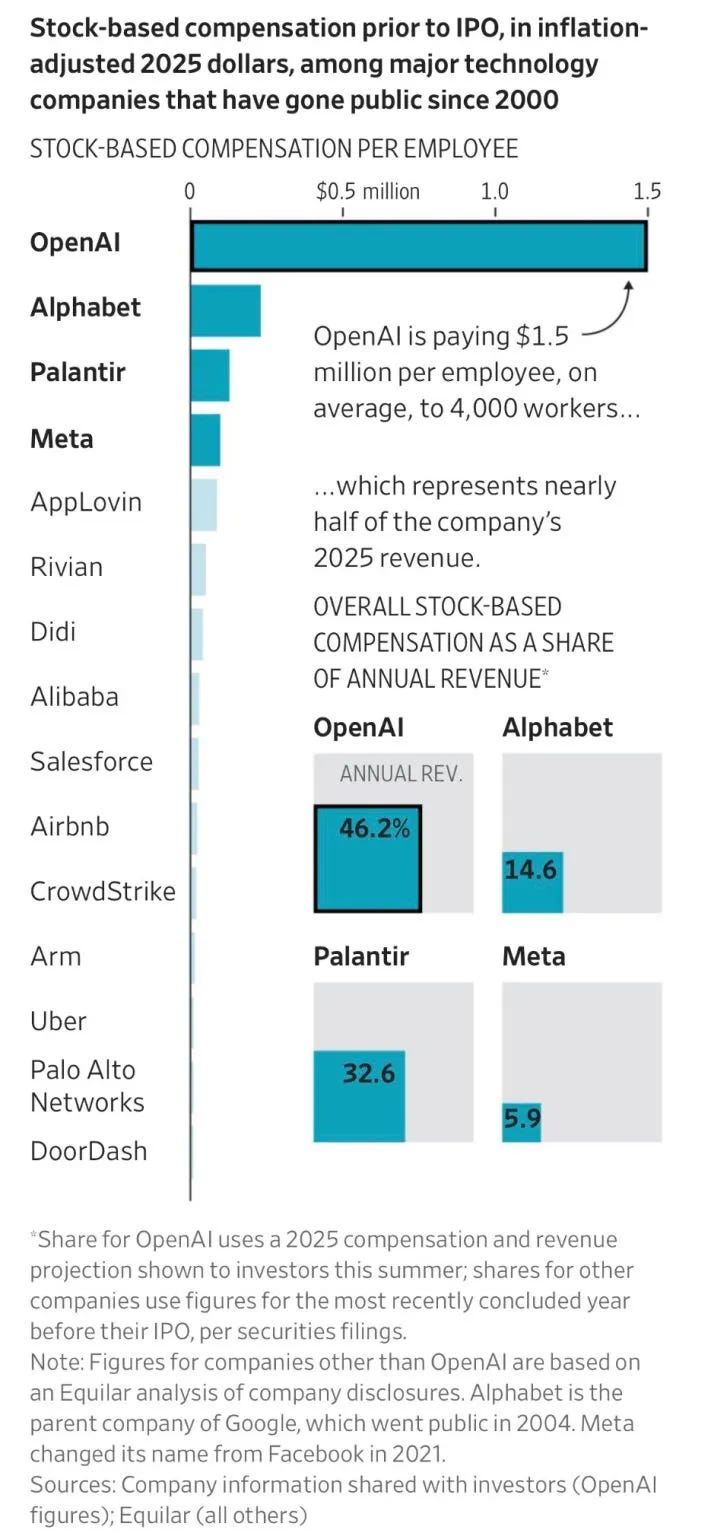
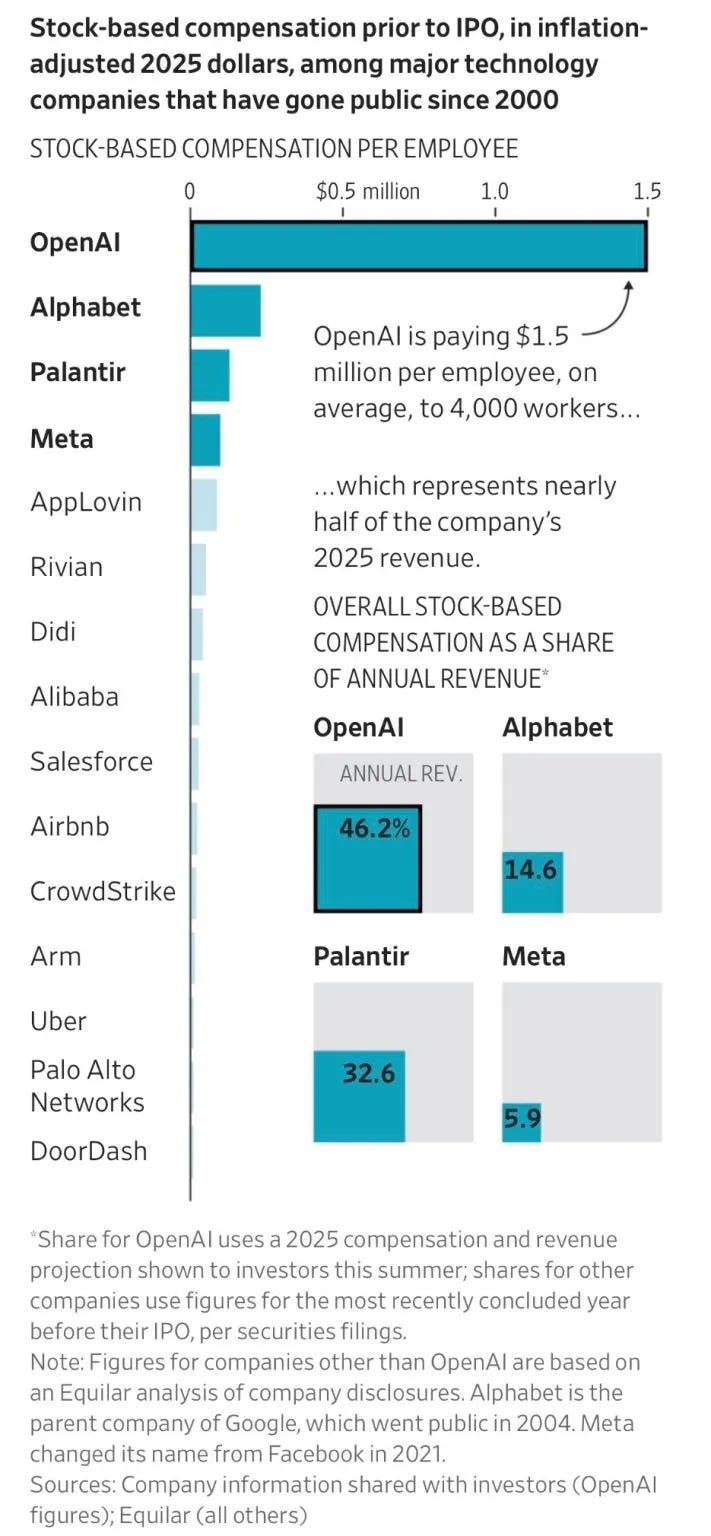
OpenAI’s stock-based compensation averages about $1.5m per employee across a 4k-person workforce. It’s 34x higher than the average across 18 major tech companies in the year before their IPOs. In 2025, it amounted to 46% of OpenAI’s revenues. - WSJ
OpenAI is breaking all the rules on stock based compensation to preserve its lead in the AI race with mega packages and no vesting despite significantly diluting shareholders.
“OpenAI’s stock-based compensation was expected to increase by about $3 billion annually through 2030.”
“The company recently told staff it would discontinue a policy that required employees to work at OpenAI for at least six months before their equity vests.”
Meta acquired Manus for $2bn+. Manus is a general purpose AI agent for research, automation and complex tasks. In April, Manus raised a $75m funding round at a $500m valuation. It crossed $100m in ARR at the beginning of December, eight months after its product launch and was at around $125m ARR when Meta acquired the company. Initially based in China, the company fully moved to Singapore after raising from Benchmark. - WSJ, Manus, Meta
“Manus gained a wide following after previewing an AI agent in March that was capable of producing detailed research reports and building custom websites.”
“The deal is a move in a new direction for Meta, which is investing aggressively in AI to compete with Google, Microsoft and OpenAI. The deal would help the social-media giant cement its position in the product segment of AI agents, an increasingly intense battlefield of AI companies that make tools to conduct complex tasks with minimal human input. Microsoft has operated a popular AI assistant, Copilot.”
“In just a few months, our agent has processed more than 147 Trillion tokens and powered the creation of over 80 Million virtual computers.”
Stripe acquired Metronome for $1bn. - Upstarts, Pymnts, Patrick Collison
Founded in 2020, Metronome is a billing software specialised in usage-based billing enabling companies to charge customers based on actual usage (e.g. API calls, data processed, agents deployed). It works with AI companies like Anthropic, Cursor, Hugging Face, LangChain, Nvidia, OpenAI and Together. Metronome previously raised a series C at a c.$500m valuation back in Feb. 25.
“Metered pricing is the native business model for the AI era. As far as we can tell, the associated shift in how businesses generate revenue will be as big as the advent of SaaS. (It may even turn out to be considerably bigger.)” - Patrick Collision
For Stripe, the acquisition bolsters a billing business line already estimated at a $500m run-rate, and advances its push to become the default payment and monetisation platform for AI-native businesses.
French CRM platform Brevo raised €500m (mix primary / secondary) at a €1bn+ valuation. General Atlantic (25% ownership) and Oakley Capital (25% ownership) are co-leading the round. The management retained 26% ownership in the company. - Techcrunch, General Atlantic
Brevo will surpass €200m in ARR in 2025 growing 12% YoY and reached a 20% EBITDA margin. It has 600k customers worldwide (including LVMH, Carrefour, H&M and eBay) and has 1k employees.
It will use the capital to expand to the US (15% of revenues today), to add AI features to the product and to acquire adjacent businesses to accelerate the product roadmap or international expansion. Brevo aims to reach $1bn in revenues in 2030.
Brevo started in email marketing but has since then expanded into an all-in-one platform with marketing automation, CRM, customer data management, and communication across email, SMS, WhatsApp, live chat, push notifications, and even integrated sales calls.
It’s another example of secondary liquidity in the French tech ecosystem with Partech fully exiting its stake into the company.
French accounting startup Pennylane crossed €100m in ARR growing 130% YoY. - Les Echos, Le Monde du Chiffre, Arthur Waller
It works with 700k companies implying that 16.7% of French companies are working with accountants on Pennylane. Out of them, 150k are using Pennylane’s ERP and 34k are using Pennylane’s bank account.
Pennylane started its geographical expansion opening Germany earlier this year.
In Sep. 2026, all French companies will have to use a third party like Pennylane to digitally process their invoices.

Entropy
France faces entrenched corporate distress driven by excessive leverage, weak growth and repeated restructurings. - FT
“Corporate bankruptcies in France have reached an all-time high of 68,227 cumulatively over the past 12 months to September. While France is about 16 per cent of European GDP, its companies account for about 30 per cent of all the distressed loans.”
“French companies simply have a lot of debt. The country has been a particularly fruitful hunting ground for private equity, with 4,675 leveraged buyouts since 2015, according to analysis by HEC business school, compared with 2,786 in Germany and 1,749 in Italy.”
“The sorry state of the French economy — with high debt and growth at a miserly 0.7% of GDP this year — does not help domestically focused businesses.”
“There are two ways of bringing French corporate distress back down to manageable levels. The first is to stop adding to the pile, and the second is to clean out the existing backlog. It is not clear that either is happening, however.”
“The amount of total debt piled on to companies during buyouts may have fallen slightly, from nearly six times trailing EBITDA in October 2021, says PitchBook LCD, to 5.7 times in the past year. But that’s still far above the debt loaded on to German LBOs at 4.33 times, and the UK’s five times.”
China warned that a humanoid robotics bubble is forming with over 150 companies now operating domestically in this field. Moreover, we still need to fully solve manipulation and navigation for humanoid robots to become mainstream. - WSJ, Bloomberg
“China’s powerful economic-planning agency warned of the risks of a bubble forming in the country’s humanoid robotics industry with 150 companies in the same field.”
“That recalls past over-spending in sectors from bike-sharing to semiconductors, many of which ended in shakeups that eradicated smaller players.”
“The ruling Communist Party designated the industry one of six new economic growth drivers, in guidelines for drafting China’s development plan for the five years through 2030.”
“Before we imagine robot assistants in every home, it’s worth remembering that we’ve been here before. In 2000 Honda introduced Asimo, a humanoid robot that could walk, run and serve drinks. Robotics enthusiasts hailed it as the next logical step after the personal-computer revolution—a robot for every household. More than two decades later, Asimo sits in a museum, a reminder of how far robotics still has to go.”
“The venture industry has poured nearly $5 billion into humanoid startups that promise to bring down the cost of onshore manufacturing and aim to give millions of Americans a low-cost domestic helper.”
“Robotics problems can be broken down into two main categories: navigation and manipulation. Navigation involves the challenge of a robot getting from point A to point B. Manipulation involves getting a robot to mimic the motions of human hands, and that’s no easy task.”
“Tasks requiring any kind of manipulation will remain human-centric for the foreseeable future. Dentists, surgeons, house cleaners, cooks, HVAC and electrical contractors will all be well-protected from the many advances in AI.”
Thanks to Julia for the feedback! 🦒 Thanks for reading! See you next week for another issue! 👋
Comments
Nothing yet. Say the first thing.
Sign in to join the conversation.