
Hello, readers! If you’re new to The Stelnove Saga, be sure to visit the series landing page here, including the “orientation” (author’s note) page.
Your lecturer also appreciates donations for her coffee supply.
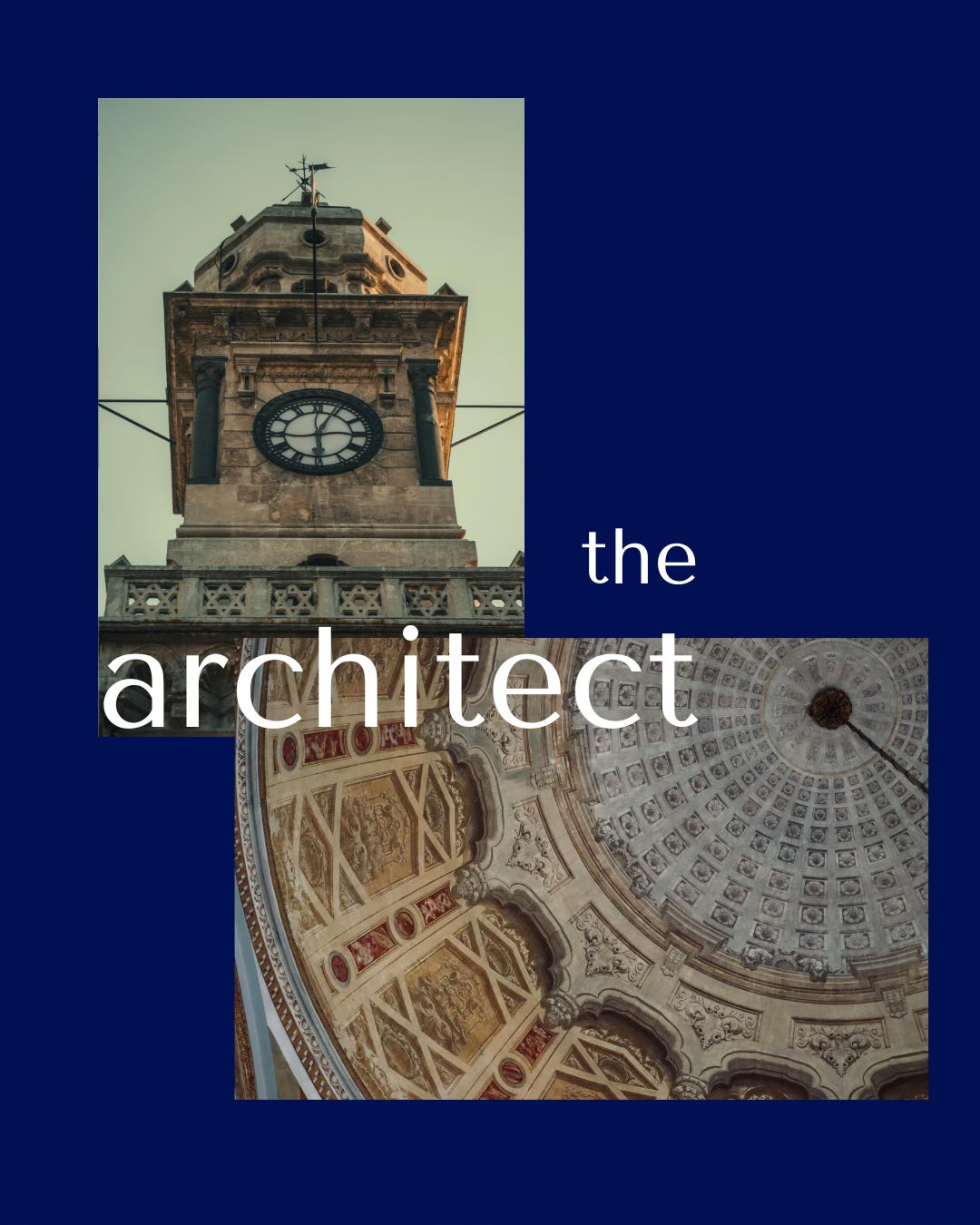
Today’s subject: An architect is brought in to conduct a survey of the clock shop, and Clemenza has an unfortunate realization.

When Clemenza returned to the clock shop, something was off.
“What is it?” Clemenza asked no one in particular. She removed the oversized nobleman’s mantello1, set her bag down at her station, and looked it over to make sure everything was as she’d left it. Papers were stacked properly, movement parts organized, with a nice, clear space for working.
To her surprise, Benigna answered. “The architect is here to oversee building repairs.” She spoke in a flat, reporting tone. “He’s from the Accademia. And a nobleman. And, apparently, handsome.”2
Clemenza rolled her eyes and sat at her desk. If he was both a nobleman and associated with the Accademia, then he stood for everything she had lost and everything she was against.
“He’s coming in,” someone hissed, and the women flocked back to their seats like children about to get caught eavesdropping. Clemenza sighed and took up her clock—a different commission, this one for a merchant—to tighten the fasteners.
Gaspare poked his head in the room a few minutes later. Clemenza glanced over, then returned to her clock. “Ladies, I’m sorry to interrupt. As you know, our building is magnificent, but also old and in need of some structural repairs. Nothing too serious, but I’ve hired an architect to do an evaluation, so he’ll be going around for the next few days. I’m introducing him to the various sectors here, so please say hello to Maestro Gianpaolo Velia.”
A sharp pain skittered up the side of her finger and Clemenza swore. The offending fastener clattered to her desk. Annoyance flaring, she turned her attention to Gaspare and the architect who’d come in beside him.
She burst out laughing.
The man who stood there, a head taller than Gaspare and dressed in a pleated, dark red giornea over a sleek black farsetto, rolled parchment tucked under an arm, was the same nobleman who’d been drunkenly singing opera in the piazza last night and spilled his wine all over her.
Everyone in the room turned to her, and Clemenza shut her mouth. Giggles continued to bubble up within her.3 The architect—Gianpaolo—met her gaze, and for a long moment his expression was a blank mask. His green eyes narrowed behind those gold-rimmed spectacles. Clemenza grinned as his mouth fell open and a blush blossomed up from the high collar of his farsetto.
“Yes, madonna Giudice?” Gaspare snapped. Gianpaolo glanced at him at her surname, most likely recognizing it as one of the dispossessed. Good. After all these years, some dispossessed families had changed their surnames, but Clemenza had always thought that cowardly. Even if she were judged for it, still occasionally given a sneer or even a pitiful look, she’d always maintain hers.
“Niente, niente.” She could tell the whole room of fawning women what a fool he’d made of himself, but no, she’d hold that close until she found a better opportunity to use it.
Gaspare continued talking. Gianpaolo held Clemenza’s gaze for a moment longer before composing himself. His name was familiar.
Velia: the family she’d designed the clockwork weapon for six cycles ago. So, she had been right in assuming this man was related to the one who’d purchased it from her when she saw him on the bridge.
What was a nobleman associated with Ambizioso doing as an architect? He should’ve been serving on the signoria for the Republic of Selvascura or involved in the minor councils. Didn’t he have a wife? He was old enough, but there was no spousal medallion attached to his livery collar.
She cursed herself for devoting so much thought to him, and returned to her work.
“…this is my most specialized sector,” Gaspare was saying. “Upstairs, the workers focus on one particular aspect of a clock at a time. They make larger, commercial clocks and automa. The women in this sector take specific orders from patrons and do everything from start to finish. They are more specialized with watches, table clocks, and smaller devices.”
He was probably boring Gianpaolo. Gaspare never passed up a moment to impress someone with his workshop, especially someone with connections to the Accademia.
“This sector also uses aether in their clocks. Very dangerous, but when implemented, it not only improves timekeeping, but can also create performative functions our patrons find amusing.”
Clemenza didn’t need a reminder of all the bouts of aether poisoning that had left her crippled for days at a time, shaking in her bed and wondering how long it would take someone to find her body if she died alone. All for the amusement of nobles who hadn’t lost their status and those privileged enough to afford such luxuries.
“Right.” Gaspare clapped his hands together. “Back to work. Maestro Velia won’t be long here, then he’ll be out of your way.”
“Pity,” Annamaria muttered from somewhere behind Clemenza, and some of the women snickered.
The nobleman blushed again.
Gaspare left and Gianpaolo, keeping his head down, crossed to the empty desk in the room in one stride and spread out his parchment. He fumbled in his bag for measuring sticks, a pad of paper, and a few pieces of charcoal. Whispers flitted around the room like buzzing owl automi. Gianpaolo didn’t notice, adjusting his spectacles and frowning at the plans before him. Clemenza stabbed a fastener into the casing.
For a while there was only the clicking and scraping of clock parts and the incessant ticking. The quiet conversation amongst the women toned down to their usual topics concerning clockwork, the latest news in the city and republic, and the like. Gianpaolo walked around the room, comparing the plans he had before him with what he saw in person. He scratched notes down on his pad. At one point, he took one of his measuring devices to verify two different parts of a corner, then spent some time writing down calculations on his paper. Benigna was watching him like a snake tracking its prey. She had an automatic distrust of any new person who entered the territory of the clock shop, even if unaffiliated.
Clemenza was prepared to ignore him when he made it to her part of the work room, but she couldn’t resist the remark. “Is opera your hobby or a separate career?”
A flush rose to his cheeks again, but he answered without hesitation. “A pastime after a long day.” He had the lilting Selvascuran accent, a strong contrast to her breathy, soft consonants from Edenico. His speech was well-modulated though, fitting for a noble, no longer the thick dialect he’d used last night.
“It must’ve been a very long day then.”
The whispers had started up again. Clemenza gave a pointed glare at a couple looking their way, giggling at what they’d overheard. Gianpaolo’s eyes flicked to hers before he studied the angle in the corner they were in. Various numbers and equations covered his pad, and some sketches, though Clemenza had barely seen him use a measuring device.
Gianpaolo faced her. He seemed about to say something, but the set in his jaw softened. The hand holding the charcoal trembled. “If you’re looking for an apology, Signorina, you have it. I am sorry.”
“My title is—” Clemenza cut off, then narrowed her eyes at him. Only the nobility used such titles. “Don’t patronize me,” she snapped.
“I wouldn’t dream of patronizing you,” he said evenly. “In the now two encounters we’ve had, you have managed to make quite a fearsome impression in each.”4
She glared at him, but chose not to respond to that. “Apologies are meaningless unless they’re followed by action.” Venom laced Clemenza’s words. She expected him to read the two-fold remark, but if he did, his expression didn’t show it. He would be a good furbizia player.
Again, there it was, the line between his brows, the firm set to his mouth, as if he were about to lash her with his words like any good political noble. It was gone in a moment. His eyes lowered. Clemenza had the urge to snatch the Ambizioso livery collar right off him. He didn’t deserve it.
Then again, which of the nobles had ever deserved their status?5 None of them held up to their assigned Value all the time. Clemenza knew this, somewhere deep in her heart, in the recesses of her memory from the short time when she’d been raised as a noblewoman. They had an endless amount of opportunities to do better, be better, always striving for the common good. No one was completely rejected over a few bad decisions.
Gianpaolo’s eyes fell on the mantello thrown over the back of Clemenza’s chair, and his lips quirked in a smile.
“Cold?” Clemenza asked. “Would you like it back?”
“No, no.” He looked as if he were about to laugh. “Keep it; it suits you.”
This exchange elicited more whispers around them, and Clemenza suddenly realized what the implication might be. Gianpaolo glanced at the other women, then tactfully walked off. Face burning, she abruptly turned back to her work too.
Clemenza did one final check to ensure the fasteners were tight on the case, then took her cloth and polished the shining metal. She set it safely on the top of her desk, then checked the status of her supplies. Before her next commission came, she’d need to make some more plates and wheels.
Clemenza arranged her uprighting tool6 on her desk, then used it to align a couple wheels she’d already begun cutting. She could’ve gotten movement parts from the upstairs workshop, where such things were made much quicker than down here, but she preferred to make as many of the parts herself. She only trusted her own quality. After arranging the delicate pieces in the device, she pressed down on the top of it with the heel of her hand, then twisted the wheel at the bottom with her other hand.
She worked on this for quite a few minutes, then took up her hand drill to create the holes that the tool had marked. Her thoughts returned to the cursed balestrino she’d made for Leonardo Velia. Unthinkable that a noble family would do such a thing. They didn’t murder each other. Not since the Dark Times.
She recalled being a young girl, before the Raids, and being forced to recite and memorize the Values and responsibilities of each of the families. Fede, Speranza, and Carità families to help the poor and negotiate city-state relations. Costanza and Contemplazione families to maintain cultural activities to enrich society. Giustizia and Guerriera families to enforce the law. And finally, Saggezza and Ambizioso families to uphold the law.
She glanced over at Gianpaolo again. An Ambizioso noble masquerading as an architect.
This was what had happened. The dispossession of a few had had the effect of removing players from a furbizia board. You didn’t think it would impact the game until you were left with fewer and fewer players, and realized the whole structure of the game had become unraveled. What was there left to do, other than create your own rules?7
And if everyone created their own rules, what game were they even playing?
Thanks for reading Chapter Three of Of Constellations and Clockwork! Tell me what you enjoyed in the comments.
Supplemental materials:
Check out this video on antique watchmaker tools, including an uprighting tool.
During my research, this was an interesting article I found regarding the use of arithmetic in architectural practice in the Renaissance. While it didn’t directly influence my writing of Gianpaolo as an architect, it was a fascinating read: Sebregondi, Giulia Ceriani. “On Architectural Practice and Arithmetic Abilities in Renaissance Italy.” Architectural Histories 3, no. 1 (2015): 1-15. https://doi.org/10.5334/ah.cn.
I actually wasn’t a fan of the women in the clock shop fawning over Gianpaolo in the beginning because it felt a little too cliché. I also didn’t intend for him to be that noticeably handsome. But this was somehow what organically happened when I wrote the scene, and I felt it worked, mainly because it irritated Clemenza so much.
One of my favorite moments in the whole book.
Real Darcy and Elizabeth vibes here, though I don’t usually think Clem and Gp fit them that much.
I was thinking a lot of here of Catholic teaching in terms of growing in virtue and overcoming sin.
I read about this in Rebecca Struthers’s book, Hands of Time.
Highly thematic and important to Clemenza’s character arc.
No posts
Comments
Nothing yet. Say the first thing.
Sign in to join the conversation.