
Last Friday, SpaceX went public with a market cap of $1.75tn and ended the day at $2.1tn. It was the largest IPO in history by a factor of more than 2x capital raised, and the headlines have all been about numbers: capital raised, market cap, Elon’s status as the first trillionaire ever.
But none of those numbers tell the full, or more interesting, story. Since 2012, I’ve argued Elon’s entities would eventually fold into one (as have many others)—although I’ve always viewed a merger as the beginning, not the endgame. So with the listing finally done, it felt like a good time to share a memo I finished earlier this month.
Pundits (especially on X) have spent the past few weeks arguing about SpaceX’s valuation and price action. I think that’s the wrong question—by any standard valuation method, it’s wildly overvalued. The more interesting question is why people are willing to pay seemingly irrational prices for it. For most, the answer is “the vision,” but I haven’t seen a good one (since Tim Urban’s 2015 piece) that actually lays out what that entails today.
This memo is an attempt at understanding that vision. It simply asks: What if everything goes right?
Behind the paywall is ~7,000 words on: 1) a SpaceX-Tesla merger, 2) Valuation, 3) the cloud business, 4) SpaceX vs Berkshire Hathaway and Alphabet, 5) how culture is what makes everything work, and 6) A wild idea—even by Elon standards. It also includes the Appendix.
For reference, the memo above the paywall is ~6,000 words (15 pages)
The memo is reprinted below as initially completed.
A Letter a Day is a reader-supported publication. To receive new posts and support my work, consider becoming a free or paid subscriber.
Memo
Date: June 6, 2026
Re: SpaceX is building a planetary starter kit
Introduction
SpaceX is on track to go public next week in the largest IPO in history. There’s a lot of discussion about the headline valuation, but I don’t think it’s a good use of most people’s time. Start with what a valuation is even trying to do — Warren Buffett put it as well as anyone:
“The intrinsic value of any business, if you could foresee the future perfectly, is the present value of all cash that will be ever distributed for that business between now and judgment day. And we’re not perfect at estimating that, obviously. But that’s what an investment or a business is all about. You put money in, and you take money out.”
It’s the logic behind a discounted cash flow model: What’s the present value of all its future cash flows? The issue, as any first-year banking analyst can tell you, is that a model can be made to show anything: start with the valuation you want, then adjust the assumption until you show it. It’s why I prefer reverse DCFs: input the valuation and read out the assumptions you’d have to believe. This is particularly helpful in tech because humans can’t seem to grasp exponentials, and a reverse DCF forces the required assumptions into the open instead of letting them hide.
So should we value SpaceX this way? We could—but I’m not sure that’s a good idea. SpaceX isn’t a standard standalone company—it’s the holding company for Elon’s ambition to build what I’ll call a “planetary starter kit” (more on this later). It’s already acquired xAI (which includes X), and once public, I believe it will acquire Tesla and consolidate everything into one entity he firmly controls. The result is a vertically integrated machine that, in a friend’s words, “eats sand on earth and poops out compute in space.” Even a merger model breaks down, because the lines that matter most—Robotaxi and Optimus—are only on the cusp of monetizing, so there’s almost nothing yet to model.
While I won’t do a reverse DCF, I’ll adapt its logic: the tool backs assumptions out of a price; the logic backs requirements out of a vision. So that’s what we’ll do: treat Elon’s grand vision as the “valuation,” and work backwards to what we’d need to believe for it to be real.
I want to be clear that this is a purely exploratory memo — nothing in it is a forecast, nothing is a valuation, and nothing should be treated as gospel. It’s an attempt to take seriously the question Marc Andreessen and Josh Kushner have both publicly posed: what if everything goes right?
In that spirit, the memo explores Elon’s vision in three movements, each building on the one before:
The system as a sequence of loops: how the pieces compound into a single machine.
How that machine becomes a planetary starter kit: the bill-of-materials for a civilization.
A track record of turning plans into reality: the reason to take the first two seriously.
And then, having laid the vision out, it closes where the reverse-DCF logic always points: what we’d need to believe for it to work.
Again — this is a vision memo, not an investment memo. The question it sets out to answer is simply this: what is Elon’s master plan for SpaceX (not Tesla; he’s published four of those), and, however improbable, is it possible?
Three Lenses to Frame this Memo
Before we jump into the vision movements, I want to share three frameworks that will shape the rest of this memo: 1) fixed-point variables, 2) log-scale timelines, and 3) back-cast laddering.
Fixed-point variables
This is my name for a framework that has been shared by both Warren Buffett and Jeff Bezos. Buffett has said he looks for businesses where he can “predict what they’re going to look like in 10 or 15 or 20 years”—this is why he’s avoided tech: the industry moves so quickly that he can’t grasp how a company might look in 3 years (much less 10), unlike electricity, railroads, or insurance. Bezos has shared a similar thought: “I very frequently get the question: ‘What’s going to change in the next 10 years?’…I almost never get the question: ‘What’s not going to change in the next 10 years?’ And I submit to you that that second question is actually the more important of the two—because you can build a business strategy around the things that are stable in time.”
Apply this to SpaceX: at the level of physics and cost curves, some things are more predictable over fifty years than over five. We can’t know what the price of a stock will be, but we do know that sunlight is continuous in orbit, that a falling cost curve eventually crosses a line, that any planet will need energy and transport and connection. Planets and economies have needs just as humans do. They are the fixed points, and they are why feasibility, not price, is the question worth asking.
Log-scale timelines
This is my name for a framework Steve Jurvetson shared with me: “I like to think about things on 5-, 50-, and 500-year timelines.” He had built a thesis around electric cars (and became one of Tesla’s earliest investors) because he applied this to gas-powered vehicles: “Will we all be driving electric vehicles in 5 years? No shot. What about in 50 years? Maybe, but probably not. What about 500 years? Absolutely. At the very least, there’s zero chance that we’ll be driving gas-powered cars.” This is about inevitability: once 500 years answers “yes,” the question stops being whether and becomes when can it be accelerated and who is the right person to tackle it.
Apply this to SpaceX: Will SpaceX be a planet’s infrastructure in 5 years? No shot. In 50? Maybe. In 500? If we are anywhere off this planet at all, it is hard to see how the answer is no.
Back-cast laddering
This is my name for another framework Jurvetson shared with me. I had asked him why he was friends with someone who regularly promoted seemingly outrageous things (like asteroid mining). He shared two thoughts: 1) people on the fringe are more fun and have more fun ideas, and 2) ideas that seem outrageous may actually be grounded in rigor. He said of the asteroid-mining proponent: “Look, it may sound absurd, but [Person] is really good at breaking up absurd ideas into 28 steps and walking you through each step individually in a way that no individual step sounds absurd.”
Apply this to SpaceX: What does SpaceX dream of being? Then take a look at its list of assets, and organize them by companies and layers. You’ll see that what initially looked like an intimidating mountain turns out to be a ladder (albeit with daunting rungs). Take orbital datacenters: it’s easy to doubt the power, but the power is the easy part. The hard part is shedding heat in a vacuum. That’s engineering, not physics, meaning it may be improbable, but it’s not impossible.
The system as a sequence of loops
To understand Elon’s ecosystem, it helps to know what it actually comprises: SpaceX (Falcon 9/Heavy, Starship, Dragon, Starlink, and planned orbital datacenters), which now owns xAI (Grok, and Colossus, which doubles as a neocloud) and, through it, X (the app and X Money); and Tesla (vehicles, FSD, Robotaxi, Optimus, and Energy — Solar, Powerwall, Megapack, Supercharger). Around the edges sit Terafab (a foundry JV between Tesla, SpaceX, xAI, and Intel), The Boring Company, and Neuralink. (See appendix for full taxonomy.)
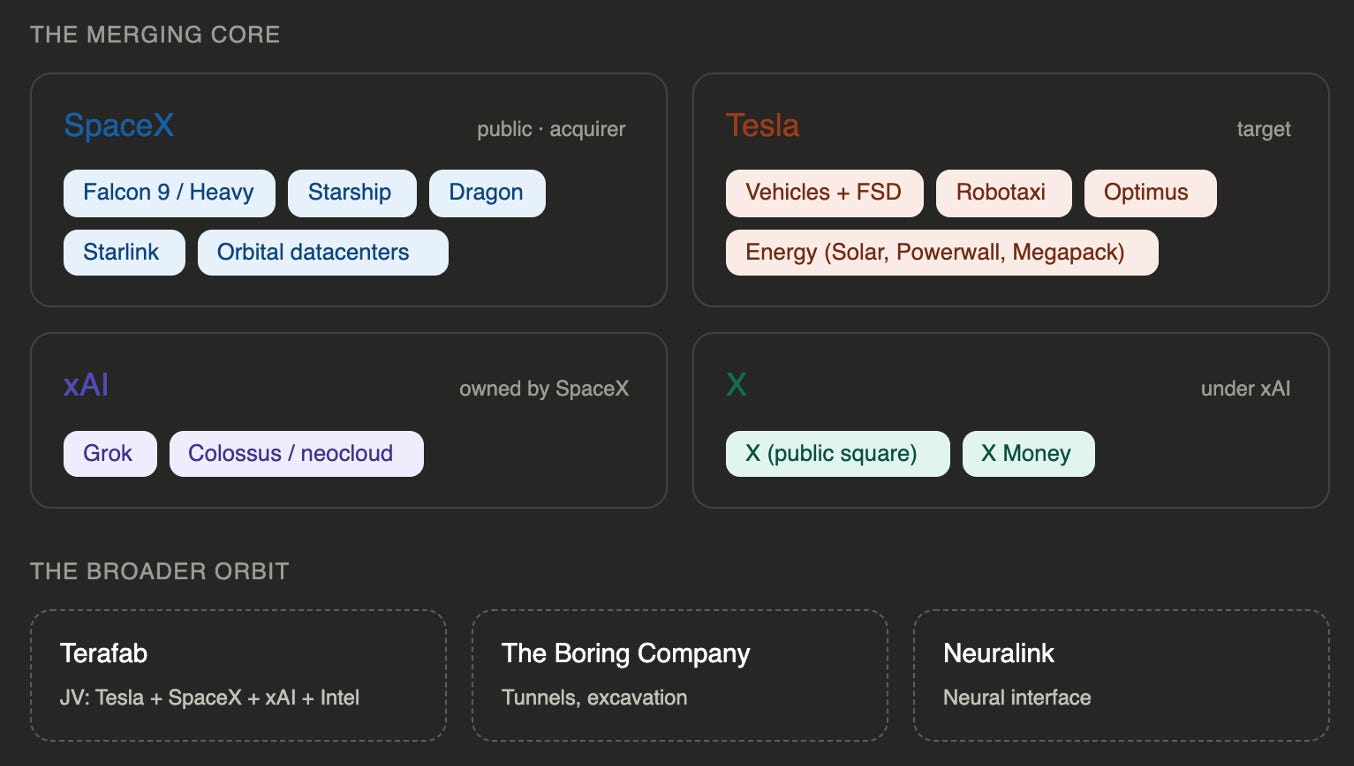
Above you’ll see the assets grouped by company—who owns what. And it’s an easy grouping, but the wrong grouping. Instead, we should group these components by function. And once we do, we’ll see that the corporate boundaries dissolve—Tesla shows up in energy, transport, labor, and silicon, and SpaceX appears in launch, connectivity, and compute. The components don’t sort into companies so much as layers, and as the companies repeat, we start to see the shape of a holding company whose structure is unified and more elegant than multiple different entities.
There are two ways we can group these components: 1) a stack, and 2) a web.
As a stack, the components organize into layers: energy, connectivity, autonomous transport, humanoid labor, launch & logistics, compute, silicon, and the digital substrate (X and X Money) a society runs in (not on).
Threaded through the top of the stack is a single general intelligence: a digital brain that drives the cars, animates the robots, writes the software, and runs on the compute that Terafab builds and that the brain itself helps design.
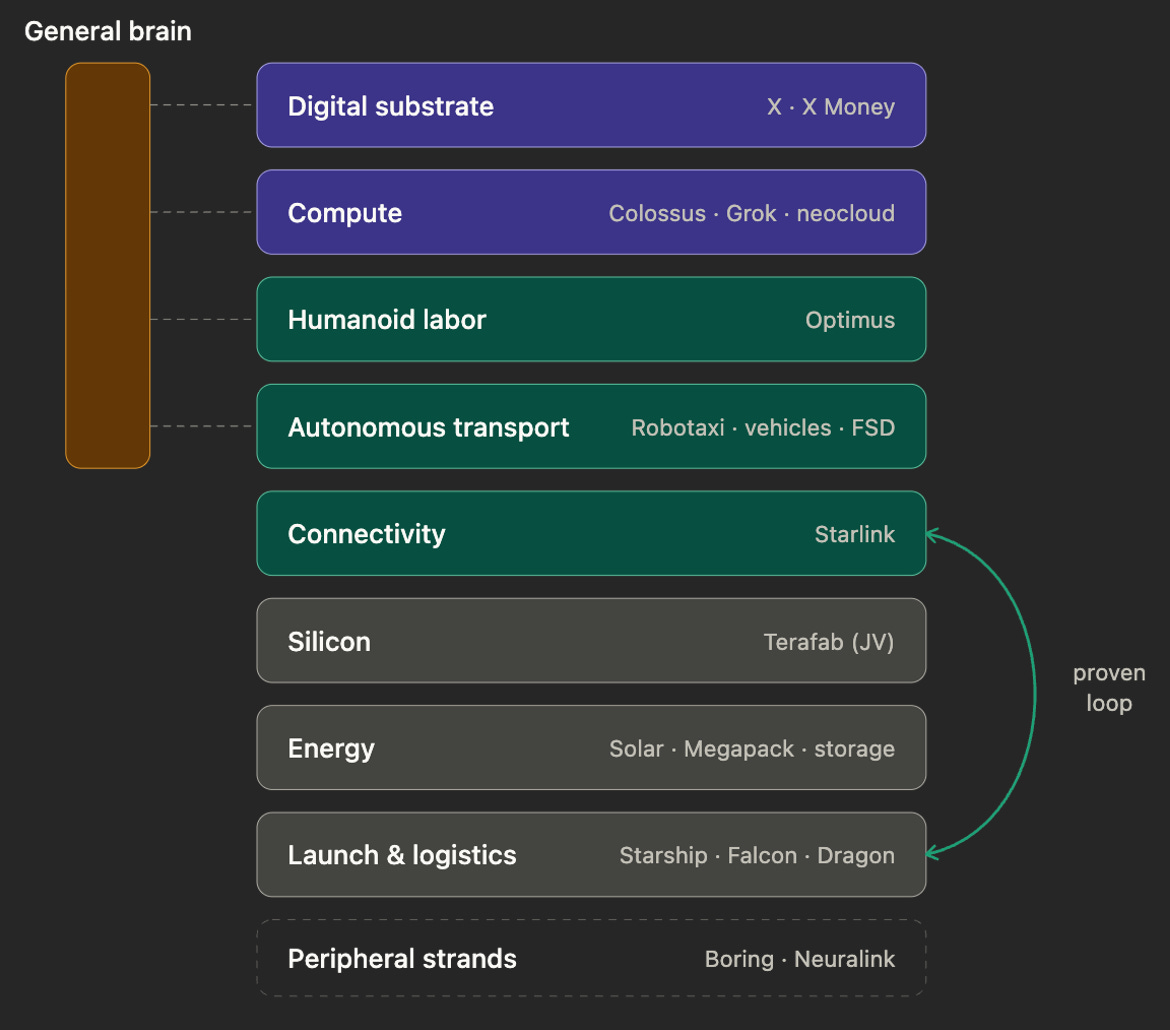
Stack the layers and something begins to emerge. On its own, it’s impressive, but not mind-blowing. There are plenty of large technology companies that own multiple layers of an industry that can be illustrated as a beautiful stack: chips at the bottom, cloud in the middle, and applications on top. If that’s all there is to this, it would simply be a conglomerate with a tidy org chart, and we could simply run a sum-of-the-parts analysis to value it.
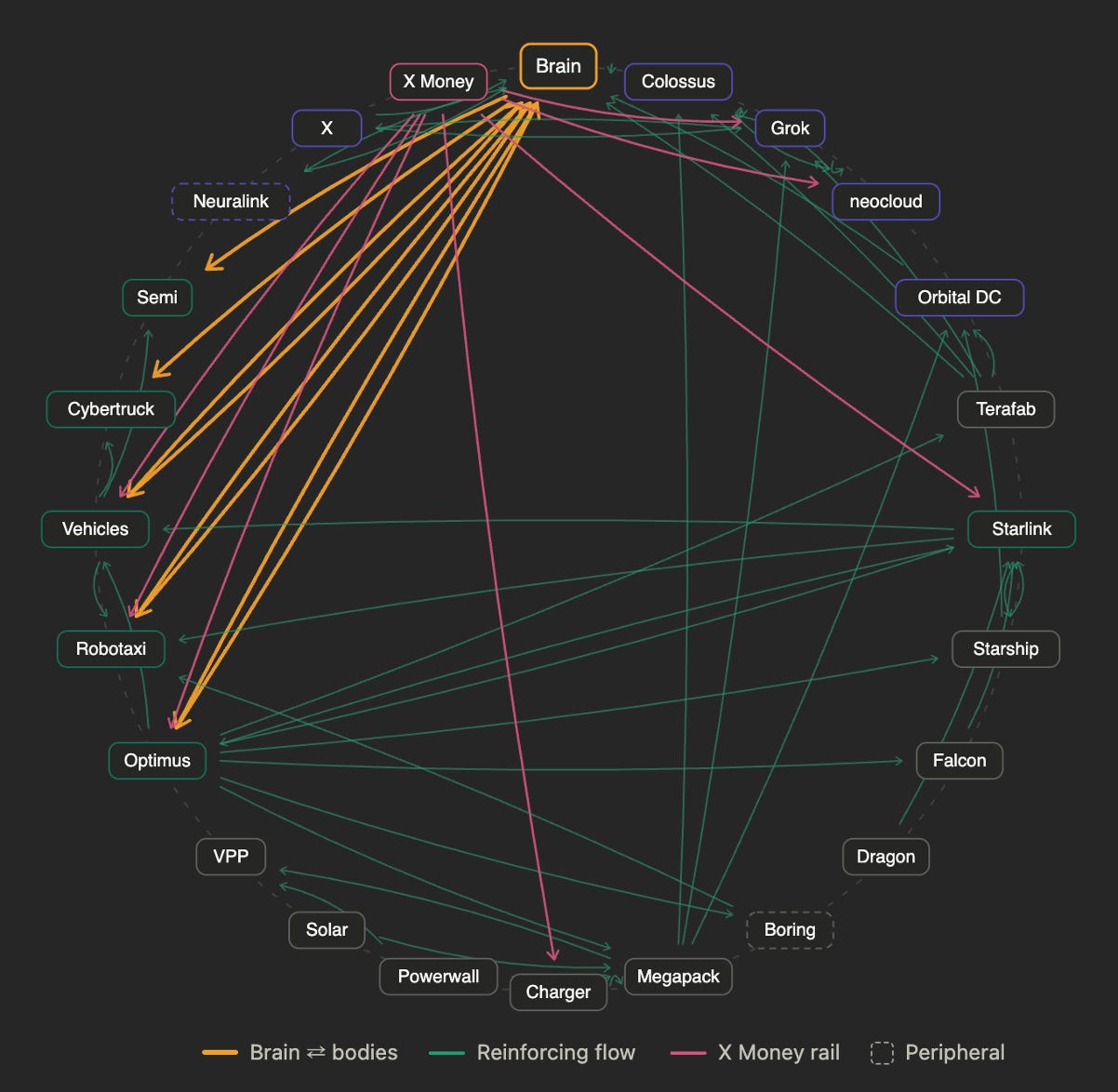
But the layers here don’t just sit on top of each other—they’re wired to and throughout each other. This is where it’s helpful to view the components as a web. The components become the nodes of a graph, and they loop within each layer, between layers, and even across layers in a way that no org chart can properly showcase. There are even nested cycles within larger cycles the way a tide contains its waves.
Take the brain as an example: the same autonomy stack is the brain of both the car and the robot, so a mile driven in Phoenix and a box lifted in a warehouse train one network. Three bodies, one brain, wired across three layers.
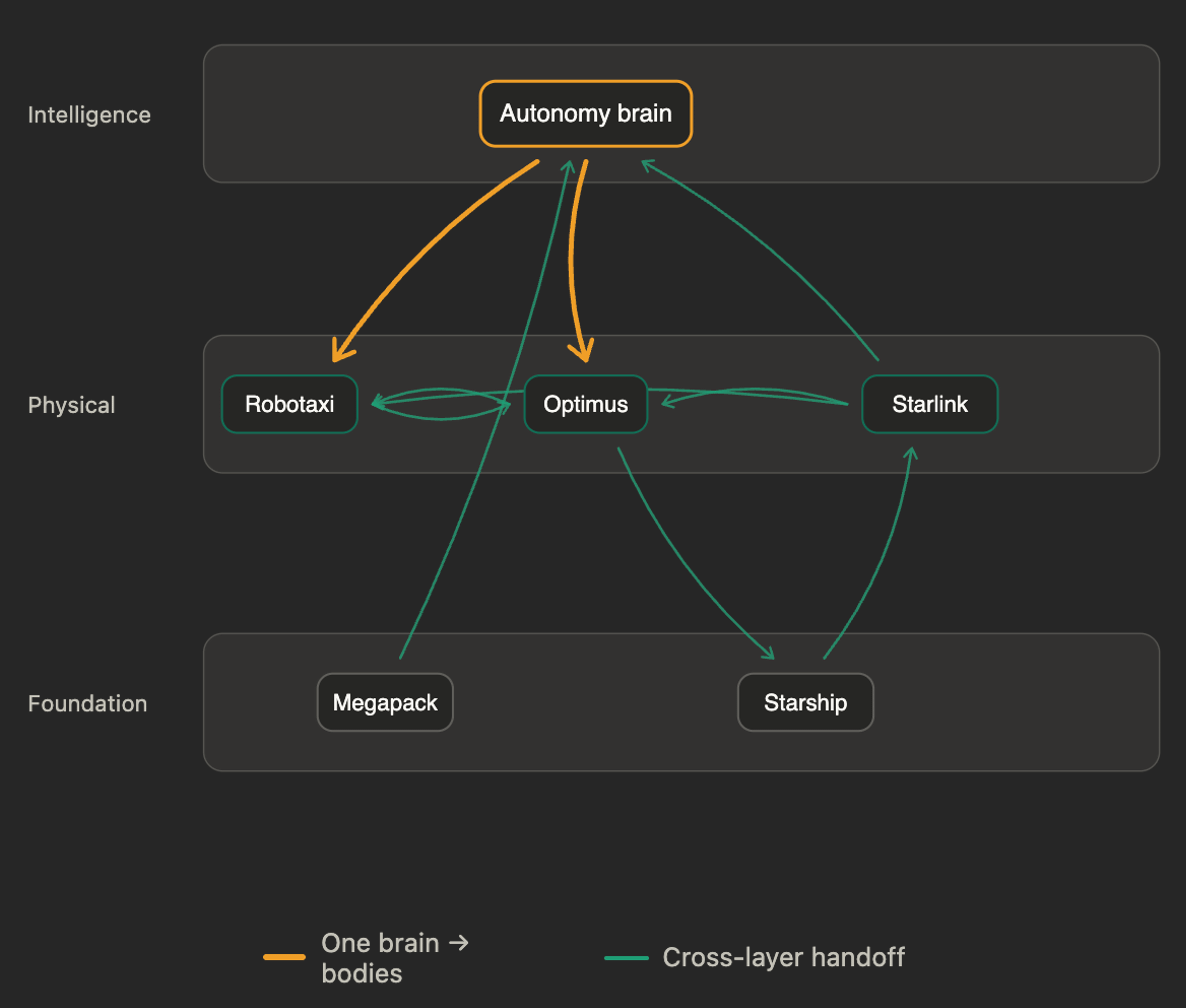
Now multiply this one wire by dozens. Each component connects to other components in other layers: energy powers compute clusters, launch deploys the satellites that in turn connect the cars and the robots, embodied robots build the fabs that make the chips the brain runs on. The connections close into loops, and the loops nest inside larger loops. Even the money is a loop: X Money is a settlement rail that can sit under every fare, every subscription, every kilowatt-hour and hour of robot labor, drawing a thread from every other loop’s cash flow.
But that’s not all. Beneath even that runs the deepest loop of all: the loop between the digital world and the physical world. Intelligence in software scales the way software does: you can copy it a million times for essentially zero cost. But it’s trapped in the digital world, and can’t interact with the physical. Optimus changes that. Optimus serves as a body for that brain, giving it a pathway to interact with the physical world. And because the same brain can be implanted into every body, physical labor can start to scale like software does. Those bodies can then build the substrate (chips, energy, robots) that the intelligence runs on. So we get physical scale that begets digital scale that begets physical scale that begets digital scale. Put that all together, and the full web looks less like a diagram and more like a circulatory system.
The web’s compounding is enabled by the breaking of two bottlenecks: 1) cheap launch, and 2) cheap compute. The launch story is one of the cleanest cost collapses in modern industry—it’s already gone down an order of magnitude, from ~$18,500 to ~$2,700 to ~$1,400 (~92%), and is targeted to reach ~$150, which would make it two orders. That last rung is a Starship figure, so apply the standing discount: the timelines slip. But the relevant fact was never any single number; it’s the slope. A curve that steep doesn’t merely lower a line item; it moves entire activities from the column marked uneconomic to the column marked inevitable.
At $18,500/kg, an orbital datacenter is a thought experiment and a satellite constellation is a few hundred birds you ration carefully. At $150, the datacenter is a procurement decision and the constellation is tens of thousands of satellites blanketing the planet. Nothing about the physics changed; only the price did. But a price falling far enough is indistinguishable from a new law of nature: things that could not be done simply start getting done.
And when things start getting done, what unlocks can be divided into two types of loops: 1) the ones that are already turning, and 2) the ones that are still bets.
Some are closed and turning today. Launch carries Starlink; Starlink’s revenue funds the next launch. This loop is already closed and visible in the financials: the rockets pay for the satellites that pay for the rockets. Others are open, taken on “what if it works” terms. The big one right now is autonomy feeding humanoid labor. The bet is concrete enough to picture: one brain, trained on billions of real-world miles, poured into a body that costs a few dollars a day to run (cheaper than the human whose work it does). If that works, labor stops being a headcount and becomes a fleet you manufacture. The gate is equally concrete: the brain has to actually drive, and fully autonomous driving has been two years away for the better part of three decades. The proven loop earns the speculative one (presenting them as a single undifferentiated flywheel would spend the credibility of the first on the second, so the appendix marks which is which throughout).
Here’s the part that makes the whole thing more than a conglomerate: the loops compound only on a single balance sheet, because the handoffs that make them work would not survive a market boundary. The parked car that becomes a Robotaxi, the one autonomy stack that is the brain of both the car and the robot, the idle cluster that becomes rented compute, the embodied agents that build the fabs they then run on — none of those transfers would clear cleanly between independent companies bargaining at arm’s length.
Take just the idle cluster. Inside one firm, a training run that finishes early frees compute that’s immediately resold as inference capacity, at marginal cost, with no negotiation. The spare capacity simply flows to its next use. Between two firms, the same handoff is a contract: one side prices the capacity to extract margin, the other guards its workloads as competitive data, and neither hands scarce compute to a rival at cost. The transfer that is automatic inside a single owner becomes a standoff across a market boundary, and the value that would have compounded leaks out in the friction.
Multiply that by every handoff in the web and the conclusion is forced: a confederation of best-in-class specialists could not run this, because the seams are where the value lives, and only a single owner holds the seams. Part of that edge is legible in the specific transfers above; another part is the harder-to-quantify advantage the great do-everything platforms capture that pure-plays never quite can — being good enough at everything and owning the connections between them (the thing Google and Amazon and Tencent have and a collection of focused competitors lacks). This is the structural reason the rest of the memo rests on “one operator.”
This returns us to the question back-cast laddering taught us to ask: not whether a given link is probable, but whether it’s possible — and if so, whether the cost curve bends fast enough to carry it from uneconomic today toward inevitable. That’s where the real argument lives, and it’s worth closing on a skeptic. Elon has told the story of a lunch with Charlie Munger, who laid out every way Tesla would fail; he recalled of the conversation, “Made me quite sad, but I told him I agreed with all those reasons & that we would probably die, but it was worth trying anyway.” Years later Munger said he didn’t recall that specific conversation, but stated plainly that Elon had gone on to perform “minor miracles.” A skeptic can be airtight on every fact he has because he is reasoning from the world as it is priced today — but the whole wager is that the price is about to move. The case against can be correct and the bet can be right at the same time because the question was not whether it was safe—it was whether it was possible, and getting cheap.
The Planetary Starter Kit
Let’s return to the loop. Look closely and you’ll see it’s not just a matter of stacking adjacent layers. Together, they make a vertically integrated machine that, in a friend’s words: “eats sand on earth and poops out compute in space.” Take the analogy further: that compute beams back down to power the digital brains and physical robots that act on the world: robots that mine the sand and build the next launch. The loop closes. But it isn’t only a single loop spinning in place: the same AI-powered robots can build the launch infrastructure that carries the whole loop to another planet. It doesn’t just spin, it picks up and moves.
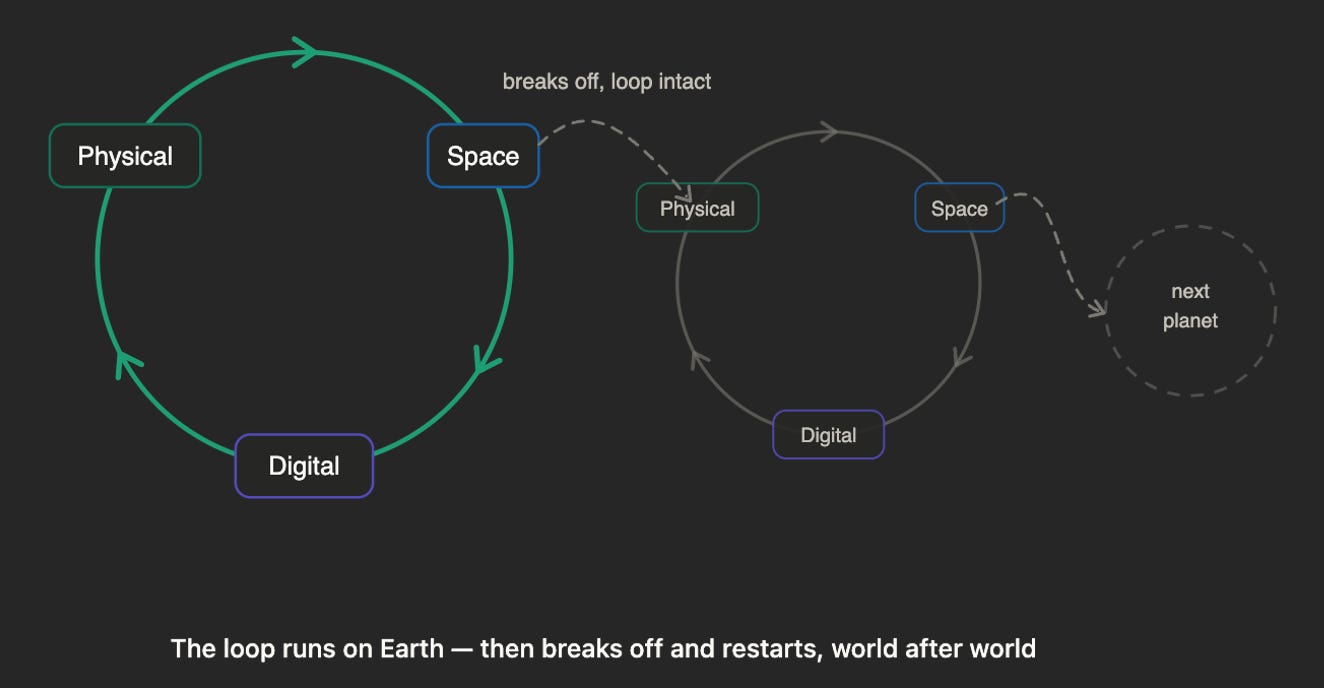
Simply getting to another planet isn’t enough though—you have to be able to survive when you get there. So take a closer look at what’s in the stack: energy (generation and storage), connectivity (a satellite network that needs no ground infrastructure), autonomous transport, humanoid labor, shelter and life support (habitat dug underground, which may be necessary on planets with radiation high enough to make the open air lethal), and the launch logistics to deliver all of it. Then the AI as the general brain, which drives the machines, animates the robots, writes the software, and coordinates the rest. And lastly the digital substrate today’s society runs on as much as the physical one: a public square to bind a people together, and a payment rail to move value among them. Not one piece each, but the whole set.
The easiest way to feel the scale of this is to think of it as a mini ecosystem — an economy, if you will. Map it to Earth: imagine a single firm that is simultaneously its planet’s TSMC and its NextEra, its AT&T and its Uber, its Boeing and its OpenAI, its Visa and its Meta — and, on any given world, the first, and, for a while, the only one of them that is there.
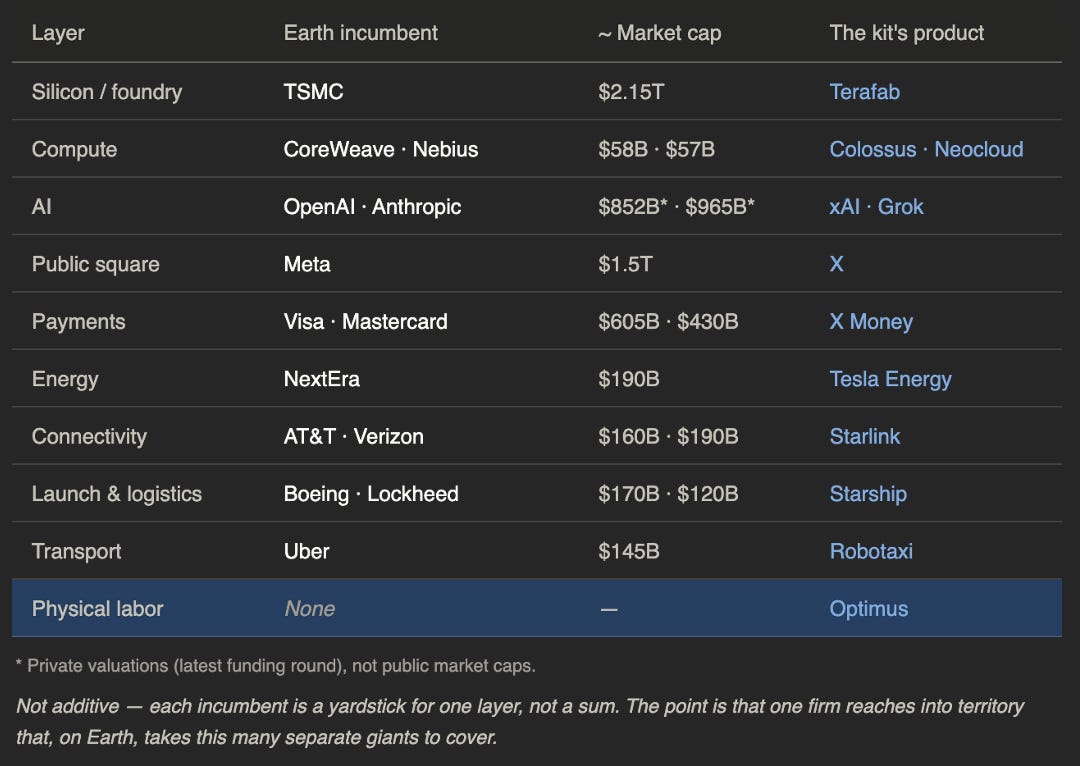
The table above is an identity mapping for each layer. Take a look at the highlighted bottom row: Physical labor. There is no Earth incumbent to name because human labor has never been a single company. This means Optimus doesn’t displace an incumbent the way the other layers do; it’s the only layer with no corporate incumbent. The incumbent is human labor itself, the largest market there is. No firm has ever sold into it before.
Now follow the kit off Earth: the loops stop being an efficiency story and become a civilization story. This same kit, loop and all, can “break off” and be deployed to new worlds, loop intact. From Earth it can be sent to the Moon, then Mars, then beyond. It is recurring, critical infrastructure: a per-world monopoly at founding that converts into recurring revenue as the colony grows (and then erodes as competition intensifies). In many ways, it is an entire economy: it owns the infrastructure, the commerce that runs on it, the means of coordination, and the medium of exchange itself. And not by conquest, but arithmetic: it’s the only actor present. It gets a monopoly-like position at founding, although it is temporary by nature, because as each planet fills in and grows its own population, so too will its politics and its competitors.
The same logic implies a split worth holding onto: 1) what this system is, and 2) what it is not. On Earth, the system is a prototype iterated under heavy competition. It won’t — it can’t — be number one at every layer. For several layers, it won’t even be in the top three. It won’t beat TSMC at foundry, it’ll be hard to beat the frontier labs at AI, and it won’t be a bigger energy provider than NextEra. But best-in-class at each layer was never the point—the point is proving out the model of vertical integration and refining the ability to build a platform advantage (the one Google and Amazon and Tencent capture by owning the seams). Off-world is a different motion entirely: not competing for a layer someone already holds, but horizontal expansion into ground no incumbent holds at all, where being the only show in town is good enough for a monopoly. While this may seem far-fetched, remember that for decades experts said it was impossible to create a new American carmaker (or beat the Japanese), or to out-launch and out-engineer NASA. Now we have Tesla and SpaceX.
SpaceX acquiring Tesla would be the corporate embodiment of all this: the moment the bill of materials becomes one balance sheet and one mission, when the integration edge stops being an argument and becomes a cap table, and “the operating system for civilizations” stops being a metaphor. A short word on mechanics, kept minimal since this memo is about vision, not financials: it’s less a SPAC than a reverse merger in which the shell is the crown jewel. What it shares with a SPAC is purpose, not emptiness. A freshly public, ~$1.75tn SpaceX is not an empty vehicle but a control-consolidation one. SpaceX has to be the acquirer because Elon holds a supervoting majority (~85%) in it and a far smaller share of Tesla; to consolidate control, Tesla must be absorbed by SpaceX rather than the other way around.
The off-world thesis pays for itself by removing one of Earth’s biggest limiters: energy. In space, the energy ceiling relocates (it doesn’t vanish). In orbit, sunlight is continuous and unattenuated: no night, no atmosphere, no weather. With batteries, anything that isn’t immediately used can be stored, so the binding constraints move. First to collection area (how much surface you can deploy to catch sunlight) — and deploying surface at scale is precisely what cheap launch is for. Then to waste-heat rejection, the one constraint that tightens in a vacuum, because radiation is the only way left to shed heat. This isn’t to say energy is free in space, but the ceiling rises by orders of magnitude. We can’t contain the Sun, and off Earth that bound doesn’t vanish — it resets by orders of magnitude, then re-binds against radiator physics.
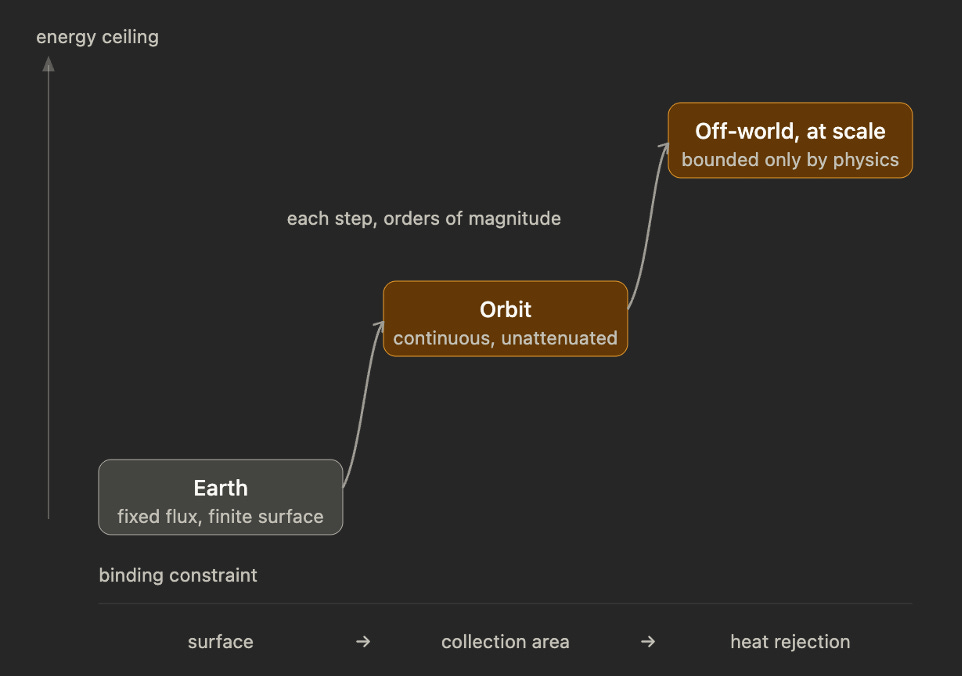
Its deep form is the Kardashev climb: a civilization that harnesses first its planet’s energy, then its star’s — which is what “the operating system for civilizations” means, taken to the limit.
SpaceX (and Tesla) is not “rockets and cars,” but “the operating system for civilizations.”
A track record of turning plans into reality
At the crux of any vision is whether the vision-holder can turn it into reality. That breaks into two questions: 1) is it physically possible to build, and 2) has the person done it before? The prior sections explored the first question. This section explores the second. As they say in finance, “past performance is not indicative of future results,” but I’d wager most people study the past to try and get a better sense of the future. As the other saying goes, “history doesn’t repeat, but it does rhyme.” A track record establishes a direction and a base rate, and can provide some comfort that someone is capable of the improbable.
Fortunately, for Elon, or more precisely, for Tesla, we have four master plans spanning two decades to study. Read them in sequence and they make up a whole, widening along a single axis: cars, then energy, then planet, then abundance. They aren’t timelines, but they are goals we can grade.
The first, in 2006, was a ladder: 1) build a sports car, 2) use the money to build a sedan, 3) use that to build a mass-market car, and 4) add clean power generation along the way. Enter at the top of the market, then drive down. That is exactly what happened: Roadster, then Model S, then Model 3. And the category around them was a graveyard: Fisker gutted, Coda bankrupt, short-sellers holding something like 40% of the float and waiting for the end. They were late on dates and pricing, but they shipped. What’s easy to miss is that there was no electric-car industry to ship into — EVs had been invented in the 1800s but abandoned. Tesla didn’t join the market so much as make one.
The second, in 2016, widened the plan: 1) storage fused with generation, 2) expansion across every vehicle segment, 3) full autonomy, and 4) a car that “could make money for you when you aren’t using it.” Most of it shipped: the Model Y, the Cybertruck, the energy business, FSD now running real commutes. The piece that hasn’t, the Robotaxi fleet that earns while parked, is currently in beta and scaling. Everything was late again, and once more it nearly ran the company out of cash: the Model 3 ramp was, in Elon’s own words, “production & logistics hell,” and brought Tesla within about a month of bankruptcy before a 2020 free-cash-flow inflection that critics had sworn would never come. Late, even late enough to scare, and still delivered.
The latter two plans — 2023’s electrified planet, 2025’s sustainable abundance — are too early to score; they widen the axis, but the clock hasn’t run. Elon may have been late on every plan old enough to judge. But deliver he has.
But simply delivering doesn’t excuse the lateness, which more than once has put his companies at the brink. The starkest was 2008, before any of these plans had paid off. Musk poured the last of his PayPal fortune into Tesla and SpaceX, split between them rather than let either die, and ended up borrowing money from friends to make rent. SpaceX survived on its fourth and final launch reaching orbit — three failures, one shot of money left — and the NASA contract that followed days later; Tesla’s financing closed at six in the evening on Christmas Eve, three days from insolvency. That he keeps clearing these moments has depended on finding people who believe in the mission and the execution, which isn’t guaranteed to hold forever.
Survival shouldn’t overstate what he’s done: he’s created two trillion-dollar companies, and arguably two industries: the commercially viable electric car, where the category had been abandoned since the 1800s, and commercial orbital launch, where before there were only government programs — NASA among them, the very agency whose contract saved SpaceX, now a customer rather than the only game in town. But he doesn’t win every race he enters. He didn’t create robotaxis (Waymo was there first, and is ahead) and he didn’t create frontier AI (the labs predate xAI and are ahead). And not every moonshot lands — no hyperloop venture has reached meaningful scale, and the Boring Company has gone quiet. Category creation is a low-base-rate capability with spectacular tails.
Against that discount runs a second base rate, pointing the other way. The market has, repeatedly and recently, failed to imagine a giant company multiplying several-fold inside a decade — and then watched it happen. Apple was already among the largest companies on Earth when Berkshire began buying in 2016, near $500bn; people said Warren had lost it, that he was buying another IBM. It became, in absolute dollars, his best investment ever. Today, Apple is worth ~$4.5tn. Nvidia was a ~$350bn company when ChatGPT launched in late 2022; less than four years later it’s ~$5tn. Nobody predicted either—the companies were already massive and the growth looked spent. The lesson isn’t that scale is easy to call, it’s that it’s routinely impossible to call—even from the top.
This is why possibility, not probability, is the lens for this memo: an argument that is airtight about today’s prices can’t refute a claim about where the price is headed in the future. Charlie Munger sat Elon down at a 2009 lunch and laid out every way Tesla would fail; he was, at that very time, the loudest champion of BYD (another electric-car maker), which he has called his best investment. Peter Thiel argued, vociferously, that long-range electric cars were impossible, that there was no new chemistry to be had; he was, and remains, one of the largest backers of SpaceX, another Elon company. Two of the most respected investors alive, each dismissing one Elon venture while funding an adjacent bet on the very same thesis. The point isn’t that they were foolish — they aren’t. It’s that careful reasoning from sound premises can still miss entirely, which is exactly why the question worth asking is whether a thing can be built, not whether the odds say it will.
It helps to see where the system has already found genuine exponential growth. Starlink is the clearest case: roughly $11.4bn in revenue in 2025, up about 50% on the year, and SpaceX’s only profitable segment, throwing off some $4.4bn in operating income. Tesla is the second, having crossed its free-cash-flow inflection in 2020 after losses critics swore were permanent. The AI segment loses money for a structural rather than a damning reason: xAI is building capacity ahead of demand, the same posture Tesla wore before 2020, and that capacity is already monetizing. Their idle compute is being rented to Anthropic for $1.25bn/month and will be to Google for $920mn/month. Both are cancellable on ninety days’ notice, but the labs are starved for compute, so as long as SpaceX can deliver it, the arrangements likely hold – at least until xAI believes it can compete again.
In a valuation exercise the AI losses would be a mark against it; in a vision memo they are simply the cost to build. None of this is to say today’s revenue justifies the price – it doesn’t. But there is a real, profitable engine growing fast enough to potentially fund the build in the future. Whether the rest can be bridged, no one knows. What we do know is that Elon has, as Charlie Munger later conceded, produced more than one “minor miracle.”
What We Need to Believe
Recall the opening’s preference for reverse DCFs, and the back-cast laddering from the three lenses: for each step, ask what must be true, and how large a leap that is.
Given the prior sections, we can start to size things — with three caveats: 1) humans are terrible at exponentials, 2) this is bounded to Earth, and 3) it’s market sizing, not valuation work.
Rather than run a reverse DCF, I’ll think in units: how many subscriptions, vehicles, gigawatts the world would have to absorb. Units isolate the one question that decides the thesis: Can the world absorb this much? — and refuse a dollar figure’s false precision. Not price, but distance: how far each step has to travel, and whether you can believe it can.
Here are a few of the leaps. Notice that they aren’t the same kind – they get harder as you go.
Scale: increasing the amount of a known quantity. Starlink would have to grow subs from ~12mn to 100mn+ (more than any ISP on Earth carries today). This is the most believable because nothing new has to be invented — the satellites work, the terminals ship, the model is proven. What has to hold is the cost curve: each new sub has to stay cheap to serve as the constellation densifies, so that scale compounds margin instead of eroding it.
Category: building out categories that are still nascent. Tesla would have to be reborn around Robotaxi and Optimus, two businesses that today make little revenue and no profit, rather than the cars it sells now. The bet isn’t that Tesla sells more cars; it’s that the car becomes the least of what Tesla makes. That’s a harder thing to believe than scale, because the evidence is mostly forward-looking — but it’s the same move the company has made before, from roadster to sedan to mass market, one rung at a time.
Capability: creating capabilities that don’t yet exist. The AI would have to cross from acting on information to acting on matter. The other two leaps are about more; this one is about first. No amount of scaling today’s models gets you a robot that can reliably do physical work in an unstructured world — that’s a capability that has to be achieved before it can be sized, which is what makes it the hardest bet of the three, and the one the rest depend on.
That last crossing is the hardest. Today’s models move bits: they answer, they transact, they write. The thesis needs them to move atoms: to drive the machines, animate the robots, do the physical work of building and tending the kit. It is the leap with the least precedent, and the one the whole system waits on. Without it, the loop never closes.
Each leap seems improbable; not one seems impossible.
The leaps above are measured against today’s markets: more subs than any ISP, more autonomy than any fleet. Now throw the markets out, and ask instead what a planet needs (energy, transport, connection, labor, coordination) whether or not a market for them yet exists. It runs the opposite way: forward from physical limits, not backward from price.
A note on how to read the table below: the floors are real and sourced: a capable humanoid body already sells for ~$16k (Unitree), and falling fast—lower than Optimus’s ~$20–30k target implies. The ceilings are the opposite kind of number, order-of-magnitude scaffolding, possibilities not probabilities. Don’t bother adding the rows—each is its own yardstick, not a line in a SOTP.
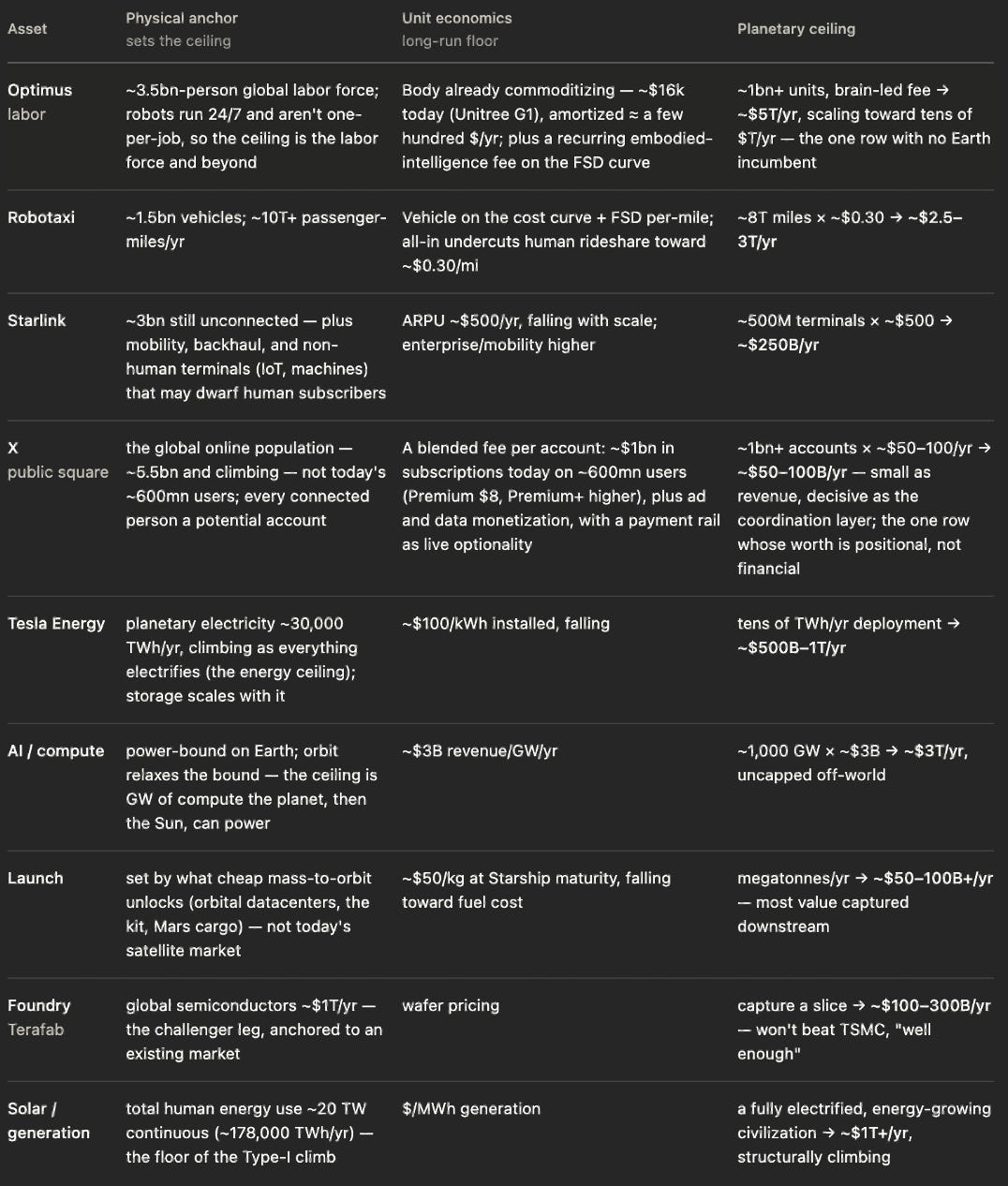
Two things are worth focusing on: 1) the Optimus punchline: a machine that runs around the clock, at an all-in cost that falls below even the cheapest human labor, is priced not against a wage but against the global cost of labor itself (a German factory line and a household paying a dollar a day, alike). And because the body is already a commodity, the durable value sits in the recurring brain: the loop surfacing inside the unit economics. 2) the hinge: the bottom row’s anchor, total human energy use, is the floor the next rung climbs from — so the one-planet exhibit hands off, without a seam, to the scale of a civilization.
That hand-off leads to the largest claim in the memo, and it rests on a single number precise enough that it can’t be quibbled into vagueness. A Type-I civilization on the Kardashev scale (canonically, one that harnesses energy on the order of 10¹⁶ watts, roughly the sunlight a planet like Earth intercepts from its star) runs on the order of 500× humanity’s current ~20-terawatt draw — the same bottom-row anchor from the exhibit, now read as a ceiling rather than a floor. It’s an asymptote the kit climbs toward over centuries, not a target it reaches in any horizon a spreadsheet could hold. That is the whole content of “the operating system for civilizations”: not a slogan but a measurable ceiling. Think of it as one yardstick at three scales: down sizes the businesses, the exhibit sizes one saturated planet, and up sizes the vision — and not one of the three has priced the company.
These are the conditions that must be true, and each is stated as a condition, not a risk, because a “what if it works” memo needs falsifiable requirements, not a list of exits. There are three:
Capital. Building categories from zero is enormously capital-hungry, so the question isn’t whether the money is large (it is), but where it comes from, and at what dilution. The down payment is already in hand: a profitable Starlink growing ~50% a year, which makes the build fundable rather than speculative. Not enough on its own today, but a base that compounds — and one Robotaxi and Optimus would widen.
A “single” operator. A thesis that rests on one balance sheet rests, underneath that, on a single integrating core — the tight group Shaun Maguire calls “Elon the collective,” a few dozen people who price the handoffs no market would clear. The real condition is whether that integration outlasts the person who binds it, because right now Elon is the binder.
Colony productivity. A world must eventually generate enough surplus to pay for the infrastructure that sustains it. That same productivity turns the founding monopoly into recurring revenue — and, as it grows into population and politics, erodes the monopoly in the same motion.
Now pause and think through the memo. However improbable its contents, ask whether any link in it is actually impossible. None is — not the launch curve, not the orbital radiator, not the labor whose only incumbent is human work itself. Each rung, taken alone, breaks no law of nature. So the whole improbability collapses onto a single question, and a sharp one: whether one integrating core can hold every seam across a single arc — and “one operator” isn’t a flourish but a structural claim about that core and the balance sheet, carried to its end.
I won’t relitigate the improbability. The finding is narrower than “it works” and harder than “it might”: no part of this is ruled out, and what’s left is one bet, named exactly. For a future this large, that isn’t a small thing to be able to say.
If you’ve made it this far, thank you for reading. If the subject of this memo is something you’ve been thinking about, I’d love to hear from you (email; twitter).
Behind the paywall is ~7,000 words on: 1) a SpaceX-Tesla merger, 2) Valuation, 3) the cloud business, 4) SpaceX vs Berkshire Hathaway and Alphabet, 5) how culture is what makes everything work, and 6) A wild idea—even by Elon standards. It also includes the Appendix.
For reference, the memo you just read is ~6,000 words.
Comments
Nothing yet. Say the first thing.
Sign in to join the conversation.