
I’m in New York and Boston this week. If you’re in either city and would like to try and grab a coffee/meal or go for a walk, please reach out (email; twitter).
More on this newsletter here.
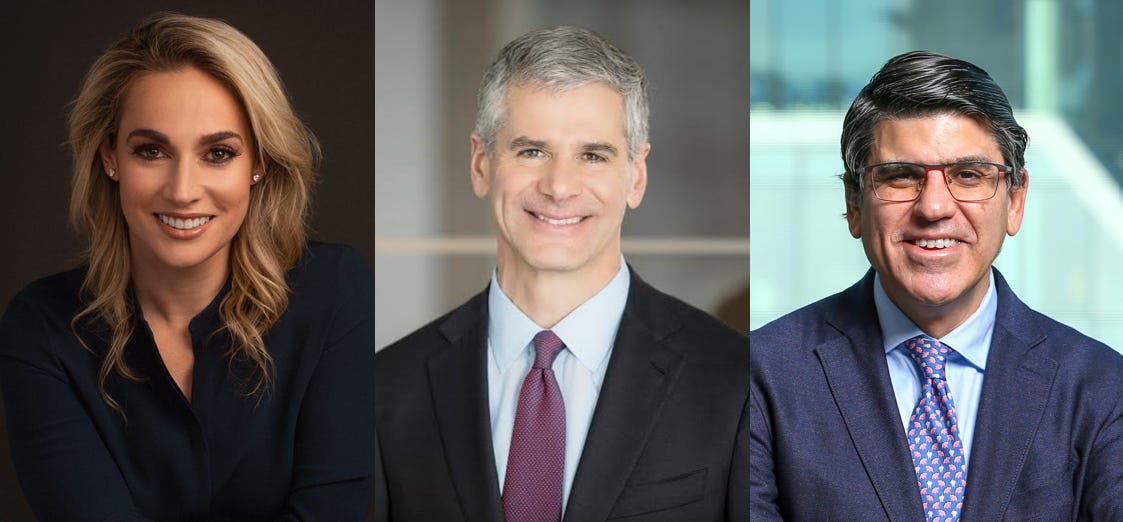
Today’s letter is the transcript of a conversation with Angela Aldrich by Michael Mauboussin and Tano Santos on developing a differentiated view. It’s one of the more tactical interviews I’ve ever heard from a PM.
Angela Aldrich is the Founder, Managing Partner, and Portfolio Manager of Bayberry Capital Partners. She previously worked with Byron Trott at BDT and John Griffin at Blue Ridge.
Michael Mauboussin is Head of Consilient Research at Counterpoint Global, a Trustee of the Santa Fe Institute, and an Adjuct Professor at Columbia Business School.
Tano Santos is a Professor at Columbia Business School and Director of the Heilbrunn Center for Graham & Dodd Investing at Columbia Business School.
Summary, Full Bios, and Related Resources below paywall
Michael Mauboussin: Welcome to a new edition of the Value Investing With Legends podcast. My name is Michael Mauboussin, and I'm an adjunct professor at Columbia Business School, and a faculty member at the Heilbrunn center for Graham and Dodd investing. I'm here with my co-host, Tano Santos, the Robert Heilbrunn Professor of Asset Management and Finance at Columbia Business School. And he's the Faculty Director at the Heilbrunn Center. Hi Tano. How are you today?
Tano Santos: I'm doing great. What about yourself, Michael?
Michael Mauboussin: I'm doing very well. Thanks.
Tano Santos: Yeah, we're both teaching this semester, right? You're teaching security analysis, I'm teaching the value investing class. So we're gonna be very busy puppies, I guess.
Michael Mauboussin: That's right. And I know you've got us some stuff before you -- you get your block week coming up. So you've got some stuff going on right away.
Tano Santos: Yeah. This is that political economy class that I'm teaching now with Glenn Hubbard. Quite a treat, I have to say.
Michael Mauboussin: That's fabulous. Well, I'm really looking forward to the conversation today. One of the most exciting things in our industry is finding young investment managers who are extremely bright, hard working, and very well trained in the investment process. And our guest today fits that bill perfectly, as you will hear in our discussion.
Tano Santos: Yeah, actually, our guest today is one of those names that comes up often in every conversation. I think you've met her before. I know of her. I think we met briefly at CSIMA. But I've never spoken with her, so I'm doubly excited about this.
Michael Mauboussin: Yes, we are delighted to welcome Angela Aldrich, co-founder of Bayberry Capital Partners, a hedge fund with a half billion dollars in assets based in New York. Prior to starting Bayberry Capital in 2019, Angela worked at John Griffin's Blue Ridge Capital. That fund had an amazing run for more than two decades, delivering an average return of more than 15%. John worked with Julian Robertson at Tiger Management, making Bayberry Capital a Tiger Grant Cub. Angela graduated from Duke University with a degree in economics and received an MBA from Stanford University's Graduate School of Business. She previously worked at Goldman Sachs, joined her colleague Byron Trott at BDT Capital Partners, and had a stint at Scout Capital Management. As you pointed out, Tano, I first met Angela when she was at Blue Ridge, and I had the benefit of spending a little time with her before she launched Bayberry. And I walked away from all those conversations extremely expressed. So welcome, Angela, thank you very much for being here with us today. We're really looking forward to talking to you today.
Angela Aldrich: Oh, thanks for having me. It's such a pleasure to be here.
Michael Mauboussin: Well, I mentioned a bit about your background. But can you tell us a little bit more, for example, where did you grow up? How did you get involved with investing? And I think there's a story out there of you working at a mall and pointing out how things could be done better. Is that right? So just tell us a little bit about how you got to where you are now.
Angela Aldrich: I definitely have my fair share of very interesting jobs growing up. Working at a jewelry store in a mall is one of them. I'm originally from Florida, my dad's from Cuba, my mom is from very rural North Florida. So they sort of met in the middle in Miami. I grew up in North Carolina. Neither of my parents was involved in finance or investing in any way. My dad loved to talk about stocks, and he talked about the idea of investing, which is probably where I first had my original introduction to even the thought of going into something business related. But through that sort of group of odd jobs, I always thought going into college and I wanted to do something business related, whatever I thought that meant at the time. So I was lucky enough to go to Duke for undergrad. While I was there, saying sort of I want to do something finance related, I want to do something business related, I got some very good advice from the Career Center to try investment banking as just the best sort of overview and the best background in the industry. So I interned at Goldman. I worked in banking as an analyst at Goldman for two years right after college. For me, Duke is obviously a liberal arts school, I was an econ major. But it was sort of the technical background that I really needed before I could try something like investing. I needed that background in excel, in modeling, and just sort of all that comes along with the professionalism you see within the banking ecosphere. And so while I was at Goldman, it was a bit of a wild time. We were there at the -- sort of right before, and then during the great financial crisis. I was lucky in that my boss, and the head of several teams that I was working on, was Byron Trott, as you mentioned, and he was in the process of starting his own private equity firm. And so I went with him to BDT Capital pre-launch, back in 2009 when we were first starting up. And to your question on how I first got interested in investing, and specifically in public equities, BDT was a really meaningful and important part of my history in that I knew that I liked looking at stocks when I was in banking. When I was in college, I would do the stock pitch competitions, and I would invest in my PA, but it was always something of a hobby or something that I did on the side. Whereas at BDT, in our first few months of operations, we allocated a really small piece of what was a traditional private equity fund structure to public equities, and it was in that moment that sort of the light bulb went off that Hey, this thing that I've liked doing on the side, you can actually do at work, during the day, all the time. And so it was that experience that really drove me to go back to business school. I went to Stanford for business school, like you said. When I explicitly went wanting to work at a hedge fund. While I was there, I was really lucky to meet John Griffin early on in my business school experience. I had never shorted before, I had obviously never worked at a hedge fund before. I interned at Blue Ridge throughout school, working remotely even before COVID sort of forced us all to live on Zoom, like even we're doing right now. And then the rest is history. From there, I worked at Blue Ridge full time until the firm closed, and then obviously straight into Bayberry.
Tano Santos: One of the things that comes out often with our students, and with many analysts we talk to is this idea of mentorship. And of course, you have Byron Trott and John Griffin as mentors. Can you talk a little bit about that process? What is it you got out of that? How do you structure that process? What are the lessons that you got from them, that you're building on?
Angela Aldrich: I mean, working for John Griffin was an absolutely transformational experience in every way. I had the benefit of, even as an intern, we sat at an open desk right outside of his office. So you're literally sitting outside of his door, getting to learn by osmosis, getting to eavesdrop on his conversations with other analysts, getting to learn his entire process, and watching it unfold. That was incredibly valuable. That's obviously where I was really trained in public equities. And you'll see when we talk about Bayberry, a lot of similarities between what I learned at Blue Ridge and what we're doing here. And sort of everything that we're doing here is rooted in a lesson that I took from Blue Ridge. I will say, John, as a manager, and a mentor, was really like a case study and how to manage... I think what he did that was just incredibly impressive, and one of the reasons I think you've seen so many people from Blue Ridge leave and do things that are entrepreneurial, really start to take those risks, is he does a really good job of walking that fine line between giving you almost too much responsibility. So he really subscribed to the Julian view of you take young smart people and sort of thrown into the deep end, and the people who are really meant to be here, people who are really passionate about it will survive, and not only survive, but thrive. He walks that line with also giving you a ton of his lessons from what he's seeing in the market today, from pattern recognition on investments he's seen before, and a lot of it was very informal. So it was just in catching up in our pantry when we were both getting a cup of coffee or around the office. But even from a formal perspective, at our weekly meetings, he would start off the meeting with just sort of a 15 minute overview. And it would always be a topic, whether it was This is a dynamic that I'm seeing today that I think is interesting -- it reminds me of this that I thought 20 or 30 years ago, or just a chosen topic about there's something that Blue Ridge did really well or something he wanted to do more of. And those types of lessons was like getting a classroom experience every single week. And that, for somebody like me, at that really young point in my career, was incredibly valuable. He and I also taught a class together at UVA for many years, which is how we actually, here at Bayberry, have recruited several of our analyst teams, and hearing him not only mentor me directly, but also watching that mentorship to another group of people, and getting to facilitate that, really drove a lot of those principal [talents] and sort of helping, in that class, process and really distilling ideas and topics and themes down for somebody else, really crystallizes everything in your own mind as well. So watching the mentorship was really valuable, taking part in the mentorship for the junior analyst at Blue Ridge, but also the students in our class, really was helpful in sort of crystallizing those ideas ideas as well.
Michael Mauboussin: So Ang, just a little bit on background too -- I think when we think about the investment industry, we think about analysts and we think about portfolio managers as somewhat distinct jobs. And when I think of John Griffin, I think of perhaps one of the greatest, most talented portfolio managers of all time. I don't think Analyst first, I think Portfolio Manager. How do you think about that blend? I assume when you were at Blue Ridge, you're more of an analyst than a portfolio manager, obviously. So how did you meld those sets of skills? And what did you have to learn in thinking about portfolio management as you start to run your own firm?
Angela Aldrich: Yeah, well, learning about portfolio management -- I'm definitely still doing that. It's a lot different to study portfolio management when somebody else is doing it and put together your thoughts on how you think he would do it, and then do it in real time during COVID, during 2021, during 2022. So I think that's one of those sort of mix of art and science projects that lasts forever for everyone. What I did, personally, when I was going through that transition, and that is really, Michael exactly to your point, where you see a lot of pickup. Sort of people going from that analyst role when you're 100% in the weeds on every one of your ideas. You may have 10 or 20 names that you're covering. Suddenly you're a Portfolio Manager and you're responsible for way more names, and you don't know them as well, and you're not capable of trading them as well. What I did to mitigate that risk was: the size of our portfolio here at Bayberry, in terms of number of names, we're very, very concentrated, was similar to the number of names that I was working on at any point at Blue Ridge sort of by myself. So presenting those to my portfolio manager at the time, who was John. And so that ensured for me that I could be actually in the weeds, in the research process, to enable me as a portfolio manager to be as nimble as I wanted to be when I was thinking about being a smaller firm and being a concentrated portfolio and really being able to adapt and move quickly. And so what was helpful for me, obviously, I had my own framework for portfolio management, and we've had our learnings and our lessons and been refining that process. But I think having a really concentrated portfolio where I can be more in the weeds, rather than being solely on the receiving end of somebody else's work is really, really helpful in understanding the true risk, the true inner correlation, the true upside-downside profile of those different ideas. For me, that's been really just incredibly valuable. And that's something that we're continuing forever. That won't change. The number of positions in our portfolio won't grow. But that will be the case into perpetuity.
Tano Santos: So building on that, Angela, and building on your answer to Michael's question, I wanted to ask you -- I think you said something quite interesting, that you want to be in the weeds, and that that calls for a concentrated portfolio, because you want to know your positions well. And I think this is a point that is typically missed. Concentration can also -- if you bundle it with knowledge about the positions, if you bundle it with a deep understanding of the business operations, the firm, of the industry, it's kind of a form of risk management, right? It allows you to be nimble, because you have the knowledge to adjust to whatever the market is throwing at you in terms of shocks to this company, shocks to their business operations, to their valuations, to their regulatory environment, and so on and so forth. Is that how you see it?
Angela Aldrich: I 100% agree with that. I think that was a much more articulate description of concentration of risk management than I have given in the past when asked about it. So I'm gonna steal that from you. But what I think is interesting is a lot of times when we talk about having a concentrated portfolio, we're concentrated on both the short side and the long side, so we're even taking concentrated short bets. Concentration to a lot of people immediately equals very risky, very volatile. So I actually view it in exactly the opposite way, as you laid out. One, you need to be concentrated so that your best ideas are truly moving the needle. If you have something that's super high conviction, super high upside, that should not be a small position just because you want to have on hundreds of positions for diversification. And I think a lot of times when you see sort of under concentrated portfolios, people trying to avoid catastrophic exposure, it's sort of playing not to lose rather than playing to win. And when we think about investing, it is not easy. We're wrong all the time. A great track record is being right 60% of the time. You really have to optimize for those times, and you're not going to accidentally make money. And so what we've seen, at least anecdotally what I've observed over the years is, people generally getting less concentrated over time, as you've seen, short squeezes like 2021 and as you've seen, just the wild volatility that we've seen over the last three years, that has continued even literally today as we're speaking, you've seen people wanting to be more diversified to avoid having exposures large enough that if something happened, it would be really catastrophic to the portfolio. I think, in a situation like that, if you're suddenly diversifying into names that you don't know that well, you are going to trade them poorly. And you are not going to accidentally make money through that strategy. And so even after everything that's happened, and a question that we get from investors a lot is, We talk a lot about the short side; I'm obsessed with the short side. Have you changed your approach? Have you gotten more diversified after 2021? And I actually think getting more diversified would be a massive risk, because suddenly we're putting on lower conviction names. Lower conviction shorts are never going to generate a profit for you sustainably going forward. And so that concentration, for me was really important as a driver of returns. And then also it just happens to help with the transition from analyst to PM. And it allows you, I think, to be more nimble. It removes a little bit of bias from the process in that it gets the analyst trying to pitch you something to get it into the portfolio. I'm right there, I'm on the call. They don't need it to be pitched to me. I'm working with the analyst to come up with analyses and questions to be asking people. But it removes sort of that promotional layer at least as much as we can. And so I do think that it's a risk mitigant in a bunch of different ways, actually, and really important.
Tano Santos: I think this is actually a fantastic discussion on this call. In ways we do have a misunderstanding, right. In volatility, periods of crisis, I always tell the students, Look, you may end up with a very concentrated portfolio in those particular situations precisely because the market is gonna throw at you two or three great names that you -- there's nothing to think about it -- they're wonderful companies, they are protected by powerful barriers to entry, they are robust, solid. And all of a sudden, you really want to go big on those ideas precisely because of the dispersion of valuations in the market is basically telling you that you should be less diversified. So can I connect a little bit about -- I'm sorry, Michael, I don't want to analyze the conversation -- because in a way, this answer makes me think that you started Bayberry Capitol precisely in a very volatile period. You basically get going, and we're getting hit with COVID, with the inflation scare, with monetary policy change, with all these big events that are shaping the market... a certain turn on the market. This kind of correction in growth. So, how has it been to get going in this particular environment, Angela? How did your experience and your lessons help you through this phenomenal volatility at the macro level? Can you talk a little bit about that?
Angela Aldrich: So we launched with external capital on April 1 of 2019. So the COVID crisis, the massive drawdown in March of 2020 happened less than a year into our fund life. So it was baptism by fire, to say the least. What we always say is: Volatility is opportunity. Opportunity often feels like a punch in the face. And so if you have a long-short portfolio where you are trying to be purely opportunistic, and take opportunities as they come, you need volatility. So volatility allows us to have portfolios that are optimized, that are dynamic. It allows you to have opportunities you would have never otherwise had. So just taking March of 2020 as an example. We had the opportunity to buy companies that we thought we would never get a chance at because valuations were too high. And so when you see opportunities like that, you have to thank volatility, you have to view it as the gift of giving you opportunities you wouldn't have. The same continued going forward, and I think what it means for you, and sort of the lessons learned, and how you have to sort of operate in this new world of heightened volatility that seems like it might never end is, just focus on being really nimble. Don't overstay your welcome. We are really longterm. And so we underwrite every single name, even shorts in our portfolio, for three to five years. We do tend to hold our longs for multi year period, our shorts between a year and two years. What happens in these situations, though, is you get opportunities to trim and add along the way. And if you're going to own something for the next five years, you should know it well enough to be able to trim when the valuation is getting ahead of itself, or add when you're seeing that idiosyncratic disruption. And so I think not using a long term horizon as an excuse to be complacent becomes increasingly important in these periods of volatility. And if you're using them, and if you're really being proactive during volatility, you can make so much more money just being opportunistic in the sizing of existing names in your portfolio. And so when you see these elevated volatility levels, I think it gives you increasing opportunity to express your conviction, your level of upside-downside asymmetry along the way, rather than just setting something and forgetting it. And so for that, I think it's incredibly exciting. I would be remiss to not acknowledge that it's also exhausting, and the Bloomberg screen flashing red, green, changing, doing a 180 in the middle of every day is a lot. But the opportunity set is incredible. And I think volatility is a big reason that's the case.
Michael Mauboussin: So Angela, I'd like to take just one big step back and talk about investment philosophy. Obviously, starting a fund is super exciting, and super challenging. You also worked for some world class firms. Were there any specific organizational principles that you wanted to instill in the organization to provide you with what you thought would be the best chance for long term success? You mentioned already a little bit about concentration -- some other elements? But were there -- if someone said to you, What are the organizational principles that are near and dear to your heart that will drive your your results, what would those things be?
Angela Aldrich: Yeah, so I think from a business perspective, one thing that was really important to us is, actually perfectly keeping with the volatility conversation, in order to make a truly long term decision and in order to truly take advantage of periods of volatility, I do think that to have a long term horizon, you have to have a long term capital base. You cannot make a long term decision when you have daily liquidity sort of breathing down your neck. And so for us, I think the number one thing I was most focused on when we were starting and setting our [terms out] was making sure that we were aligned with investors and investors were aligned with our time horizon. That gives us the opportunity to do things like March of 2020 -- our largest position was down peak to trough 60%. Rather than freaking out and bailing at the moment it was down in the double digits, we were able to just keep aggressively adding. And since then, that positions been a 4x. And so I think that from just a business perspective, in order to optimize returns, if you're going to take volatility as an opportunity, you really do have to have people in it with you who are aligned on that time horizon and allow you to take advantage of those mispricing in those wild opportunity periods. And so that to me was the principle number one when we were structuring our capital base and just thinking about what our firm would look like from the outside. From the inside, things that were really important to me as we were thinking about our investable universe, our analysts team, what we were going to do what we weren't going to do, one was just staying incredibly focused on defining very clearly what we do, what we do not do, and only doing the things that we said we were going to do, only doing the things that we're good at, or at least that I think that we're good at. Time will tell. But rather than spraying, rather than seeing period where TMT is the only sector that's outperforming now, TMT goes down every day, and trying to change your approach to capture the factor flow of the day, especially as volatility has been so high and you've seen sentiment really moving all over the place, stick to your knitting. And so our thought process throughout this entire period of disruption has been as the world gets noisier, try to make your world as small as possible and try to really clearly and tightly define what it is that we do. That for me, and sort of that culture that we've instilled in our process, and is really the driving factor of every decision we make is: we do primary research on fundamental theses. And so that's all that we do. We don't make macro calls, we don't make valuation calls, we don't use our short book to fund our long, we don't have macro exposures that we're hedging on both sides. We are doing fundamental research. We're out there in the field doing primary research. And as a result, we only look at names that lend themselves to that specific research process rather than getting caught up in the -- as the tides are turning, whatever the investment philosophy is, or the style that happens to be in vogue that day -- rather than chasing it, even when everybody else is doing something much sexier, that seems to be doing better on a given day, really sticking to what you know and what you're good at has been really, really important for us. Another thing that I'll just add on to that is just obsession with the short side. Everybody works on shorts. It's not something that we view as an afterthought, it's really critical to our firm, to our process, to our portfolio. I know that's been sort of a hot topic of debate over the last couple of years. That is something that is really culturally ingrained here.
Tano Santos: I have two questions. There's many things in this answer you gave to Michael. So let's go back a little bit to this narrowing down. So can you describe a little bit your search process? How do you actually look for ideas? What is the type of company, and what are the characteristics of those companies and those business operations that you are attracted to? Above and beyond the valuation. Is there some type of screen that you impose on the quality of those business operations, for instance?
Angela Aldrich: Yeah, so for us, what's really in our wheelhouse, we tend to chase really mid cap opportunities. So we're really hunting in the $1bn to call it $7-8bn space. The reason for that -- it's not an artificial cut off, but the reason that we tend to focus on mid cap is, that's where you tend to find the most researchable businesses. So by the time you're $100bn in market cap, it's sort of inevitable that you have a bunch of different business lines going on under your sort of top umbrella. I can't have great differentiated views on each of those business lines from a fundamental primary perspective and have them all hit at the same time in order for that to be a 10% position in our portfolio. It just doesn't make sense for our process. So that's really the universe that we're staying in. Because I am so focused on fundamentals, what we tend to think about just when we're outlining opportunities in what we think is interesting is less focusing on sort of stated valuation and making multiple calls. So sum of the parts are saying, Hey, this is trading too cheap, I think it's going to trade at a higher multiple -- what we really like to see are businesses of what I call: anecdotally surprisingly high business quality, where we see earnings and free cash flow that are going to be significantly ahead on the long side or below on the short side consensus over the next three to five years. And so if we take that sort of long side versus short side, what we really like are -- the reason I say surprisingly high business quality businesses is because if something's obviously high quality -- take your typical SaaS business with a -- they're very long contract and the sticky customer base, the business quality there is so obvious that typically the price is at a level that's just not appropriate for our portfolio. It's just not going to meet the hurdle that we need. Or you would have to underwrite something like a 60x revenue multiple -- that does not tend to be my speed. We really -- if you look, the traditional growth versus value spectrum, we tend to be really squarely right in the middle. So we won't buy declining businesses -- it has to be growing, it has to be really high quality. But a big part of our business model misunderstanding tends to come from people think this business sounds lower quality, more capital intensive, more cyclical than it actually is in reality. And that tends to be a really common theme within our long portfolio. So you see us tend to play in a lot of service businesses -- so industrial services, business services, some consumer businesses. You tend to see us not be in names that are highly sensitive to exogenous factors that we can't do primary research on. So just as an example, I will never have a differentiated view on the price of oil from doing really interesting field research, so you'll never see us in an E&P. I'm not going to have a differentiated view on where interest rates are going, so it's highly unlikely that you'll see of taking a really big long position in a traditional balance sheet financial, just as an example. And so that -- what we really like to see are those tangible operating businesses that are trackable, where there is the potential, at least, when we're starting to look at something, that we could theoretically get out into the channel and have a really differentiated view because it's a relatively single product, single end market type of business. So if you find something in your research, a really interesting piece of data, it could be wildly different from what other people are expecting. And as a result of that just sort of digging around in less well covered, less known businesses -- we tend to like a lot of the niche names that don't squarely fit within one industry buckets. So if you look at the sell side silos, for example, a lot of our positions aren't easy to fit into that silo, and as such don't have great sell side research -- that to us is really attractive. So rather than having a perfect public peer set, a lot of our longs don't have a great comparable that's publicly traded that you can look at as an example. And we would do that as a benefit, as sort of an information asymmetry. On the short side, we tend to look for -- we will not short of high quality business. So it has to be a low quality business, it has to be in decline, and we really need to see a fundamental reason, a tangible, trackable reason earnings and free cash flow are gonna go down going forward. So we're not looking for things that are going to grow at 20% but the street is expecting it to grow at 40% and we can sort of split the difference. We're looking for a crappy business that's in decline and there's a quantifiable reason they've been over earning, that reason is going away, and we can really see free cash flow coming in 50% below where people are expecting. Those types of declining businesses that are trackable, that have milestones we can look at, KPIs we can be on the lookout for, signposts as to whether or not our thesis is tracking. We always have to have something that could cause us to change our mind. So there has to be a data point that would say, Hey, your thesis is not tracking, it's time to re underwrite on the long side or the short side. And so as a result, you won't see us doing a lot of the sort of typical -- the fraud that a lot of people like to talk about, or sort of the more salacious management headlines. We really need a fundamental business reason to short a stock. If there's a salacious management story that's a really fun headline, not enough to get us involved on the short side.
Michael Mauboussin: So Angela, I do want to follow up on one thing, which is talking more about primary research or value added research. There, in the last, say, 15-20 years, massive proliferation in expert networks, alternative data, increasingly now artificial intelligence coming to bear -- how do you, if at all, use those tools? It sounds like you're trying to navigate a bit around them to try and find things that are unique. But how do those tools come into your strategy, if at all?
Angela Aldrich: I do think that more information is better. And so if there is a data source out there on one of our names, we are happy to consume it. And I love to see it. And I think most importantly, if there is a data source out there that other people are tracking, it's important to just know what other people know as a reason for maybe why a stock is moving in a certain way. For us, something like the credit card data, or email receipts, or those sort of more traditional alternative data, which sounds silly, is never going to be the needle mover for us. We're not trying to call quarters. So this isn't we're trying to figure out whether or not earnings are going to be slightly above or slightly below and sort of put on temporary positions. However, I do think it's important to see what other people are seeing so that you can understand the other side of your argument. So no matter how amazing and clear you think your investment thesis is, whether it's a long or a short, there are smart people on the other side. And I think it's really important -- in order to have conviction in a long or a short, I do think it's critically important to understand the other side of the argument. And if you can't understand why people don't see your perspective, and why that's going to change, that they're going to see things the way that you see them, it's really hard to unlock value from a thesis. So it's a really cute sort of intellectual exercise to say, Hey, this shouldn't trade at this valuation level in an absolute way, but hey, there are people on the other side of the table who are buying it everyday at that valuation. You have to understand why they believe that's the case and what's going to change their mind in order to forecast the actual share price moving going forward. And so for us, I think the data is really important in understanding what other people are seeing. But the things that really give us a lot of confidence are really the old school talking to people in the channel, going to trade shows, finding people that are quoted in trade association magazines, and people that are interviewed that are viewed as thought leaders in the industry -- really getting their take on what's going on on a day to day basis is really what tends to get us excited versus not. Any data that you can see around the fringes is interesting -- it's probably too widely consumed to represent a variant view anyway. And we do need to have a variant view. But I am not of the view that you should completely take that noise out of the equation. I do think from a sentiment perspective it's important to understand why people are on the other side, or why stocks move the way that they do. But it's definitely not the crux of our process.
Michael Mauboussin: Angela, you mentioned a few moments this concept of signposts. And I wonder if you could tell our listeners a little bit more about this. So you're coming up with this variant view of things, variant perception -- you're saying if our variant perception is going to unfold, our thesis as we anticipate, we should see certain things happen. You might even attach probabilities to those. A) Am I explaining that I correctly? B) Do you assign probabilities to those? But what's so important about it is it gives you -- it almost compels you to revisit your thesis if something seems to be going astray. Because often if your thesis is not unfolding, stock may look cheaper, for example, and so you go, Oh, no, it's cheaper now. It compensates for... So how do you how do you maintain that discipline of really updating your views accurately given your thesis?
Angela Aldrich: It's such a good question. And we've spent so much time thinking about this process-wise. What we do to avoid thesis creep -- there are two things really. The first is, to your point, about keeping milestones. Everything that we submit -- so every call note, every sort of meeting recap, at the top, we have a key takeaways section. It has to include key bold takeaways and key bear takeaways. So at every single interaction you're having, you have to pick up the other side, even if you have to stretch to come up with something negative from a call, you have to have it at the very top just to keep it concrete in writing. That is more just a cultural thing that we're really married do. But in terms of making sure that we're not sort of creeping along the way, what we do when we first get into an investment that I think is interesting is we write out our thesis, exactly to your point, what we think should happen if our thesis is playing out. And then we lay out the other thesis. So the alternative thesis, if it's a long for us, what the short thesis is, and what the shorts would expect to see along the way if they are right. And then, as silly as it sounds, that's sort of in stone when you first put on the investment. You can't just update it and say, Just kidding, our thesis has changed a little bit, now the stock is really cheap, now I think it's a little bit of a turnaround. It's in our internal database. And we basically just -- as new data points come along, you check whether or not it's supporting your thesis or the opposite thesis. And so what I think is a really dangerous situation is a stock is actually working in your favor but your thesis is not tracking. That should be an immediate, Hey, my long is up, but none of the checkmarks have been around my bull thesis -- we need to get out and completely reevaluate because the stock may be working but it is not because of the reasons that we underwrote, and so this is not the original investment that we thought. The other side of that is, when a stock is not working in your favor, but your thesis is tracking, it's a flag for you that 1) either you should be bigger -- people are still missing it. The opportunity is getting juicy or by the day. Or, is your thesis on the fundamentals that actually matter to the stocks trading? So after -- for a few quarters, it's really fun when your thesis is tracking, your short continues to go up, you're adding at better prices. But at some point, other people have to care about your thesis. And so it also keeps you honest to: Do we have a thesis that is intellectually correct, but not actually commercial -- not what people who are trading the stock every day actually care about? And so those flags along the way I think are really, really important. And so in order to get into a position, there have to be signposts that would prove you wrong, or show you that you're continuing to track and then compare with what the stock is actually telling you.
Michael Mauboussin: And this feels like a really important point, right? Because getting that key idea, that simplicity of the key idea, requires actually in-depth knowledge of what's going on the business. And I think that's probably the biggest component of art in what we do. Is figuring out what matters to move the stock and those expectations. What have you learned about that in your career -- evolving from starting off as an analyst to a portfolio manager -- how have you refined those skills? How have you gotten better at that whole process?
Angela Aldrich: Well, I think when you start, especially coming from banking or the private equity side, you have the desire to know everything. And so I remember my first few projects at Blue Ridge, I would say, Here's my work list on this name, and it was like 80 items that I was going to do, and I was going to reconcile the working capital from back in 2005 -- and it was like, that is not going to make a stock double or triple in the next three to five years. And so being comfortable with imperfect information -- incredibly important in this job. And as a result, you have imperfect information, you're not going to know everything -- you really have to focus on, I think there are 2-3 things max that are really going to make a stock double, triple, quadruple over the next few years, or get cut in half over the next couple of years. And actually one of the first -- as we're saying sort of go or no go on a new pipeline idea, we put together, obviously, what the company does, the bull thesis, the bear thesis, because we're obsessed with having both, and then what we think the 2-3 -- we call them KIFs -- key investment factors are over the next 3-5 years. And our biggest debate of whether we should green light or red light a new research project is, How confident are we that the KIFs that we identify from the start are actually right. Sort of how confident can we be that we're looking at the right things, and then how researchable are those things for us? And so a lot of that journey is pattern recognition, a lot of it is really sticking to your wheelhouse. So if you are doing similar research processes, looking at names that really fit within sort of your process and your framework, you get a lot faster in learning what the key investment factors are, whether or not they are researchable, whether it's too noisy, whether there are too many other businesses in there. But it's that quick kill process that really -- it's critical to the research process and making sure that you're looking at only the most important names that actually have the potential to be in the portfolio either today or at a future date, as well.
Tano Santos: I mean, it's an idea that I like enormously, and a common friend of ours, of Michael's and mine, Kent Daniel always says that the best investors always ask themselves whether they're making money for the right reasons, whether they're making money -- which I think is exactly right. You always have to ask yourself, Well, did I get lucky? And also whether I'm taking too much risk, and maybe just the fact that I'm just taking investments that -- they look great, but the reason why the returns are high is because of compensation for the [enormous] risk you're taking, which will eventually come back to haunt you. And I cannot emphasize this idea enough. You mentioned about writing it down, precisely to avoid the pitfalls of self attribution bias -- that all the good things happen because I'm awesome. And everything played out the way I first saw it. And if you have it written down, you can go back and say, Oops, I made money, I got lucky, but not because... So can we talk a little bit then about the issue... a complicated issue of portfolio construction? How do you see it? And we talked a little bit about concentration, but how do you actually size positions? How do you actually express that conviction, in particular, portfolio sizing? Do you have anything there to tell us?
Angela Aldrich: Yeah, so our portfolio typically is right about 20 long, somewhere between 30 and 40 short. Our really big longs tend to be between 10-13% of capital. We cap shorts at 5%. Because I'm crazy, but I'm not quite that crazy. And the way that we size is, in my opinion, your largest go forward IRR opportunity should always be your largest. However, your go forward IRR should be weighted by the asymmetry of the different outcomes that you see happening. So then, we're simply -- it should be a probability adjustment or risk weighted go forward IRR. And so for something to be a really big position in our portfolio, if you just look at the long side, not only does it have to have huge raw magnitude of upside, but it has to be hyper asymmetric going forward. So that risk versus reward, the predictability of the business, the downside protection has to be massive. So you'll see for us, we could have a 12% position where my base case, or my upside case is actually lower upside than a 5% position, but the skew is much more favorable on those really large names. And so for us, that's at a high level how we think about it. Your biggest opportunities should be your largest, but you should be sizing, or adjusting, risk weighting those opportunities by how asymmetric they are going forward. And then what I think is, on both sides of the portfolio, theoretically every day that a stock is working in your favor for the reasons that you set out -- so assuming that your thesis is actually tracking, your long is going up as you would expect, that means that every single day your go forward IRR is coming down -- unless something has fundamentally changed in your thesis and your target price has increased, which happens all the time, so this is not sort of a hard and fast rule, but in the absence of a major change, that IRR profile is going down. And so my default, or my -- in that sort of hypothetical situation, you should be reducing those exposures. And the way that we think about it is, How variant is your view? So as a long is working, you have this view that clearly nobody else appreciates, because you're long shouldn't be trading at a 20% free cash flow yield -- as that valuation comes more in line, as you see those stock prices appreciate, your variant view is not as variant. Other people are appreciating parts of your thesis -- those data points are becoming much more public. That inherently lowers the skew to your upside and base and has to increase your downside allocation and your probability risk weighting. So even if you were upside still screams as a very large number, it has to change the probabilities. And as a result, you should be trimming. And the same is on the short side. So every day that a short is coming down because your thesis is playing out, you should be trending and taking profit. And it's really when those are going against you -- your thesis is still tracking -- you can understand why the stock is moving against you even though your thesis is tracking, those are the moments where you're really sizing up rather than the inverse.
Tano Santos: Just to clarify it. So you start trimming your position naturally. So the decision to sell is naturally given as you see the market converging to your viewpoint about that particular name.
Angela Aldrich: Exactly. It's almost the opposite of momentum. So as you're seeing social proof of your thesis being right and other people appreciating it, that means that your thesis is less variant. Inherently, that means that your go forward IRR is coming down, and your allocation to a base case or even a downside on multiple contraction should be higher.
Tano Santos: Angela, can we talk a little bit about some specific names, and you walk us through your thinking process with them? So a couple of names: WillScot Mobile Mini Holdings -- so why don't you tell us a little bit about that. How do you come up with that idea? Why don't we start describing what they do, by the way, for those of our listeners who don't know about mobile solutions, offices, things like that, exactly.
Angela Aldrich: One of the descriptors I typically use when I describe our standard long portfolios is really unsexy businesses. This is a perfect example. So WillScot leases the trailers that you see on big construction sites that they use for the engineers that have the blueprints, where the workers take breaks, where the coffeemaker is on a big -- think about a highway construction project -- there has to be a building with air conditioner and a fire extinguisher somewhere. They own those, and they leave them to contractors when they're doing construction projects. Incredibly unsexy. To my point of surprisingly high business quality, it sounds super capital intensive, and it sounds super cyclical, right, it sounds like you're making a bet on the construction cycle. So we've actually owned WillScot since inception. We found it on a short screen when we were pre launch. We were looking for names -- WillScot, so much to hate about it. So it had come out of a SPAC in 2018. And this was before SPACs were popular in 2020. So SPAC was a really dirty four letter word. Came out of a SPAC. The moment they came out of a SPAC, they bought their number two competitor. So levered up to do that. It had come out of a distressed private asset, so the financials on Bloomberg were as organized as a child's fingerpainting. And so it screened at 10x leverage, and we're like, it's go to be a short -- it's a bet on commercial construction. We start digging in -- the things that we really liked about it, and that started to change our mind --and actually, when we launched, this was our largest long. So talk about like a complete 180 in sort of evidence versus prediction. That's another thing that we really harp on -- we invest on evidence, not prediction. So we predicted it was going to be a short, the evidence was it was actually a really great company that we wanted to own. These guys have a three year lease life -- these guys are a tiny piece of the overall cost of construction. That's what we really like when we look at a value chain -- picking something that's super necessary, but super low cost. So you have to have one. So by code, you have to have an office on these big construction projects, it has to be an enclosed building where you hold the plans, you have to have a fire extinguisher that is also in an enclosed building, have to have it. It's about $500/month to rent one of these offices -- we're talking about $50mn highway construction projects, skyscrapers. We're not talking about any single family homes or any sort of small construction project. And so what was interesting at the time, if you think back to 2019, everybody was worried that we were going into a non-res down cycle. And how times have changed, and how times have stayed the same. But everybody was worried about exposure to construction. When we actually dug in on it, we are not talking about these short term projects. This isn't URI where your average lease length is 30 days, 60 days, 90 days, this is a three year contract. And what we thought was particularly interesting about it is, the cost to put up an office, or the cost to take it down, was about six months of rent. So there's no quick decision-making, you're going to pause construction for a month, you're not going to take down your office, you're clearly going to leave it up because economically it just doesn't make sense. What was so interesting about WillScot at the time, and this is before it had bought Mobile Mini, is they had just bought ModSpace. So they were now well over 50% of the market, and they were the only national competitors. So the short thesis on this type of business historically has been for every dollar of revenue that you bring in, you were going to have to buy a new container to then lease to that person. So full utilization isn't interesting, because that means every dollar of revenue you bring in for new business is going to equal $1 of capex. That's a wildly uninteresting business model. What became super interesting about WillScot is, all of these businesses have been hyperlocal in the past, and so you would have a New York City focus, they would have a few trailers that they would lease, you would have a California-focused business. Now that they actually have a national presence, what they could do is move inventory around amongst themselves. So now rather than having to operate at a 60% utilization rate because you have to be able to service a new customer who comes in, you have to have some available capacity, you can operate at 80%, and you can move that inventory around yourself, which becomes incredibly interesting. And so from a free cash flow perspective, even without any of the other things that we're looking at, rental increases and VAPS, which is the most interesting part of the story, suddenly your ability to take your utilization from 60% to 80% makes a real hockey stick in free cash flow projections for a reason that makes sense. And then layer on top of that, now that these guys are the dominant player, this was -- it was described to us by contractors as WillScot is the Kleenex of modular offices -- if there is a Kleenex of offices, it is WillScot. People no longer even go to any competitors because it's much easier to have a national purchasing decision at the top with the only national provider versus having each individual office making a different discussion. So their ability to drive base rental prices was incredibly high -- they had continued to demonstrate that over time. But the real kicker for us was they just introduced what they call VAPS, which stands for value added products and services. And so this meant -- they used to just rent you a box. And then the contractor would have to go to Lowe's and Kmart and fill that up with a conference table and a coffeemaker and the air conditioning unit that they use to keep it cool. Then, Willscot moved to this model right after they were sort of out of that distressed private vehicle, or they would rent you the box completely specked out inside how you needed it to be so that you could just show up and start working. Well the monthly ticket for VAPS was actually more than your underlying rental rate for the box. So if a standard box is $500/month, the average VAPS ticket was almost $700. So your underlying rent, that people are opting into VAPs are more than doubling. And what's interesting about that -- all of our checks when we would go talk to contractors, like, Hey, are you going to do this? They're like, Yes, of course. We're not in the business of owning office furniture and then having to offload it at the end and like buy pods for our Keurig coffee maker that we had to go buy at Kmart the other day, buying surge protectors, all of these things -- 100% of the people that we talked to -- literally 100% were saying they were going to opt into VAPS. And then when you look at the model, it is one of the most beautiful mathematical waterfalls you've ever seen. You have an average three year leaf length, they give you the LTM opt-in rate to VAPS -- you can perfectly waterfall that through over the next few years. And so the reason, Tano, to your question on sizing, that was able to -- at one point that was a 13% position for us -- the reason we were so comfortable having it be so large is you have that underlying predictability of your revenue stream. And so what happened in 2020, in March of 2020, they bought Mobile Mini, which is a storage business -- super complementary, most of their customers buy storage and an office -- they're now introducing VAPS into that storage business, which is another interesting opportunity. But it was at almost perfectly the wrong time -- right at everything was collapsing. So what we saw happen -- WillScot was our largest long -- it went down peak to trough 60%. We're 11 months into a new hedge fund -- we kept the position size about consistent, so we actually put a ton of new capital in at a very, very low price and were able to average cost down, and really ride that from there. But that's one of those classic businesses where it's a lot of things that are very common in the Bayberry portfolio. So it's something super unsexy, there's not a sell side analyst that covers modular office rentals, there's not a pure play competitor that you can compare it to valuation wise, it's a relatively small market cap. It was truly hated, so it wasn't a consensus positive sentiment name in any way. And it was really tangible. You could really you have a very quantifiable way to predict revenue and to see your upside really flowing through your model. Because that was one that -- Gosh, I mean, it's been almost four years of owning that one at this point.
Tano Santos: Yeah. I love this business, by the way. And if anyone wants to have a lot of fun -- and maybe, Michael, you were raising your hand as one of those who didn't know this company, they have an amazing investor presentation. It's so much fun. They tell you exactly where they're going to put the coffee machine. But there's several messages to this, which is -- I love this idea, Angela, you mentioned, that they are a tiny percentage of the cost of construction. So if you really want to compete and bid more aggressively for a particular contract, this is not the place to do it. Because it's not gonna make a difference whether you're going to be winning that bid or not -- it just doesn't make -- and that is, it gives you a very powerful barrier to entry. The idea of being a local business, but being able to basically move the equipment around. And the thing that is striking is the consolidation. I mean, this is quite something. I mean, they're really the dominant beast in this industry right now. And there are economies of scale in running this business. And it's beautiful, the idea of leveraging the box with the additional services -- they're overlaying on the box. So it's just the embedded operational leverage of how they're building their business is quite striking. So good for you. This is a great play. This is wonderful.
Michael Mauboussin: And can you talk a little bit about how you value something like this? So how do you go about valuing businesses?
Angela Aldrich: Yeah, so for us, when we're thinking about -- in order to have a target IRR, you kind of have to have a target price, even though I hate that term, because it means you're calling a multiple or you're calling some sort of valuation metric. What we always do is we get the vast majority of our upside or downside in situation from how different our earnings estimates are versus consensus. And so when we were first entering this position, our -- I mean, the consensus free cash flow numbers were are basically non existent, there was no coverage -- our free cash flow was well above 100% higher than what people were expecting three to five years later. And so that for us gave us most of the confidence in making that such a huge position. Typically, when you see free cash flow surprise so much to the upside -- it's literally double what people are expecting -- you're going to see some sort of multiple expansion or contraction of free cash flow yield, we actually always interrupt that case as our base cases, assume multiple contraction. We don't ever say the peers trade at x, this is trading at y, they should clearly rerate to x. I think it's just as likely that all of the people who are trading at x are going to rerate to y, and I really think that's more of a call on like a market multiple and a factor flow. So for us, when we're thinking about appropriate valuation, we're really thinking about how surprised people are going to be by the earnings and free cash flow. And then you typically see multiples then sort of work in your favor when that happens. The same thing on the short side. If free cash flow comes in 50% below what people were expecting, it's unlikely you're gonna see multiple expansion the next day.
Michael Mauboussin: And are there free cash flow yield numbers, like ratios, that get you excited or get you bummed out? I mean, are there numbers just in your head that you say, If I see 15% I'm jumping up and down, or --
Angela Aldrich: If I start to see teens free cash flow yields, I do start to get excited on a high quality business. Free cash flow yields in the low single digits for me are just really hard to digest. It's just the lack of cushion on valuation when we're not making a call on what valuation should be when that's not really the business we're in starts to make me a little bit uncomfortable. But when you have -- when you're looking at WillScot, and it's trading at a 25% free cash flow yield on your free cash flow numbers three to four years out, it feels really good from a valuation perspective.
Michael Mauboussin: Alright, so let's talk about a different type of business. Burford Capital. What's the story there? How'd you find that? Again, what do they do, and why does that look interesting to you?
Angela Aldrich: Alright, so this is a spicy one. Actually, similarly to WillScot, this was actually written up as a short by Muddy Waters back in 2019. So everybody that's heard of Burford has heard of it as a short -- they sent the stock down massively. That sort of started us looking at the business in general. We came out thinking the business was higher quality, and much more stable and sticky, and we ended up refuting a lot of the points in there around accounting -- 100% debunked those claims, a lot of it around corporate governance, which have been completely cured. But that's what first sort of draw our attention to the business. And if you let me, I will get so in the weeds on what they said about the business versus what the reality is, but at a really high level, it's the largest global litigation finance business, which sounds like ambulance chasing, and it sounds very sleazy -- and a big part of this thesis is also business model misunderstanding, because when I first heard it was litigation finance, I was like, Oh, it doesn't sound like something we could be invested in. But what their business is -- they don't do anything consumer related. They don't do consumer class action suits, 50% of their business is from large law firms, and 50% of their businesses from big corporations. What they do is they fund litigation in exchange for a piece of the eventual outcome. So they will pay the legal fees, the lawyers, the paralegal, all of those fees through trial -- for a piece of the eventual outcome. The reason this business needs to exist, which I think is really important to understand is, from a company perspective, the reason this company was ever started was the CEO was actual General Counsel at a big Fortune 500 company. And what he saw was, you would see very obvious cases coming up of patent infringement or contract violations that were relatively small, but very obvious. And companies wouldn't pursue them, because, if you are valued on a multiple or even a free cash flow yield, a lot of your litigation expenses are flowing through your P&L. So even if you're a business unit manager, it doesn't matter. If you're being compensated on an income number, you're being dinged for pursuing litigation, even when it's very obvious that you're going to win, and you do eventually win, because those cash outcomes come through in CFI or CFF, so Cash From Investing or Cash From Financing, which is below the free cash flow line. So you're constantly getting dinged for these litigation expenses. When you actually do get a cash collection, nobody even cares, because nobody's looking that far down in the cash flow statement. And so that's really where the business was born, was taking that P&L burden off and still allowing for the eventual outcome, and just better contract enforcement along the way for -- we're talking like Time Warner, we're talking for Google -- anybody who has any contract with another business. The other side of their business is funding litigation for the big law firms. And so what's interesting about that business is law firms typically are organized as a cash partnership. So at the end of every year, they pay out the money leftover in the business to all of the partners -- we're talking about Simpson Thatcher, we're talking about huge firms where there could be 200-300 partners. In order for that firm to fund a piece of litigation on spec -- so for free in return for a piece of the eventual outcome, they would have to get all of the partners to agree to write a check out of their own pocket back into the firm to pay the paralegals and the attorneys who are working on whatever case they're doing -- that's never going to happen. That's just not a logical or possible sort of situation. So that's really why the business exists, which I thought was just -- from a business model understanding -- was really important. What's interesting about Burford today, and why the situation exists, and why the stock is just so damn cheap and so interesting to us is, you've had a couple of things sort of working against the name. So one is, this is an inherently lumpy business. So their EPS is based on them collecting outcomes after -- it's either a settlement or after a court decision. That is not going to be a smooth quarterly business. Really hard for public market investors to underwrite. So to the question about sort of how we set up our firm to be longer term, if you have daily liquidity, you are not investing in a name where who knows what they're going to collect on in a given quarter -- they've done a lot of things that we can talk about to smooth earnings going forward, but that's always been a historical knock against the name. Then, throw COVID on top of that, where the courts were closed for a really long time. And so you are in a criminal case entitled to a fair and speedy trial, so when the courts opened back up, they had to legally prioritize criminal cases. So all of a sudden your earnings are based on courts actually hearing a case and deciding on a case and then suddenly the courts are closed and then when they reopen it's only criminal cases. We don't do criminal cases. So we're talking about a really trough earnings period. On top of that, to add some more hair on that already hairy situation, they have, optically, 45% of their book value is concentrated in one case. And so when we talk about understanding the other side of an argument, you look at a company that makes a ton of little bets in litigation, and their book value is almost 50% in one case, it's really easy to say Too binary, too hard. You'd have to sort of project what the outcome of that's going to be. We don't tend to do those binary situations ourselves. When you actually -- and the reason I think Burford is so interesting is because it's really easy to understand why people are confused about this. If you actually dig in, the litigation that is 45% of book value is related to Argentina's expropriation of YPF [shares]. There was a majority shareholder, Repsol, a Spanish business who owned 51% of YPF -- they've already settled and collected billions of dollars. The litigation that Burford is invested in is for minority shareholders, and in the YPF bylaws, it said -- when they listed on the New York Stock Exchange, they had to add this protection: if we expropriate the shares, minority shareholders will be compensated at this formula. And so minority shareholders weren't compensated -- they sued YPF the corporate entity. What's interesting to note about our litigation versus the Repsol case is, Repsol actually sued a sovereign entity. So Repsol sued Argentina, the sovereign nation -- sovereignty tends to supersede contracts. That's a really hard case to win. They ended up settling and collecting, which is very interesting. Our case, when they announced that this case would be heard in a New York court -- so it is purely contract, it is against a legal entity, not a country, not a sovereign entity, a legal entity -- when it was said that it was gonna be held in New York -- there's been so much public discussion of this case, and to some -- and I'm not going to say that we exactly know what the outcome of the case is going to be, but the fact became so obvious that a secondary market suddenly opened up. So there is no secondary market in litigation finance, typically, because you and I don't have the ability to do diligence on these cases. Like we can't just go to Simpson Thatcher and say, Hey, I want to read all of your confidential materials on a bunch of cases, and then like, I want to fund some of them. And they would tell you, very impolitely, to get out of their office. But, because this felt so obvious at the time, a bunch of private equity firms came to Burford, said that they wanted to buy a piece of -- Burford's piece of this litigation. So, they were actually able to monetize -- their original investment in all the YPF litigation was $27mn. They were able to monetize 38% of Burford's stake in the outcome for $275mn just on the decision to hear the case in New York. So that was such a solid milestone to us as well. But sort of, as evidenced by sort of social proof, was such a big milestone--
Michael Mauboussin: And who are those, Angela, who are those people doing that?
Angela Aldrich: It was a lot of private equity firms.
Michael Mauboussin: It's smart money, basically.
Angela Aldrich: Correct. It's a lot of names that we would all recognize and get really excited about. So they came in and bought it. But what was -- from a book value perspective, what's interesting about that -- so from an investment, they've made a 10x on their entire investment. Let's say the other 62% that they own goes to zero, they made a 10x, that's a massive IRR. Like I will take it all day long. That would still be the best -- one of the best returns on capital they've had. However, on that 38%, it was a 24x. Selling that 38% of the $27mn investment for $275mn. Because it was a valuation event, they had to mark up the rest of their book value. So the 62% that they still owned, accounting wise, got marked up. So when you look at the book value, the only reason it looks so concentrated in YPF is because they've already been successful in monetizing a big piece of that case, and the rest of the book value is held at cost, or at the investment value, because there is no secondary market, typically, for litigation finance claims. And so the thing that is so scary about Burford from the outside is its huge concentration. The huge concentration is actually just a symptom of how successful they've already been in monetizing this investment. And so going forward, we're actually expecting a catalyst on this any day now, irrespective of how YPF turns out. We actually expect it to come very favorably. But irrespective, this is an incredibly high quality and consistent business that is completely uncorrelated to anything else out there. So price of oil moved around, doesn't matter. Interest rates moved around, doesn't matter. Recession hits, litigation rates actually tend to increase in periods of economic disruption. So this is one of those incredibly steady businesses -- every annual cohort of their investment has increased in the realized IRR. They continue to get better and better at what they do. We have this overhang because of the YPF headline, because of the trough earnings during COVID. Andso when you look at the valuation today, what's currently implied in shares is that the returns on current commitments, so the investments that they've already made, come in at a 65% haircut to historical returns, which have increased every single year, and are modeled to be even higher on this vintage. That YPF goes to zero, which is fine. That there are no future commitments, so they don't put any more money to work. They're putting the money to work every day. We get a press release every day about a new case that they've invested in. And, over the last few years, they started a third party fund business, so Burford the corporate entity is the GP receiving the 2 and 20 management fee structure. It's assigning zero value to that piece stream, which in a public market is, if you look at any asset manager, is an incredibly sticky, obviously contractual revenue stream that trades at a very high multiple. And so from a valuation perspective, it's just wild what it currently implies. So even outside of its potential near term catalysts on YPF summary judgment -- should come back on that case any day now -- but even outside of that, the business quality is way too high. The predictability is way too high. And the situation is way too interesting to not be involved today.
Tano Santos: This is a super interesting case. I remember, as a Spaniard, I remember when there was that nationalization of Repsol assets in Argentina, but I didn't know of the story about minority stake holders still litigating that case. It's absolutely absorbing.
Angela Aldrich: That was 10 years ago.
Tano Santos: I know. Exactly, exactly. Because Repsol settled in 2012, or 2013 -- I don't remember when this -- a long time ago, actually.
Angela Aldrich: It was a while ago. And billions of dollars have been already collected on it.
Tano Santos: Yeah, yeah, exactly, exactly. No, I remember it was very political in nature. I remember there were big things going on between the governments of Argentina and Spain. So it was a very complicated -- even think the EU got involved with some sanctions in Argentina. So we're getting to the end of our conversation of this fascinating conversation, Angela, and we always finish with two questions. So I will ask mine, and then Michael will ask his. So my question is, What keeps you awake at night with worry or with excitement about markets in the future? You were talking, and we started talking about volatility and the many things that we've seen over the last couple of years. What keeps Angela Aldrich excited, or worried, about the future?
Angela Aldrich: The answer to both of those -- what keeps me excited and what keeps me worried -- are idiosyncratic opportunities and risks in each of our separate investments. So, we work really hard --
Tano Santos: A true value investor, Angela, you are.
Angela Aldrich: Haha. So we try really hard to keep all macro predictions and sensitivities out of the portfolio. So I am not the one who will say I sit around and I won't sleep because I'm worried that the SPX is going to trade to a specific index value. That, to me, is totally irrelevant to where our portfolio is going. My worries are -- you name a stock in our portfolio and I'll tell you exactly what I'm excited about and I'll tell you exactly what I'm worried about. And so a really simple way to say that is, I am worried about everything. And I am excited about -- between our longs and our shorts, about 50 individual investment theses.
Michael Mauboussin: That is a great answer. And Angela, is there anything that you're reading or listening to these days? And is there a book or books that you would recommend to our listeners?
Angela Aldrich: My favorite book of all time is -- and I think it's very relevant to investing, although not a traditional investing book -- is Carol Dweck's book called Mindset. It's about having a fixed version of the growth mindset, about teaching your mind to view failures as a learning opportunity in a business where we are wrong so often. And the market tells me whether I am wrong on a second by second basis. I do think it's really critical to keep reminding yourself to -- I look at my dumb trades, my stupid mistakes, I can see them all, which is fortunate and unfortunate. Put them in your investing journal, view them as a lesson. That book is one of the things that actually goes through my head every single day that I remind myself of, so that was a really powerful book, for me, personally. A couple of other ones that I love -- Gang Leader for a Day is actually also not an investing book, but is, I think, a very fun example of primary research. It's a sociologist who's doing work on gangs in Chicago, actually goes to live with them for months, and completely immerses himself in that life for his project. And for people who do primary research all day long, it's sort of a level of primary research that you strive to. And so those types of examples get me really excited about going out and doing primary research and doing something really unique and creative. In terms of what I listen to every day -- investing in the public markets I think is one of the rare luxuries in a job where any data point that you hear and any story that you hear could be relevant to your job. And so ideas can come from anywhere, and I just think that being on top of news, listening to what's going on around you, whether it's political headlines, whether it's product reviews, anything could lead to an investable theme, or investable idea. So I really do think it's important to stay abreast of what's happening out there. And I very obsessively and very neurotically listen to 10 different news sources in the morning just to make sure that there's not an interesting headline that I missed. And I share those podcasts with our analyst team when I think something is relevant on one of their names. But that, I think, is actually a really fun part of this job, that anything you listen to could eventually come up to an investment idea.
Michael Mauboussin: That's awesome. So it's Mindset by Carol Dweck.
Angela Aldrich: Yep, exactly.
Michael Mauboussin: And Gang Leader for a Day by Sudhir Venkatesh.
Angela Aldrich: Exactly.
Michael Mauboussin: Perfect.
Angela Aldrich: And so neither will be on a traditional investing book list, but I love them both.
Michael Mauboussin: Well, Angela Aldrich of Bayberry Capital Partners. Thank you very much for joining Value Investing with Legends podcast. And to all of you, thank you very much for tuning in. We'll see you for our next episode.
Tano Santos: Thank you very much, Angela.
Angela Aldrich: Thank you guys for having me. What an honor.
Summary, Full Bios, and Related Resources below paywall
Comments
Nothing yet. Say the first thing.
Sign in to join the conversation.