
Arrival opens with On the Nature of Daylight, strings that carry a haunting, unbearable weight, and over them a montage of a life: a child, sickness, death, and then grief. It plays with the shape and certainty of an ending, something whole, something resolved, before the film has even properly begun. For a moment, it feels like we already understand what kind of film this is. And then it cuts.
A near-empty lecture hall. Phones begin to ping. News flickers across screens. Jets move through the sky. Military briefings try to impose order on something that resists reason. The shift is immediate and disorienting. What seemed like a contained story gives way to something much larger, much less certain. There is no explosion, just the slow, barely perceptible tilting of the ordinary toward.
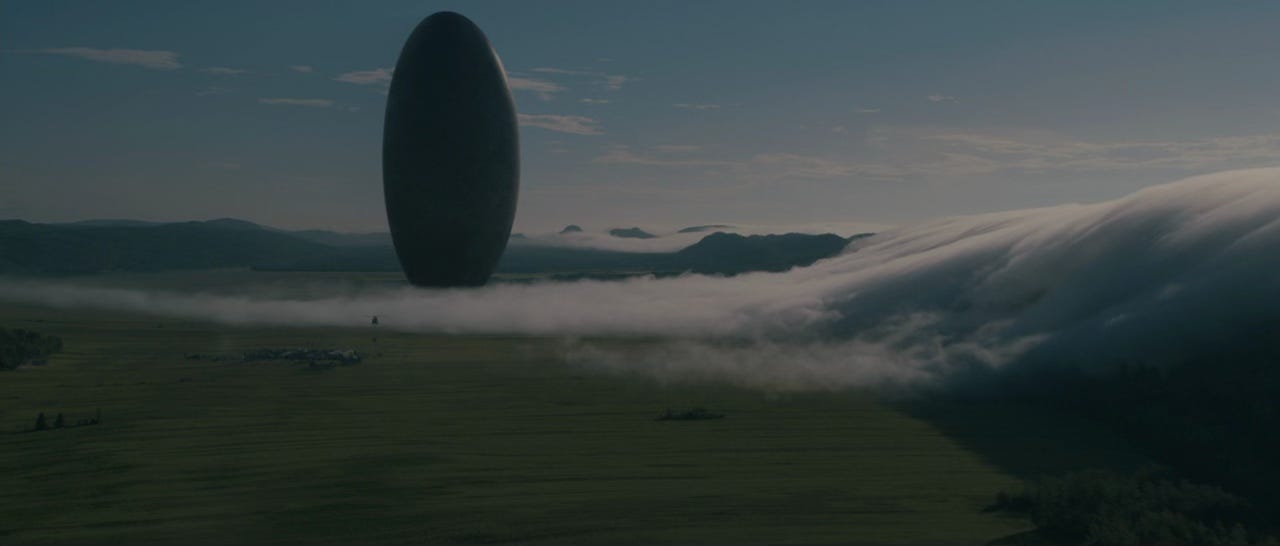
Then the helicopter shot. If you have seen Arrival, you know the one. The camera lifts across misted landscapes at the pace of thought rather than action, circling rather than arriving. It is one of the great establishing shots in recent cinema, not because it conceals anything, but because full visibility offers no comprehension at all. The helicopter crests, and there it is: a dark oval suspended above the valley floor, clean against the sky, neither threatening nor welcoming. Just present. The fog sits beneath it. The mountains recede behind it. The military encampment below is a scatter of dots. It does not announce itself. It simply occupies the space, at a scale that takes a moment to process, and waits.
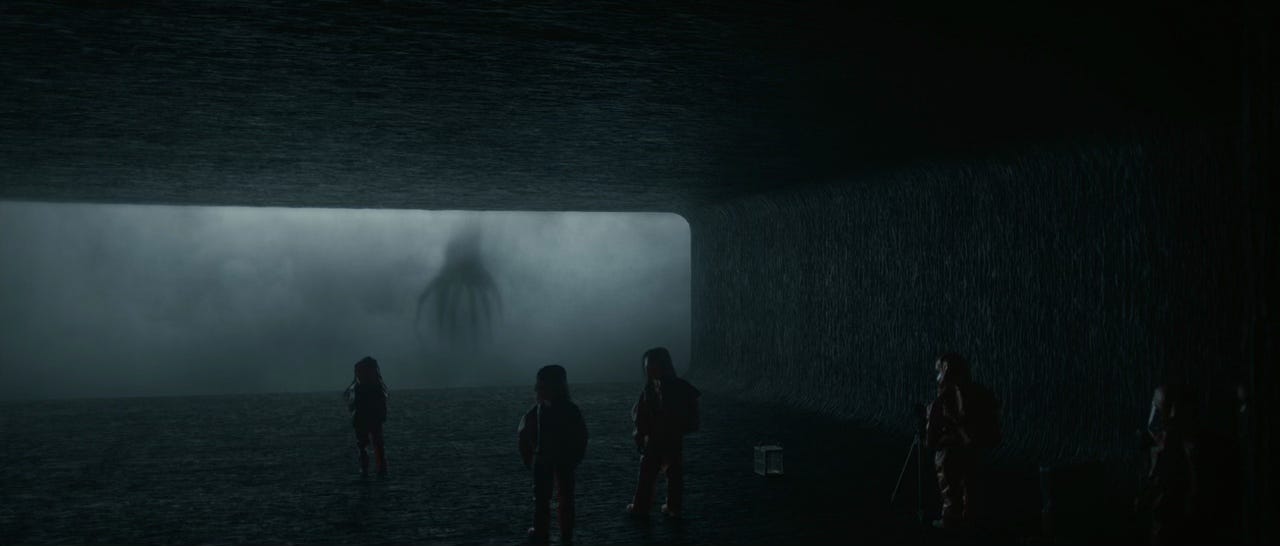
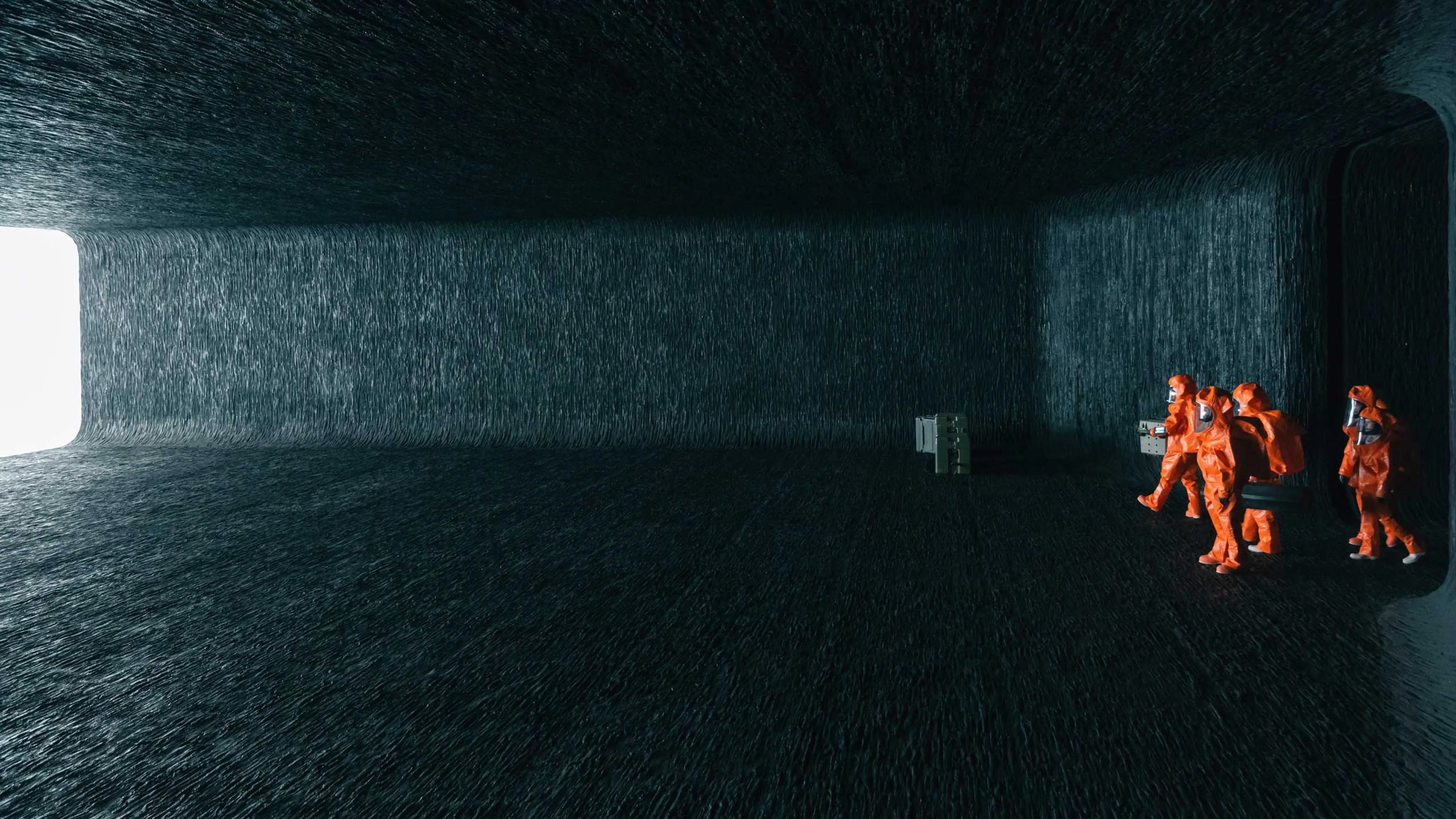
Here is the thing about Arrival that you only fully understand in retrospect. For the entire first act, some part of your brain quietly insists that this film cannot really be about communicating with aliens. The setup is too interior, too muted, too focused on one woman’s particular quality of attention. The genre signals are present but muffled. And then corridors stretch. Gravity tilts. Floors become walls. The body adjusts before the mind can catch up. Silhouettes in the dark, facing the viewing panel, the white rectangle beyond which something moves but will not yet resolve. And then the Heptapods appear, and you realise: it is about communicating with aliens. It is exactly and precisely about communicating with aliens. And that realisation, arriving as it does, after so much careful preparation, produces something close to goosebumps. Not because the creatures are frightening, but because the film has spent twenty minutes teaching you to receive them properly.
Awe, in Arrival, does not arrive. It accumulates. Or maybe that’s too neat. It doesn’t feel like accumulation when you’re watching. It feels like waiting without knowing what you’re waiting for.
Villeneuve is one of the few directors working at this scale who trusts silence more than spectacle. His films place ordinary people inside enormous forces and resist the urge to resolve the tension between them. Characters are small within their environments. The world does not organise itself around human need. Meaning, when it comes, arrives slowly. This is his signature across every film he has made, and Arrival is its purest expression because here the method and the subject are the same. The film is about the gap between seeing and understanding. Louise receives her future before she has the framework to read it. The Heptapod language restructures perception before meaning arrives. Villeneuve does not close that gap for us.
Bradford Young’s cinematography is the visual language of that choice. His camera moves at the pace of observation. Compositions place figures small within their surroundings, subject to forces that dwarf them. The ship hangs in the open sky, fully visible, and still resists comprehension. Young frames it at distances that force you to reckon with scale before detail, presence before meaning. There are no heroic wide shots of humanity standing its ground. There is open land, and pale light, and something enormous that has not yet decided to notice you.
Amy Adams carries all of this, and it is worth stopping to say how extraordinary that is. Villeneuve provides very little expository material to lean on. No speeches. No moments of declared feeling. No dialogue that announces its own importance. What she is asked to do instead is make thought visible without externalising it, to let the audience watch consciousness change in real time. Watch her in the scenes inside the ship: the quality of her attention, the slight delay before she lifts her hand to the glass, like she’s checking something internally first. You are watching someone think. Really think. In a film about the transformation of consciousness, that is not a small thing. It is the whole thing.
And then there is the dialogue, which is where Villeneuve’s style becomes slightly paradoxical. He has spoken at length about his distrust of words in cinema, his preference for image and silence. When Louise begins to perceive time non-linearly, you feel it before you understand it. The film trusts your nervous system more than your brain. And then nine words stop you cold. “He doesn’t look at me the same way anymore.” A child, talking about her father. The confusion and hurt of a child who can feel a parent withdrawing but cannot name why. The director who doesn’t believe in words just broke you with nine of them.
Jóhann Jóhannsson’s score anchors the film, but On the Nature of Daylight is not his. It is Max Richter’s, and its presence here is one of the rare instances of Villeneuve licensing existing music. That choice is deliberate. He did not need something written. He needed something that already existed, that already carried the weight he was reaching for. On the Nature of Daylight is one of the oldest textures in Western music. Strings carrying the particular kind of grief that strings have carried for centuries. The sound of loss before loss had been named. Its first appearance accompanies what seems like a memory of Louise’s daughter, but it functions as a harbinger, threading inevitability into the narrative before chronology has given you the tools to understand it. This is not manipulation in the way film scores so often manipulate, pushing emotion into scenes that haven’t earned it. It is temporal architecture. The music is shaping your experience of the subject before the film has revealed what the subject is.
There is a version of this story that a different director would have made. The aliens arrive. Humanity responds. A scientist unlocks the code. The world is saved. The emotional stakes are established through a dead child used as backstory, a source of motivation rather than meaning, grief as fuel rather than subject. This version of Arrival exists in rough outline in a dozen other films. You’ve seen it. It is competent. It is not what Denis Villeneuve made.
What Villeneuve made instead is a film about child loss, about a marriage breaking under impossible weight, about grief as a condition of love rather than a punishment for it. He made this film in 2016, in the middle of a career that had already included a film about torture and moral collapse in Prisoners, a portrait of war and its legacy in Incendies, and a searing depiction of the war on drugs in Sicario. These are not the subjects mainstream cinema typically reaches for. They do not lend themselves to the kind of broad commercial appeal that justifies the budgets Villeneuve commands.
And yet he keeps reaching for them. This is what makes him distinctive, not his visual style, which is remarkable, not his formal patience, which is rare, but his insistence on bringing genuinely difficult human material into the centre of event cinema. He is not making arthouse films with difficult subjects for small audiences. He is making films that open wide, that compete for the same screens as superhero franchises, and that are quietly, stubbornly about grief and violence and the cost of love.
Arrival sits at the peak of that project. Because underneath the first contact premise, underneath the linguistic conceit and the formal beauty and the Amy Adams performance, the film is asking one of the oldest questions available to it. A question that most films, even good ones, find a way to avoid.
If you could see your life twenty years in advance clearly, the love, the pain, the loss, would you still take the step? If you knew exactly how something would break your heart, would you still make the same decisions?
This is what Louise Banks is asked. She acquires the ability to perceive her own future, including the birth of her daughter, the death of her daughter, the collapse of her marriage under the weight of what she knows. She sees the full cost before she pays it.
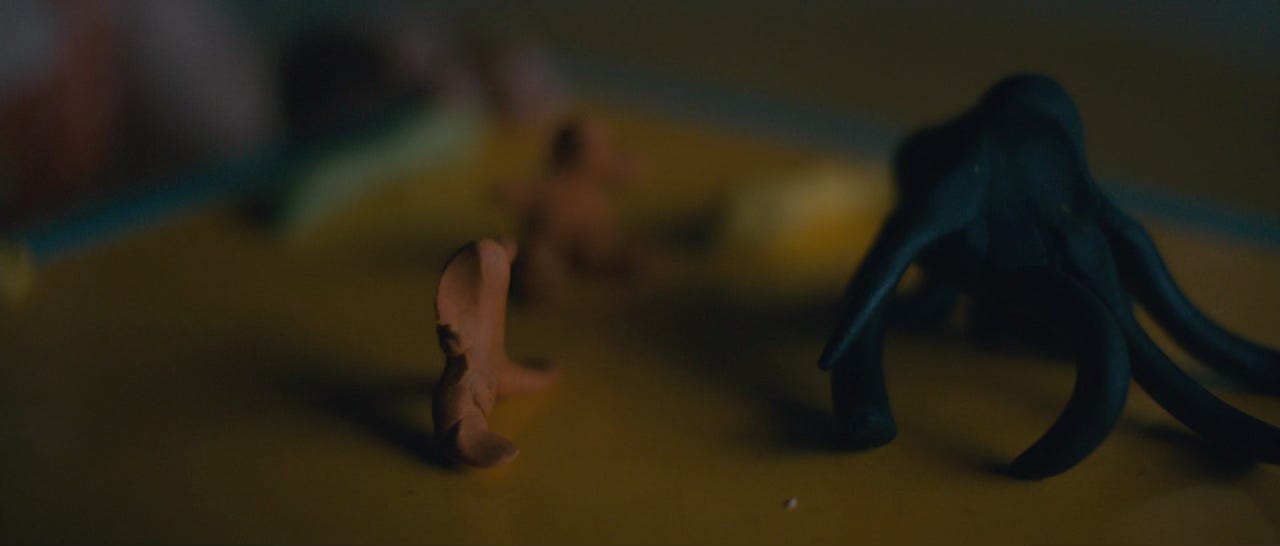
The film could be framed as a question about free will, and that framing is correct. But the sharper question underneath it is about the nature of love itself. Because love, any love, has an endpoint. To have a child is to enter a relationship that terminates in death, and you just pray it’s yours, not theirs. To marry is to make a promise that can only be kept until it cannot. We know this. And we proceed anyway, but at a careful remove from the full weight of that knowledge. We maintain, necessarily and perhaps wisely, a buffer of not-quite-knowing. We do not think about the end while we are in the middle of the beginning.
Louise does not have that buffer. She makes her choice in full conscious knowledge of what it costs. The marriage will not survive. Her daughter will die young. The grief will be real, and it will be devastating, and she will carry it alone because the man she loves will leave when he learns what she knew and when she knew it. She steps forward anyway. The reason is not complicated. She chooses because Hannah is Hannah. You cannot have Hannah without also accepting her death, and Louise decides, with full knowledge and open eyes, that Hannah's existence is worth any price the universe asks.
The film does not sentimentalise this or resolve it cheaply. It holds the question plainly, with the same patience it brought to the helicopter shot and the gravity tunnel and the long approach to first contact. The grief is not instrumentalised. It simply is, present and inevitable, a condition of the life Louise is choosing rather than a price she is paying for something else.
I find myself returning to this question more often than I'd like. If you knew the greatest love of your life would end in tragedy, would you take it? Watching Arrival for the first time, the answer feels obvious. Of course you would. The romantic version of ourselves demands we do. The film makes it feel like the only human response, the only answer a person of feeling could give. But then you leave the cinema, and you go back to your life, and you watch yourself make a hundred small decisions that protect you from exactly that kind of exposure. You don't make the call. You don't say the thing. You keep a useful distance from the people and the feelings that could undo you. I do this. You do this. Every day, in ways large and small, we choose safety. We do not leap.
The truth is, I don’t actually know what I would do. Most of us have never had to answer that question honestly, without the buffer of not-quite-knowing, without the comfortable distance that makes bravery feel easy in theory. To know is to have experienced genuine heartbreak. Arrival takes that distance away. It asks you to sit with the full weight of the choice, and in doing so reveals the gap between who we believe ourselves to be and who we actually are when the cost becomes real.
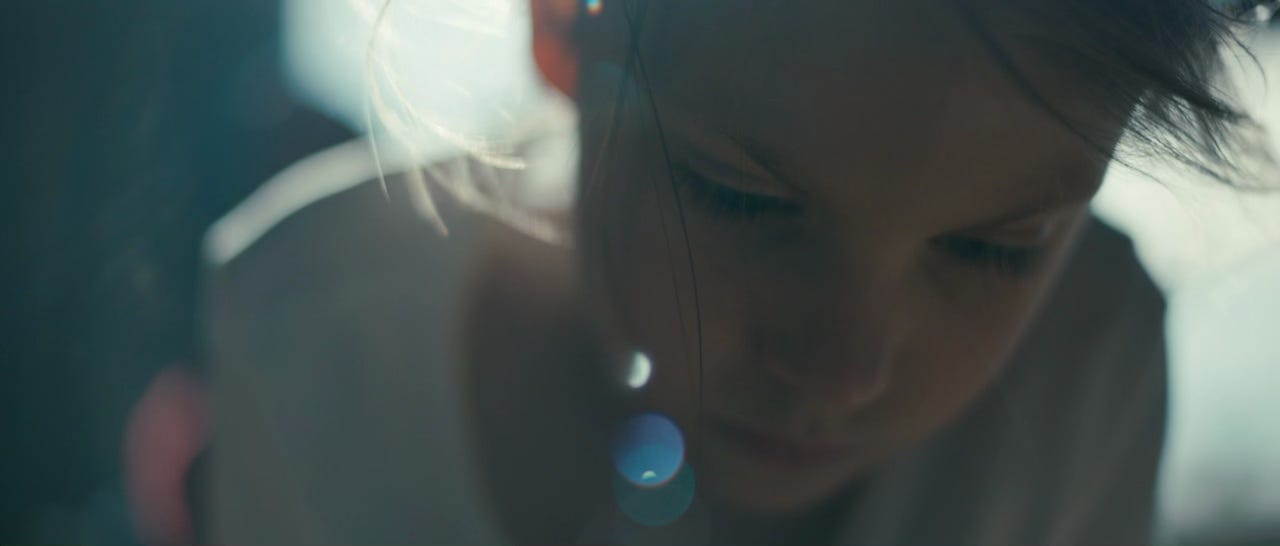
After all the patience, all the withholding, all the careful preparation, the film finally releases. Wave after wave of emotional revelation, each one building on the last, the music holding it all together, Richter's strings and Jóhannsson's score weaving in and out until ancient grief and present heartbreak become indistinguishable. Memory, foresight, and present experience collapse into one another. You are hearing the same notes you heard at the beginning, and they mean something completely different now.
Arrival doesn’t offer closure. It offers something rarer: the sensation of having understood something true about yourself. Not what happens next, but whether you would choose it if you knew. The future in Villeneuve’s hands is not a mountain to conquer or a mystery to solve. It is a weight to carry.
The film ends as it began, quietly. The world is still shifting. The unknown is still a horizon. Louise knows what lies beyond it and moves toward it anyway. Somehow, that is enough. Or at least, it has to be.
This is the first in a series on the films of Denis Villeneuve. What Arrival establishes, the patience, the formal precision, the willingness to bring genuinely difficult human material into mainstream cinema, is not incidental to his work. It is the lens through which everything else he has made can be understood. Next: Sicario
No posts
Comments
Nothing yet. Say the first thing.
Sign in to join the conversation.