
Charles Schreyvogel’s painting, In Hot Pursuit, disrupts a familiar trope of late 19th century paintings of the American frontier. Schreyvogel unexpectedly foregrounds a Native American subject holding a gun and clad in partially western clothing, rather than stereotypical Indigenous garments. The figure is on horseback and shown quickly fleeing two pursuers, who are nearly hidden in the snow-covered mountains that form the background.
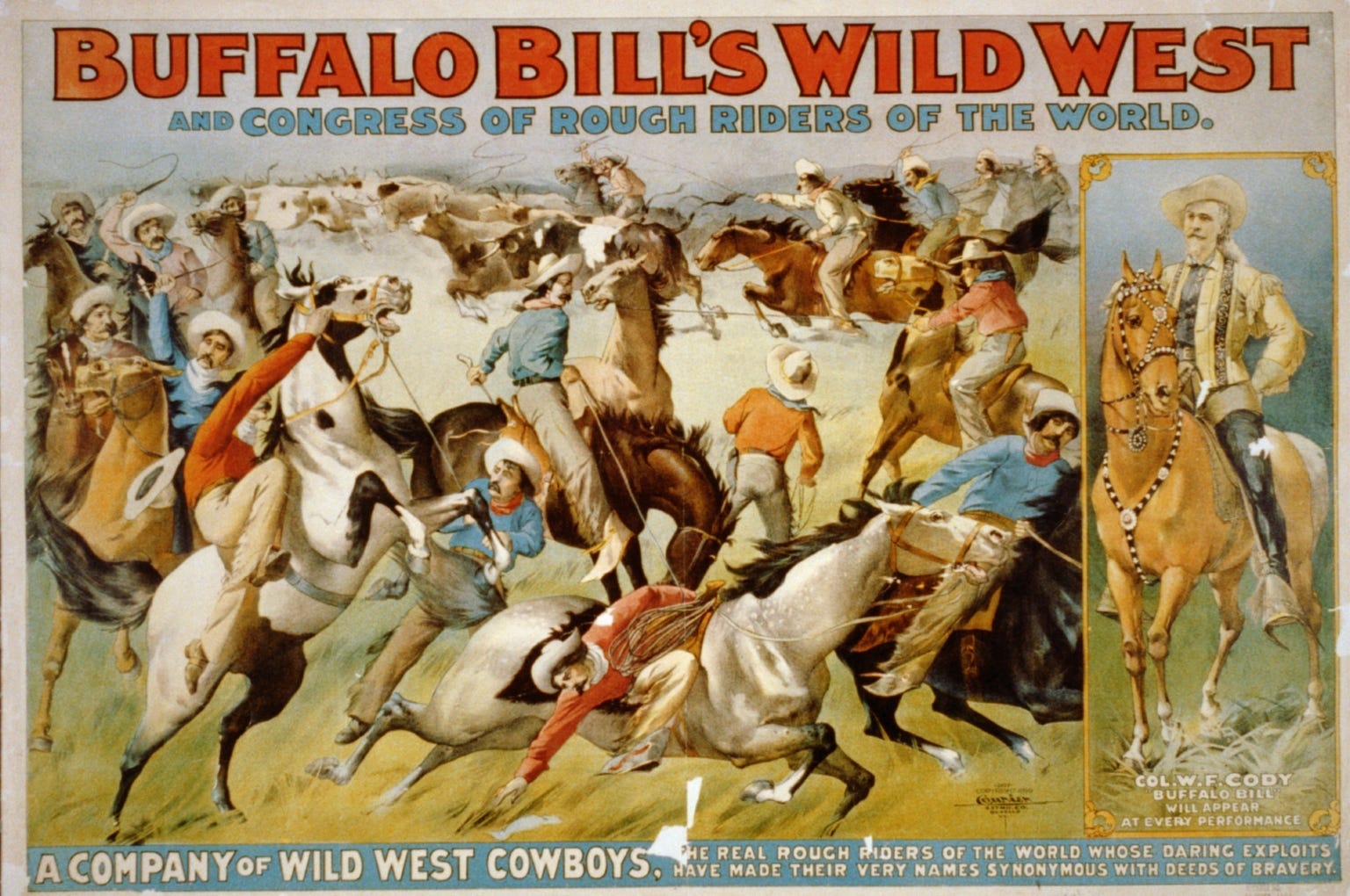
Historically, Native American subjects were depicted either as “savages” or as the antithesis of modern: a group “backwards” in their ways of life and slowly dying out.1 Paintings of the frontier, western films, and Buffalo Bill performances employed depictions of Native Americans laden with stereotypes that worked to deepen the divide between Indigenous people and European colonizers, consistently casting Native Americans as the “other.” However, Schreyvogel’s painting blurs the lines between the two groups, depicting his subject as simultaneously “traditional” and modern, achieved in the man’s western dress and the inclusion of the pistol alongside stereotypical Indigenous tropes like the feather and red face paint. The fusion of iconography present in this piece underlines the competing discriminatory and tolerant sentiments towards Native Americans at the turn of the 20th century, and highlights the inconsistent, and at times contradictory, modes of Indigenous representation in visual culture.
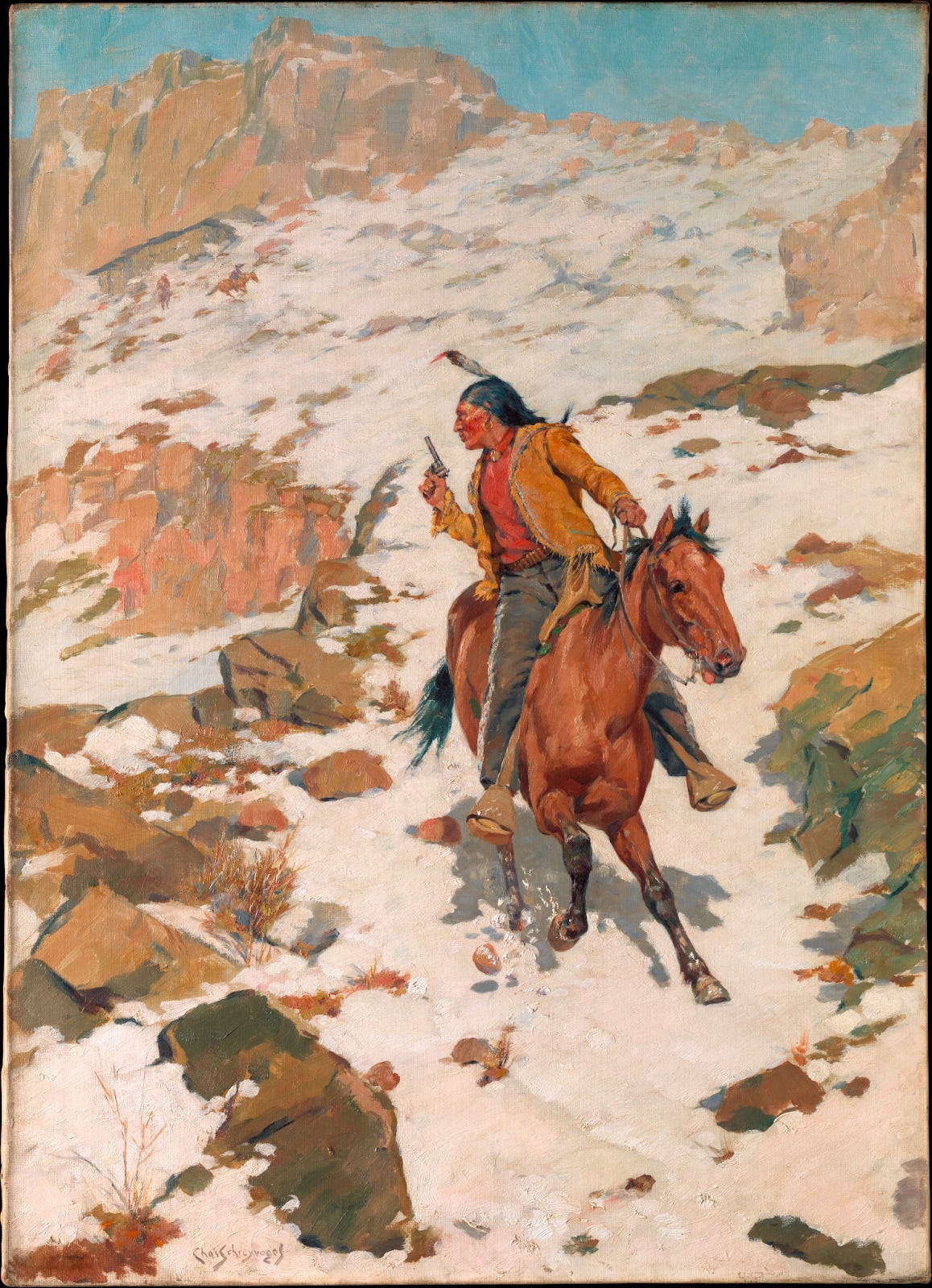
In Hot Pursuit depicts a Native American man on horseback riding through jagged peaks, looking back at the two cowboys who chase him. The Indigeneity of the man is signaled through imagery including red face paint, his complexion, and the feather on his head. However, this conglomeration of elements does not hold substantial historical or cultural legitimacy, instead painting an image of a Native American man based on stereotypes and reproductions likely viewed in locales far removed from the American West. The red-tipped feather, for example, is cultural adornment found in Northeast Woodland tribes,2 while golden earrings are typically seen in tribes only as far north as Mexico.3 These features, paired with Western dress and a snowy landscape reminiscent of the Rocky Mountains, spin an imagined image of the West, a wild land people thought of as uninhabited, dangerous, and thrilling.
19th-century artists played a crucial role in consolidating the “mythic image” of the Wild West, presenting the frontier as a “theater of warfare,” and in doing so aestheticized the violence that occurred there.4 In this painting, however, the violence is not front and center, instead it is concentrated exclusively in the subject’s pistol, perhaps one of the most important details of this piece. Instead of the white cowboy in a position of control over the West, we see an Indigenous man dominating the scene, and maintaining a far enough distance from his pursuers that we do not feel an immediate threat for his safety. This power is amplified through his tight grip on the pistol, ready to pull the trigger if the need arises. The pistol is angled up, pointing directly towards the distant cowboys and asserting the prowess of the Indigenous man. Further, the shadows of the hand are detailed in red, echoing the red paint covering his cheek and the meanings of battle and strength that it signifies. In this artistic choice, Schreyvogel injects the man with power, for not only is he commanding the composition, but his gun is pointed back at his presumably European pursuers, signaling the subject’s strength.
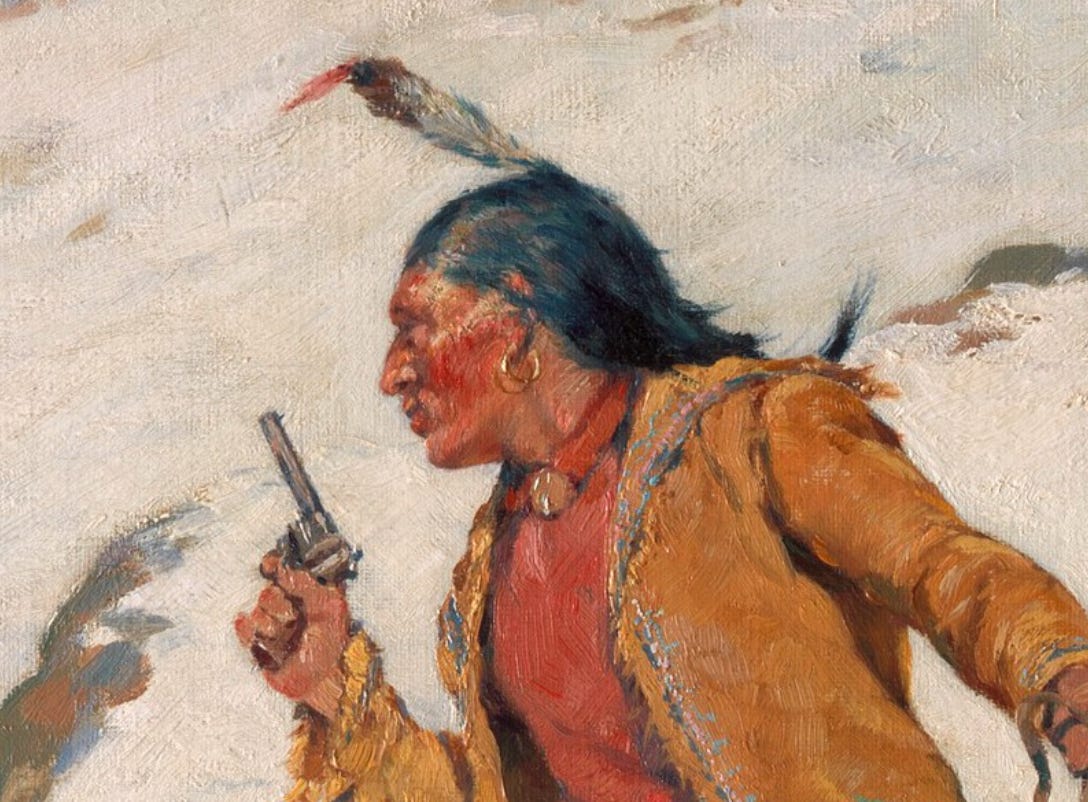
Representations of Native Americans created by white artists will always be informed by current sociopolitical contexts, and Schreyvogel’s painting is no exception. Working in the last decades of the 19th century and into the early 20th, Schreyvogel would have been conscious of the Indian Wars and political struggles between Native Americans and the US government, as well as visual media including early American westerns and Buffalo Bill performances, the latter of which he was an avid attendant.5 Schreyvogel likely painted this scene to mimic the adventurous narratives of the Wild West; He viewed the pistol and Western clothes on his central figure as a costume used to tell an exciting story of mountainous pursuit, and would not have considered a postcolonial reading of this work. However, when we analyze this work today, the pistol immediately jumps off the canvas as a symbol of conquest over the West, and a tool used in violence against Native Americans. In the hands of an Indigenous man, the pistol becomes an emblem of power, an appropriation of a Western motif that now threatens the former oppressor.
In 1893, ten years before In Hot Pursuit, Frederick Jackson Turner identified the frontier as “the most decisive factor in shaping American political and social institutions and in creating a specifically American national character.”6 With an aim of casting the West as a uniquely American space, artists and filmmakers employed a recurring cast of stock characters, like the “savage Indian,” to reinforce the need for control and Western civilization. Schreyvogel’s work plays to this male fantasy of exploration and conquest of “uncharted” lands. Freud’s concept of wish fulfillment, the notion that if a desire cannot be realized in our waking lives, it will manifest in our dreams, can certainly be observed in In Hot Pursuit.7 As a painter once based in New Jersey, Schreyvogel is living out his cowboy fantasies through his dramatic, snapshot-like images of the West while comfortable in his Northeast domicile.
Schreyvogel’s divergence from such a prominent tradition of Indigenous representation is only furthered by the fact that the Native American subject is occupying the central space on the canvas, historically reserved for the heroic white cowboy. Perhaps in this choice the artist wished to capture the anxieties surrounding Indigenous assimilation into Western society, or the fear of Native American military success in the decades that followed the Battle of Little Bighorn. However, it is equally likely that Schreyvogel created this image without a specific motive in mind, and the contradictory image is a result of the melting pot of Native representation in various forms of media and political discourse, evident in the quasi-European clothing and the pistol. This painting, which at conception served as a stereotypical portrayal of a Native American starring in a colonial fantasy of the American West, could today be read as an act of resistance. The figure has taken the pistol, a symbol of conquest over Native lands, and turned the barrel back to the cowboys, reminding the viewer, and the men in pursuit, who the true tenants of the land are.
Michael Valdez Moses, “Savage Nations: Native Americans and the Western,” In The Philosophy of the Western, (Lexington: University Press of Kentucky, 2010).
Alan C Braddock, “Shooting the Beholder: Charles Schreyvogel and the Spectacle of Gun Vision,” In American Art 20, no. 1 (2006).
Jonna Eagle, “Manifest Destiny in Action: Sensational Melodrama and the Advent of the Western,” In Imperial Affects: Sensational Melodrama and the Attractions of American Cinema, (New Brunswick: Rutgers University Press, 2017).
Heike Paul, “Agrarianism, Expansionism, and the Myth of the American West” In The Myths That Made America: An Introduction to American Studies, (Germany: Transcript Verlag, 2014).
Sigmund Freud, “Chapter 3,” in The Interpretation of Dreams, (Germany 1899).
No posts
Comments
Nothing yet. Say the first thing.
Sign in to join the conversation.