
“Future Geographies: Art in the Century of Climate Change” opened last week at the Vancouver Art Gallery, presenting a thoughtfully curated collection of international contemporary artists tackling the issue of climate change head-on. I had the privilege to attend the exhibition opening, and hear directly from curator Eva Respini and guest curator Dr. T’uy’t’tanat Cease Wyss, as well as collaborative partners from the University of British Columbia’s Climate Action Lab. During these opening remarks, the speakers underlined the intergenerational ramifications of climate change, the urgent need to fight for our shared future on this planet, and the importance of contemporary art in raising awareness and supporting an open dialogue.
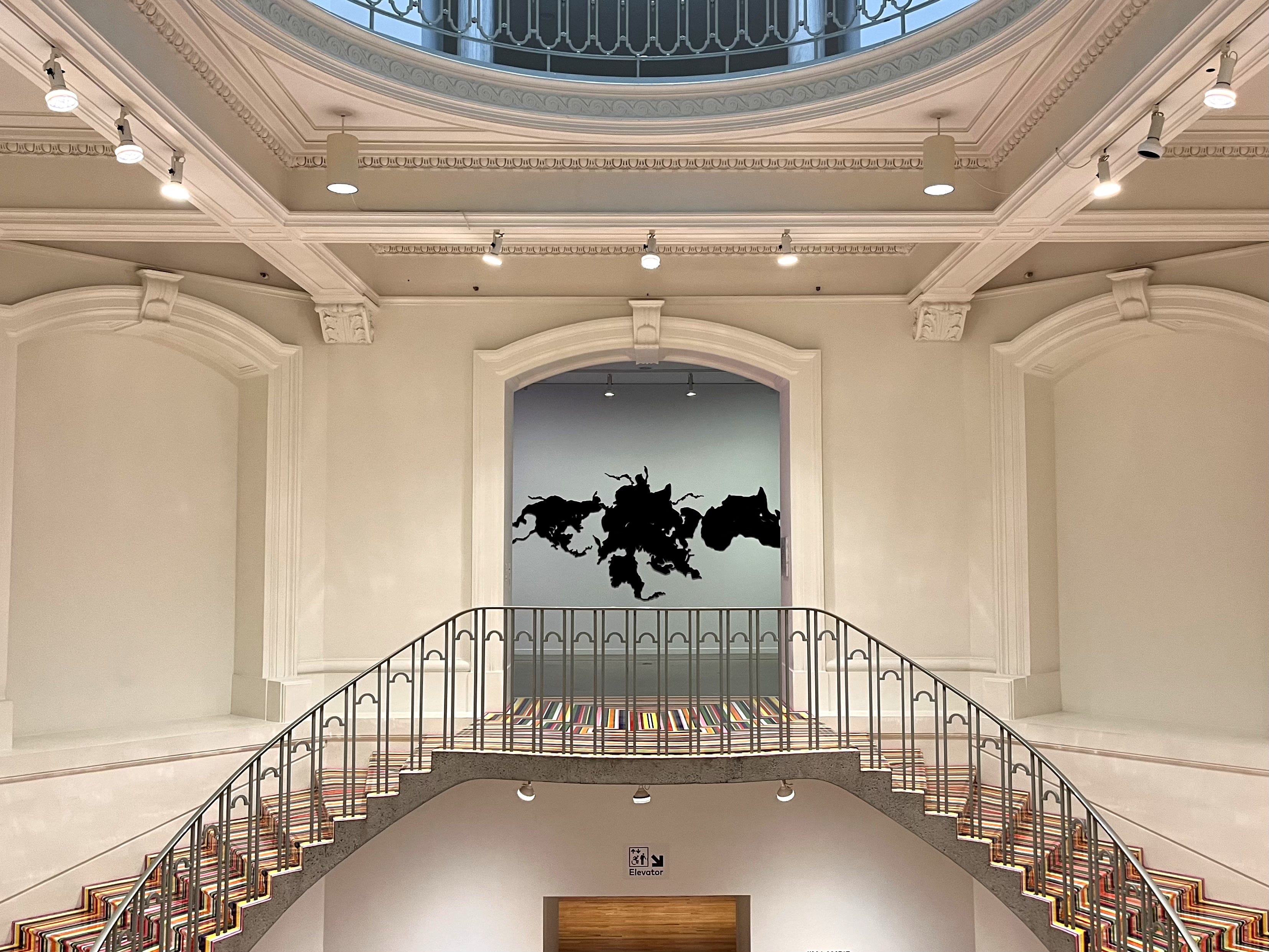
This exhibition features more than 35 works spanning virtually all mediums, all engaging with the same question: What is the role of contemporary art in the climate crisis? What impact does art have on ecology, sustainability, land use? Unsurprisingly, there is no definitive answer found within the galleries of this exhibition. However, the selected pieces thoughtfully question our shared future on this planet, and foreground the need for active imagination and creative resistance, tools that are central to successful political action or revolution. Further, several artworks consider the British Columbian perspective in the context of logging and Indigenous peoples, which successfully grounds the thematically vast exhibition in tangible issues that will resonate with the local audience.
The exhibition primarily lives on the 2nd floor of the museum, with a few works populating the 4th floor gallery. When you enter, you are greeted with Teresita Fernandez’s Island Universe 2 (2023), a disfigured map of the world rendered in charcoal. The artist has strung all seven continents together into one connected form, an apt visualization of the globality this exhibition seeks to address. In the first gallery, “Living Knowledge,” we are greeted with five mixed media works addressing the range of sociopolitical forces that shape the environments we inhabit today.
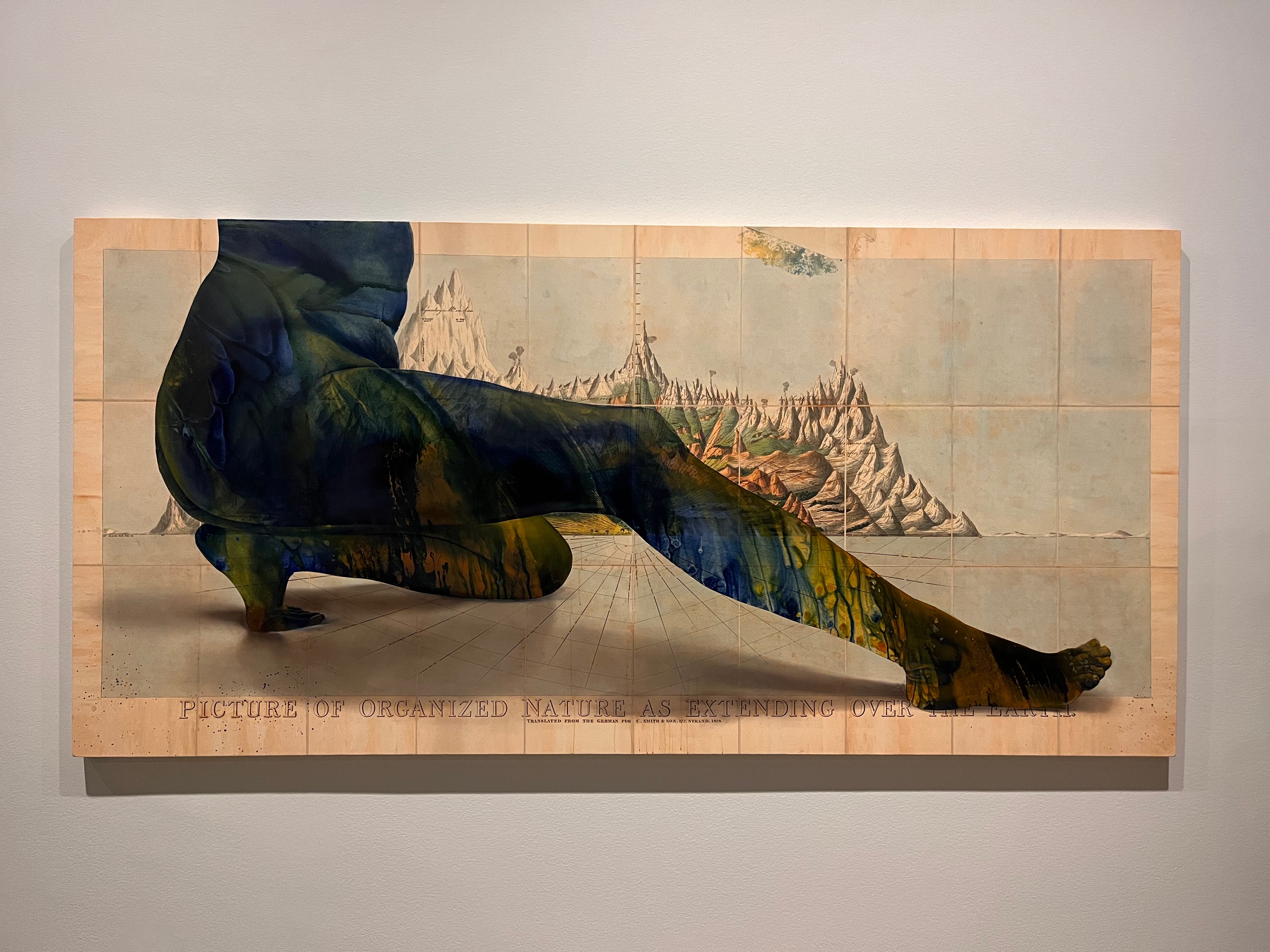
This gallery is home to two of my favorite pieces in this exhibition, Firelei Baez’s Unbound (one way ashore, a thousand channels (2024) and Carolina Caycedo’s To Drive Away Whiteness/Para alejar la blancura (2017). Unbound is a large oil and acrylic work painted on archival canvas, depicting the lower half of a female form overlaid on a topographical map of North and South American mountain ranges. The early 19th century map, constructed by British cartographer Charles Smith (1776-1854), was created in a time of conquest, when European colonial domination painted the American continents as untouched and ripe for the taking. By layering a women’s body overtop the existing cartographic work, Baez obstructs the archival print, disrupting the existing eurocentric narrative of colonial conquest and recentering the focus on humanity, femininity, and Indigeneity. The figure is painted in swirling shades of deep blue, moss green, and ochre, presenting an allegory of Mother Earth that aligns the histories of colonialism represented by the print with the larger discussion on climate change.
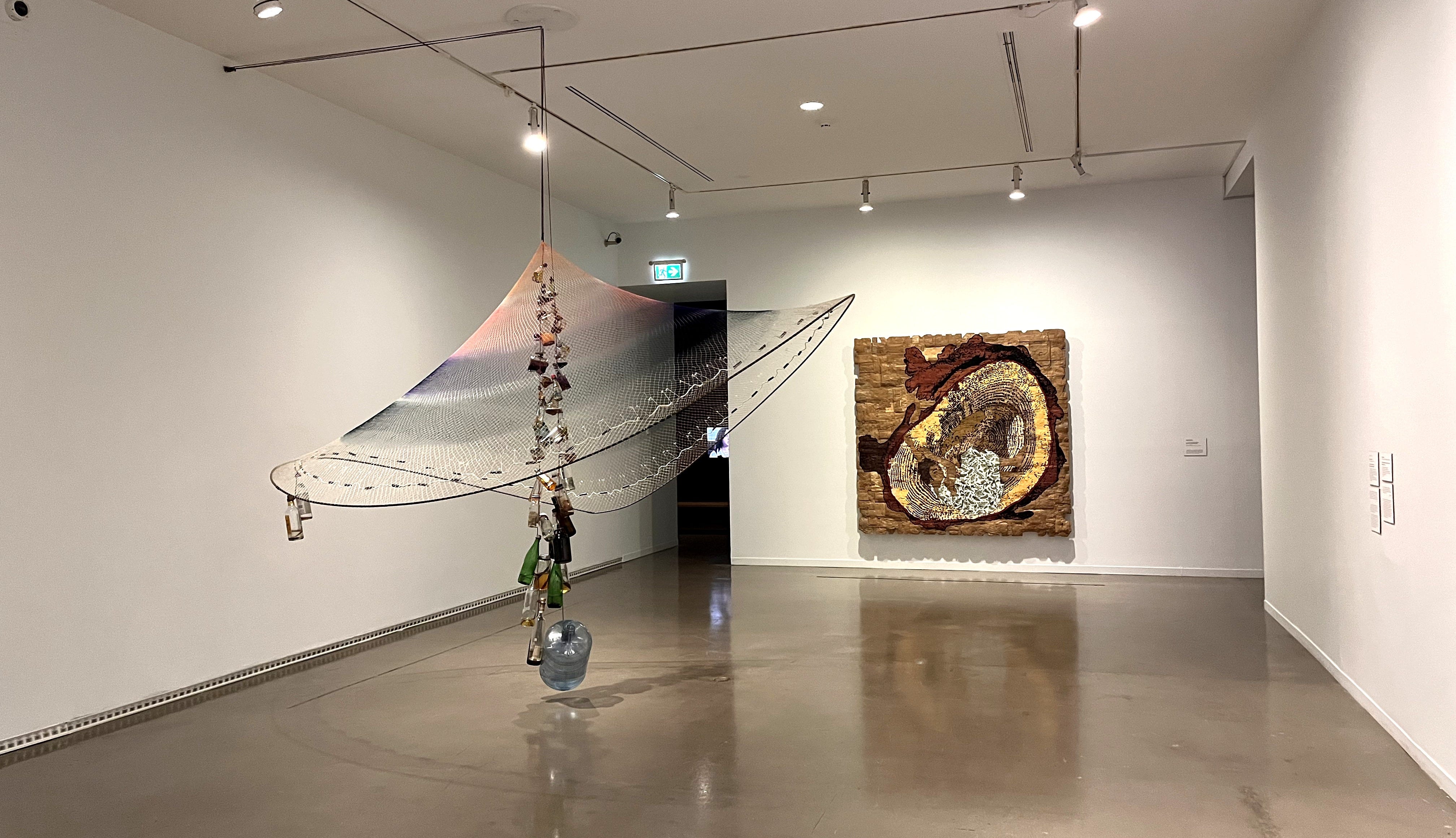
Caycedo’s To Drive Away Whiteness/Para alejar la blancura (2017) is part of the artist’s larger Cosmotarrayas sculpture series addressing Latin American river communities affected by the privatization of crucial waterways. The mixed media artwork consists of a large, hand-dyed fishing net framing a collection of found vessels strung up with rope. Each bottle is unique, weathered, and filled and/or adorned with a variety of materials including water, tea, sand, seeds, and other natural substances. Through the inclusion of water collected from the Pacific Ocean, Fraser River, and Capilano River, this piece connects the Indigenous relationship with rivers and oceans in Vancouver to communities in Latin America navigating similar challenges and barriers to resources as a result of neocolonial and capitalist policies. Caycedo’s work, like many others in this exhibition, present site-specific narratives that seamlessly enter into the larger international discussion of climate change, highlighting the true globality of the environmental crisis.
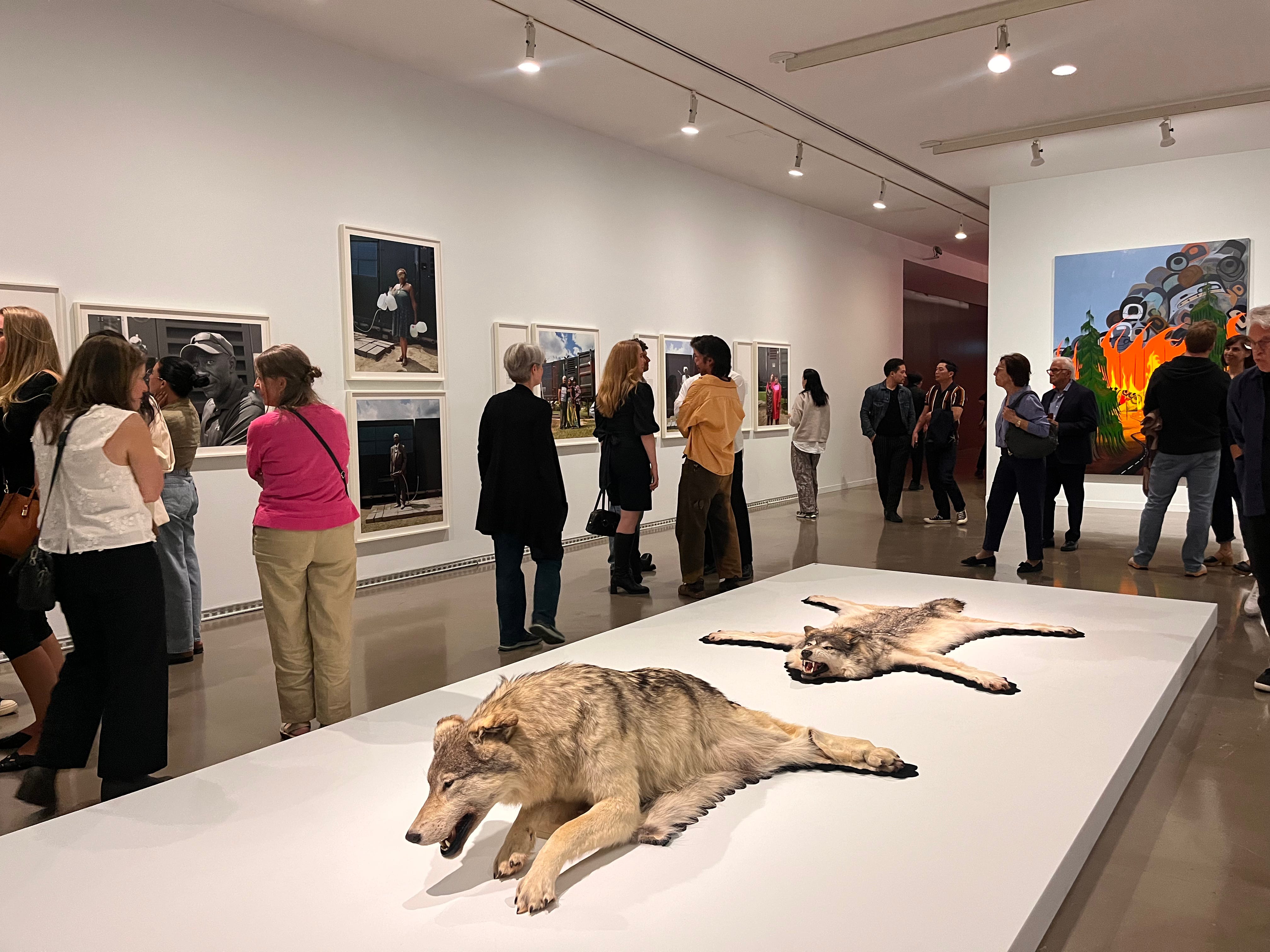
Upon exiting this gallery, visitors enter into a long corridor with a gallery off to the right playing a visually stunning three-channel video installation by John Skromfrah entitled Vertigo Sea (2015). This work opens “Consumed Earth,” the next section of the exhibition that explores artistic interactions with extraction and extinction as a result of human impact. In this gallery, artists including Judy Chicago and Nicholas Galanin foreground the effects on animal populations, while Lawrence Paul Yuxweluptun and LaToya Ruby Frazier consider environmental ramifications. Throughout the entire exhibition, the artist’s voice is featured prominently on each exhibition label, providing intimate commentary on process, inspiration, and intended impact. In Frazier’s photography series documenting the communities impacted by Flint’s water crisis, interviews with each subject are displayed next to their photograph, further emphasizing the importance of collaborative narratives in the realm of contemporary art.
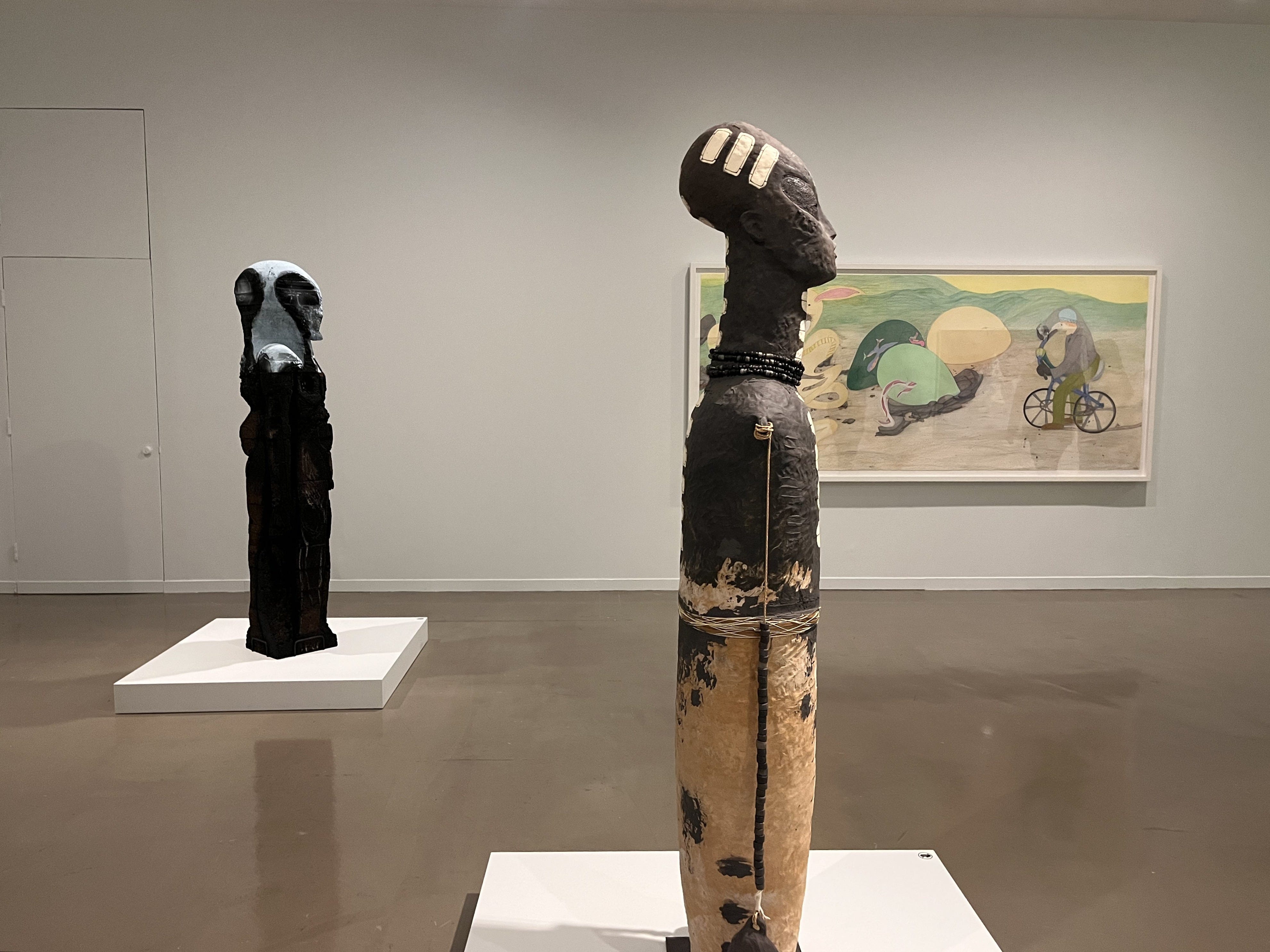
In the next gallery, titled “Speculative Worlds,” approaches the question of climate change with a futuristic approach, with artists drawing upon mythology, storytelling, and science fiction to create imagined landscapes. As a longtime fan of contemporary Inuit art, I immediately spotted Shuvinai Ashoona’s work from across the room. Her large scale colored pencil piece, Untitled (2019), is a quintessential Ashoona work, combining playfully intimate scenes of life in the north with elements from Inuit mythology and the artist’s own imagination. In this drawing, a large two-headed chimera with walrus tusks, a human face, rabbit ears, and a tangle of tentacles holds a smaller creature in its clutches, floating next to a series of egg-like forms surrounded by fish. A figure on his bicycle looks on, unfazed by the scene unfolding in front of him.
This work is especially poignant when read with Douglas Coupland’s paintings directly across the gallery, Ellesmere (2023) and French’s Mustard with Strawberry Sauce (2023). This duo depicts colorful, modernist icebergs that employ contemporary visual language to emphasize the artificiality and impermanence of once steadfast geographical features. The arctic is perhaps the biome most affected by climate change, and the melting northern landscapes have put Inuit communities like Ashoona’s directly on the front lines. As a result, surrealist works like Untitled respond to rapidly shifting arctic landscapes, rendering imagined worlds and mystical creatures in an unprecedented time where no future is certain, and the imaginary may be just as tangible as a landscape changing from one day to the next.
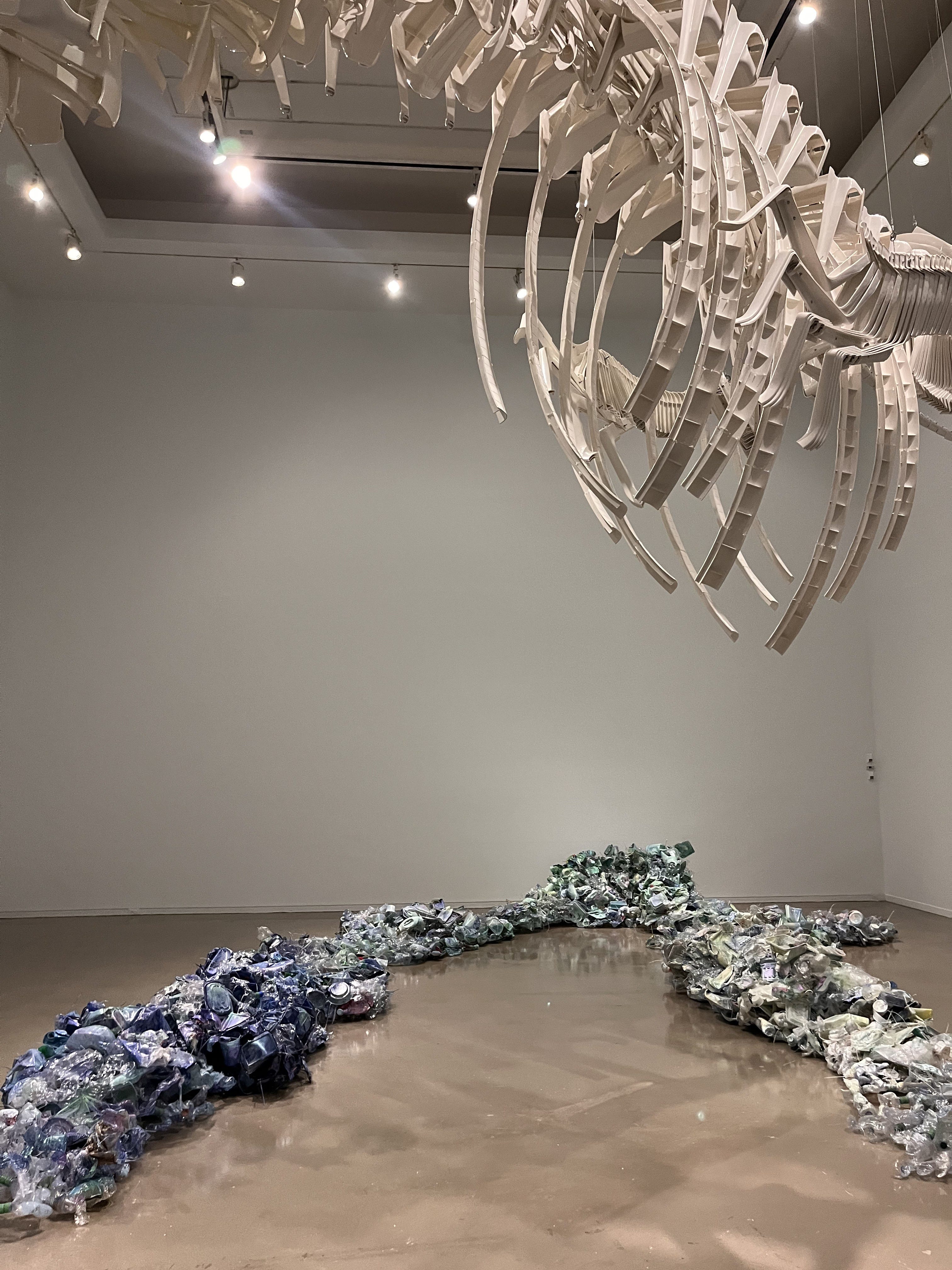
The final section of the exhibition, “Material Memory,” considers human-made materials in the context of recycling, repurposing, and art-making, commenting on the excess and waste inherent to our overconsumption and prevalence of single-use objects. These galleries open with the largest, and perhaps most striking, piece in the exhibition, Brian Jungen’s Cetology (2002), a life-size whale skeleton made from white plastic patio chairs, hanging over a reef of shimmering plastic. The bone-white of the patio chairs and the ceiling suspension mechanism instantly evokes genuine skeletons on display at natural history museums, presenting an eerie glimpse into what future archaeological discoveries may look like as a result of our overconsumption and plastic-dominated world. The plastic sea populating the floor of this gallery is a work entitled Meerschaum Drift (Blue) (2020-21), created by California-based artist Liz Larner. The sculptural installation feels organic, evoking natural reef formations and furthering the commentary surrounding plastic waste in our oceans.
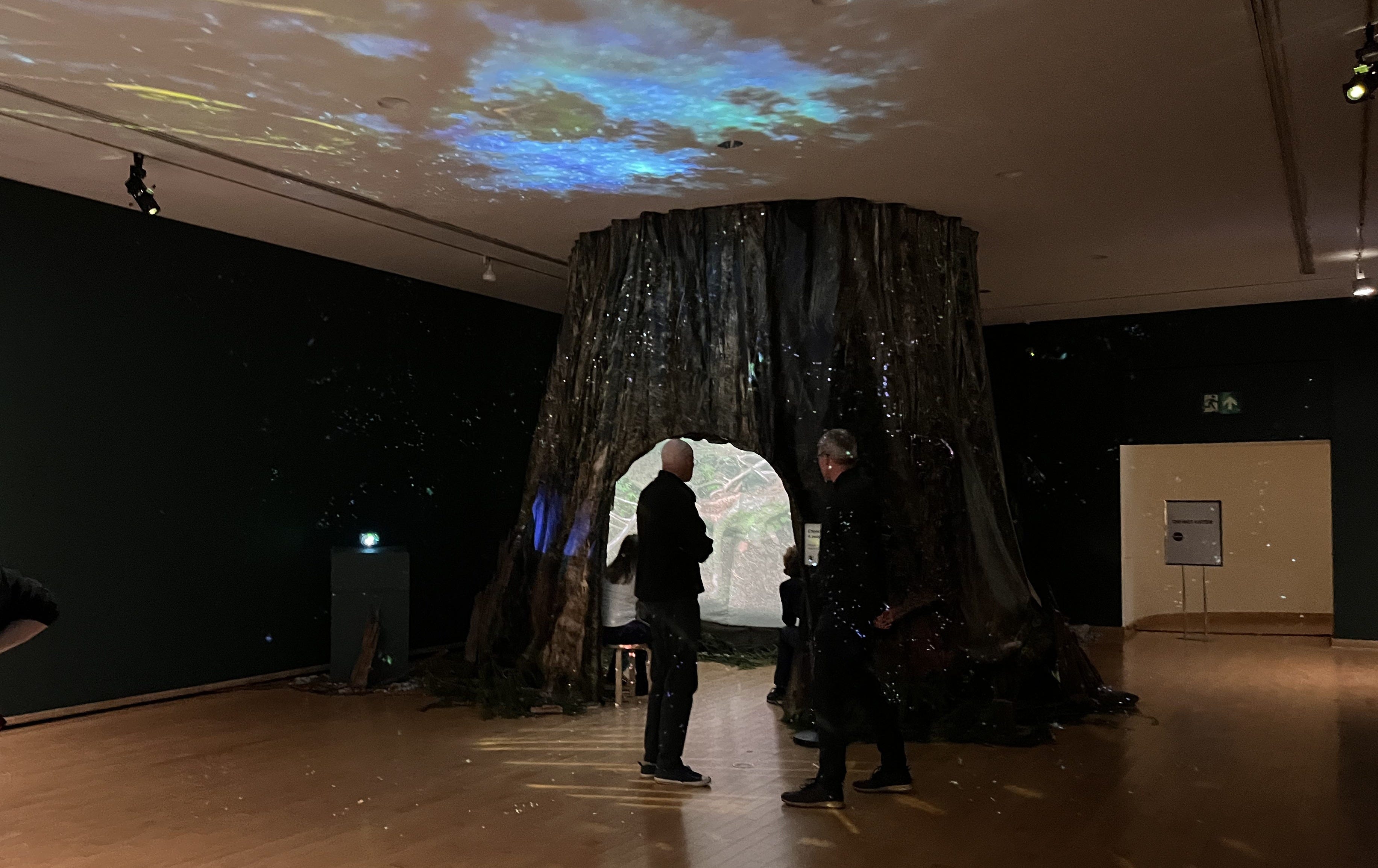
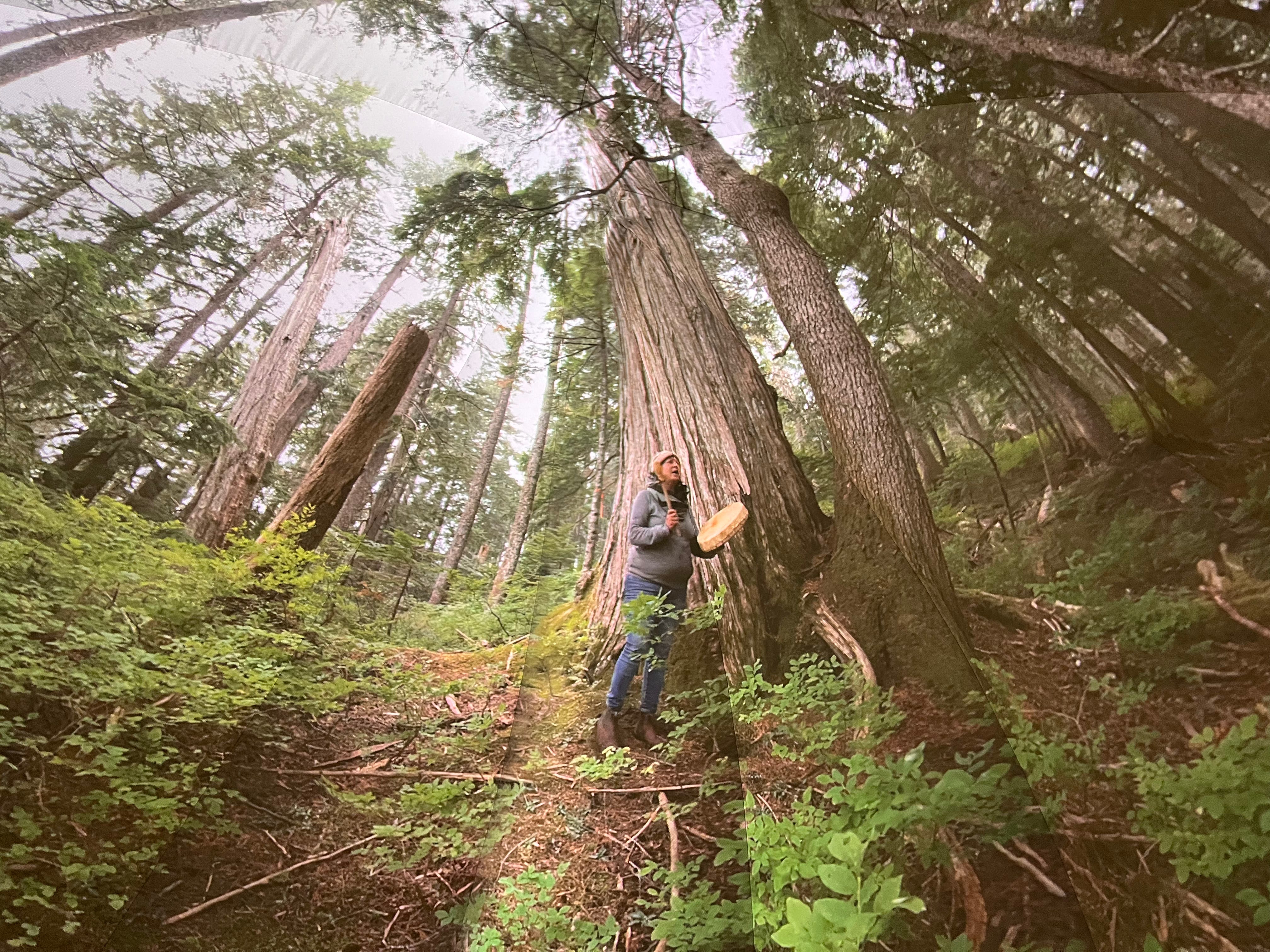
Future Geographies extends to the fourth floor of the museum, where Dr. T’uy’t’tanat Cease Wyss has curated a space titled “SANCTUARY: The Ancient Forest Experience.” This installation encompasses the entirety of the gallery, foresting the space and providing a refuge for thoughtful consideration on the impacts of the logging industry on Indigenous communities in British Columbia. The gallery features a handful of distinct artworks, but the exhibition design has rendered the space into one cohesive piece, with each work in clear dialogue with the others. When you enter the gallery, the lights are dim and projections dance across the walls and ceiling, emulating the speckled sunlight in an old growth forest. It was the smell of cedar that hit me first, wafting from the freshly cut branches carefully installed around the room.
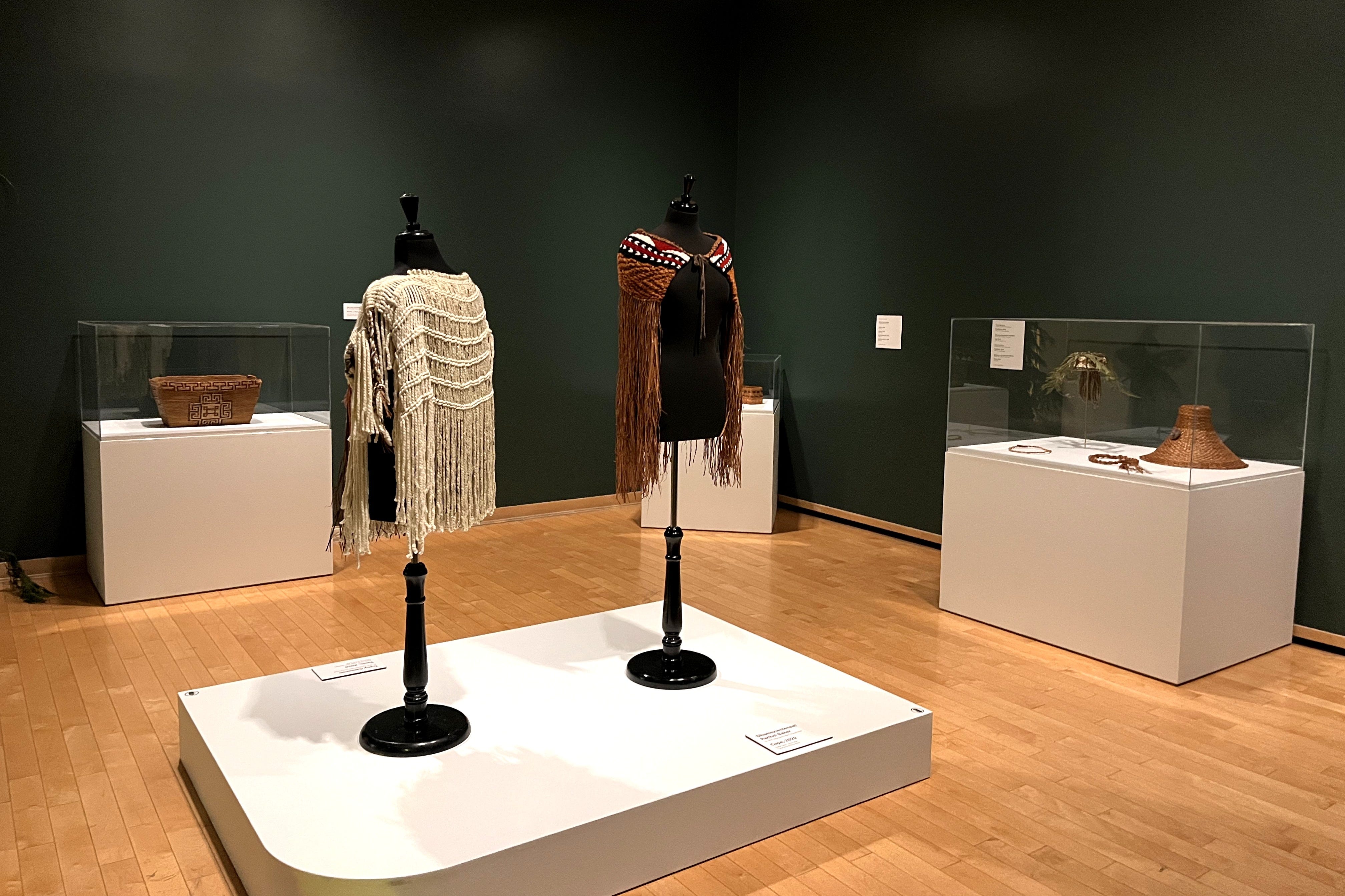
Along the left hand wall, a series of woven baskets, medicine pouches, hats, and clothing are arranged, highlighting the ongoing history of cedar in Coast Salish Indigenous visual culture. A basket made by Eva May Caufield Nahanee in the 1940s stands out as the only piece in the exhibition created in the 20th century, undoubtedly included to underline the generational practice of cedar weaving. In the center of the gallery space, a large tree stretches from floor to ceiling, hollowed out to create a small bear den theatre where viewers can observe Wyss’ “SANCTUARY,” a film on the eco-cultural impacts of clear cutting, created in collaboration with filmmakers Damien Gillis and Olivier Leroux.
The Vancouver Art Gallery has billed this show as “the first major exhibition in Canada to examine the intersection of contemporary art and future climates on a global scale.” While this may be true, this exhibition certainly draws on the international language and collaborative curatorial choices made in recent shows like the Whitney’s “Shifting Landscapes” (2024-26), The National Gallery’s “Anthropocene” (2018-2019), and even the Belkin’s “Structures of Smoke” from earlier this year. It begs the question, is “Future Geographies” an important exhibition because it is presented in Canada, or because all artworks were made in the 21st century? How much of an impact do borders and time have in the larger discussion of contemporary art and the climate crisis? Why are these meaningful characteristics to consider?
“Future Geographies” succeeds in laying the groundwork for meaningful conversations, with well-curated galleries that highlight shared experiences and that resonate internationally, even while addressing site-specific issues. This exhibition presents a glimpse into contemporary artists’ global commentary on the climate crisis, emphasizing international discourse and the powerful role of art in reflection, awareness, and shaping dialogues. While artists are not politicians or climate scientists, their work undoubtedly contributes to larger environmental discussions, and can reach populations and communities in meaningful, interdisciplinary ways. As Dr. Wyss stated in her opening remarks, “anyone making art is changing the world.”
Future Geographies: Art in the Century of Climate Change will be on display from May 14, 2026–January 10, 2027, before moving to the Art Gallery of Ontario in Toronto.
No posts
Comments
Nothing yet. Say the first thing.
Sign in to join the conversation.