
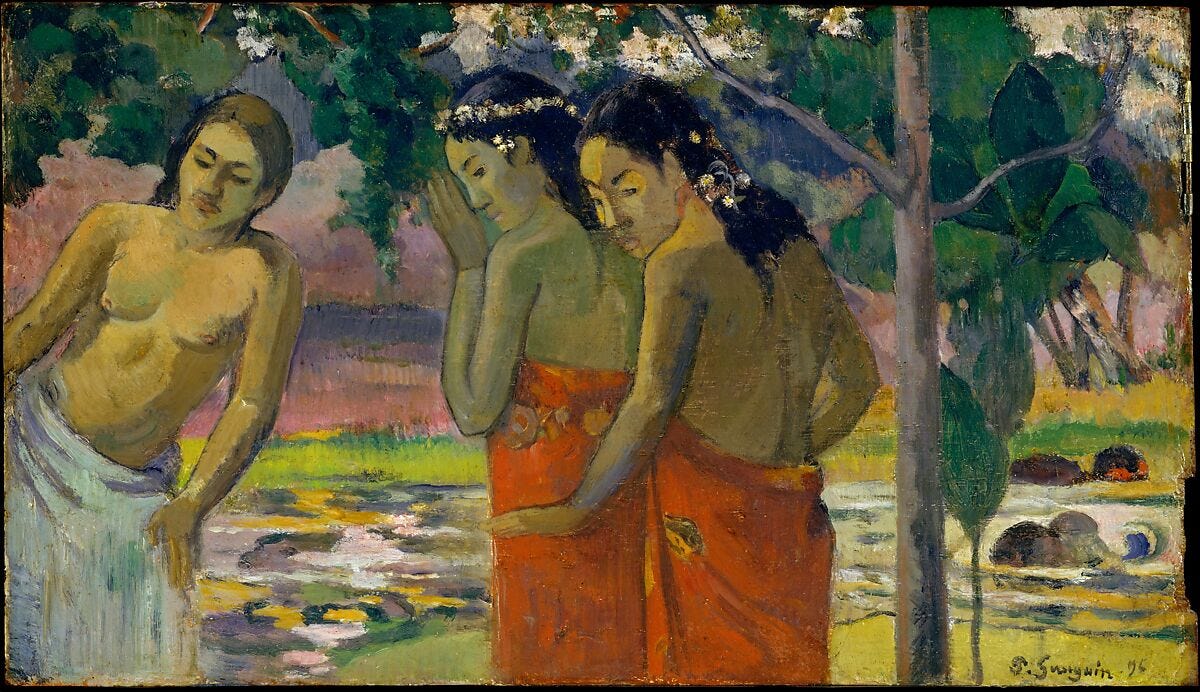
Paul Gaugin’s “Three Tahitian Women” is defined by the artist’s own colonial gaze and romantic depiction of Tahitian women that is rooted in his broader aestheticization of Indigenous Pacific culture. Currently, The Met’s curatorial choices surrounding this work fall short of addressing its complexities, and instead focus solely on archival and formal qualities. The painting is hung alongside primarily inhuman subjects such as landscapes and still lifes rather than other figural works, further contributing to the dehumanization of Indigenous women. “Three Tahitian Women” should be read as a complex and problematic depiction of modern women, and curated accordingly.
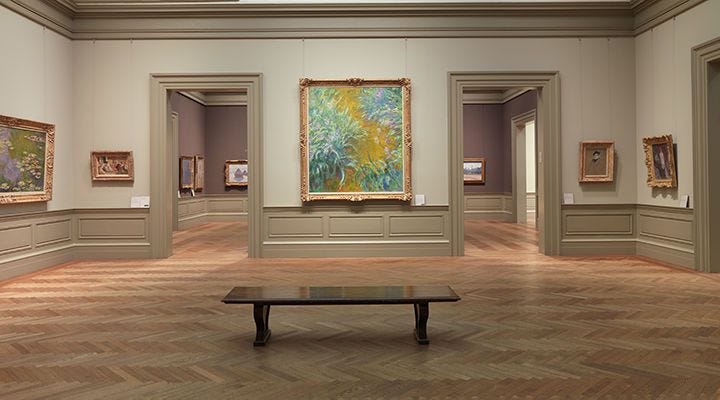
“Three Tahitian Women” is one of four oil paintings by Gauguin hung in Gallery 822 of the 19th and early 20th century European Paintings wing. Gauguin’s works are joined by a selection of paintings by Van Gogh and Monet, representing part of the Annenberg Collection. It is crucial to acknowledge that the selection of works in this gallery were displayed together by the terms of the Annenberg bequest, which has undoubtedly limited critical curatorial choices. In the smallest corner of the gallery, Gauguin’s “Three Tahitian Women” and “Still Life with Teapot and Fruit” are hung facing each other. These two works enter into a direct dialogue with one another, as they are isolated from the other paintings in the gallery by doorways on either side. In the opposite corner of the space, Gauguin’s other two works, “Two Women” and “The Siesta” are displayed. These paintings are hung next to one another, opposite from the gallery’s only other figural representation, Van Gogh’s “La Berceuse.” Apart from Gauguin’s three paintings of Tahitian women and the Van Gogh portrait, every other work in the gallery is a landscape or still life. This choice highlights Gauguin’s figural representations and places the women in the context of the natural world, a comparison that cannot be read without considering the colonial gaze and the role of primitivism and exploitation in the French colonies.
Ethnographic studies of Indigenous people have a long history in the tradition of European painting. Typically, works that depict an Indigenous body were created alongside representations of local flora and fauna, likening the human subject to the natural environment rather than a person with agency. In Gallery 822, “Three Tahitian Women” is displayed opposite a still life and surrounded by images of landscape and flowers. This curatorial choice places the Tahitian women in an atemporal, natural environment, exemplifying the historic treatment of Indigenous subjects. This framing is especially important to adjust, as Gauguin’s personal life in the Pacific colony was riddled with exploitative sexual relationships with young Tahitian women.1 While the dark underbelly of Gauguin’s time in Tahiti may not be appropriate to discuss in the limited space of a gallery label, it is crucial to frame his works in a way that reflects the complexities of the colonial experience, rather than display the Met’s only modern depictions of Oceanic women alongside water lilies and still lifes.
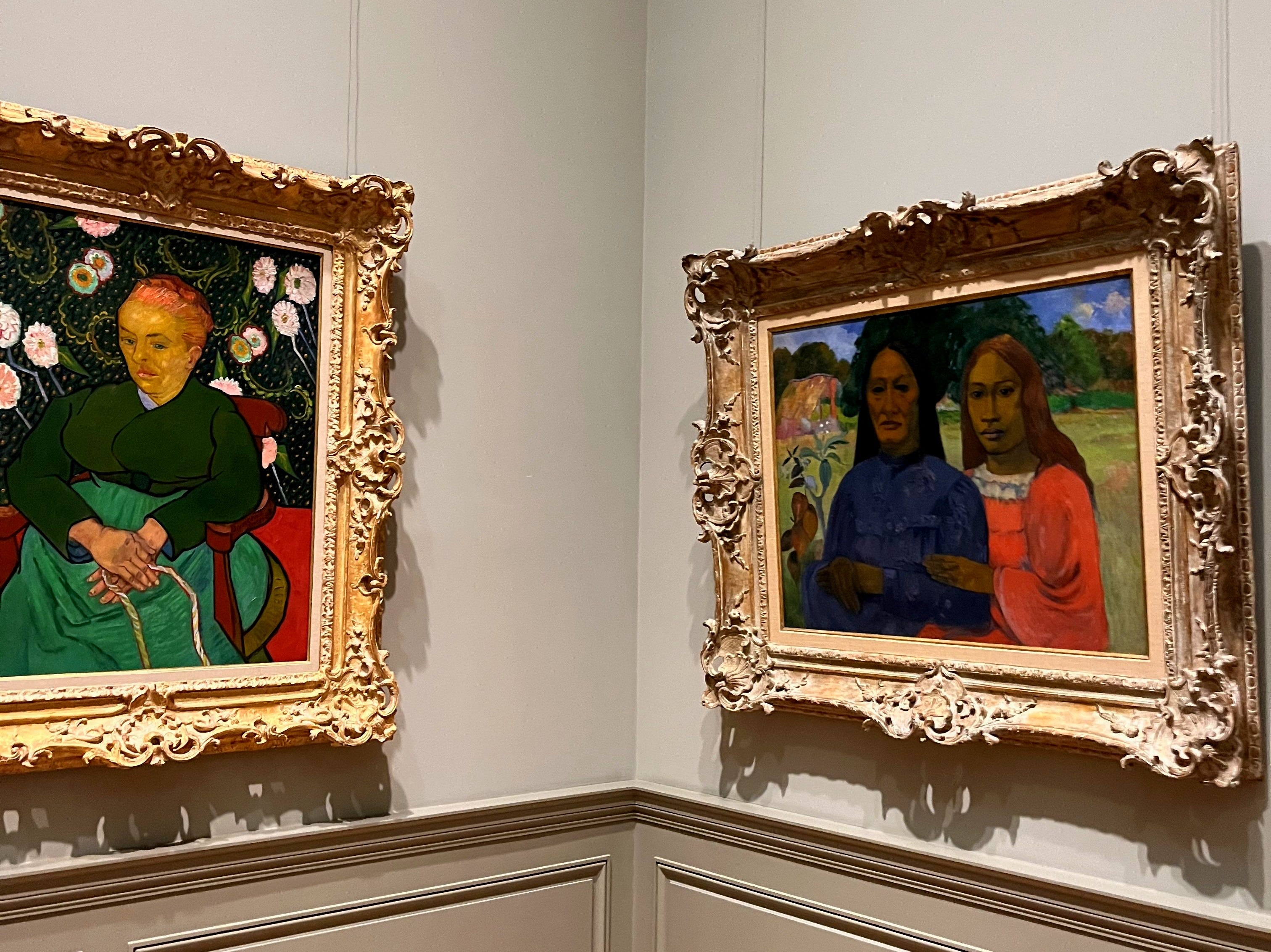
There are several different ways a curator could reframe the narratives surrounding Gauguin’s painting. The most straightforward choice would be to hang the work with other depictions of modern women. This would concretely frame the three Tahitian women as human subjects, rather than components of a natural landscape. Further, in a setting focused on female modernity, the Tahitian figures are read in the time period in which they existed: women at the turn of the 20th century, rather than part of an idealized, primitivist imaginary. This method is already successful across the galleries, with the pairing of “Two Women” and “La Berceuse.” As a result of this choice, the painting of two Tahitian women is read as a portrait, as is Van Gogh’s piece. Although the wall label does not give the viewer any insight into who these women were, they are seen as complex sitters with a seemingly close relationship due to the linking of their arms. The viewer is curious about the identity of these women, a quality that could be extended to “Three Tahitian Women” if it was hung alongside other depictions of female subjects.
The three women in Gauguin’s piece are intriguing subjects worthy of attention. The two women in orange are seemingly rendered as one, near replicas of each other, prompting the viewer to consider a close relationship- perhaps sisters, friends? Their forms overlap, and both of their faces appear downturned with shoulders hunched, protecting their bodies from our gaze. However, the woman on the far right, closest to the viewer, almost appears to be glancing back towards us, though her facial features are not clearly defined. When read in conjunction with the protective left arm wrapped around her partner’s hip, the composition implies a sheltering relationship, perhaps from Gauguin himself. In stark contrast, the woman on the left wrapped in white cloth is completely facing the viewer, her bare upper body on full display. Her eyes appear closed, or cast downward, fabricating a voyeuristic relationship between herself and the viewer. Gauguin’s panel straddles the line between representations of the female nude and romantic depictions of an exotic land rooted in primitivist artistic tendencies. This analysis illustrates the complexities found in “Three Tahitian Women” and Gauguin’s body of work in the Met collection as a whole, solidifying the case for a curatorial reimagining that appropriately frames their narrative in the context of other modernist depictions of women.
While it is certainly more feasible to hang the Gauguin painting alongside other representations of modern women given the abundance of relevant works with the Met’s 19th and 20th century European paintings collection, it would also be exciting to reimagine Gauguin’s works as a part of an entire gallery that focuses on the theme of colonial encounters and the idea of the “primitive imaginary.” The newly reimagined wing, “European Paintings, 1300-1800,” excels in addressing colonial narratives and harsh realities of European presence abroad through curatorial choices such as the inclusion of objects like sugar bowls, as well as wall labels that do not shy away from outlining the colonial realities of the era.
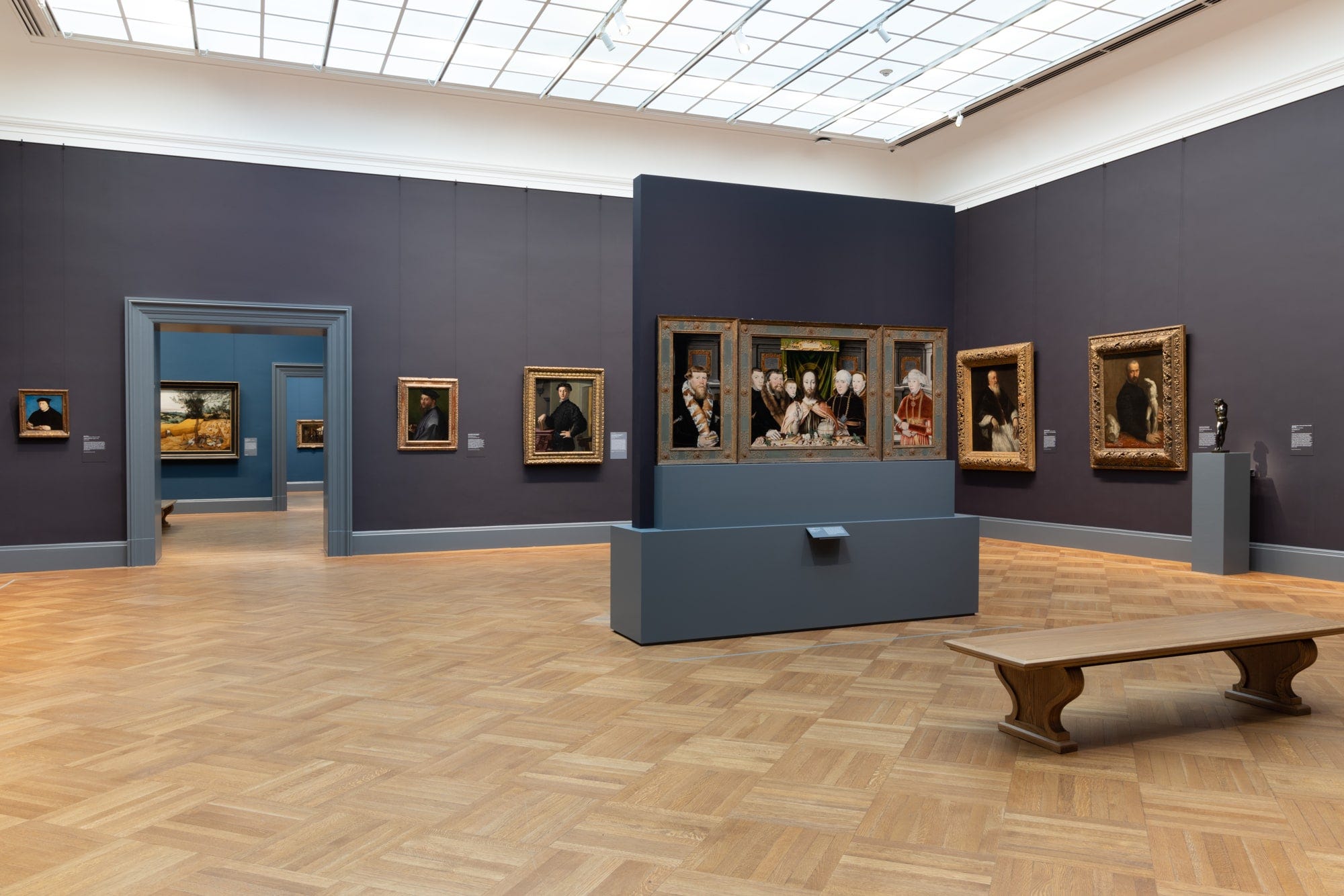
In addition to the choices made in object selection and layout, the new installation of European Paintings 1300-1800 was successful due to the contextualizing and educational gallery labels. The wall label for “Three Tahitian Women,” on the other hand, does not provide any thematic or formal insights into the work. Rather, the author has decided to replace a curatorial voice with a direct quote from Gauguin that once accompanied this painting: “
To the unknown collector of my works, Greetings— That he may excuse the barbarity of this little picture: the state of my soul is probably the cause. I recommend a modest frame and if possible one with a glass, so that while it ages it can retain its freshness. . . .”
While rewarding to consider an artist’s voice when regarding their work, this label could be significantly improved to contextualize the painting and provide more relevant information to a viewer. I propose:
“This panel, painted during Gauguin’s time in Tahiti, depicts three women on the bank of a river. The forms of the women in orange overlap, indicative of a close relationship. Their faces appear downturned with shoulders hunched, protecting their bodies from our gaze. The rightmost woman appears to be glancing back with a protective arm wrapped around her partner, attempting to shield her from prying eyes. In contrast, the woman on the left faces the viewer, her bare upper body on full display. Her eyes appear closed, creating a voyeuristic relationship between herself and the viewer. This painting exemplifies Gauguin’s interest in representations of the female nude and romanticized depictions of Tahiti that are often informed by primitivist tendencies and characterized by a colonial gaze.”
Gauguin’s paintings in Gallery 822 are complex representations of Tahitian women that must be considered in the context of the artist’s neocolonial presence on the island and his role as a white French man. While ideally the works would be reconceptualized in a gallery space that adequately frames narratives of colonialism and modern depictions of femininity, the conditions of the Annenberg bequest may leave that project shrouded in red tape. In any case, the caretaker of “Three Tahitian Women” might consider updating the gallery label to reflect contemporary curatorial interests, namely the urgent need for humanization and modernization of Indigenous female subjects.
Heather Higgins, “The Monster and the Painter: The Case of Paul Gauguin” The Loyola Phoenix, 2023. https://loyolaphoenix.com/2023/11/the-monster-and-the-painter-the-case-of-paul-gauguin/
No posts
Comments
Nothing yet. Say the first thing.
Sign in to join the conversation.