
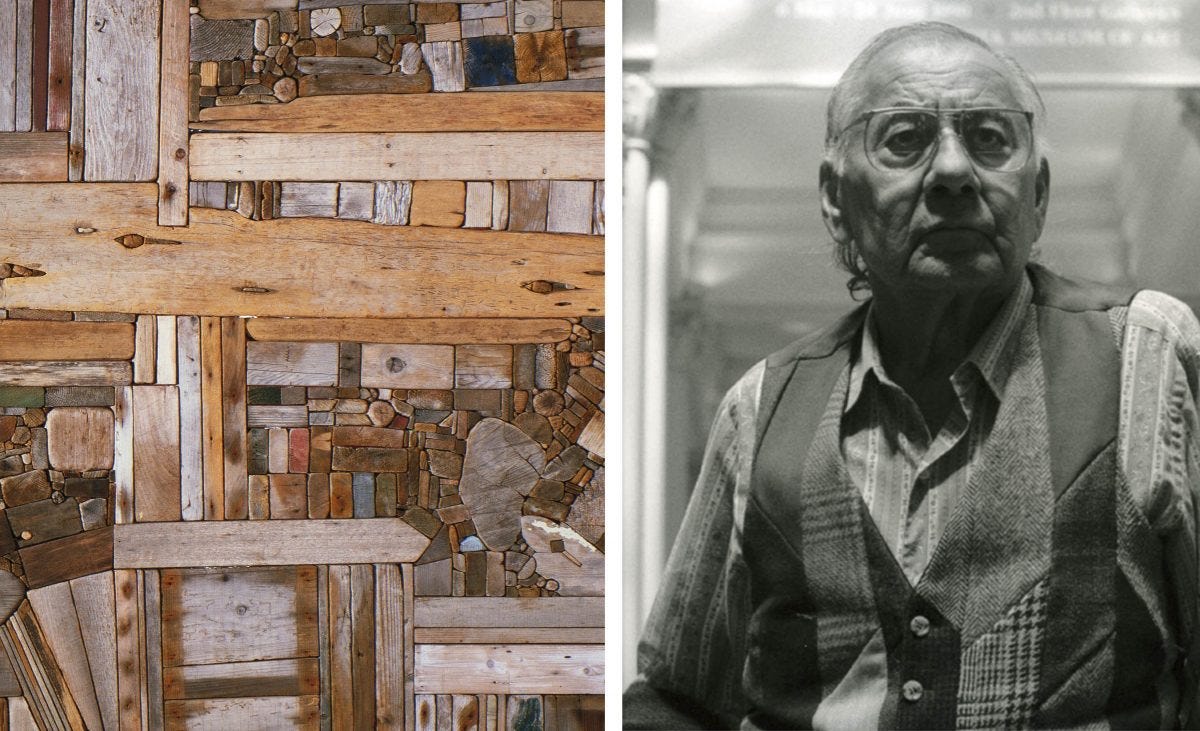
Morrison, Collage IX: Landscape (left) and George Morrison (right)
20th century modern artists Louise Nevelson and George Morrison were uniquely entranced by the material qualities of wood, a medium they both turned to while exploring notions of abstracted landscapes. Although Morrison and Nevelson were peers, exhibiting alongside one another in New York City and frequenting the same spaces, there is an absence of scholarship that places their works in dialogue with one another, and relatively sparse discussions on the curiously potent presence of wood in their constructed environments. This essay will directly compare two arboreal works and the overall artistic processes of Morrison and Nevelson, demonstrating how the distinct multitemporal and site-specific characteristics of wood rendered both artists’ focused explorations of landscape visually abstract yet materially representational.
Louise Nevelson was born in Ukraine as Leah Berliawsky, though her family immigrated to Rockland, Maine when she was only six years old.¹ When Nevelson began her artistic endeavours, she made the decision to change her name and discard her past, primarily because she grew up as an outsider. Nevelson was a “rebellious” Jewish woman living in abject poverty who consistently resisted societal expectations and ultimately forged her own path in the art world. Her father, Isaac Berliawsky, worked as a woodcutter and junk dealer upon his arrival in the United States.¹ In the 19th century, Jewish people were forbidden from owning land in the Russian Empire. However, they were occasionally permitted to work as woodcutters, and Nevelson’s family successfully worked around the laws to purchase trees to sell their wood and make a living. Thus, Nevelson’s unique use of wood in her artistic practice is rooted in a long familial tradition centered on wood as a principal source of livelihood. Due to this history, Nevelson believed that a “sensitivity to the livingness of wood” was in her blood and thus inherent to her practice.¹ Further, her scavenging characteristics directly parallel her father’s gathering and peddling of discarded objects. Even in her childhood, Nevelson reports gathering pebbles, sticks, marbles, and other trinkets to display in little boxes. Once an artist, her collecting process allowed her to transform old wood most would view as junk into coherent artworks, in many ways a vindication and elevation of her father’s earlier occupation. Further, Nevelson notes that her interest in the transformation of found objects was likely rooted in the injustices she experienced in her childhood as an immigrant in Rockland; she saw herself in discarded fragments, and thus began to see “anything on the street as art.”¹
George Morrison grew up in Chippewa City, near the Grand Portage Indian Reservation on the North Shore of Lake Superior, where he would eventually settle down towards the end of his life. Though he primarily worked in paint, Morrison made several wood collages and wooden totems towards the end of his career. Several scholars have presented reasoning for Morrison’s attraction to wood: Maurer wrote that Morrison “began working with wood because of its associations as a traditional (Chippewa) material.”² Makholm continues, arguing that Morrison was drawn to wood due to its “inherent Indian values,” citing the interconnection of elements in nature and the role of wood as an interpreter of “refinement, continuity, and rhythm.”² While his Indigenous roots are an aspect of Morrison’s woodworking, these arguments are vague and neglect to cite Morrison’s lifelong fascination with found wood.³ From a young age, Morrison was attracted to tactile qualities of wood grain, and the sense of history and geography uniquely present in each piece. Like Nevelson, the act of foraging, collecting, and reimagining was a key part of his process, motivated by his connection to the natural world as well as an interest in the medium’s material qualities.
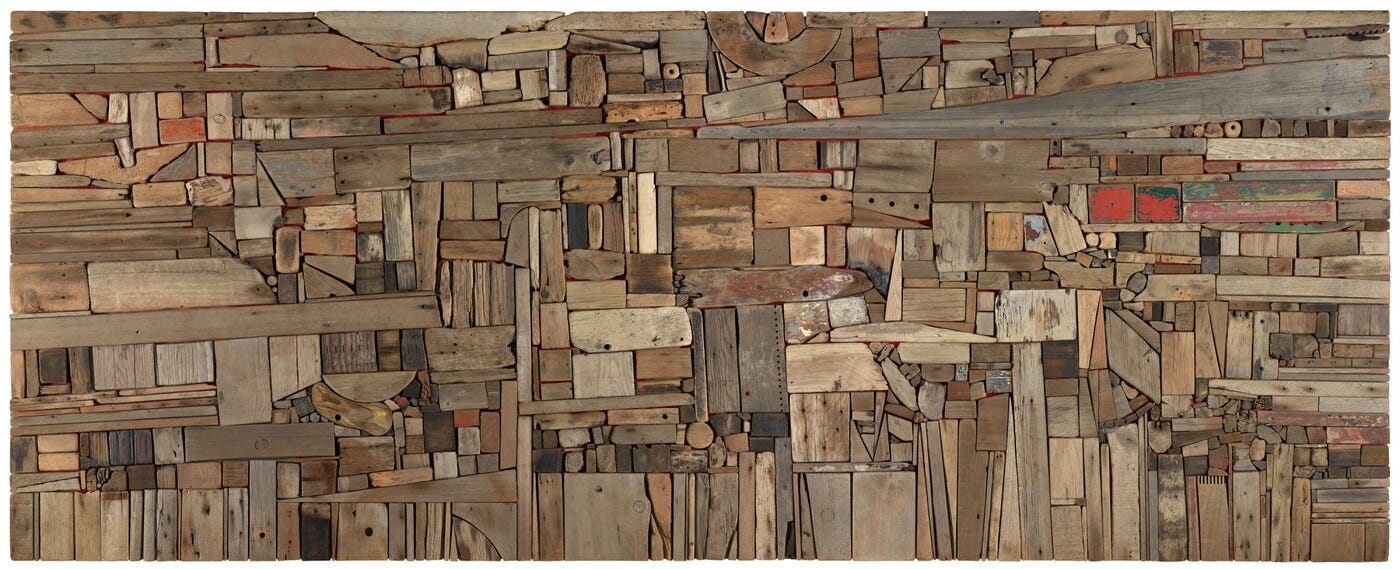
George Morrison, New England Landscape II, 1967, 48 x 119 7/8 in, Amon Carter Museum of American Art, Fort Worth.
Morrison’s New England Landscape II (1967, Fig. 1) is one of Morrison’s most well-known works in wood, taking the Grand Award in 1968 at the Fourth Invitational Exhibition of Indian Arts and Crafts in Washington, D.C.⁴ This work is composed of raw and unfinished fragments of driftwood, a type of found object that links his practice to that of Nevelson’s. However, while Nevelson finds her material primarily in urban environments like New York City, Morrison’s collages are made up of wood from the beaches of the Atlantic Coast and Lake Superior, connecting his process more concretely to the natural world.
To create New England Landscape II, Morrison walked along the beach, searching for fragments with interesting shapes, textures, and unique characteristics like nail holes or chips of paint. Then, he let the wood age in his studio until it displayed a weathered, grayish look, giving the fragments an additional life as parts of a collection. After this intermittent aging period, Morrison would form the collages, relying on gridding and geometric linearity, as well as chance and “organic vitality.”² Morrison was drawn specifically to driftwood for its dual connection to both the land and the sea, and its resulting ability to convey the intricacies of a specific landscape as well as reflect his lifelong connection to water. Each collage has its own personality, much like the wooden fragments of which they are composed. Nevelson, who did not work within set dimensions of a canvas, was extremely fluid in her sculpting, continuously adding and building onto a form until she felt it was complete. However, despite this free-form approach, she believed that the singularity inherent in a piece of discarded wood meant that its placement within the work had to be precise, much like Morrison.¹
An important component of Morrison and Nevelson’s practices is their shared interest in reimagined landscapes. In New England Landscape II, Morrison presents a view of New England, as the title would clearly suggest. The horizon line stretching across the upper portion of the canvas helps to define this abstract collage as a landscape with defined topography, a feature present in many of his works. Although the use of geometric wooden forms abstracts and distorts the landscape, the use of New England driftwood renders this work representational. By underlining the origins of the material, the work’s multifaceted relationship with the concept of the landscape is revealed. Morrison has approached the landscape from many different vantage points throughout his career, but his arboreal works represent the first time Morrison has incorporated physical elements of the land in his art. Thus, these works further complicate Morrison’s career-long exploration of landscape through the inclusion of reclaimed, site-specific wood, adding a representational and multitemporal dimension to otherwise abstract works.
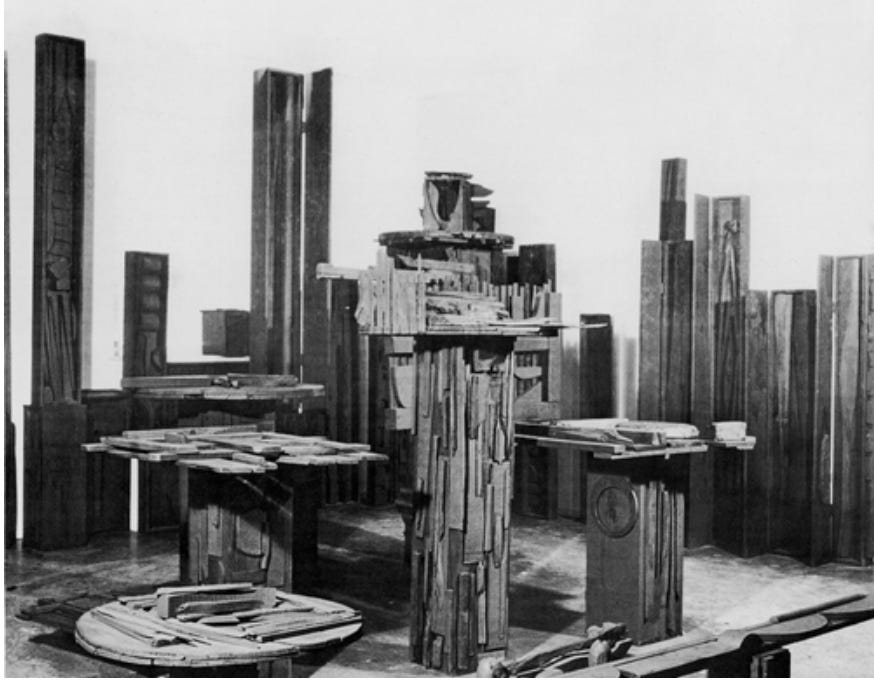
Louise Nevelson, Moon Garden Plus One, 1958, various dimensions, Grand Central Moderns Gallery, New York.
If Morrison’s wooden works are to be considered a form of landscape, Nevelson’s sculptures are better described as abstracted environments. This is especially true of her large-scale installation works like Moon Garden Plus One (1958, Fig. 2), which consists of several different sculptures made of various discarded wooden objects saturated in deep black paint. She was especially interested in the biotic qualities of her pieces, and the ecosystems that could be created when joining together different objects; Nevelson describes her pieces as “colonies in which each cell strengthens and supports its neighbors.”⁵ In Moon Garden Plus One, her sculptures were arranged like a theater set that could be walked through, transforming the gallery space into an interactive environment that viewers could enter and directly engage with.⁶ The recognizable wooden forms, including milk crates and tabletops, remained visible within the assemblages despite the thick black paint, creating an unsettlingly curious environment that was simultaneously familiar and foreign.
Despite their shared interest in giving found and reclaimed wood a second life in the form of abstract landscapes, Morrison and Nevelson differ in their approach to finishing. While Morrison preferred to leave the wood raw to highlight the natural grain, Nevelson was more inclined to take the original forms and manipulate them into something completely new. Ott notes that it was not the qualities of the unfinished wood that attracted her as it did Morrison, but the potential found in the textures and forms of fragments that had already served a different purpose.⁷ This is further emphasized by her trademark use of thick monochromatic paint, which unifies the entirety of the piece by suppressing the individuality of the found objects. Morrison, on the other hand, frequently left his works unfinished, as to better highlight the discrepancies between each wooden fragment.
Thus, both artists are interested in fabricating alternative, abstracted, and constructed landscapes, and turn to the medium of wood to do so. Both artists use almost exclusively found and reclaimed materials, stressing the value of the wood’s former life in the overall composition and meaning of the artwork. These discarded wooden fragments already possess multiple histories, from their arboreal origins as trees within earth’s ecosystem to their second lives as utilitarian objects. Each piece then takes on a third life as a part of an artwork, instilling the sculpture with all former sentiments and connotations. In the context of a constructed landscape or environment, the material’s unique multitemporal qualities elevate the work to an abstracted yet representational sphere, where the artist’s imagined landscape is constructed of tangible relics of specific locales, whether that be driftwood from the Northeast Atlantic, or urban fragments of New York City.
Thanks for reading! Subscribe for free to receive new posts and support my work.
Laurie Lisle, Louise Nevelson: A Passionate Life (New York: Summit Books, 1990).
Kristin Makholm, W. Jackson Rushing, and George Morrison, Modern Spirit: The Art of George Morrison (Norman: University of Oklahoma Press, 2013).
George Morrison and Margot Fortunato Galt, Turning the Feather around: My Life in Art (St. Paul: Minnesota Historical Society Press, 1998).
W. Jackson Rushing III, “George Morrison,” Minnesota Museum of American Art (Accessed 29 April 2025).
Louise Nevelson, Shirley Reece-Hughes, organizer Amon Carter Museum of American Art, and host institution Colby College, The World Outside : Louise Nevelson at Midcentury, First edition (Fort Worth: Amon Carter Museum of American Art, 2023).
Elyse Deeb Speaks, “Experiencing Louise Nevelson’s Moon Garden,” American Art 21 (2007).
Cindy Ott, “Visions in Wood: Four Twentieth-Century American Wood Sculptors,” Archives of American Art Journal 43, no. 3/4 (2003).
Comments
Nothing yet. Say the first thing.
Sign in to join the conversation.