
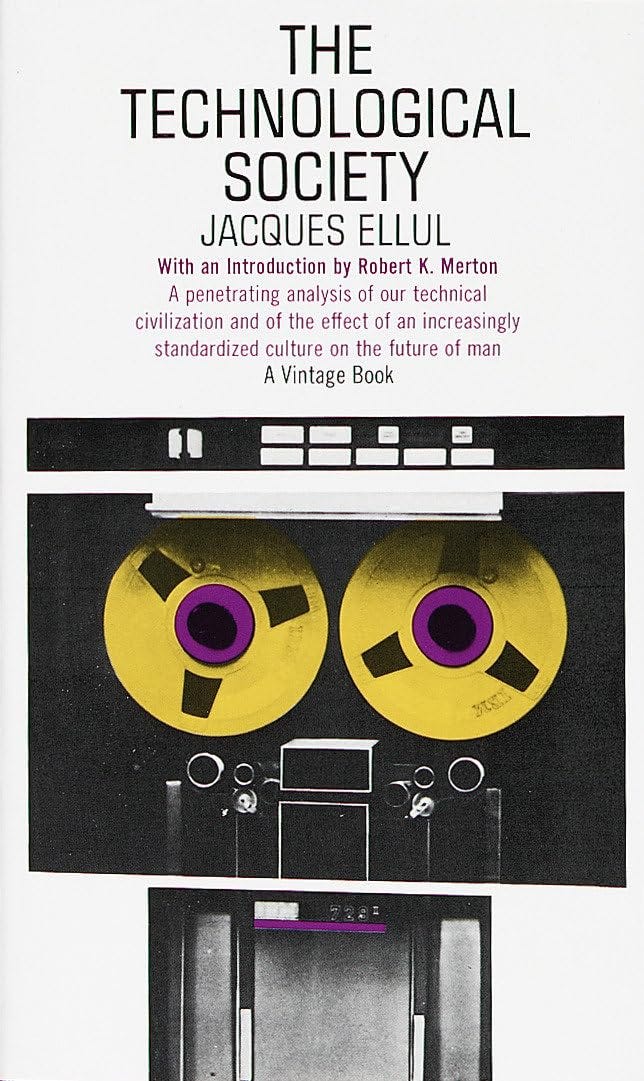
In 1954 Jacques Ellul published in French his book that would be translated to English in 1964 as The Technological Society.[1] He begins this work making a distinction between technology, on the one hand, and the impulse that gives rise to it, on the other. The latter abstraction he referred to as “Technique.” So to be clear, when discussing Technique in Ellul’s terms, we are not addressing how one goes about installing some bit of technology. Rather, we are talking about the rise of the Machine. Not about tools, but about the inexorable human drive to efficient automation in the abstract.
Ellul finds agency in Technique. Technique is not merely an expression of one form of human-like agency; but an entity unto itself, with its own means and its own ends, or purposes. The purpose of Technique is not directed to an outwardly-defined end, however. The end is always that which is most efficient, a predetermined end. The purpose of Technique is Technique. It’s end being merely pre-directed to that which is most efficient, it is really directed only to means; to advance what it advances.
This lack of ends does not negate its agency, however. We can see this is so if we compare it to human agency. Human beings often consider, in their philosophies, what is the chief end of man, as when we acknowledge that it is “to love God and enjoy Him forever,” as the Westminster Shorter Catechism has it. But often too, we may go about thoughtless of ends, as when we so fixate on how to make a living or just get through the day, not pausing to consider the point of it all. A person can live an unexamined life. And yet human beings are undeniably agentic entities, if agency means anything at all. Means can be described without reference to end(s); the sole end being the perpetuation of means. If this can be true for a person, it can certainly be true for another agentic entity. Thus could we accept Ellul’s presentation of Technique as a self-motivated entity: “Technique is nothing more than means, and the ensemble of means.”[2]
Ellul does not go further to say what kind of entity Technique could be. “Entity” is about as generic a phrase as we can use. A spirit perhaps, literally or figuratively. Or perhaps an egregore, a socially-generated phenomenon rooted in certain ineradicable features of the human condition but whipped up by a shared energy of social expectations or fears. Such socially-generated ideas can certainly take on a life of their own. This idea that Technique is a living entity with a direction of travel has been expressed by others since Ellul. Kevin Kelly suggested as much in his 2011 book What Technology Wants,[3] albeit in a much more optimistic vein. Paul Kingsnorth writes that “what progress wants” is “more,” and even, sounding a transhumanist theme, “to replace us.”[4]
Ellul was a critic of our overly mechanized world, citing for example its noise, its dehumanizing employments, and its destruction of nature. But, “[c]apitalism did not create our world, the machine did.”[5] The machine, in his locution, is the sum of all our industrial mechanization. Were he writing today, he would no doubt include computers, the internet, and what we confusingly call artificial intelligence. And he wouldn’t exclude them from the criticism that the state of “our world” is lessened by the spread of “the Machine.”
The relation of machine to Technique is this: “The machine is solely, exclusively, [T]echnique; it is purely [T]echnique, one might say.”[6] A machine is the physical manifestation of Technique, in other words. It is the spirit of Technique as seen through the proliferation of such objects. We should be quick to say, however, as Ellul would, that such physical manifestations are not limited to objects like steam engines and nuclear energy plants, but also to information, which is not physical but is hosted in physical ways, like with the internet, and protocols, and regulations.
Technique is manifested in the machine, but is not limited to it. Its signal feature is organization; to movement by algorithm; to efficiency. Not just to government regulation, for example, but to the effects of regulation in its ripples through the economy. On this understanding of Technique we can return, as Ellul does, to James Burnham’s discussion of managerialism. The idea of managerialism is bigger even than its application to machines, no matter how broadly defined. “In reality, what Burnham . . . calls managerial action, is [T]echnique applied to social, economic, or administrative life.”[7]
Postmodernism as such was not a central focus of Ellul, but his analysis of Technique supports this author’s conclusions[8] that the shift to the postmodern era is as consequential as the shift from pagan to Christian; that the rough date for commencement of postmodernism is the turn of the twentieth century; and that what defines postmodernism is the rejection of God and perforce the rejection of moral realism, leaving us to search frantically for some stable moral order in no place we might actually find it, and in every place we won’t. The taboos of religion and of social norms, writes Ellul, were not readily transgressed because “[T]echnique was held to be fundamentally sacrilegious,”[9] the norms and taboos being what they are because they represent not just traditionalism, but tradition premised on right religious belief.
This began to change in the eighteenth century, the French Revolution again being a major marker in this trajectory, followed by ongoing industrialization and technical innovation before the twentieth century. These conditions altered the milieu in which the average person had theretofore comfortably found himself. That milieu is misunderstood by modern man, Ellul informs us, because he “does not know what a balanced social environment is and the good he could derive from it.”[10] Technique thrives, in other words, when mankind is atomized and adrift from his fellows and through technology from the natural world.
The ideology of the Machine twines with and is accelerated by other postmodern ideologies to deliver us to totalitarian capture, reducing us effectively to slavery. Not as one in bondage, yearning to be free, but rather it hollows us out to a paper-thin version of our former selves, the New Man being a consumer and producer, just an element of capital, the true Economic Man. “Technique became a concerted action to shape the economic man it needed.”[11] (emphasis added).
Technique delivers us to the totalitarianism of mass man: “no longer a man in a group, but an element of the group.”[12] Indeed:
The nonspontaneous union of the individual and the collectivity is one of the essential conditions for the development of techniques in the special sociological form they take in our society. . . . This complete mutation of the human species has not been produced by a collectivist theory or by someone’s will to power. The cause is much more profound, at once human and inhuman; inhuman because it is occasioned by things and circumstances, human because it answers the heart’s desire of every modern man, without exception.[13]
If this was colorably so in Ellul’s time, how could it be less so in the age of the internet? How can we not mark and understand the Machine’s “mutation of the human species?”
[1] Vintage Books 1964.
[2] The Technological Society, p. 19.
[3] Penguin Books 2011.
[4] What Progress Wants, May 24, 2022,
[5] The Technological Society, p. 5.
[6] Ibid., p. 4.
[7] Ibid., p. 11.
[8] The Mountain and the River/Genesis, Postmodernism, and the Machine, New English Review Press 2023.
[9] The Technological Society, p. 49.
[10] Ibid., p.50.
[11] Ibid., p. 223.
[12] Ibid., p. 335.
[13] Ibid.
Comments
Nothing yet. Say the first thing.
Sign in to join the conversation.