
I want to make the case that postmodern thinking delivers us to ideological capture, but first I need to say what postmodernism is. In this first installments, I try to bring us up historically to rejection of God in the culture, the event I believe initiates the postmodern era.
There was a time in most of Europe when it seemed all the world had been reached with the Gospel, and the Gospel seemed so self-evidently true that disputation about it was foolish or worse. From our vantage point today we may disapprove of the Inquisition, among other negative events of church history, but we should also note how wide and how deep genuine Christian belief must have been, to imagine a world when it was felt justified, by people at least as smart as us.

The Renaissance (c. 15th century) brought about a renewed breadth in thinking about the world, though church authority, if not genuine piety, was still mostly unquestioned. A humanist loosening came from within the Catholic church by the time of Erasmus of Rotterdam (1466-1536). And of course the Reformation, conventionally dated to 1517, initiated further divisions. Yet the central claims of the Christian Gospel remained strong well into what we now consider the Enlightenment era.
The modern era (c. 1600-1900) is called that primarily because of increasing scientific and technological gains. The mindset that produced them also affected political thinking, and by the end of the era we call the Enlightenment, many social elites had cast off belief in Christ’s death and resurrection, adopting instead a simpler deism or even atheism. Religious pluralism became acceptable and then expected, as at the founding of the United States in 1776. By the end of the nineteenth century, a strong freethinker movement could gain traction publicly in the West.
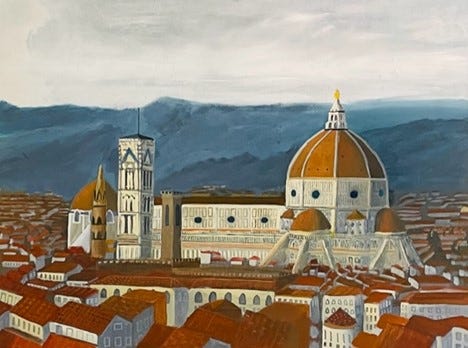
Gone missing from our moral imagination has been the necessary connection of social order and realism. Smart people lamented the loss of the reassuring presence of the Divine, for example Matthew Arnold in his famous poem Dover Beach, published in 1867. Max Weber borrowed from Friedrich Schiller (1759-1805) the concept of a general spiritual “disenchantment” in society and considered its consequences in his 1904 The Protestant Work Ethic and the Spirit of Capitalism.
A far-thinking philosopher of the times on this subject was Friedrich Nietzsche. In his 1882 The Gay Science he famously wrote “God is dead.” He was making an observation, not a declaration, and he went further than to just mark the epochal shift. The rest of the quote goes like this:
God is dead. God remains dead. And we have killed him. How shall we comfort ourselves, the murderers of all murderers? What was holiest and mightiest of all that the world has yet owned has bled to death under our knives: who will wipe this blood off us? What water is there for us to clean ourselves? What festivals of atonement, what sacred games shall we have to invent? Is not the greatness of this deed too great for us? Must we ourselves not become gods simply to appear worthy of it?[1]
Nietzsche was no friend of Christianity, and preferred a vitalist will to power to replace it. But, he understood the immediate consequence of the “death of God.” When God dies, all of our constructs of right and wrong, and indeed of our conceptions of truth and falsity, die also. Nietzsche foresaw that the death of God would mean also the death of realist metaphysics, and then what would replace it? With realism set aside, the universality we relied on must be set aside also. No longer do they provide the common ground on which we can meet. Liberalism is impossible, science is impossible, moral constraints cannot be agreed upon. Enlightenment rationality would be finally extinguished too, but for the remnant of left-brain radically hyper-rational attention-directedness, now a loaded gun waved around haphazardly.

God is not actually dead, of course, in fact to say so is nonsensical. We can deny Him all we want, however, and bear the consequences, but He is there for those who love Him. A tipping point was reached in the culture, however, and we are now more than a century beyond that tipping point. I argue that the postmodern era began around the turn of the twentieth century, and what makes it the postmodern era is widespread rejection of God in the prosperous West.
Next time I will begin to distinguish moral realism from moral skepticism, and say why it matters.
[1] The Gay Science, section 125, 1882.
Comments
Nothing yet. Say the first thing.
Sign in to join the conversation.