
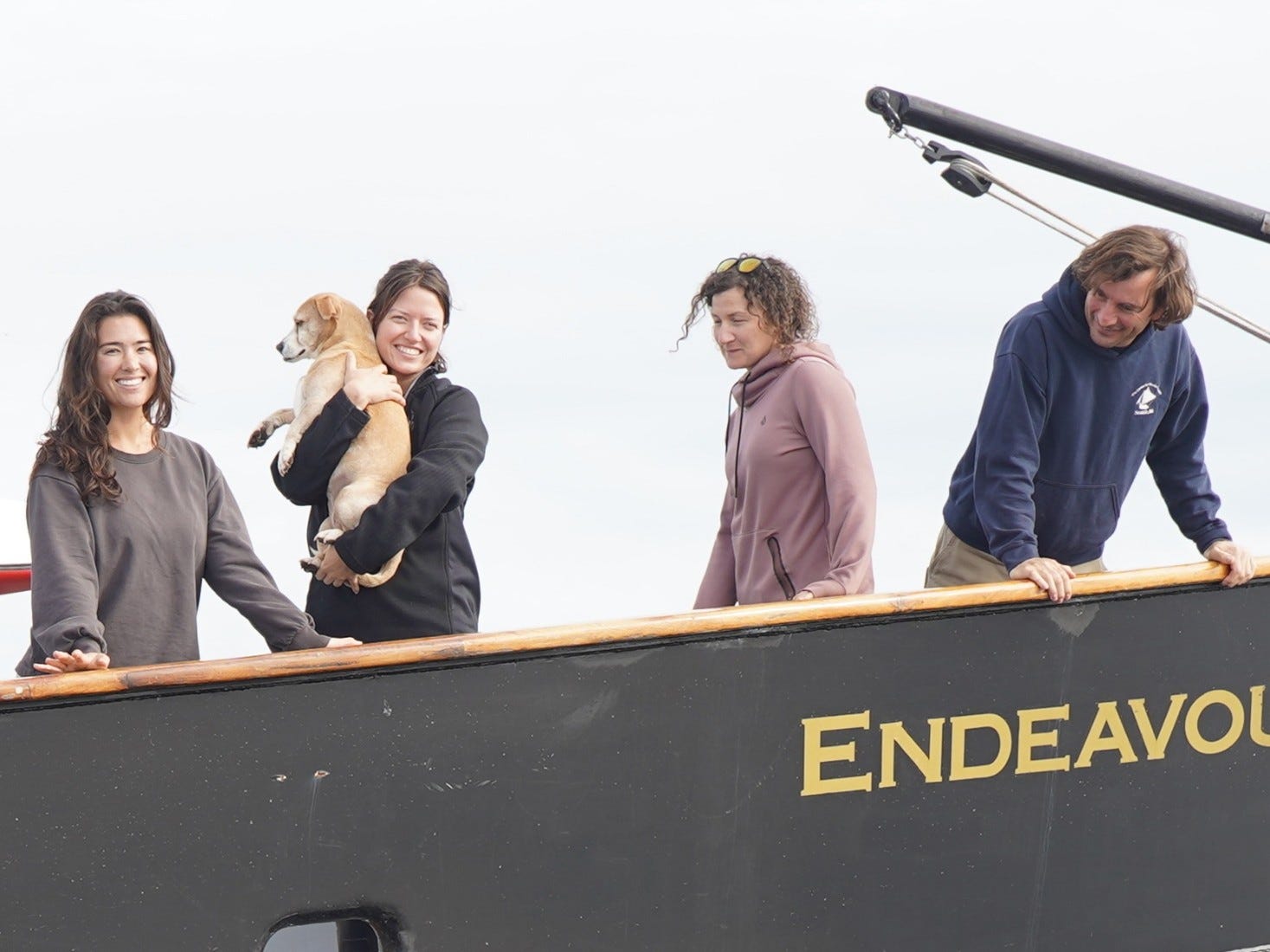
The Kotzebue Sound hydrophone crew L-R: Chloe, Bibi (holding Bella), Emmy, and Manuel.
Know a high school or college student passionate about nature? Read through to the end.
In 2023 we took the Endeavour above the Arctic Circle into Kotzebue Sound to recover hydrophones that had been recording whale conversations under the ice over the winter. The research was led by Manuel Castellote PhD, from the National Marine Mammal Laboratory with help from Chloe Lew, a researcher with the California Ocean Alliance. The main question was, with a warming ocean, are the orcas moving north into Kotzebue Sound and eating the belugas. The expedition was funded by the Wildlife Conservation Society, which happens to run all the zoos in the New York metropolitan area. Our crew was Emmy Garnish, an experienced Alaska fisherwoman and guide, and Bibi Renssen, a graduate student at the Scripps Institute, studying corals.
But this post isn’t about that expedition.
This post is about the power of words to inspire and motivate researchers and conservationists. I’ve read most of what John Muir had to say about Alaska, and I’ve read it more than once. He thought deeply about glaciers and documented the plants he found to a fine degree, but he isn’t remembered for his academic contributions. We remember Muir for how he made us feel about a wondrous place we have never seen, and most of us never will.
I thought about the value of Muir when Bibi, our crew on the Arctic expedition, sent me this:
It was just last summer that I found myself on the small fishing dock of Dillingham hoping that Bill, in fact, would remember that he was picking me up that day. I had time to reflect; here I was, a 24-year-old marine biology grad student from San Diego who studies coral reefs, on the docks of the rural Alaskan shores… I had bought the durable waterproof fishing boots, yes, but could I fill them? Soon I saw Bill’s dinghy entering the docks and I felt the excitement bubbling inside of me as I was about to embark on an incredible adventure and rare opportunity to see the wild coastline of Alaska.
For forty days, I joined Bill (the captain), Emmy (our first mate), and Bella (our furry-pawed companion who was of utmost importance for early morning morale) on an exhilarating journey aboard the Endeavour, a 72ft research vessel. Those durable fishing boots got worn in and worn out - I lived in those things, and with it, altered completely to life at sea.
Our time with the NOAA scientists in Kotzebue Sound was nothing short of exhilarating since their mission, to retrieve their hydrophones for their whale research, aligned perfectly with our own goals of exploring the mysteries of the ocean. It was a daunting task: last winter’s turbulent seas and shifting ice made finding these hydrophones oftentimes feel like a game of cat and mouse, but we pressed on, positive we’d track down their elusive equipment. After a week of searching, we succeeded and celebrated by polar plunging in the chilly Arctic waters.
Besides our time in Kotzebue, you could imagine that forty days of traveling along the rugged Alaska coast allowed for much time to explore. We were a curious crew, us four, and often found ourselves itching to set course for the islands and peninsulas we came across on our way. As we lay anchored for the nights, we would hop in dinghies, kayaks, or canoes- anything to quickly get ashore and immerse ourselves in the untamed land taunting us just a couple yards beyond our boat. From towering mountains to vast expanses of wilderness and wildlife, every corner of this land whispered tales of adventure, history, and its discovery.
Grizzly bears roamed the shores, reminding me of the delicate balance between man and nature. We caught fresh crabs using crab pots and I experienced the most direct sea-to-table meal you can have as we immediately boiled them, cracked them open, and dipped them in butter and herbs. We made conversation with the handful of fishermen we crossed, exchanging information and spare fish. We crossed between Big and Little Diomede in the Bering Strait, traversing the two-and-a-half-mile distance between the United States and Russia. We stumbled upon deserted fishing huts and towns with populations of a hundred people or less, offering us glimpses into more rural Alaskan village life and culture.
Perhaps, however, the most thrilling part of it all was taking on that role of a sailor – wind in my hair and salt on my skin... it felt like utter and complete freedom. I can’t reveal all the amazing things we saw and experienced, because what’s the fun in that? I’ll save those true sailor stories for those curious enough to come visit me in San Diego and offer me a pint of beer.
For me, science has always been a gateway to adventure, a means of exploring the world and uncovering its hidden wonders. My time on the Endeavour was wonderful, and I know that my twelve-year-old self is endlessly excited to see where we have ended up, and where we have yet to go.
To the adventurers out there, I hope this love letter find you well. I hope that whatever direction you take, it be wild and passionate. Be bold, for who knows, it might just land you a spot on a boat in the middle of Alaskan waters.
— Bibi O Renssen
We have an opportunity coming up soon for young adventurers. It’s a way for them to see and understand Alaska through the eyes of great writers who have come before them – and to see it for themselves.
In partnership with the Institute of Field Research, we are hosting Tobias Menely, chair of the English Department at the University of California Davis, on a 12-day expedition through Southeast Alaska, from Wrangell to Glacier Bay to Juneau, more or less following the route that Muir took. Along the way we’ll be reading and discussing Muir, Spellberg, Simonetti, Henry, Estes, and others. It’s a deep dive into writing about nature and it earns our guests six college credits from Connecticut College. This is an extraordinary opportunity for a high school senior or college student who cares about nature.
The Institute for Field Research is also offering a $500 grant toward airfare. For more on the expedition, requirements, and costs, visit their site at https://ifrglobal.org/program/us-ak-environmental-storytelling/, or contact me.
No posts
Comments
Nothing yet. Say the first thing.
Sign in to join the conversation.