
Many topics during the pandemic seemed to become almost impossible to have reasonable debates or discussions about, and one of the more surprising topics was air filtration. This took the standard dynamic of a determined group on one side citing overly optimistic predictions of its efficacy, and another stating that the whole endeavour was utterly useless. Sadly, we lacked much evidence of the effectiveness of the implementation of such systems at the time, but hoped that as new evidence emerged it might help make the debate more sensible.
Alas, the topic still seems to result in people losing their heads, as we have discovered with the publication of a new RCT.
Let’s take a look.
Thanks for reading The Munro Report! This post is public so feel free to share it.
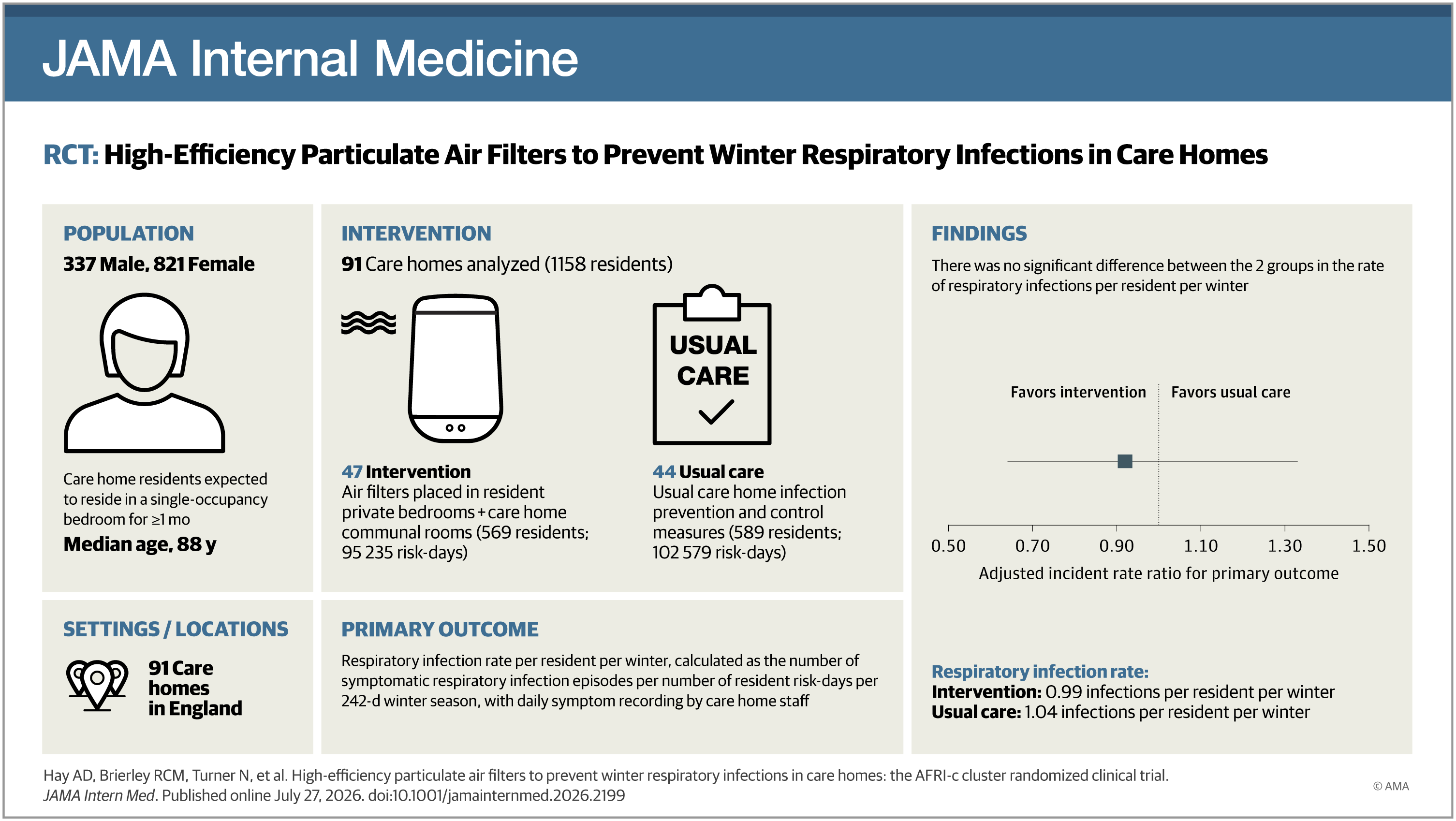
The study was conducted by a well respected team from Bristol in the UK. They conducted a cluster randomised controlled trial of air filtration devices in care homes; meaning that randomisation occurred at the level of the care-home, not of the individuals within it.
This type of study has a higher likelihood of showing benefit than randomising individuals. When one person avoids an infection, they protect the people around them from the infections they would have otherwise caught. Multiple people within the care home being protected should produce a larger signal, which is easier to detect in a trial.
The intervention was the introduction of up to 5 air filtration devices into communal areas and up to 16 into the bedrooms of residents, compared to care homes acting as controls that did not introduce air filtration devices.
Unlike previous trials, the study had, in my opinion, a robust statistical design that was powered to detect a reduction of one infection per 242 care home days, with sufficient recruitment to account for residents who did not wish to participate, moved on, etc. As such, an impressive 91 care homes were recruited with over 1000 residents contributing data.
By the end of the study, there was not a significant difference in the number of respiratory infections in the residents of care homes with filtration devices and those without (0.99 vs 1.04, p=0.67), nor a difference in rates of absenteeism in staff, antibiotic use, etc. The study authors acknowledged there are other benefits to air filtration outside of any use for preventing respiratory infections.
Many people have advocated strongly for the introduction of air filtration devices into shared spaces such as care homes and schools, and the response from some groups towards the study has not been positive.
Many experts in air filtration have rightly pointed out some limitations in concluding that air filtration does nothing on the basis of this study, such as the units being small, often used on the lowest setting or turned off by residents, and that we don’t know where they were placed or other factors that could impact how effective they are. The implication here is that if big enough filtration devices are used properly, located in the correct place, and turned on all the time, then they are much more likely to show an impact.
This may be true, but this raises a new and important point. If it is that difficult to get people to use these machines in a way that actually provides benefit, then they are useless. It is like suggesting that a medication that needs to be taken 11 times a day, not within 2 hours of food, and causes explosive diarrhoea is highly effective as long as patients take it precisely according to instructions.
A key part of the efficacy of an intervention is how easy it is for people to adhere to the intervention. If it is too noisy, too sensitive to positioning, or too easy to urinate into (this did unfortunately occur during the RCT), then it is no good. One commentator suggested filtration devices should be placed immediately next to residents when they are sick in order to be effective; an idea I don’t think many care home residents would find appealing.
At this stage, the most positive argument for the use of air filtration is to have it embedded prospectively in new buildings with the appropriate specification (so long as this doesn’t prove prohibitively loud).
This is the best available evidence on this topic so far, and as the authors point out, it is consistent with systematic reviews which have not found evidence of efficacy.
It looks to me from all the available evidence so far that retrofitting these devices in public spaces provides little to no benefit in reducing rates of infection. There are other benefits to air filtration, such as reducing pollution and aeroallergens, but these need to be weighed against the significant costs of purchasing, installing, and running such devices in an already stretched public sector. Estimates are that it would cost >£150 million to install such HEPA filters in care homes across the UK.
This is not to say institutions such as care homes or schools should not install such devices, but would suggest large-sale retrofitting projects are probably not a good use of funds for this purpose.
For more on the difficulty of controlling infections that move through the air, and why they are not comparable to controlling infections that spread through water, you can read a previous post on the topic here.
Air is not “the new poop”, Covid is not cholera
·
May 30, 2022

The new-found interest in airborne transmission following the emergence of Covid-19 is welcome. It provides new impetus for focussing more on building ventilation and improving the quality of the air we breathe, especially when indoors. It brings all kinds of benefits beyond simply reducing risks of disease transmission.
No posts
Comments
Nothing yet. Say the first thing.
Sign in to join the conversation.