
Smoke on the water...
And fire in the sky.
The other night, Ritchie Blackmore walked out on stage at Jones Beach and joined Deep Purple, the band he helped found in 1968, for the first time in 33 years. And he played their most famous song, the riff that every guitarist had to learn for decades - “Smoke On The water.” A one-song, one-time only reunion that sounded great. (See below.) Blackmore is a actually a towering figure in the history of guitar, one of the fathers of both prog rock and heavy metal in my estimation. He has always been an elusive figure, doing very few interviews. For many years he largely gave up playing electric guitar in favor of acoustic in his folk-rock, Renaissance styled
I believe you were the first person to scallop your guitar neck. What inspired you to do so? And do you anything similar to your acoustic guitars? -Steve Athey
I first did this when I was 18 after playing an old guitar whose neck was so pitted that it had a scalloped effect. I liked it so much that I sandpapered down the wood down between my frets, and I loved the results. The scallop simply makes it easier to hold a bent note because the string does not get caught up. I also find that I have more control over the vibrato with a gouged-out piece of wood there. My acoustics are custom-made by a few small luthiers and I have had some of them scalloped, though it is less essential because I rely on trills more than bends on the acoustic.
You are a virtuoso guitarist, yet you are most associated with “Smoke on the Water”, one of the all time simplest -- and coolest -- riffs. Are you surprised that has had such a lasting impact? -Carmen Davis
Yes and no. I am kind of surprised that so many people jumped on that when there so many other riffs that I thought were better, but it pays the bills, so I don’t mind. And I was trying to write something simple. When I first started writing music, I listened to people like Pete Townshend and marveled at how simple and catchy he made his music. I was following that route. Writing something banal but catchy is an art in itself, often more difficult than writing a complex piece with many parts.
I have long marveled at your ability to keep your Strats in tune given your style of heavy bending and tremolo dives. Do you have any tips or tricks you could share?
-J. Todd
Indeed I do. Leo Fender made Stratocasters with an extreme angle for the tailpiece – nearly 45 degrees, I believe -- and setting it as such makes all the difference. If done so with the right amount of springs it will always return to being perfectly in tune. I disbelieved this until the guy who fixed my guitars showed me. He would correct that about once every six months and it was amazing. In fact, I called Fender about it and they knew absolutely nothing about it. They just assumed that tremolo arms went out of tune.
Does it anger you that Yngwie made the inclusion of classical music into rock look ridiculous? -Justin Davis
No, not at all. Yngwie is a very good player. He is much better than people credit him for. I think his wardrobe might bother me more than his playing.
I always loved the way the organ and guitar solos meshed in Deep Purple, especially on “Burn.” How closely did you and Jon Lord work out the ideas on the solos? -John Gister
We worked very closely because we generally went into a song understanding we would each take a solo. What we generally did was each write out the progressions we wanted to solo over and then show them to each other. On “Burn” we sort of swapped solos actually, because I was having a very hard time with the progression I had written myself, but Jon liked it. So he took it over for his solo and I wrote a new one for myself.
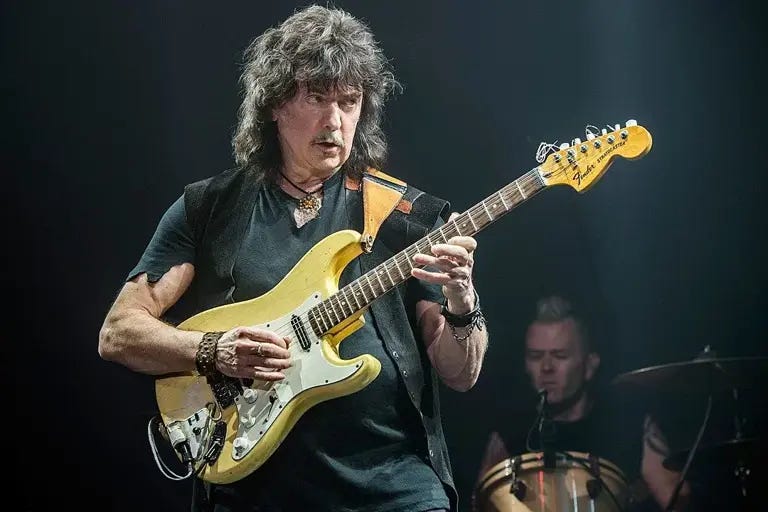
Your rock playing always had a jazzy feel in the way it is laidback but in the pocket. What jazz players influenced your playing and/or phrasing? -Dustin Ehrlich
Actually, though I went through a jazz period when I was about 15 centered around Wes Montgomery and the amazing Django Reinhardt, I came out of it quite quickly and I really don’t like jazz. I was always more into classical, country and renaissance music. I do love jazz drummers, though, and prefer to play with them than rock drummers because they have a lighter touch and subtler feel.
You had such a great rock sound. What were playing through on Machine Head?
-Michael Curry
I was using a 200-watt Marshall with a Treble Booster, probably a Hornby Skewes, but I can’t say for sure which Strat I was playing. For one thing, I used to change the necks on my guitars often because I might like the feel but not the sound. I also glued necks in place so they couldn’t move.
For such a seemingly simple riff, people sure do play “Smoke on the Water” different ways. So what is correct -- power chords or single note passes? -John Paradis
It’s two notes picked at the same time, using fingers rather than a pick and it sounds wrong when strummed as a chord or picked with all downstrokes. The bass part of the riff is plucked downward with the thumb while the finger is pulling up at the same time. I pick the fourth and fifth strings together on the fifth fret, then I pick the third and fourth strings on the third fret. The next shape is on the same two strings on the fifth fret, then the semi tone above that and then back to the first two shapes.
It has been said that you were outside of your body when soloing in Deep Purple and Rainbow. Were you in fact astro-projecting or did you just practice a lot?
-Kevin Potts
I always practiced a lot but I also believe that most musicians enter a state similar to astro projecting when they are really deep in thought. You’re not flying around the room, but I think you are mentally elevated and in that sense beyond your body.
Is your guitar tuned standard or down a half step? -James Bettis
I always tuned my electrics to standard pitch, in part because I played with keyboardists. I find, however that the acoustic guitar screams a l little bit when tuned to concert pitch, so I prefer to be a semi tone under.
What has been the one thing in your rig that has remained the same through all the years and changes in your sound? -Sean Oster
The tape recorder, which I picked up around my house and converted into a preamp in ’72. We’ve tried to emulate that sound with a million different pieces of gear, none of which sounded right. So I’ve carted around this big tape recorder that is falling apart. Finally, some German guy just made me a little box, which seems to replicate the sound – it flattens it and fattens it up without fuzzing it up. That is now my backup and one of these days may actually replace the irreplaceable.
You once categorically stated that, “Eric Clapton is not a very good guitar player.” Why would you say that—especially since he gave you your first Stratocaster?
-Marlon Cortes
Those were not my exact words and I regret that what I said came across as a putdown, which is not how I meant it. Eric is very good but it’s amazing how so many other guitarists are just forgotten about or never known and that’s the point I was trying to make – that there are a lot of other brilliant guitarists out there. Eric has done a lot for the guitar, especially with some of his work with Cream, and he certainly did a lot for me by turning me on to Strats as well as Clifford Essex strings.
He indirectly gave me my first Strat -- he gave it to his roadie, who sold it to me. And in ’68 when Deep Purple supported Cream at the Forum in Los Angeles -- with Jimi Hendrix and George Harrison in the first row -- I asked him backstage what kind of strings he used because I loved his sound.
Am I crazy to think that Jimi Hendrix is overrated? His blues-based playing could not hold a candle to your work. -James Howard
You are not crazy but you are wrong, though I understand what you are getting at. Although I loved Hendrix’s playing I could see the limitations. He was the best in terms of the overwhelming feel of his playing, arrangements and riffs, and the way his guitar and voice were as one. But from a technical point of view it wasn’t overwhelming and I think Robert Fripp thought the same.
I loved listening to Hendrix play but there were not these incredibly fast runs one hears today. But he didn’t need that because he was an extension of the guitar and it was amazing how he would just make the thing sing. It was a very different approach and it really made me pause because I was focused on technical players like Chet Atkins, Les Paul and Speedy Bryant. When Hendrix came along, I thought, “What is happening here?”
What led you to became fascinated with classical chord progressions and harmonies? Did any particular composers excite you? -Alan Jones
The main composer who inspired me was obviously Bach, who had a rock and roll sound on some of his organ pieces. The guys who turned me onto the concept were the guitarists Joe Moretti and Tony Harvey of Nero and the Gladiators. I saw this unbelievable band at a community center when I was 15 and was blown away by. They did “In the Hall of the Mountain Kings” and other classical pieces and it really grabbed me. I started fiddling with classical pieces right then.
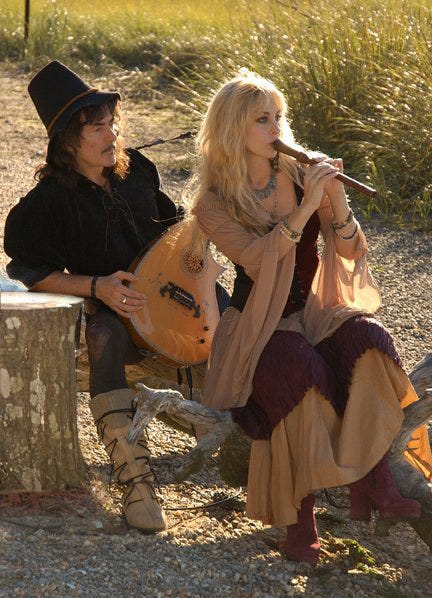
What is your most recent Blackmore’s Night release? And will you ever make it to the West Coast? Please. -Rita McKinney
In fact, we’re coming this winter for the first time. We’re looking at vineyards and other interesting out door venues, which we prefer to rock clubs. Our most recent release is a compilation, Beyond the Sunset, which we put together largely for people to play at their weddings, since we get such requests so often. Have a look at my website for more information on both issues: blackmoresnight.com
Did any of you guys ever kick Frank Zappa’s ass for running away from the fire in Switzerland? -Ample Al
No, we didn’t. Though it was funny how he told the audience to calm down then proceeded to jump out the window.
You’ve just woken up and found yourself in the middle of the 16th Century: Who’s the first person you would want to jam with and would you be able to find musical currency? -Remi Audy
My favorite composer is Tillman Susato so I would hunt him down in Antwerp in the 1530s. He was a music publisher as well as a musician so he would have lots of Flemish pageantry style music. I’m not a good reader so it might be a little tricky to play immediately but I would pick it up by ear and have a grand old time.
Brothers and Sisters: the Allman Brothers Band and The Album That Defined The 70s was my third straight book to debut in the New York Times Non-Fiction Hardcover Bestsellers List, following Texas Flood: The Inside Story of Stevie Ray Vaughan and One Way Out: The Inside History of the Allman Brothers Band. My first book was Big in China: My Unlikely Adventures Raising a Family, Playing the Blues and Becoming a Star in Beijing, about my experiences raising a family in Beijing and touring China with a popular original blues band. It was optioned for a movie by Ivan Reitman’s Montecito Productions. I am also a guitarist and singer who fronts two bands, Big in China and Friends of the Brothers, the premier celebration of the Allman Brothers Band.
No posts
Comments
Nothing yet. Say the first thing.
Sign in to join the conversation.