
Another end of an era. I never met Frank Beard, or Dusty Hill for that matter, but the news of Frank’s passing at age 77 hit me kind of hard. ZZ Top has just been part of the soundtrack of my life for as long as I can remember. Over the years, I have had some periods of being pretty close to Billy F Gibbons, who is now the last surviving member. It seemed like a good time to share a fun interview I did with Billy for Guitar World back in the day talking about some of the band’s greatest songs from the 1970’s. I could have chosen many others, of course.
When we did this interview, Billy uttered one of my favorite lines: ”Being a rock star in the 70s was wall-to-wall craziness without any threat of penalty.”
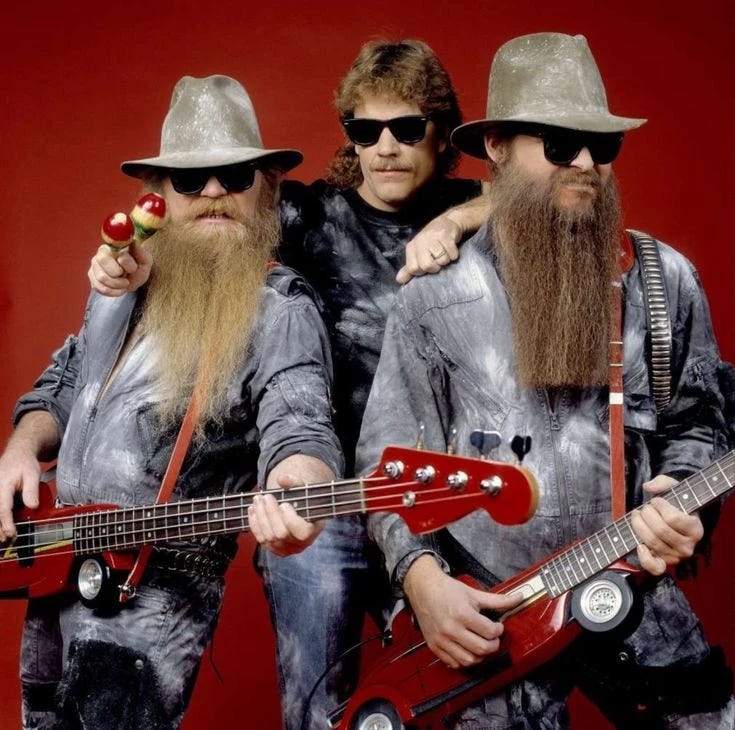
From the official announcement: Frank Beard was ZZ Top’s drummer for all of the band’s 56 years. He was in hospice care when he passed away at his ranch in Richmond, TX with family members at his side. Beard, together with guitarist Billy Gibbons and bassist Dusty Hill were one of music’s most enduring line-ups continuing until 2021 when Hill’s passing saw Elwood Francis join the band.
It was Frank Beard who, in the waning days of 1969, suggested to Billy Gibbons – then a frontman in search of a rhythm section – to audition Dusty Hill. Beard had played with Hill previously in a Dallas-based band called American Blues, and in The Warlocks, Hustlers and Cellar Dwellers before that. The three got together at Gibbons’ Houston home and proceeded to jam non-stop for three hours.
“It was a blues in D, a shuffle,” recalls Gibbons, “and we just didn’t want to stop . . . and we didn’t for the next five or six decades.” This trio played its first show before a paying audience at the Knights of Columbus Hall in Beaumont, TX on February 10, 1970. They went on to a recording career that included eleven gold albums (seven of which were certified platinum), plus two platinum video albums. The band’s epochal Eliminator album also achieved Diamond status, in recognition of more than ten million copies sold.
Limited time offer - paid annual subs will receive one of these signed Jaimoe/Friends of the Brothers posters.
Billy Gibbons on some of the band’s landmark recordings.
“LA GRANGE” - Tres Hombres (1973)
“That is straight guitar into amp: a 1955 Strat with a stop tailpiece through a 1969 Marshall Super Lead 100. That fuzz sound in the lead and in the front and back end of the composition is just pure tube distortion. Pickup-setting differentials account for the different tones. The opening part was played on what we used to call ‘the mystery setting’ in the dark days before the existence of the five-way toggle switch, when finding that perfect ’tweener [in-between setting of a three-way pickup selector] required dedication.
“That Marshall amp, which was a trusted friend through the first six records, was an import brought over by Jeff Beck’s at-the-time tech. I had four of those babies, and they were my main road amps for years. I ran them through cabinets with those [Celestion] Greenback speakers. They still retain a distinctive, rich, enjoyable tone and are well worth owning. I must, however, advise anyone fortunate enough to find one to beware of the variable power plugs. The 220[-volt] setting doesn’t work very well outside of the 220 countries, as I can tell you from experience. We had more than a few paper-clip nights over the years [due to blown fuses].”
“TUSH” - Fandango! (1975)
“The first three albums were recorded exclusively at the Robin Hood Studios outside of Dallas, and the special sound that always seemed to be accessible there was due in part to the fact that the equipment was nailed to the floor and nothing ever moved so you could always count on a sound. Quite a good sound, I must say.
“‘Tush’ was Pearly Gates, my beloved Les Paul, played through the same Marshall Super Lead, and we sure enough did stop and enjoy the G tuning for the composition’s slide element. This song was largely straight guitar to amp, but I also utilized a real odd, esoteric device called the Cooper Time Cube, which was a simplistic application of the complex world of physics. In a small rack-mounted can sits a small speaker, right up next to maybe 50 feet of one-inch rubber tubing, which is coiled, spring-like. The sound waves actually take longer to travel, having to make these corners, creating a type of delay which is quite unlike the familiar sound of a digital delay. That was a real left-field piece of gear which they had—and still have, I might add— in that studio. Some of the guitar sounds that appear to be doubled on the early albums are actually the byproduct of that oddball Cooper Time Cube.
“I’M BAD, I’M NATIONWIDE” - Deguello (1979)
“We wrote this about the great Texas bluesman Joey Long, a Gulf Coast lead-guitar picker who appeared on a great number of wonderful records by the likes of Slim Harpo and Barbara Lynn. He played on Lynn’s great hit record ‘We Got a Good Thing Going,’ which was covered by the Stones, and which was really one of the important recordings that shaped my understanding of where it was I wanted to go with my life. It was good. And so was he.
“Joey loaned me a multi-stringed mandolin- like instrument from Parral, Mexico, and I put it to good use on ‘Nationwide.’ If you listen closely, you can hear closemiked mandolin-sounding rhythm accompaniment. The lead track was played on a custom-made, half-size, real short-scaled guitar tuned to G. It was actually standard tuning cranked up a minor third, which remained quite playable thanks to the guitar’s short scale.
“The song’s tail end alternates between three distinct effects created by two pedals: an Echoplex doubler and a Maestro octave box alternating every third bar between having the octave up and the octave down. The song also contains some Hohner Clavinet, which was owned by one of our famous Memphis pals, Carlos De Marlos. It’s such an interesting sound that it ignited Dusty’s [Hill, bassist] interest in learning some keyboard skills, and it was he who subsequently handled all the tickling of the ivories.”
“CHEAP SUNGLASSES” Deguello (1979)
“This song was actually written during a trip from the Gulf Coast up to Austin, Texas. A bright spot of creativity flared as we were passing the hamlet of La Grange, and I recited all three verses of ‘Cheap Sunglasses’ within the space of 20 miles. And that’s the way they stayed. Though that may sound simplistic, the lyrics speak for themselves. ‘Simplistic’ is indeed a word which may come to the minds of some.
“The lead track was performed on a fake Fender guitar, which I used for the wiggle stick—there is a little dive bomb in the solo section. I played it through a Marshall Major, a short-lived 200-watt beast, which had one blown tube. Hence the rather bulbous, rotund sound. There’s also a little bit of digital delay for that Bo Diddley impersonation at the tail out, and a Maestro Ring Modulator, which produces the strange tag to each verse. It appears three times, and it’s a pretty funny sound. That is one insane effect put to good use.”
Brothers and Sisters: the Allman Brothers Band and The Album That Defined The 70s was my third straight book to debut in the New York Times Non-Fiction Hardcover Bestsellers List, following Texas Flood: The Inside Story of Stevie Ray Vaughan and One Way Out: The Inside History of the Allman Brothers Band. My first book was Big in China: My Unlikely Adventures Raising a Family, Playing the Blues and Becoming a Star in Beijing, about my experiences raising a family in Beijing and touring China with a popular original blues band. It was optioned for a movie by Ivan Reitman’s Montecito Productions. I am also a guitarist and singer who fronts two bands, Big in China and Friends of the Brothers, the premier celebration of the Allman Brothers Band.
No posts
Comments
Nothing yet. Say the first thing.
Sign in to join the conversation.