
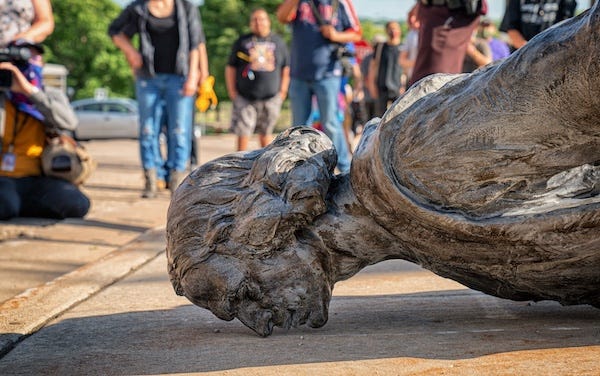
In the summer of 2020, protestors across the United States expressed their righteous anger over the murder of George Floyd in many ways—including pulling down or defacing the statues of people associated with America’s legacy of racial injustice. A lot of attention was focused on statues of former Confederates, but others, like Christopher Columbus (above), got the same treatment.
What many people don’t realize is that Americans have a long history of pulling down statues of people they have decided they don’t like anymore—beginning with the very first public statue in Colonial America.
Like the Revolutionary War novel I’m writing, the story of America’s first rescinded statue begins with the Stamp Act. In 1765, the British government had a cash flow problem. They had just fought the successful yet expensive French and Indian War in North America, (part of the larger Seven Years’ War overseas,) and they wanted the American colonists to pay for their side of things. So parliament instituted the Stamp Act, which said that all paper documents in the American colonies—from contracts to marriage licenses to newspapers to playing cards—could only be printed on paper that bore an official stamp from the British government. That stamp cost money, of course, and the paper it was printed on could only come from England.
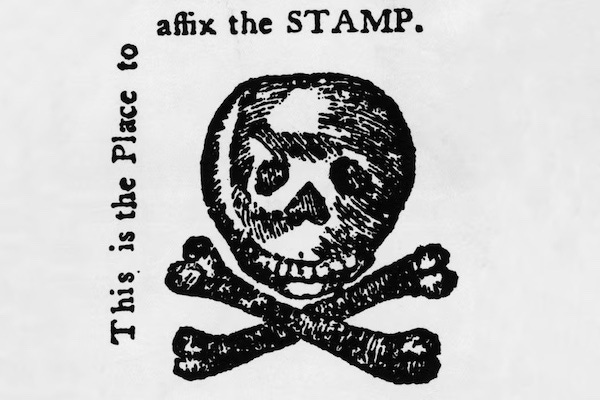
The American colonists were not amused. (As evidenced by the political cartoon/Stamp Act substitute seal above, often printed in the corner of “illegal” Patriot newspapers in lieu of the official stamp.) The American colonists hadn’t felt like the French were any real threat in North America to begin with, and they were mad that the treaties England had signed with its Native American allies meant the colonists couldn’t snatch up Indian land to the west. (Not that anybody would abide by those treaties for long.)
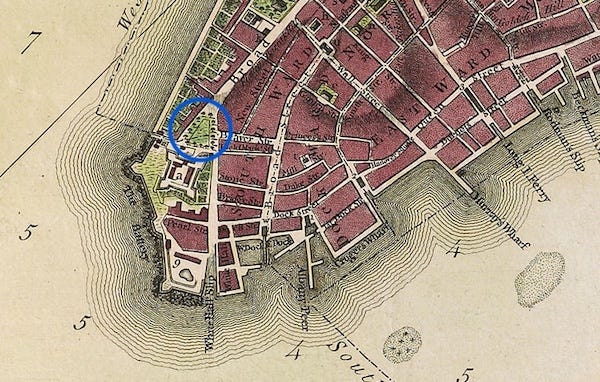
When the ships with Stamp Act paper arrived in New York in 1765, thousands of people gathered in protest on Bowling Green, near Battery Park, at the southern tip of Manhattan Island. (Right outside the fort where the British governor of New York had run to hide.) There they burned effigies of the governor and clashed with the British soldiers who were called out to quell them. The riot lasted for days, and similar scenes played out in major colonial cities from Boston to Charleston.
The rioters’ rally cry was “no taxation without representation,” as the colonies were not allowed to elect members of parliament, and thus had no vote in how or if they should be taxed. But while the colonists weren’t officially represented in parliament, they did have their advocates there. Perhaps the greatest of these was William Pitt the Elder, a populist member of parliament (and namesake of Pittsburgh), who would a year later (briefly) become prime minister of England. He convinced his colleagues to repeal the Stamp Act, averting an American revolution. (At least for the moment.)
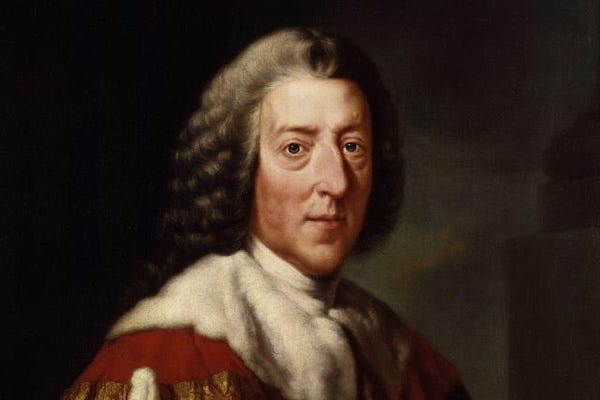
The people of New York City were so grateful to Pitt (above) that they asked the New York legislature to erect a statue to him. The legislature, which was all Tory loyalists, was like, “Well, sure, he’s great. But there’s good people on both sides. And we can’t spend money for a statue of ANYBODY before we put one up of King George III!” Then they probably put their hands up in front of their mouths and snickered right in front of everybody.
So the New York legislature commissioned two statues from a London sculptor—one of William Pitt, and the other of King George III.
Five years later, in the summer of 1770, the statues were finished and shipped to America. The William Pitt one was life-sized and respectful, and depicting him in a toga like a Roman senator of old.
The King George statue was Romanesque too, but ostentatious and enormous:
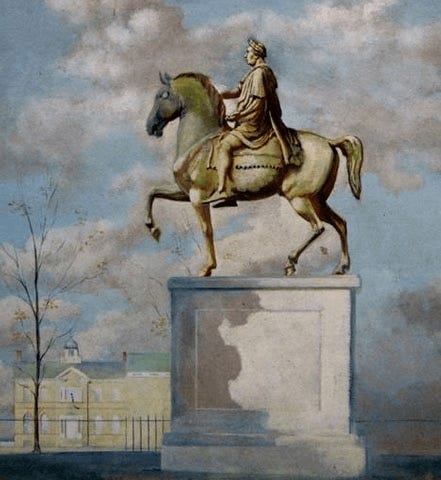
The King George in the statue was about a third larger than he was in real life, and wore a laurel wreath instead of a crown. He was also mounted on a horse, deliberately mimicking a similar statue of Roman Emperor Marcus Aurelius. (Notably the last of the “Five Good Emperors” of Rome, and the last emperor of the Pax Romana, two hundred years of peace and prosperity for the Roman Empire.) The statue was made of lead gilded with gold, and weighed 4,000 pounds.
The New York legislature put the William Pitt statue on a small pedestal in the middle of the sidewalk between Wall Street and Williams Street.
They put the statue of King George on an 18-foot tall stone pedestal right in the middle of Bowling Green, where the mob had gathered for days to protest the Stamp Act.
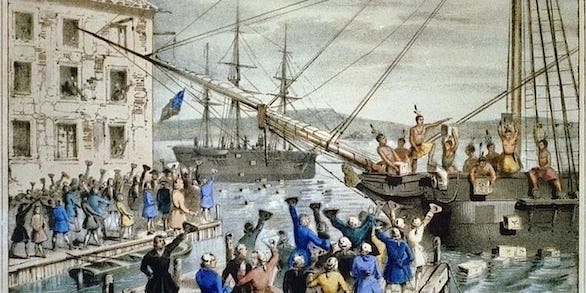
The New York legislature was probably tee-heeing again. But the political climate in the colonies had gotten much worse in the five years between the commissioning and the delivery of the statues. The Sons of Liberty—a loosely organized, clandestine, sometimes violent group of American Patriots—had been born from the Stamp Act riots, and were making trouble. In Rhode Island, the Sons of Liberty burned a British navy ship to the waterline. In Boston, they threw tea into the harbor rather than pay parliament’s new tax on tea. In New York, the Sons of Liberty burned effigies of Loyalist administrators and clashed with the British army almost every night.
Now they got a kick out of piling trash at the bottom of the King George III statue in Bowling Green, and painting vulgar messages on the pedestal.
To keep out the troublemakers, the city erected an iron fence around Bowling Green. They also passed a law that made the punishment for vandalism a year in jail or a $500 fine—the equivalent of more than $20,000 today.
The vandals just jumped the fence, ignored the penalties, and kept desecrating the statue.
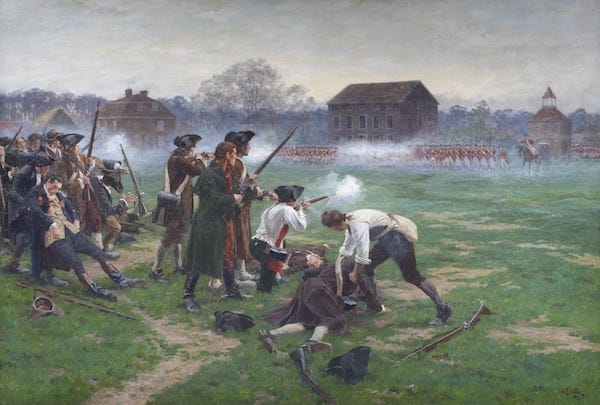
Cut to July 1776. The revolution had officially begun at the Battles of Lexington and Concord in April. After enduring a lengthy siege in Boston, the British army had escaped to Halifax, and was now headed for New York, bringing an invasion force of 130 warships and 32,000 soldiers—six times the remaining population of New York.
At almost the same time, messengers were arriving in New York from the Continental Congress in Philadelphia with the newly written Declaration of Independence. The document listed the many grievances the colonists had with the British government, and made their goal of independence official.
On July 9, 1776, copies of the Declaration of Independence were read throughout the city, causing a frenzy of Patriotic fervor. Ecstatic mobs tore through New York, destroying anything and everything that had to do with the monarchy.
Including, of course, that enormous statue of King George III in Bowling Green.
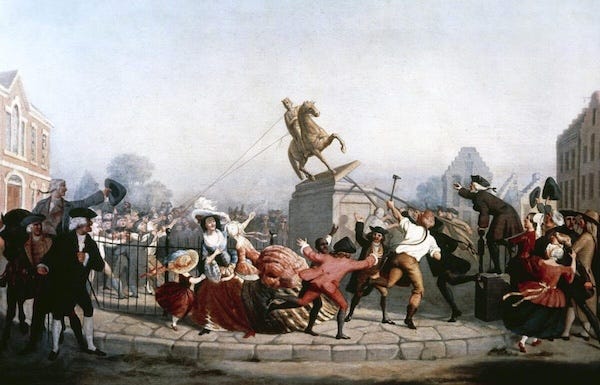
The rioters threw rocks at the statue. Then they threw ropes over it, and pulled it down. It was a singularly symbolic act of defiance—something that would have been unheard of just a year earlier, despite the Patriots’ growing conflicts with the crown. So sacrosanct was the image of the king that, until that moment, no one had ever vandalized the statue itself—just the pedestal.
It must have been simultaneously exhilarating and terrifying.
The story gets even better. With a war on, the Patriots couldn’t let 4,000 pounds of lead go to waste. So, after removing the king’s head and mounting it on a pike outside a tavern in what is now Washington Heights, they sent the statue off to Litchfield, Connecticut, where the ladies of the Walcott family melted it down and turned it into musket balls! 42,088 musket balls to be exact. (They kept track.) “The king of England’s statue has been pulled down to make musket balls of,” a colonist named Ebenezer Hazzard wrote later that month. “So his troops will probably have his majesty fired at them.”
Of the original monument, only the iron fence they put up to protect it remains on Bowling Green. King George’s head—the lead one, at least—was rumored to have ended up back in England, but has never been seen again. Strangely, the only part of the statue left is the horse’s tail, which is now on display at the New York Historical Society:
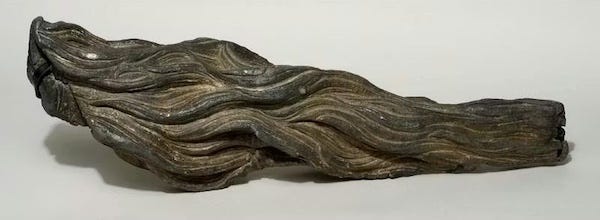
Critics argue that removing statues amounts to “erasing history.” But as The Bowery Boys podcast says in their excellent episode about the statue, “A monument itself is not a history lesson, but a time capsule of the culture who created it.” Pulling down statues of people our ancestors once regarded highly enough to build statues to them isn’t erasing those people. It’s re-evaluating them.
A reminder that my free, virtual school visits continue this month on Tuesday, March 24th at 1pm ET/10pm PT. Click here for the full schedule. And I just got back from the North Texas Teen Book Festival in Irving, Texas—thanks to everyone who came out to see me!—and will be back in Texas on June 9th to speak at the Dallas Holocaust Museum. Click here to see my event listings on my web site.
Your reward for reading this far (besides the A-plus 250-year-old statue content) is that I’m having another book giveaway! This time it’s for hardcover copies of my climate change novel Two Degrees.
Each entry will be assigned a number, and winners will be selected using a random number generator. So that everyone has an equal chance to win, please enter only once. Thanks! And sorry, due to the number of submissions I expect to get, only the giveaway winners will be notified of the results. But that means if you hear from me, it’ll be good news!
The deadline to enter is the end of the day on Sunday, March 22, 2026. Thanks, and good luck!
Enter to win a copy of Two Degrees
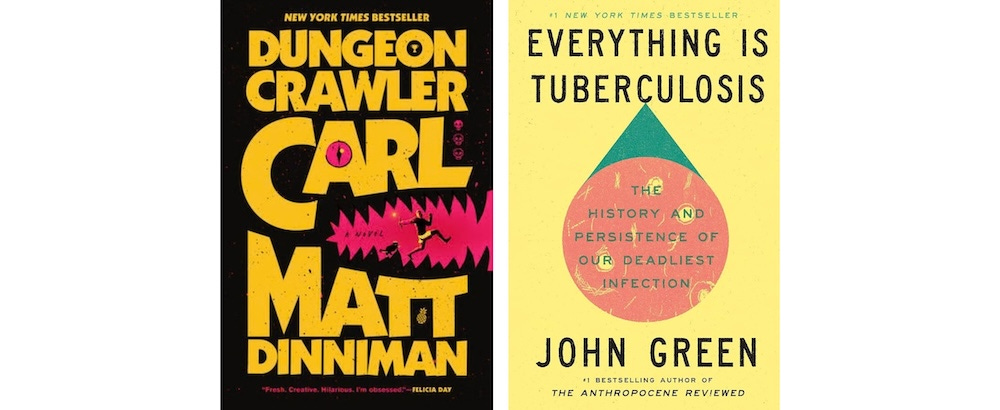
Two books for you this month. Both for adults, but one fiction and the other non-fiction.
Dungeon Crawler Carl by Matt Dinniman is a hoot. I’m very late to the game on this one, as there seven books in the series already, with an eighth to come in May. The premise is bonkers: alien conglomerates seed worlds like ours with humanoids, wait until we’re moderately advanced, then swoop in, kill 99% of the population, and throw the rest into a world-spanning reality show that’s a cross between Dungeons & Dragons, Fortnite, and The Hunger Games. Carl is dropped into the dungeon wearing nothing but a leather jacket, t-shirt, and boxers with hearts on them. Along with him is his ex-girlfriend’s prize-winning show cat Princess Donut, who can now talk thanks to the wacky set-up of the game.
Dungeon Crawler Carl belongs to a very niche sub-genre called LitRPG, where a person from the real world is somehow transported to a place with all the rules and conventions of modern video games, and has to survive. If that strange combination of elements sounds fun to you (as it does to me), you’ll love Dungeon Crawler Carl. It’s a fun, funny, action-packed, and often surprisingly pathos-infused fantasy novel. (That is definitely for adults.)
From the silly to the serious, my next recommendation is John Green’s Everything is Tuberculosis. This one, which has a long waiting list at the library, popped up on an “It’s Your Lucky Day!” shelf in my local branch, and I snatched it up. John became obsessed with tuberculosis (perhaps, by his own admission, a little unhealthily so) after meeting a young man named Henry with the disease at a clinic in Sierra Leone. Henry’s story provides the framework for John’s exploration of the history of tuberculosis, from evidence of its existence in ancient times, through the Victorian “consumption” epidemic, to the tuberculosis sanatoriums of the 1920s and 30s, and eventually to its modern-day cure.
John writes that he talked about tuberculosis so much around his family that his wife told him, “Everything is tuberculosis to you.” He agreed—and that conversely, “tuberculosis is everything.” One of my favorite chapters is where he pushes the boundaries of that idea, suggesting that, for example, World War I, the cowboy hat, and the state of New Mexico all owe their origins to tuberculosis. He readily admits there were a lot of other factors that caused each of those things (particularly World War I,) but he makes a compelling argument that tuberculosis, which is the deadliest infectious disease in the world and has been for most of human existence, has played a major part in our cultural, political, and societal development. The biggest question John asks though is why a million people still die of tuberculosis every year when we’ve had a cure for the disease since the 1950s. (And he has some very compelling answers.) Everything is Tuberculosis is deadly serious and laugh out loud funny, infuriating and inspiring, informative and heart-wrenching, all at the same time. Read it.
That’s it for this month! If you liked this newsletter, please share it online, or with anyone you think would be interested:
And if you aren’t already a subscriber and you’d like to be, you can sign up here:
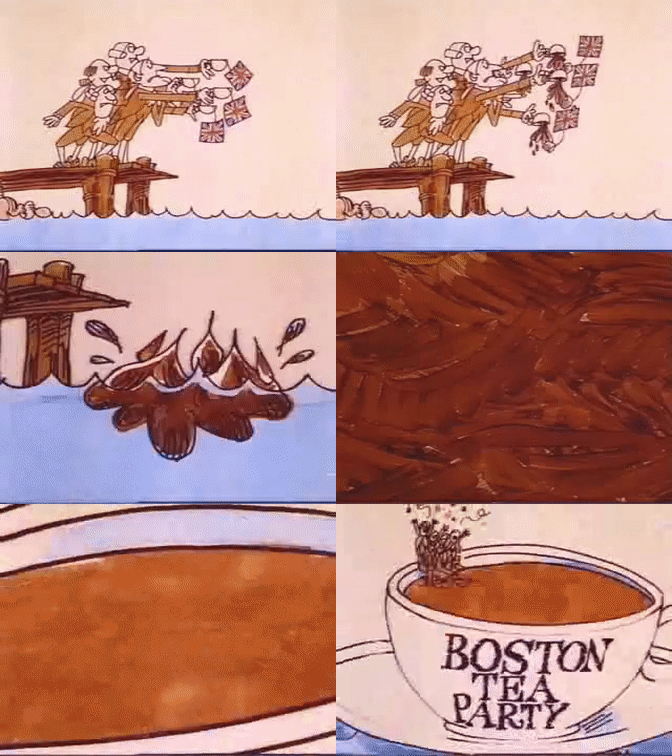
No more kings!
No posts
Comments
Nothing yet. Say the first thing.
Sign in to join the conversation.