
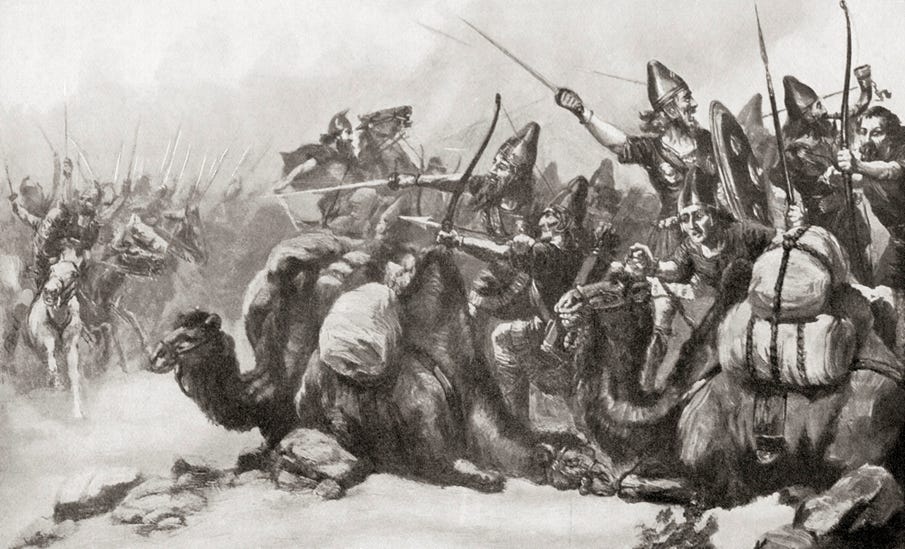
The defeat of Croesus By Walter Hutchinson 1877 - History Of The Nations Vol 2
So Midas, king of Lydia, swelled at first with pride when he found he could transform everything he touched to gold; but when he beheld his food grow rigid and his drink harden into golden ice then he understood that this gift was a bane and in his loathing for gold, cursed his prayer.
—Claudian, In Rufinum
[Croesus, King of Lydia] strove to win the favour of the Delphian god with great sacrifices ... When the sacrifice was over, he melted down a vast store of gold and made of it ingots of which the longer sides were of six and the shorter of three palms’ length, and the height was one palm.
These were an hundred and seventeen in number. Four of them were of refined gold, each weighing two talents and a half; the rest were of gold with silver alloy, each of two talents’ weight. He bade also to be made a figure of a lion of refined gold, weighing ten talents.
--Herodotus Book 1, 50
This article about the Thucydides Trap started as a presentation on the true causes of the war between Sparta and Athens which was given to the World Association for Political Economy in December 2021 at the Shanghai International Studies University, China.
The people at China Academy then invited me to make a video on it in 2023, in which I took up in more detail Graham Allison’s ‘Thucydides Trap’ argument that the rise of China would provoke war with the USA. This idea resonated in China, but I questioned it for two reasons: first; the conflict between the USA and China was not provoked by China’s rise but by America’s decline; second, the war between Sparta and Athens was not provoked by the rise of Athens but by Athens’ attempt to become a hegemonic imperial mercantile power.
Mounting tensions between China and the USA have provoked a profound discussion among Chinese policymakers and scholars. Not surprisingly, US political and economic theories, at one time respected by Chinese intellectuals, evoke growing scepticism as, with growing confidence, China asserts a vision of the modern world at variance with US narratives.
Xi Jinping has made two main references to the Thucydides trap. During Trump’s visit in May 2026 he argued that the risk of a Thucydides trap could be avoivded by collaboration for mutual benefit; in his earlier visit to the USA, he insisted that there is no “Thucydides trap” in the world, though repeated strategic miscalculations between major powers could create a “Thucydides trap” for themselves[1]. This is quite far from an endorsement of Allison’s thesis, and shows that a more careful study of this thesis will be valuable.
Nevertheless, Allison’s thesis has significant currency in China. Wang Huiyao, a leader of the Jiu San Society, took part in an extended discussion with Allison on his book “Doomed: Can the U.S. and China Escape the Thucydides Trap”, focussed on what China can do to avoid this trap[2].
But are the tensions caused by China’s rise? Dai Xu, a Professor at PLA National Defence University and a senior Airforce Colonel, believes the Thucydides Trap “is a false proposition. Because in terms of geography, politics, military, economy, strategic direction and development design, China and the United States are far from Athens and Sparta at that time…the ‘Thucydides trap’ is just one of the academic excuses to deceive oneself and others.”[3] Similar views have been expressed by Qian Chengdan[4] and by Chen Yudan[5] from the School of International Relations of Fudan University.
However, a strong current of opinion accepts the “Thucydides Trap” hypothesis; the question is then how to respond. Wang Yiwei, a Professor of International Relations at the Renmin University of China, says China and the US must work together to avoid it: “a new type of major power relationship between China and the United States is a necessity, not a choice, and it is the hope of cooperation between China and the United States beyond the ‘Thucydides trap’, which is determined by the two countries’ promotion of globalization, joint development of the global commons, and the tolerance and mutual appreciation of human civilization.”[6]
If the USA refuses to take the path dictated by necessity, the general view is that China should continue on its path of development, because the needs of its people are its primary concern, but take measures to protect itself from US aggression. Military expert Zhu Qichao writes that “The rapid rise of China, on the one hand, and the lack of signs of improvement in the unification issues between the two sides of the Taiwan Strait and the territorial disputes with neighbouring countries, on the other hand, have forced the Chinese to question the U.S. attempts to contain China’s rapid development.” [7]
Yet many Chinese scholars, though agreeing that China should not comply with US exigencies, accept the premise of Allison’s argument. Thus Lin Yifu writes: “In the 5th century B.C., Athens, which had grown strong through overseas trade, threatened the hegemony of Sparta, and a 30-year war broke out between the two countries. The current Sino-American relationship is similar to the historical situation between Athens and Sparta. Professor Ellison’s research found that from the early 16th century to the present, there have been a total of 15 instances in which the positions of the ‘oldest’ and ‘youngest’ powers in the world have been swapped, with 11 of them resulting in wars and the rest in peaceful transitions.”[8]
This acceptance of Allison’s thesis exposes China to a dangerous weakness in framing a response, since the conclusion is then that war is indeed inevitable. If the only choice facing the Chinese people were between war with the USA in which millions might die, or postponing hopes for escaping poverty, it would be understandable for anguished parents to believe that the second option is the best. There are strong grounds for thinking this is the dangerous ‘bet’ of American policymakers: be aggressive enough to convince the Chinese people that economic suicide is the best option, because the alternative is death.
The danger is this: if the cause of war is within the USA, it can only be resolved in the USA. No amount of compliance with requirements arising from the USA’s own failures will then help; they will have the contradictory effect of confirming the mistaken view that aggression is the best way for the USA to resolve its internally-generated difficulties.
This may sound a gloomy conclusion; yet it is only gloomy if we accept Allison’s thesis. There are many examples in history in which a once-dominant power was obliged to restrain and rethink; indeed Athens itself, confronted with the rising power of Philip and then Alexander of Macedon, completely rethought its relation to the ancient world, which eventually brought it into a civilizing contact with ancient China.
There is, therefore, another alternative. This is to create, in the world and in the USA itself, an understanding that true origin of the conflict is the colonial-era economic and political order on which US society is based, and that this has no future and must give way to another. This in turn calls for a fundamental restructure of US politics and economics, which all who desire peace should actively promote. In short, it is the USA and the global North, not China and the global South, who must change course.
There is much evidence that Allison’s thesis is flawed, both as regards the origins of the war between Athens and Sparta, and as the causes of US belligerence. First of all, though the ‘growth gap’ between the USA and China is beyond doubt, the major cause of is not China’s rise but the USA’s decline.
As Radhika Desai points out,[9] this is the result of the mistaken turn that US leaders took after the first major postwar world economic slump in 1974. Instead of setting to rights the country’s industrial decline by directing investment inward, responsibly managing its deficit, and raising world demand for its products by stimulating growth in the Third World, it rejected the advice of Germany’s Brandt Commission and launched the ‘neoliberal turn’, raising interest rates through the roof, provoking thirty years of stagnation and dramatically accelerating the decline in the USA’s growth rate.
Figure 1: growth of USA and of China, 1966-2021
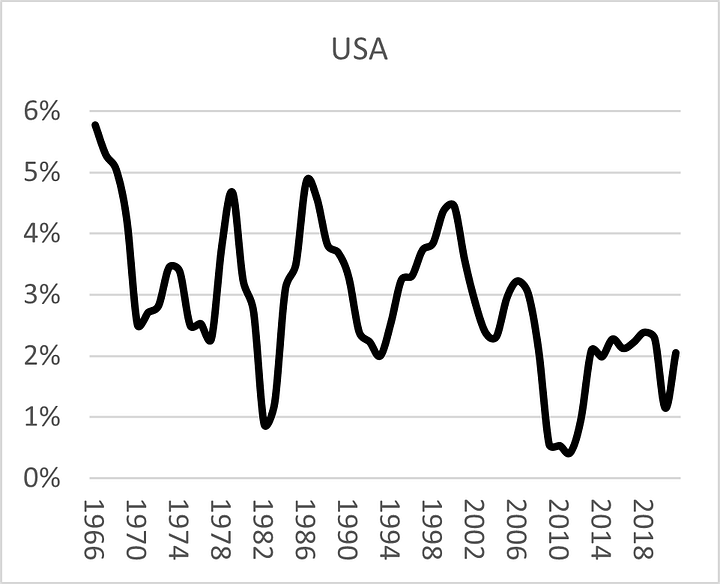
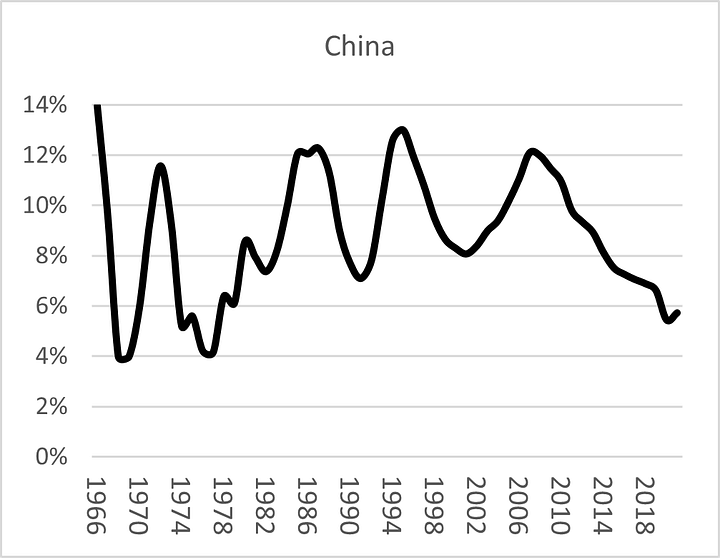
Source: World Bank, author calculations
Figure 1 shows the growth rate of the USA and of China since 1950. China has grown consistently faster since the mid-1960s. Is this the source of the USA’s difficulties? No. the USA’s growth has been declining systematically since the 1960s and it is the mistaken neoliberal turn that has created its current dilemmas; were it not for this turn, the USA would have had the option of a gradual and peaceful adaptation. Instead, it now confronts the price of fifty years of error: the bill is being presented with no clear means of payment.
Let us review Allison’s account of the Athens-Sparta conflict in this light. The war was not provoked by Athens’ rise but its transition from a defensive alliance against Persia to an aggressive naval Mediterranean imperialism. The historical problem facing both parties was the world-shaping conflict between the petty commercial city-state politics of Mediterranean traders and the historical civilizations of the Eurasian continent – in which ancient China played a fundamental role.
Allison’s Eurocentric narrative is attractive in China because it conveniently depicts the war as a moral theatre in which Spartan authoritarianism defeated Athenian democracy – conveniently dispatching both Athens and China to the status of tragically failed heroic endeavours, whilst conveniently distracting attention from the role of Imperialism in the modern China-US conflict.
Not surprisingly, Allison’s idea have captured attention of the media and politicians on both sides of the Pacific. Alan Greeley Misenheimer, in a study for the Institute for National Strategic Studies, states that it “has received global attention since entering the international relations lexicon”. BBC diplomatic correspondent Jonathan Marcus says Allison’s book “has become required reading for many policymakers, academics and journalists.”
These Eurocentric accounts of Ancient Greek history are preoccupied with the struggle between Athens and Sparta; however it is actually dominated by conflict with the Persians. Darius overran the peninsula in the first Persian war of 492BC, but failed to subdue Athens and Sparta. His son Xerxes launched the second Persian war twelve years later, and again overran the peninsula, but his defeat at the hands of Athens compelled him to withdraw from what is now Europe. The Peloponnesian war of 431-405 BC erupted only 60 years later, and within another 70 years Philip the Great, having defeated Athens and Thebes, incorporated Greece into his Macedonian Empire. Thus, only three centuries separate the 546 defeat of Croesus, fabled ruler of Lydia, and Alexander’s destruction of the Achaemenid Empire in 326 BC—smaller than the gap that separates 1492 from our modern world.
In this story, the collapse of Lydia, the dominant commercial power of Asia minor, is central. Lydia’s wealth was fabled. Herodotus describes a tribute that Croesus made to the Delphic Temple that would have been worth between $30 billion and $50 billion at today’s prices. Where did it come from?
Lydia was a trading nation. It is credited with inventing coinage. Herodotus says it invented shopping: permanent buildings for trade, as opposed to semi-regular markets. The coins also travelled; they circulated throughout the ancient world. The advantage of Lydia’s geographical position now becomes clear: it sat at the meeting point of the trade routes of the Mediterranean and those of Central Asia: Africa, Egypt, South and possibly East Asia, and Europe. This was the likely source of its fabulous wealth: it was a mercantile civilization.
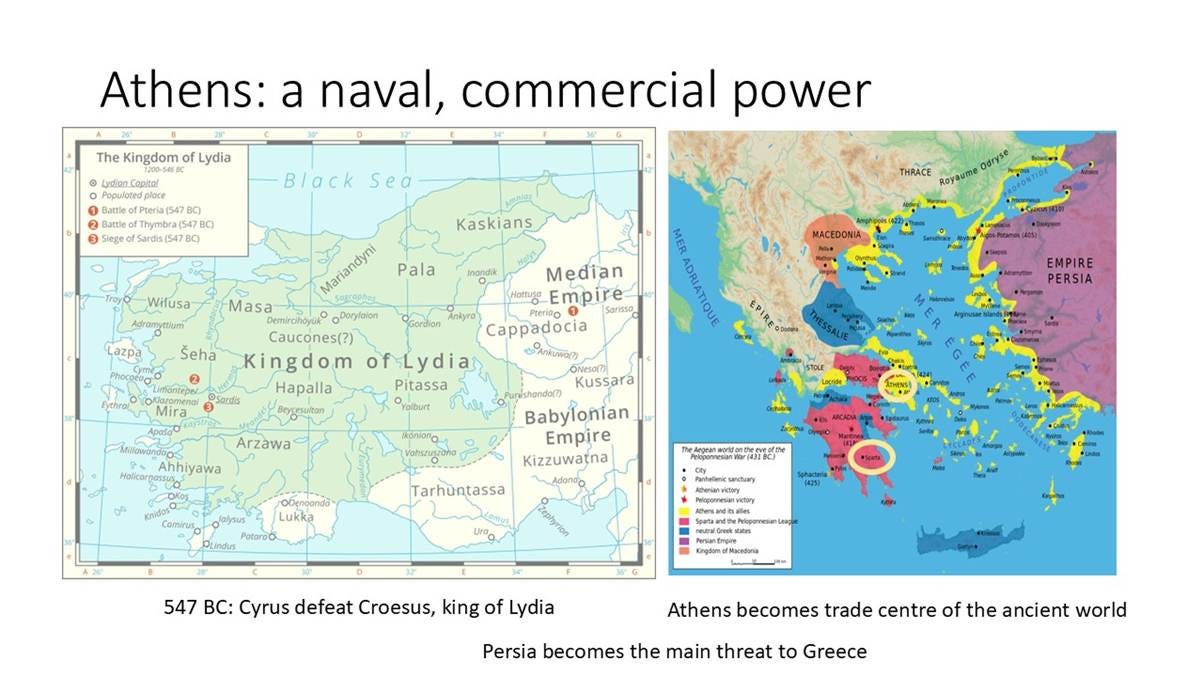
But with the victory of Cyrus and the defeat of Xerxes, Athens became the mercantile centre of the ancient world. Britannica states that
The silver of Corinth and its Adriatic colonies was very numerous and was abundantly accepted, outside the Corinthian territories, by Italy and Sicily…But the most famous commercial currency of all was that of Athens, the silver tetradrachms of which were struck in large numbers, fine quality, and obstinately unchanged appearance. These coins travelled widely in trade and were imitated as far afield as Egypt, Arabia, and Persia.
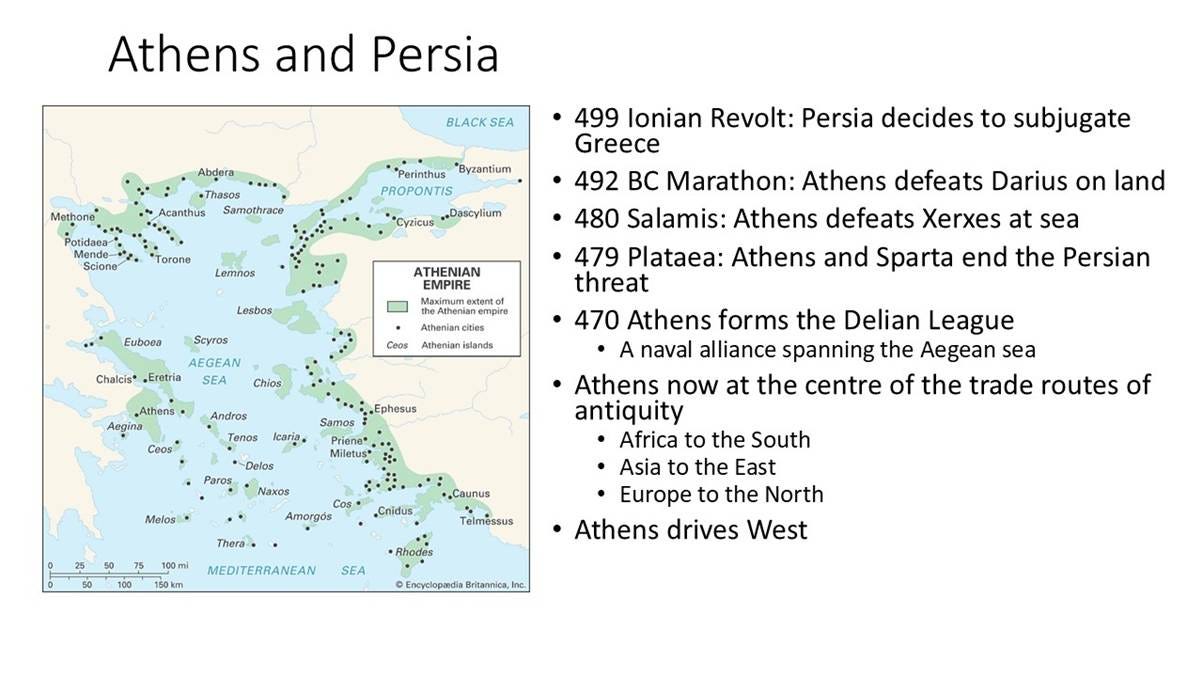
Now take a look at where Athens’ power and influence was actually located: as the map shows, it was a coastal empire. It spanned the entire Adriatic, including not only the Ionian cities of Asia Minor, but the Northern coast of the Aegean and the whole of what is now the sea of Marmara, giving it control over the Bosphorus and access to the Black Sea.
It had thus replaced Lydia not just as the buffer against Persia but as the destination of the traded wealth of the ancient world. This, not its rise as a Greek power, was the source of its rivalry with the rest of Greece.
Initially, Athens did not have an empire; it created the so-called Delian Leage, basically consisting of the coastal cities shown in the map. This had a profoundly monetary character. It was named because the island of Delos housed its treasury.
However Pericles moved this to Athens 454BC when it became the league’s formal meeting place, and centralised its navy—effectively absorbing it into Athens’ navy. Money was critical in converting it into an Empire. Under terms laid down by Athenian statesman and general Aristides, League members could contribute either ships or money. The ships had a clear economic function, protecting trade routes and conferring military superiority that let city states seize booty and slaves.
It thus became also the means to acquire productive power, because slaves, routinely taken in conquest, were also a commodity. This facilitated their use in activities like mining, where they ceased being what Marx termed a ‘patriarchal family slave’ and became a labour force, which was literally worked to death.
Indeed, the turning point of the war and the cause of Athens’ eventual defeat was entirely self-inflicted: it consisted of a disastrous military expedition to Sicily—a clearly expansionist folly and one of the clearest refutations of Allison’s thesis. The downfall of Athens was not provoked by Sparta, but by this adventure concocted by Alcibiades and his imperial co-conspirators. The role of self-interest was central: facing trial in Athens, Alcibiades deserted to the Spartan side and his military advice to Sparta secured the eventual fate of Athens. The Thucydides Trap thesis offers no explanation for this turn of events, which would be equivalent to general Douglas McArthur deserting to the Chinese side following his 1951 dismissal by Truman.
If any lesson is to be drawn it is that the conflict was brought about by Athen’s unsustainable expansionism under the impact of a vast flow of wealth, and its conversion into the centre of a world military trading empire. The result was a self-inflicted defeat arising from a classic case of Imperial Overreach.
If any analogies are to be made, therefore, the parallel is the conversion of the US national economy into a world empire organised by money—the Croesus Trap. There is only one way out of this trap, which is that the USA should recognise its sole responsibility for the present conflict and, based on this recognition, understand the need for a fundamental reconstruction of US society. Many forces may join hands to hasten this outcome. China should be one of them.
[1] “President Xi’s Speech on China-US Ties.”, China Daily, September 24, 2015. https://www.chinadaily.com.cn/world/2015xivisitus/2015-09/24/content_21964069_3.htm
[2] “Thucydides’s Trap Revisited: Prospects for China–US Relations”, April 6, 2021. https://link.springer.com/chapter/10.1007/978-981-19-3846-7_9
[3] Dai, Xu, “ ‘修昔底德陷阱’ 是学术烟幕弹”, Reference News, September 12, 2016. https://web.archive.org/web/20170511043822/http://www.cankaoxiaoxi.com/china/20160912/1301909.shtml
[4] Qian, Chengdan, 2017. 拨开“修昔底德陷阱”迷雾. Information for Decisions Magazine. 5, 27.
[5] Chen, Yudan, “ ‘中美陷入修昔底德陷阱’ 是个坑,中国学者应说不”, The Paper, July 30, 2015. https://www.thepaper.cn/newsDetail_forward_1357807
[6] Wang Yiwei, “中美超越 ‘修昔底德陷阱’ 的三大保障”, Center for China & Globalization, August 22, 2016. http://www.ccg.org.cn/archives/29582
[7] Zhu, Qichao, “中国跨越 ‘陷阱’ 需建设一流军队”, Reference News, September 16, 2016. http://m.cankaoxiaoxi.com/toutiao/china/20160916/1306443.shtml
[8] Lin, Yifu, “百年未有之大变局与新结构经济学”, Xinhua Net, July 12, 2021. http://www.news.cn/sikepro/20210712/2fc17c546d324f9c8c5acaad7f145b48/c.html
[9] Desai, R. Geopolitical Economy: After US Hegemony, Globalization and Empire. London: Pluto Press.
Comments
Nothing yet. Say the first thing.
Sign in to join the conversation.