

Justice and Divine Vengeance Pursuing Crime. Pierre-Paul Prudhon
… and share
I gave this talk in a presentation in December 2019 at Beijing Sports University at the conference entitled “Thinking of Different Nations with a Philosophical view”. I would like to acknowledge the help of the organisers and translators, especially Ya Du, but many others besides.
The slides are available on my slideshare site.
This redacted (by shortening) version of the talk discusses the fact that inequality between nations has been growing systematically since the war and even earlier. This is a phenomenon that development economists refer to as divergence.
Comments (within the limits of network courtesy) welcome
The data here were eventually incorporated in an article entitled The Geopolitical Economy of International Inequality in the journal Development and Change which the University of Manitoba has helped make open-access.
The most important thing about divergence is – according to western economic theory – not supposed to happen. What is supposed to happen, as a result of the free market, globalization, capitalism – all the wonderful things that are promoted by the West – is that the so-called “backward nations,” like China, are supposed to catch up. So the theory goes, that the reason China is doing so well, which is offered by the western economists, is because it joined the World Trade Organisation; not because of the policies of Deng Xiaoping; not because of the Chinese revolution; not because of anything to do with what the Chinese people have done but because the world has helped China recover from its backwardness.
This is the theory of the International Monetary Fund, of the World Bank, and of – I am sad to say – the United Nations. So, I think that this attitude, this cultural attitude, to how China has grown and why there is under development in the world, is a profoundly wrong idea. So, I first want to ask why the North, or the West, get it so wrong? Why do they misunderstand the cause of their own wealth and why do they misunderstand the cause of the poverty of the South, of the rest of the world – and why do they misunderstand the reasons why China is catching up? So, I’m talking about cultural attitudes.
However I want to use a Marxist approach to cultural attitudes and suggest that – as Marx himself puts it – “being determines consciousness.” This complements many of the things that Ype was saying, but also explains that this cultural attitude of North America is a product of a material circumstance, which is the economic relation between the United States and the rest of the world. However, this relation is concealed by the market. That’s why they don’t see it: it’s not obvious. You can only see it if you study it by the use of theory. And they have a wrong theory – and their theory is one that supports their prejudices.
This is a very common mechanism that leads to people making errors. They like to be confirmed in their own beliefs about themselves, so they adopt theories that confirm what they like to believe about themselves.
And that’s what I am going to talk about…
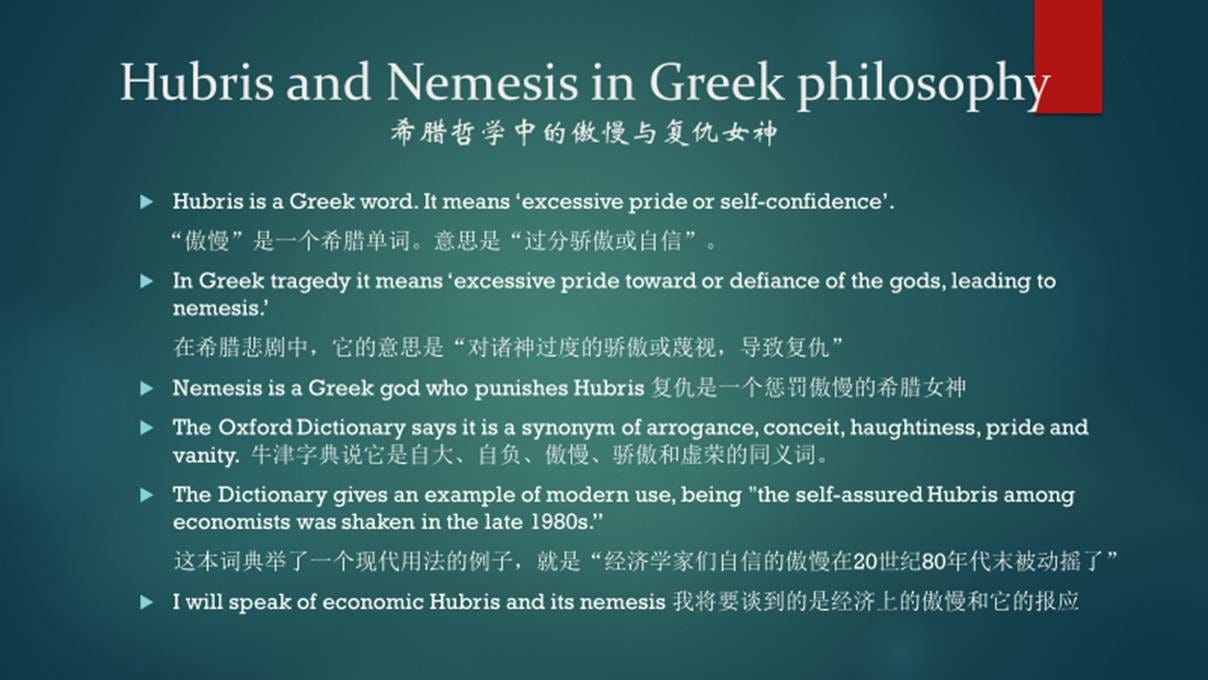
Because we are talking about culture as the origins of western attitudes let’s take a phrase from the very beginnings of western civilisation – the concept of Hubris, a Greek word, an ancient Greek word, which I want to link to the doctrine I’m going to call Northern exceptionalism.
You may have heard of a phrase, United States exceptionalism – that the United States believes it is entitled to do things that no other country is entitled to do, such as interfere in other people’s elections. Nobody has the right to interfere in the United States’ elections; it’s a crime for the Russians even to publish information and put it at the disposal of the American people. But America has the right to talk with the leaders of the colour revolution in Hong Kong in order to change the government in Hong Kong. Why? Because they have a right that the Russians do not have. This is exceptionalism.
So, I am going to link the notion of exceptionalism to the notion of Hubris. That’s what I’m going to try and do.
Now in Greek culture, Hubris and Nemesis were two gods – well actually Nemesis is a female god, which is very interesting actually. Because the function of Nemesis is to punish Hubris, which is a male trait. Hubris is a Greek word which means excessive pride or self-confidence.
Now, it features a lot in Greek tragedy – particular Athenian tragedy – which is really the beginnings of modern Western theatre. Not of Chinese theatre but of Western theatre. And it means excessive pride towards – or defiance of – the gods, leading to Nemesis. This definition is taken from the most accepted English dictionary in the world, the Oxford English Dictionary: the OED.
Nemesis is a Greek god who punishes you. She punishes you for being too proud and brings you down to your knees – kills you sometimes in very gory ways. The OED says it’s a synonym of arrogance, conceit, haughtiness, pride and vanity. And I think it’s a fairly good description of the general culture of the United States of America.
Interestingly enough, the same dictionary gives an example of Hubris, which is “The self-assured Hubris amongst economists.” So, the example of Hubris they give is taken from economics. Why? Because economics is the most spectacular form of Hubris today. It’s the misunderstanding of economic facts, leading to thinking that your reason for being exceptional is that you’re economically very successful and that’s the proof – you’re rich – that must be good. You may have heard this American saying: “If you’re so clever why aren’t you rich?” So, if you’re rich, it must be because you’re clever. Now, what I usually do is turn this round when I’m talking about Northern or Western economics and I say: “Since you’re so rich how come you’re not clever?” which I think is a much better way of looking at what’s going on.
So, I’m going to speak of economic Hubris and its Nemesis.
Now, it’s well known that Financial Hubris was punished. This was between 2000 and 2008 when there was a tremendous expansion of the banks and the financial sector.
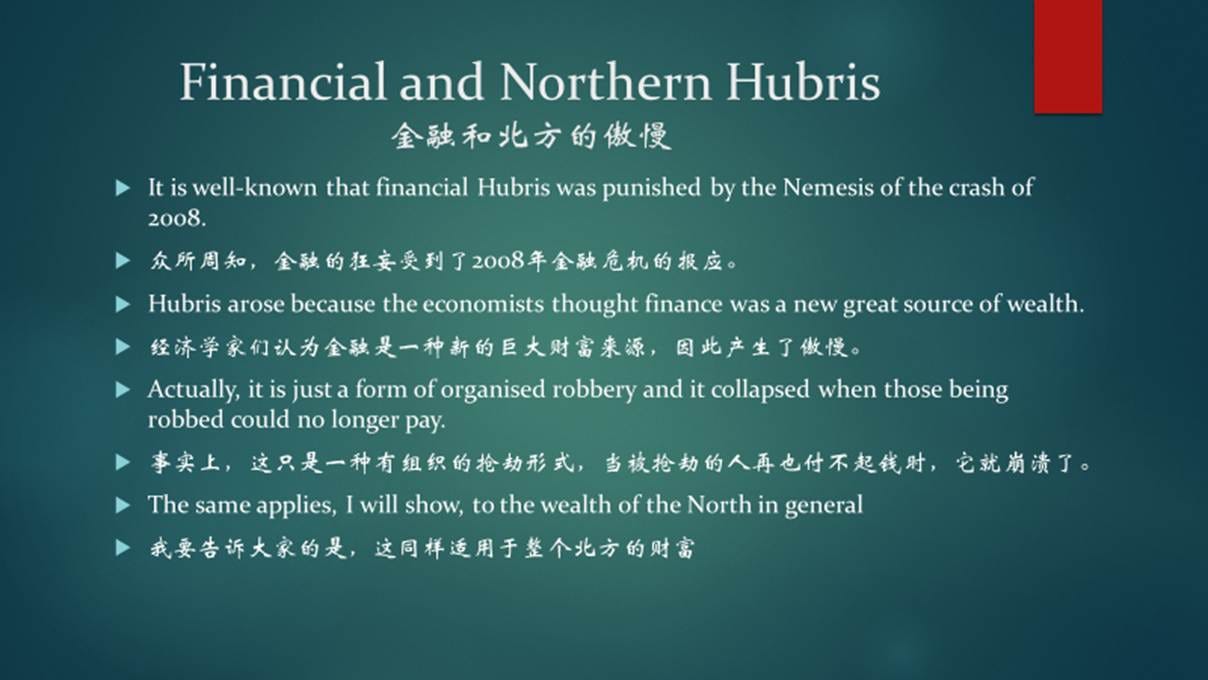
And at that time everybody believed that this would go on forever. I don’t know if you had the chance to read the American economic newspapers of the time but they said that between 2000 and 2008 was the biggest so-called bull market – the biggest period of expansion of the American economy – in history. Now I am going to show you some figures from our database in a while and you’ll see that this period saw the lowest economic growth since the Great Depression. But they believed that it was all wonderful.
Why? Because everyone was making money. The bankers were making money; the traders were making money; Lehman Brothers’ shares were going up, and everybody believed it couldn’t possibly stop. That is excessive arrogance, that is excessive pride. And the Nemesis of that Hubris was the Financial Crash of 2008. That was Nemesis in operation, punishing economic Hubris. They thought finance was a great source of wealth.
Now what’s behind this? If any of you have the chance, I strongly advise you to read the work of a wonderful economist called Michael Hudson. It’s a privilege to say he’s a friend of ours and he writes at great length about finance and debt, going way back to Sumerian civilization and Chinese civilization. He studies the history of debt. He’s one of the world’s greatest experts on debt. And there are many famous American economists, I think Robert Reich has written the testimony to one of his books, saying he is one of the greatest living economists. He has a wonderful way with words. He reduces things to their essence… and he says, “Debt is robbery.” Debt means that you lend somebody money and they pay you back more than you lent them. That’s what interest is.
So the more you can force people into debt, the more you can force money out of them and this is what happened in the real estate market in the United States in the years 2000 to 2008, is that they found ways to lend money to poor people; so called “ninja” mortgages. And they found ways to disguise what they’d done by reselling the debt and making it look clean, when in fact it was very dirty. What was happening? It was just a form of organised robbery. And it collapsed when the people being robbed couldn’t pay any more – it’s very simple. Actually, most economics is extremely simple. It’s only made to look complicated by the use of mathematical formulae, which are basically borrowed from astrologers.
I’m going to go beyond that, and talk about the wealth of the North in general. Not just the banks but the ‘clever’ countries of the North. Why are they rich? I’m going to show that their wealth also arises because they have engaged in systematic robbery, and the people they have robbed are the 80% of world who live in the poor countries. And I’m going to suggest that China is part of their Nemesis. But we’ll come to that.
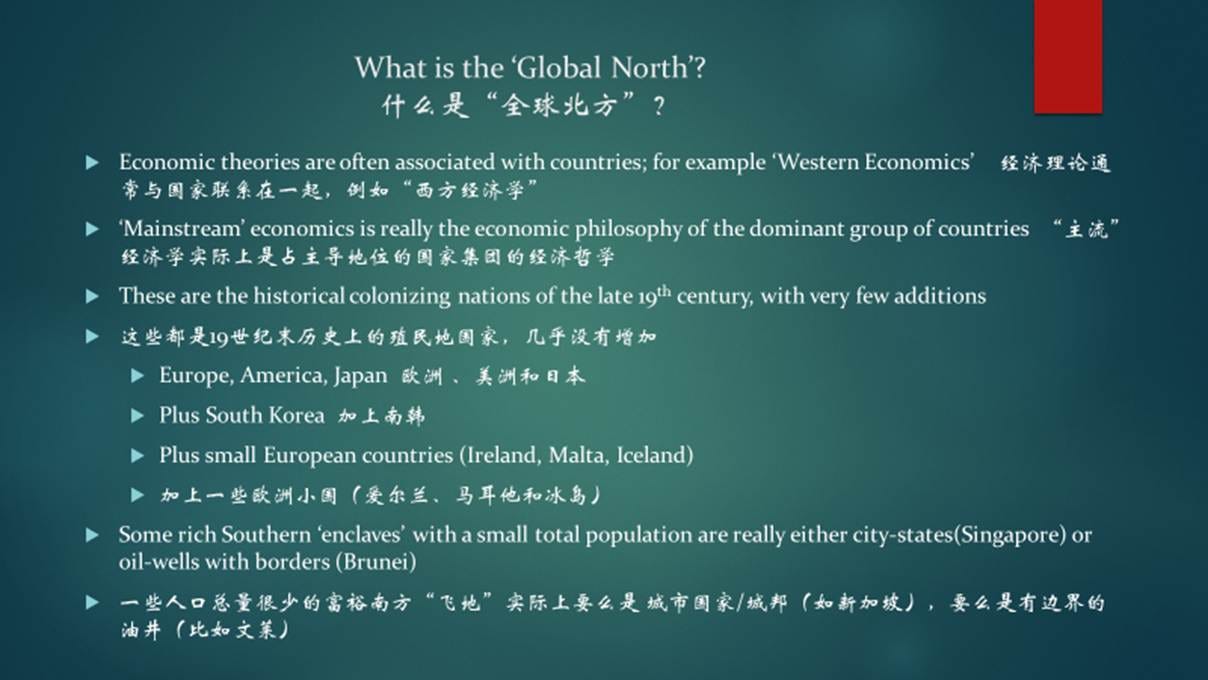
Now, first of all, what do I mean by this phrase, the Global North? Well, economic theories are often associated with countries. So, for a long time, people spoke about Western economics, Eastern economics and so on. What is called mainstream economics, which is sadly taught in many economics departments in China, is actually the economic theory of the dominant countries. That’s all it is and it is used by those countries to justify their own belief in their own superiority.
So, by teaching neo-classical economics in your own economics departments, you’re teaching the ideology of the United States; you’re teaching a doctrine, whose purpose is to explain that the United States is correct and you are wrong. So, I think this is one reason to be very careful about neo-classical economics but there are many others; not the least, it gets everything wrong. So it didn’t predict the 2008 crash, and the many other things it gets wrong.
Now, mainstream economics is really the economic philosophy of the dominant group of countries. Now, I’m going to come on to who they are: who are the dominant countries; who are the rich countries in the world? This is really obscured by most of the official statistics. I don’t know if you know this, but if you look at the World Bank or United Nations, there is no classification that tells you whether a country is from the ‘advanced’, otherwise known as the industrialised or developed world, or not. Only the IMF even has a classification which allows you to talk about the subject.
But actually, the people that are now called the Global North are the historic colonising nations of the late 19th century and I want to suggest to you that this is an extraordinarily stable group. It really has not changed at all, and the only reason people think it has changed is because the classification systems of the World Bank, the United Nations and the IMF, disguise the fact that it has not changed. It consists of Europe, America and Japan. Approximately one billion people live there. The population is one sixth of the world’s population, so it’s quite a small minority really. People talk about the 99%; they don’t talk about the fact the overwhelming majority of the 1% live in countries covering one sixth of the world’s population.
The only country that really has moved from being not part of that group to being part of that group is South Korea. Sometimes, Taiwan is included as a country, which is supposed to have joined that group and at one stage countries like Singapore were added. But the only countries that have really joined are some very small European countries; Ireland, Malta, Iceland; also Israel is now classified, I think; Cyprus is now classified by the IMF, as an advanced country. Then you have a lot of confusion because there are small, rich parts of the South – and by the South I mean – by the North I mean all this lot – and by the South I mean everybody else, except China. I am going to say later on, that in my opinion, China has now left the South. It’s a category of its own.
Questioner: “Emerging?”
Well, I’m going to critique the notion of emerging in a bit – because one of the problems I have with emerging is it already suggests that you are backward and the others are advanced. OK? But in fact that’s a myth. The reason that the so-called “emerging” countries didn’t “emerge” 100 years ago is that they were prevented from doing so. So, I prefer the term “dependent” countries to “emerging”, but that’s one of the problems we’re going to deal with – in looking at the vocabulary that is used to talk about people.
Now, if you look at these small countries, they’re sometimes given as an example of how, really, it’s possible to become rich. What is the example? Singapore is really a city state. The only reason that Singapore was able to have – well there were two reasons it was able to prosper: first of all it had an absolutely tyrannical, dictatorial leader, Lee Kuan Yew and nobody talks about the human rights violations of the Singapore population under Lee Kuan Yew – he’s just described as a great leader in the west as he made his country fully capitalist. But second is that it is separated from Malaysia, and if you look at the rest of Malaysia it is just another poor country. Its income per capita is about one tenth the income of Singapore. So, it’s only because it’s been separated out that it perpetuates this myth.
And the other things are what I call “oil wells with borders”: like Brunei, Kuwait and so on. They are carved out of the South in order to keep control over a scarce resource. But they are not really nation states in any meaningful sense of the word. The top sixteen countries in the list of non-Northern countries, which appear quite rich, all have a population of less than one million. They are a tiny part of the world’s population. In reality the world is divided into these, China, and everybody else.
I want a name for that that is neutral. There are many names you find in the past literature. For example: First and Third world is probably the best. I think Mao was the person who actually popularized the term the third world though a rather obscure French writer first invented it. But I still don’t like the idea of first and third, because it implies that first is better than third. And I don’t like the idea of emerging or developing, or backward, which we used to call them, because these names all have the implication that the rich countries are rich because they have achieved something that the other countries have not.
I want to get right out of that, so I want to use a neutral term – Global North and Global South. So, that’s why I’m using the word North.
Now, then you have the cultural ideology of the North – which is what I call Northern Exceptionalism. Because I think the exceptionalism of the United States is shared by Europe, to a lesser extent by Japan because it was defeated in the Second World War… But it certainly had a strongly exceptionalist attitude before WW2: it believed it was entitled to conquer Manchuria; to make slaves of Chinese people, and everything else which it has still not apologized for, as far as I know. Thus the notion of Japanese exceptionalism has not actually gone away, and it’s certainly a part of a world which believes its duty is to protect its wealth against the terrors of China and Russia.
Now, what is the core belief of Northern Exceptionalism? It’s that Northern economies are rich because they’re exceptional. They are naturally better than everyone else. They’re culturally better; they have greater wisdom; they were there first; they have the benefits of the historical civilisation of Europe behind them; they’re enlightened; everything you could possibly think. But actually, I’m going to show they are rich for the same reason as the financial sector: they’re very good at robbery and bribery. That’s their chief achievement but they do it in a way that uses the world market to rob the rest of the world. And that’s what I want to try and demonstrate.
However the mechanism is concealed by the working of the market – it appears natural. This is the origin of northern racism. Because exceptionalism is actually profoundly racist. It says the south is poor because they’re inferior. That’s the origin of racism; it’s the notion that the people who live in poor countries are poor because in some sense, either mentally, or culturally or physically; they are lazy; they are stupid; they are not capable of doing what we do.
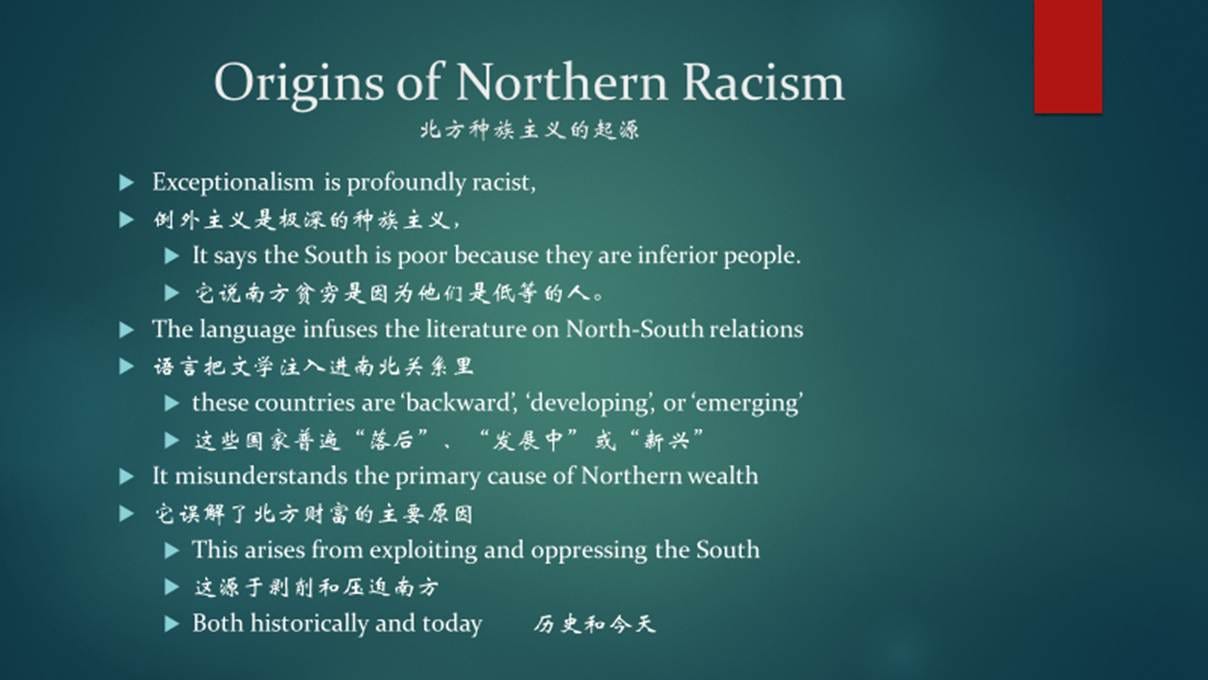
How else can you account for the fact that we are rich and they are poor, if you don’t have an economic explanation? The explanations have to be psychological, cultural, and so on: which means you’re saying they are inferior people.
And this infuses the language, which is why I don’t like backward, developing or emerging… because of that. emerging is the kindest word. North and South is in current use amongst dependency theorists and it has the least implications of inferiority or superiority. Nevertheless, actually the primary cause of Northern wealth is the exploitation and oppression of the South. Historically, this is known, but I’m going to try and show that it’s still happening today; It hasn’t stopped. To put it another way, colonialism is still with us. It just takes the form of economic colonialism.
Let’s start with history. If you look at where Northern capitalism came from, it began with enormous reserves – absolutely huge reserves – extracted from the South. People forget where the silver and gold came from. It came from the mines of what is now Bolivia and it is quite ironic that we have just had a military coup in Bolivia, the purpose of which is to supress the majority Indian government of Bolivia, because – I’ll give you a figure: the number of people who died in the silver mines was nine million.
That’s just the people who died, not the people who worked there. The people who worked there – nobody has a proper count but it’s probably thirty or forty million. Now you compare this with the size of the working population of Europe at the time it’s about three times as big.[3] I’m not including the peasant population, just the paid wage workers. So actually the origins of Northern wealth was the massive, super exploitation of a labour force that was virtually enslaved and killed. That was the origin: that’s where the gold came from.
Then slavery. Again, massive destruction and exploitation of a people, taken from Africa and sent to America, created American wealth; created King Cotton. Remember, cotton was the basis of the industrial revolution; remember that. So the industrial revolution, which replaced wool by importing material from the south, arose precisely because of slavery. It is as simple as that.
The vandalism of East Asia; the plantation economy; rubber. Everything else that you know about. The destruction of the independence of the ports of China; the Opium Wars. These are all landmarks of history and Hong Kong itself came out of that.
And not least, the colonial tribute of India… Now, Indian scholars such as Utsa and Prabhat Patnaik have done some wonderful work showing the quantities of taxes paid by Indians to Britain. Basically, Britain managed to create its industries on the strength of the money it got out of India in the form of tax. Thus it all started with the colonies: as Marx himself actually says.
The point is, this has not stopped. It now takes the form of what used to be called unequal exchange. It continues to divide the world into two great blocs, and the key to this is that there is a division of labour in the world. The North has a monopoly of advanced technology and the South is used as a reserve for producing minerals, food basics and cheap labour.
That’s why Huawei is the target of Donald Trump. Because Huawei demonstrates that China, a non-Northern power, can become a technological power equal to the rest of the North. It’s not just China itself, but the example that sets to everybody else… because it shows you don’t have to accept your status as “backward” or “emerging.” Anybody can do what China has done. That’s the real threat involved in what’s happened.
This [modern] monopoly was established at this point [when the colonies were created]. Marx actually refers to it: he says, that the birth of capitalism established what he calls “a hinterland for capitalism; a mineral, agricultural and labour reserve.” And the thing is, people used to know that because it was accompanied by invasions. So that the colonies were actually colonised. There were troops there that put rebellions down and kept the ‘peace’.
Today, there are allegedly independent nations – but the economic divisions persists. And we are going to look at the politics of it in a bit.
But now let’s turn to Nemesis. I think the first Nemesis, or the first blow struck by Nemesis was the Russian and Chinese Revolution. And probably the Vietnamese Revolution should be included in that. When countries began to simply escape the political dominion of the North – but not only escape the political dominion but escape the economic dominion as well – and say, “We are going to build our own economy.” Now, many countries rebelled against colonial occupation but did not become economically sovereign. The classic example is Ireland, and there is a famous saying of James Connelly, one of liberators of Ireland, in which he said, “If you remove the English army tomorrow and hoist the green flag over Dublin Castle, unless you set about the organization of the Socialist Republic your efforts would be in vain. England would still rule you. She would rule you through her capitalists, through her landlords, through her financiers, through the whole array of commercial and individualist institutions she has planted in this country and watered with the tears of our mothers and the blood of our martyrs.”[4]
That was the relation that was established post-colonially, in Africa, in India to some extent. There is a spectrum of the extent to which people actually achieved economic sovereignty. But I would say that the only countries that have achieved total economic independence and sovereignty were Russia and China because they established their own economic system determined by their own needs.
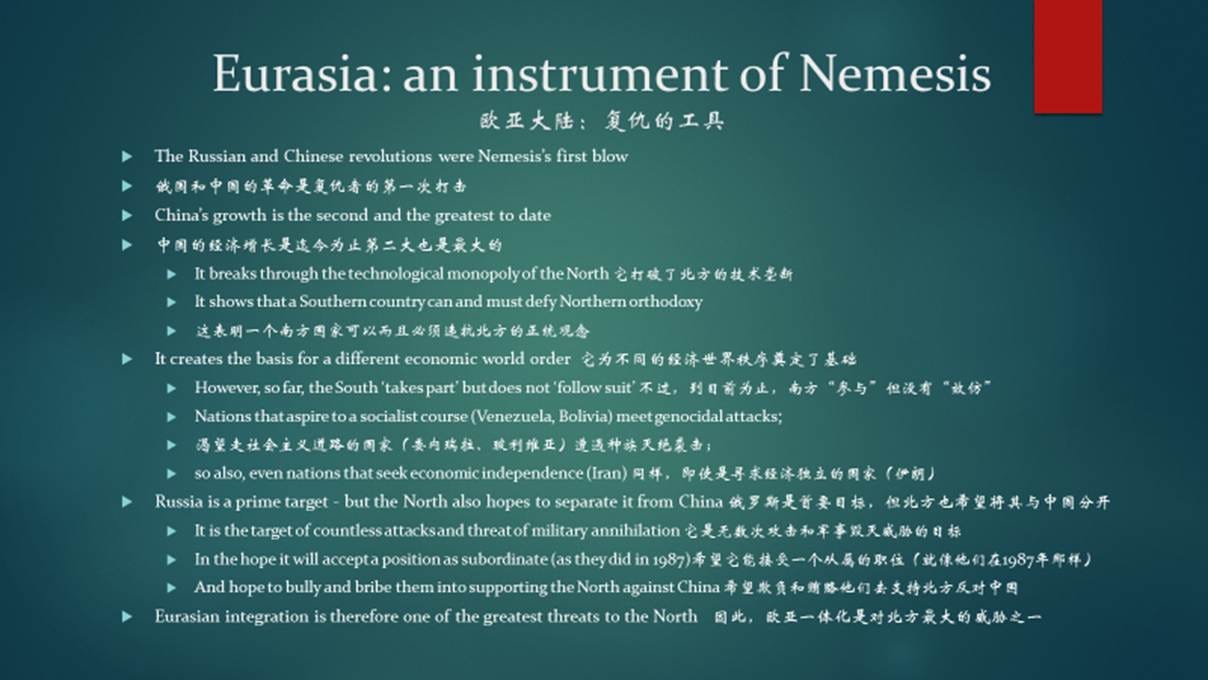
Now, I’ve talked about why that’s important – it breaks the technological economic monopoly of the North; it shows a Southern country can defy orthodoxy but it also shows the basis for a different world order. Now, this is very important, because I’m going to talk about how the Northern economies are actually in a state of decline, which again is concealed by that fact and that the Southern economies are beginning to overtake them in terms of real growth. This is not realised in terms of a difference in inequality, but it is definitely happening.
The South at present takes part in what China is doing. People trade with China. So China, through the Silk Belt and Road, has many friends but very few countries are actually following the Chinese road. You don’t find socialism with Congo Democratic Republic characteristics. You don’t find socialism with Indian characteristics. It doesn’t mean India doesn’t trade with China, and that’s very important. But the only countries that are actually following an independent course are countries like Venezuela and they’re the ones that meet the strongest attacks.
If you look at who Donald Trump is trying to shoot down, it’s exactly those countries which are seeking to become economically independent. Iran is another case in point. Why is Iran the enemy and Saudi Arabia our friend? You know, the dictatorship where nobody even votes, never mind voting being suppressed, right? But he’s the great friend that we Canadians sell our armaments to and so on. Why? It’s because Iran is trying to seek an economically independent course of development.
That’s why Russia is one of the prime targets. We’ve talked earlier about Russia being excluded from FIFA. We’ve talked about the many campaigns against Russia. I think it’s important to maybe briefly summarize what I think is the focus of that; what the intention is. The hope is that Russia will return to being a subordinate country to the United States, which was what it was on the way to doing in 1987, before Clinton came to power. I think the hope is that Russia will turn against China. I believe that’s why they’re doing it. And that’s why I think that Eurasia, the integration of Russia and China, is probably the singly the most significant thing that’s actually happening in the world today. It’s the greatest threat to the North
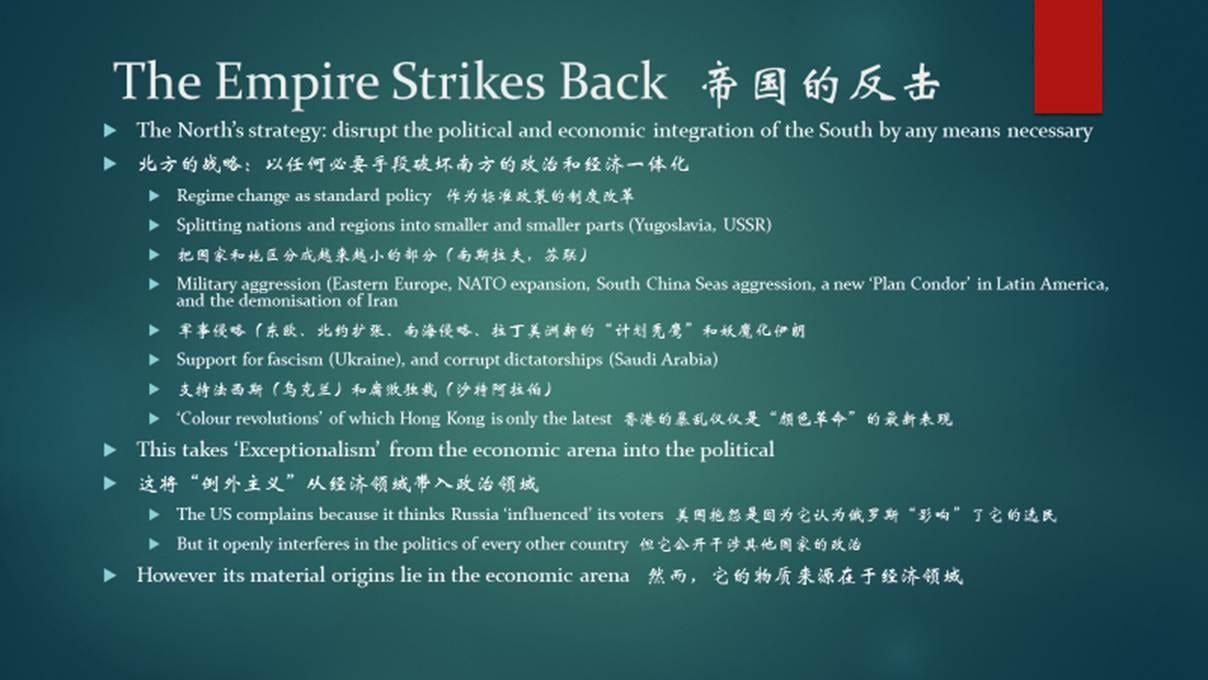
The empire strikes back! Or tries to. Its strategy is to prevent economic integration. That’s what I think it’s trying to do. There’s an old saying that “If you can’t keep your friends together, keep your enemies apart.” That’s what America is trying to do; divide everybody up into bits. And if you look, their whole war strategy, their regime change, and then they split nations into smaller and smaller parts. They divide up Yugoslavia; they divide up the Soviet Union and now they want to divide up China. There are people in Hong Kong who have Japanese maps showing China divided into four or five different regions. They’re already devising maps that divide China up because that’s what the North relies on; it relies on keeping 80 per cent of the population of the world from getting together against them.
Then it gets more and more desperate, and we’re going to look at why it’s getting desperate; why the Hubris is getting worse. You have missiles being moved right up to Russia’s border in Eastern Europe. It’s expanding NATO. You now have Pacific countries that are part of the North Atlantic Treaty Alliance; so, Columbia has joined NATO, which is an absurdity, it really is. You have the aggression in the South China Seas. Latin America is on the verge of a new civil war. I can go into that if we have the time. There is a conflagration going on in which all the different countries are pitted against each other with Venezuela, Argentina and Mexico on one side and the other countries, the dictatorships, Brazil and so on, on the other.
We have the demonization of Iran, the conversion of the Middle East into a war zone. Things are actually in a quite desperate state now. The North supports fascism openly in Ukraine and very corrupt dictatorships like Saudi Arabia; they support colour revolutions. Exceptionalism has become almost the dominant way the North is now organising.
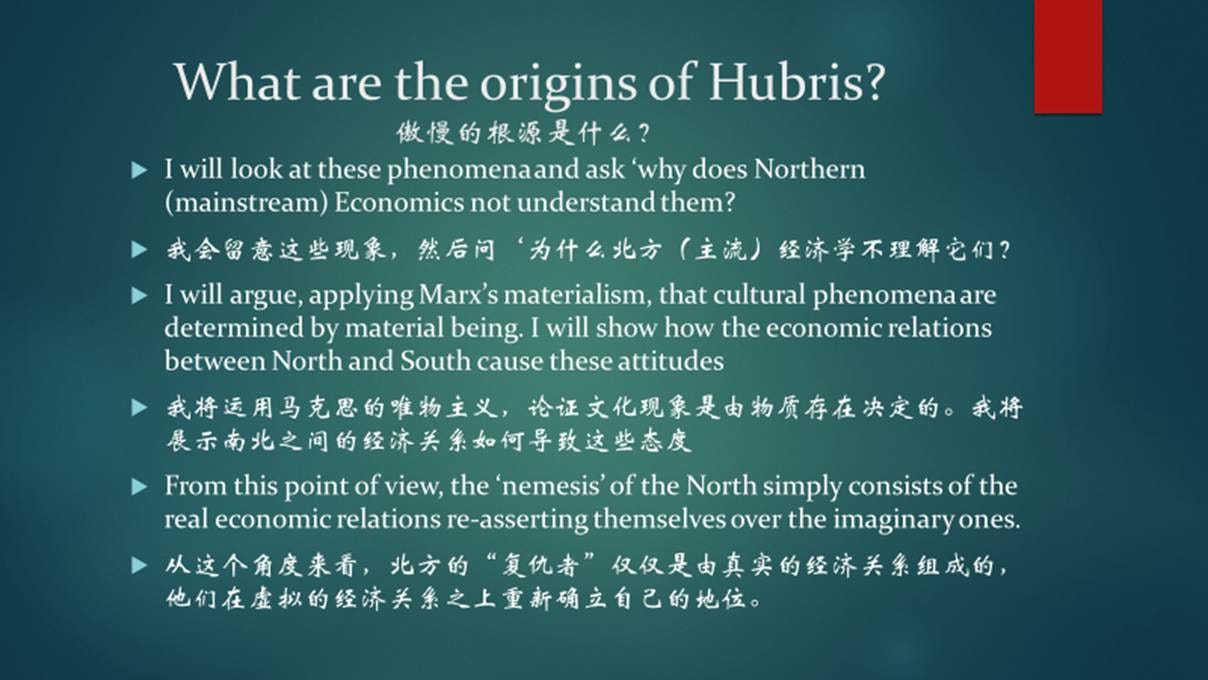
OK, so what are the origins of Hubris? I’m going to ask what are the economic origins and why does the North not understand them. I’m going to show that this particular cultural phenomenon is determined by that economic material relationship. The Nemesis of the North really consists of the real economic relations asserting themselves over imaginary ones. That’s what’s really going on: The real is coming through. Nemesis in some sense represents the triumph of the real.
This graph shows the rate of growth of the North. This is an average from 1949 until nearly the present. It’s an average of all the countries I’ve mentioned: the dominant colonial group. It has declined systematically since just after the war. It used to be seven or five per cent, then it dropped to around three or four per cent after the great slump of 1974 and then after 1997 it started to go down even more. It’s now around about one per cent, which is extraordinarily low. That’s almost stagnation. This is the second problem, and this is why things are getting worse: the North itself is in decline.
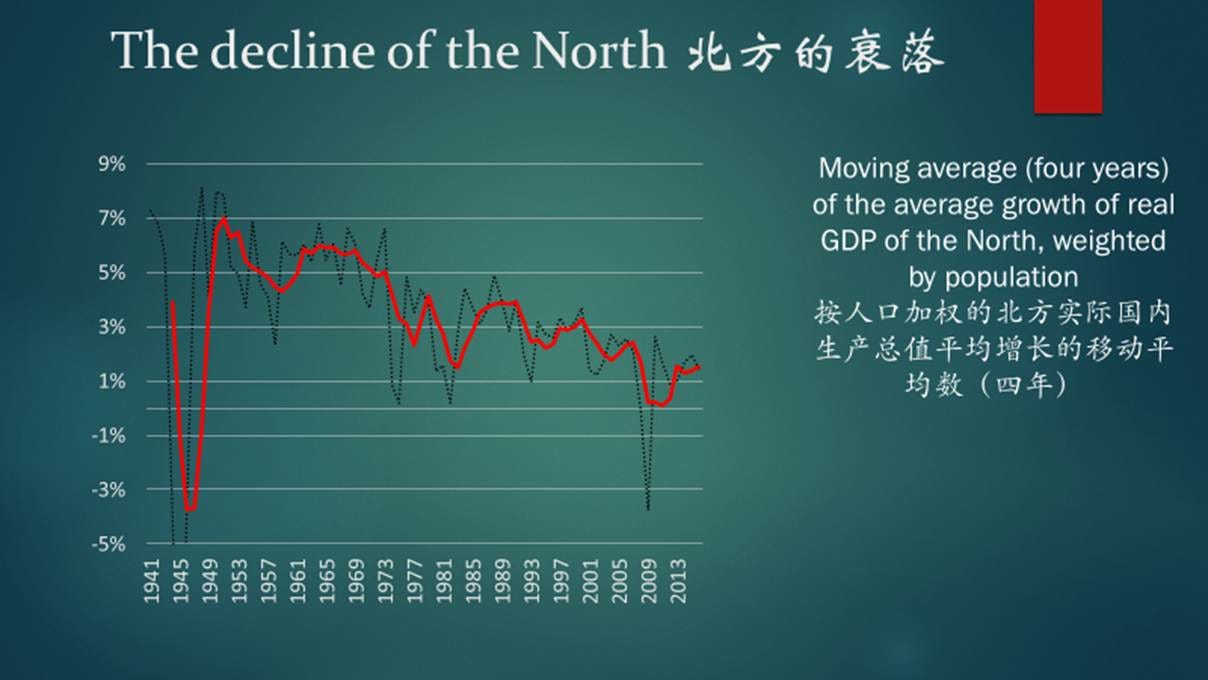
The Hubris thus really is excessive pride, because they have nothing to be proud about. And that’s why they’re so desperate: they got to where they are by robbing everybody else and now they’re in a state of decline, they have to rob everybody else even harder. This is not an artefact of the data. I constructed this graph quite carefully.
The next graph takes every economic cycle: you take the average growth between the troughs of each recession, and with the exception of this little blip [in 1961], in every successive business cycle it has gone down. And as I said, since the financial crash, growth has been ony one per cent, and its previous lowest was the period in which all the newspapers were saying it’s the greatest boom the world has ever had.
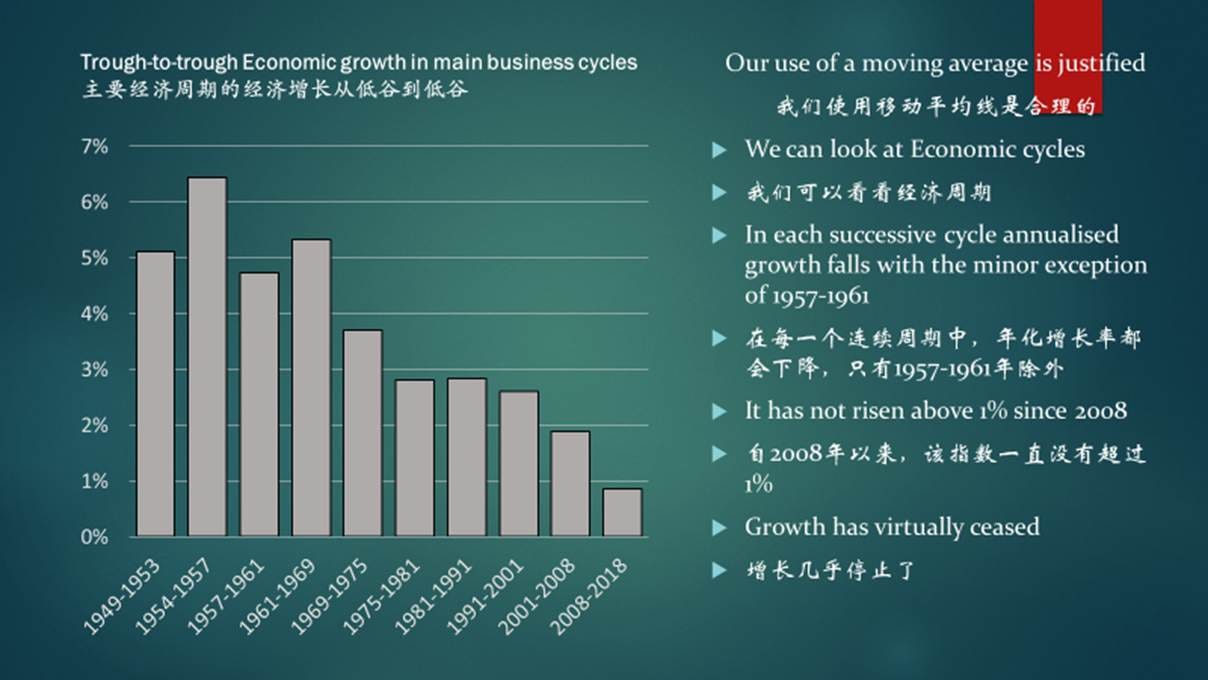
It’s also the whole North. This is very important. Some people say it’s just America. Well now, I don’t if you know but Germany is suffering in its manufacturing sector; a growth rate of minus four per cent. Germany is in recession.
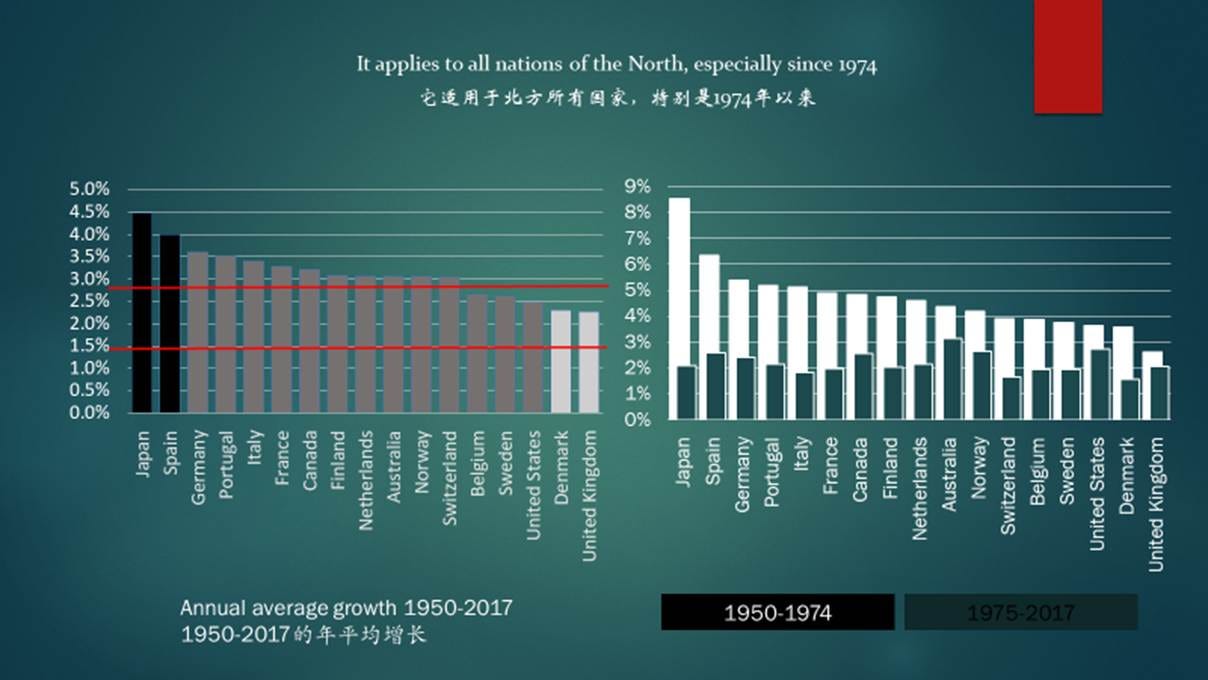
So people say, well it’s just Germany, or it’s just America, or it’s just Japan. Japan has been in recession for the past twenty years. It’s all of them. This is the growth rate of the main countries of the North between 1950 and 2017. You can see there are some outliers; Japan and Spain grew very fast. Averaged over that whole period, Denmark and the United Kingdom grew a bit slower but basically most countries lie between three and five per cent. If we now break that down into two halves, we get a startling result. This group here shows growth up to 1974. So you can see that Japan and Spain did an enormous amount of growing just after the war; for the first twenty years.
But in 1974 there was a major slump. It was called the Second Slump by the writer Ernest Mandel. After that, the growth of Japan and Spain was no different from any other country. So the whole of the North is going through this. They walk the plank together and this is very important because you can’t find a saviour. You can’t find some country in the North that you can link up with, that’s going to give you a better deal than anybody else because they’re all in the same mess.
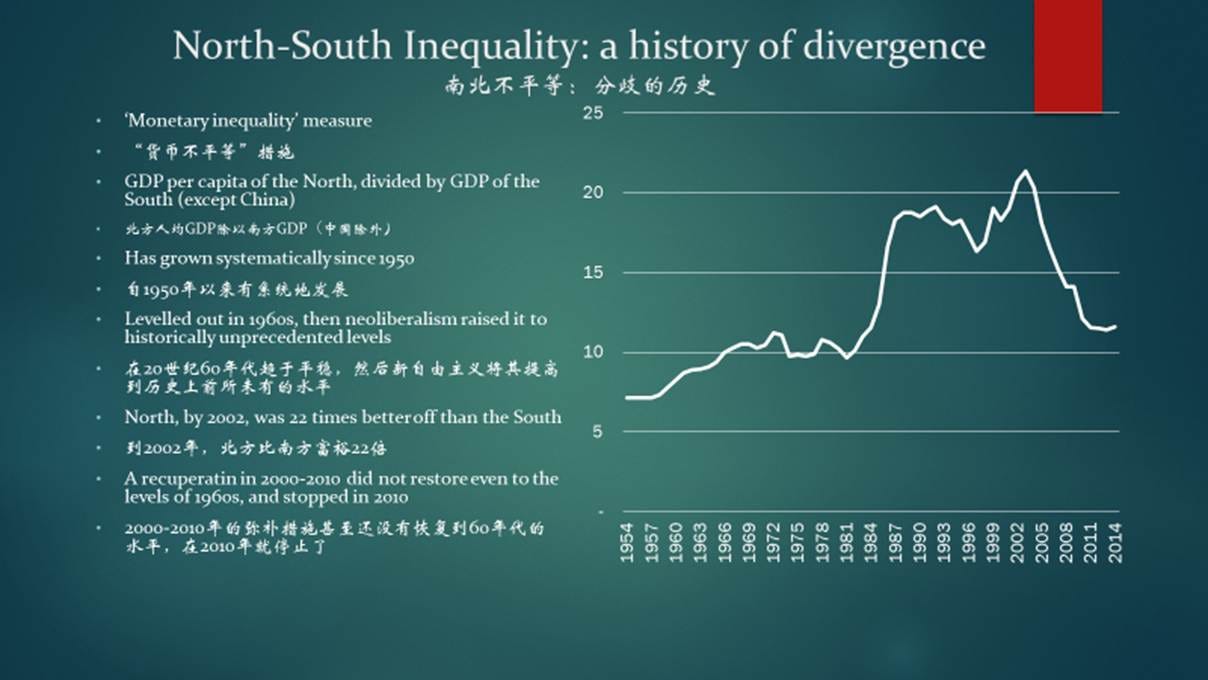
This is probably one of the most fundamental graphs that I have ever produced, and I hope that you’ll all have the chance to study it. This is what I call monetary inequality. The monetary inequality measure is this: first it compares two nations, or two groups of nations. And I’m comparing the North and the South. Remember I’m leaving China out of this. I’m also leaving Russia out because it’s difficult to get data from Russia before 1990. So, what you do is calculate the GDP per capita of the North. So that’s the average GDP and we’ve already heard how GDP is strongly related to at least affluence, if not happiness. Thus, it’s a good measure of how well off a country is – the average income per person. Then you do the same for the South and you divide one by the other.
Now, just to give you an idea of how bad things get, when you get to 2002, this Number 20 tells you that the average citizen of the North was twenty times better off than the average citizen of the South. This is the greatest international inequality that has ever existed in the world. It’s not just between the top nation and the bottom nation, it’s between one sixth of the world and four sixths of the world. All added up together – you do it is US Dollars but you can do it any currency – because dimensionally it cancels out. And it’s also grown systematically since the war with one exception: 1972 to 1984. This was the period of developmentalism. This is the period in which Latin America, in Africa, in the Middle East with people like Nasser, you had people attempting to establish economic independence, build their own industry, escape from colonialism and so on.
What happened in 1980? You had what international economists call the neo-classical counter revolution. So, the International Monetary Fund and the World Bank, and to a lesser extent the United Nations, were taken over by economists who said that we needed a new arrangement in the world and the weapon they used was debt. This was because there was a phenomenon called the Volcker Shock. This was because everybody in the South – particularly Latin America – had been borrowing money at very low rates of interest and Volcker suddenly put the interest rate up massively.
Now many people think that this – and to some extent it was – to solve a problem with the US Dollar but let’s at least say it had collateral consequences because it meant that the South fundamentally became indebted. So debt became the fundamental problem of the South. This was then used politically because the IMF said, “We will lend you money so that you can pay off your debts.”
Remember, these debts only existed because the United States decided to jack up the interest rate. So they were imposed debts. They were not profligate countries who foolishly borrowed; on the contrary, there were lenders who foolishly lent. That’s what really happened and then raked it in by putting up the interest rate. So, the IMF said, “However, in order for you to get our money, you must sell off all your state industries; you must deregulate your industries. You must enter the world market; you must open your capital markets and give us all your savings.” And what followed were the twenty years known as the Lost Decades. So in the period of the great market liberalisation you saw the greatest growth in inequality. Inequality doubled in that period when the markets were opened up.
If you ever want a most sober, clear warning against the idea that globalisation and financialisaton is going to make you rich, this is it. It’s not going to. It then stopped and there are multiple reasons it stopped: one of them was China. Because China had increased the demand for the products of the South to such an extent that commodity prices started to rise. So the South was able to get a much better price for its products for a while. Also groups of the South began to break free. After twenty years they began to say, “Hang on, this isn’t getting us anywhere… let’s do something else” and they began to work together. You had the arrival of the BRICs and I think the most important thing about the BRICs is not that the individual countries of the BRICs were necessarily doing very well but they started to work together. They began to overcome the fragmentation imposed by the IMF and by the United States.
Noticeably, this petered out… and it is quite notable I think that the level of inequality is now still worse than it was in the developmentalist decades. So we’re not there yet; Nemesis has not yet finished her work.
Now let’s consider China.
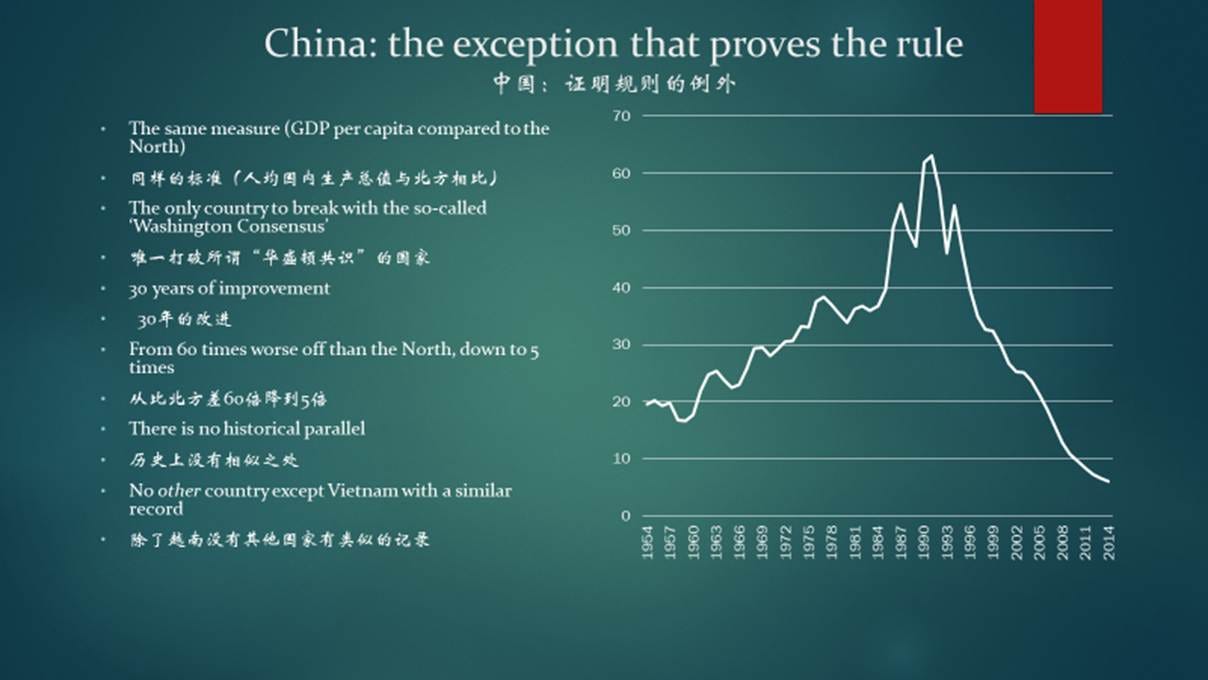
China is the exception that proves the rule. This is the same measure. This is the GPD per capita of the North divided by that of China. Up until 1990, inequality in monetary terms got worse… Now, one can make too much of this because before 1990 China’s economy was not very open. So the monetary exchange rate doesn’t tell you a lot. That’s one of the problems in discussing what was happening in Russia before 1990… it’s that the country had an economic system that isolated the population from the effects of a bad exchange rate. You couldn’t buy blue jeans but you actually had an enormous amount of ordinary consumer goods just distributed to you through the planning system. Be that as it may, once you got the economic reforms and particularly once you got the relationship of trade with the United States the true relation began to appear, as China began to acquire Northern technology.
Over thirty years, the inequality ratio of China began to drop from sixty to five, which is one of the most extraordinary historic achievements that humanity has ever seen. To bring one and a half billion people, at least on average, regardless of GDP, out of poverty: nobody has done that before. Nobody. And there is no comparator – this went on for thirty years. You have other countries which have successes, that last ten years, or fifteen years. But nobody has continuously improved their relative position in the world for thirty years. Even if it stopped tomorrow, it would still be an historic achievement. Let’s hope it doesn’t.
So, what lies behind the belief of the North that it is superior. I think underlying it is what I call the Fallacy of Northern Theory and this is quite an important one. To explain it we need to look at what’s been happening to real growth. This graph shows the gap between the growth of the South as a whole and the growth of the North as a whole, in real terms. Not in money terms but in real terms. And there is a contradiction between this and what’s been happening in monetary terms.
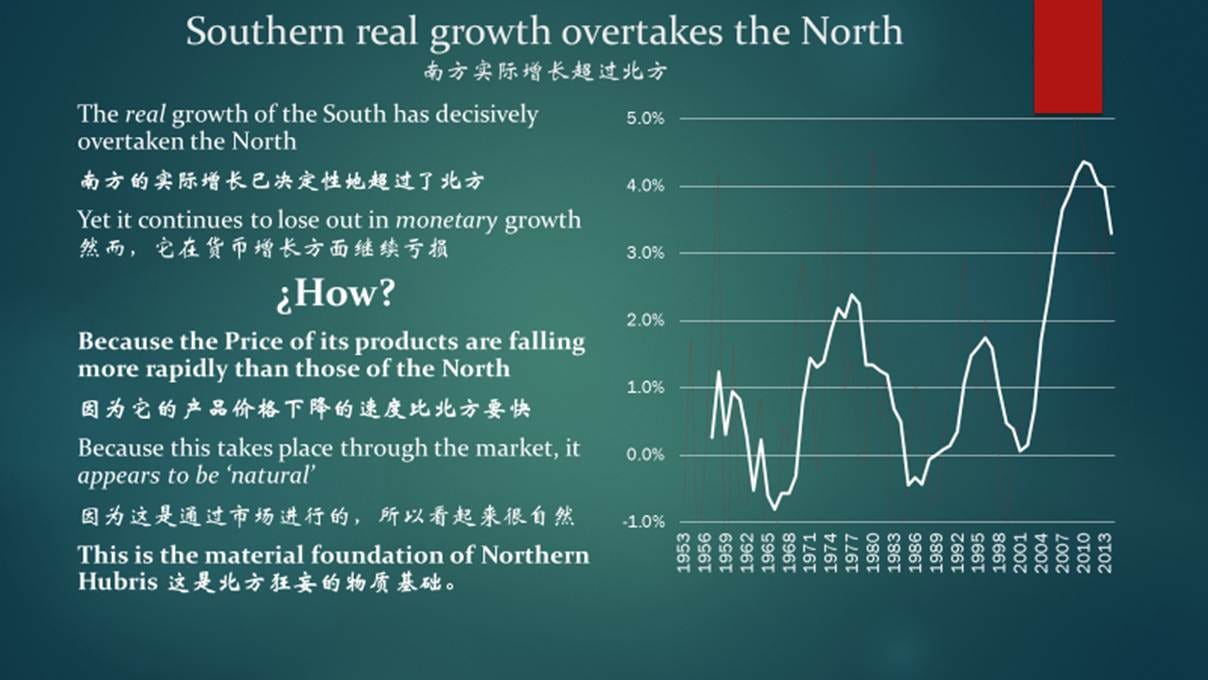
This is because the only in these years [1965-71] – actually the developmentalist years interestingly enough – was the South growing more slowly than the North. Most of the time the South was growing, two per cent or more, faster than the North. And this took off from 2001 because of that blip we saw and is still much larger. So why, if the South is improving in real terms, is it worse off in monetary terms?
This is question for any economics’ student. Your real growth is increasing; you’re producing more things but you’re worse off in money terms. Why? How? It’s because you’re selling your produce for less. And the other guys are selling their produce for more. What do they sell? They sell 5G; they sell hi-tech. They sell things that are at the top of the value chain. They sell advanced technology and they charge you for it. Why are they able to keep the price high? Because they are the only people doing it. If the countries of the South were to be developed, the price of these products would fall to about one half or one third of what they are now. So it’s a monopoly price. The price you are now charged for hi-technology goods is a monopoly price, three or four times higher than what you would pay if the production was evenly distributed in the world.
At the same time, the price of what the South sells – minerals, products of cheap labour, food stuffs – the bottom dropped out of the market. Why? Because what the IMF did was to make everybody overproduce. They told everybody to produce cash crops, use your cheap labour force – and for what they were selling, the price collapsed.
This is the graph that I think most of all demonstrates what’s going on. Up here, these are all countries – up here [on the vertical axis] we have in GDP per capita. So if you’re up here [above $10,000 on the vertical scale] you’re rich – a rich country. That’s a poor country there [below $10,000].
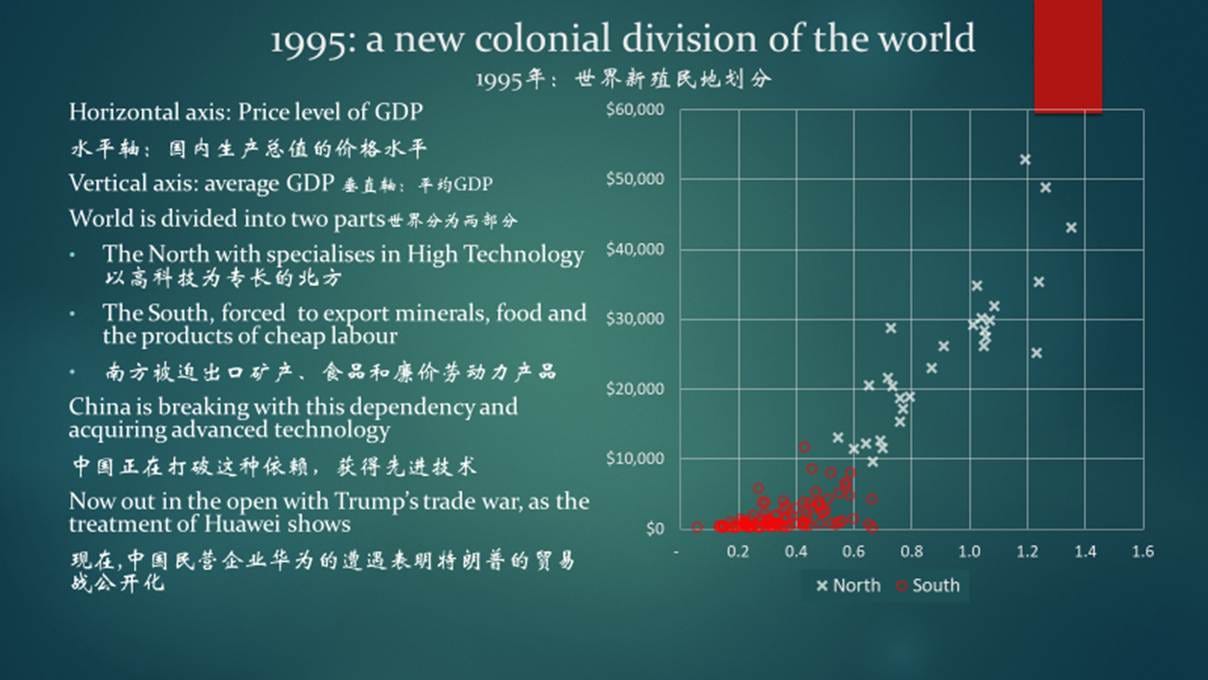
This [the horizontal axis] is the price level: whether your exports are cheap or expensive. All the red countries are the countries of the South. So the world is divided into two blocks. The rich countries - everybody up from here – are all countries of the North, that also have high prices. And the poor countries are down here, and they all have low prices. So the South is poor because it was forced to export minerals, cheap labour and food. Not because it chose to but because it was forced to by the debt mechanism; by the deregulation; by the acceptance of IMF policies.
This is robbery. Very simply. But it is robbery conducted by the market, not the army, so you don’t see it. Only China is breaking with it because China says, “We’re actually going to make our own technology; we’re going to acquire our own technology” and Trump’s trade war and the treatment of Huawei shows what the reaction is.
There is a conflict at the heart of Northern theory. There are actually two theories of development: one is developmentalism. That says everybody will catch up if you join the world market and become a capitalist country.
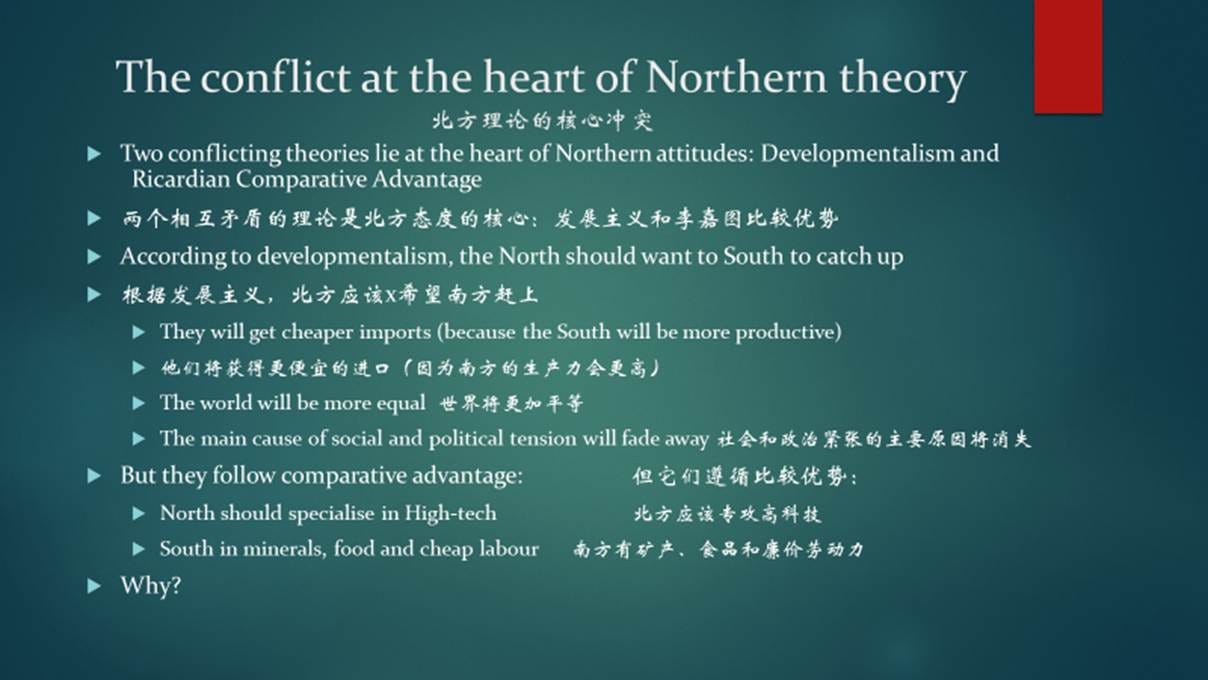
The other is what’s called Ricardian comparative advantage. It basically says you should specialise in what you do best. Now what does the South do best, according to the North? It works for no money and it exports its food and its minerals.
So you should specialise in misery… and the North should specialise in happiness… That’s comparative advantage in summary. And you should export your misery… How? Because international inequality is the biggest cause of national inequality. Because what happens is this: wages are pushed down in the North because they are in competition with very low wages in the South. But the elites in the south seek the lifestyle of the North. So actually, inequality between nations is the biggest cause of inequality within nations.
If you read Piketty and you read Milanovic there is no mention of this whatsoever. In fact Milanovic even denies it. He says, “We don’t need national inequality, we now study global household inequality.” So the truth is just concealed; that it’s national inequality which is causing all the problems in the world. The single biggest solution to the problems of the world is for everyone to develop to the same level. The North would be much better off because all the products would be cheaper; the South would be much better off, as people wouldn’t be emigrating all over the place, causing all the disruption and there wouldn’t be social conflicts.
What happens is that the North follows comparative advantage, instead of developmentalism. So it’s irrational. The material forces behind it are the monopolies… financial monopolies; extractive and hi-tech monopolies and also comparative advantage. This destroys the prospect for development unless there is political resistance. So there are two forms of that – individual nations, like China, like Vietnam, like Iran, like Venezuela but also cooperation, Belt and Road, Eurasian integration and so on.
One last point. Nemesis is not a friendly god. We do not want Hubris to go to the point where he calls Nemesis into action. Because Nemesis – her job is not to reward the people who have been the victims of Hubris – it’s to punish the people who did the Hubris. Now, the Americans can be punished by many means. For example, you could destroy the world through climate change. That would be a typical operation of Nemesis. Or even provoke a world nuclear war. That would be a typical operation of Nemesis. Nemesis doesn’t care about doing good, she only cares about punishing Hubris. So what we have to do is get ourselves in between Hubris and Nemesis and actually convey all the visions that have been put forward at this conference in order to stop Nemesis from doing her job.
Thank you
[1] https://github.com/axfreeman/Economic-History
[2] www.geopoliticaleconomy.ca
[3] According to David Levine at https://www.encyclopedia.com/international/encyclopedias-almanacs-transcripts-and-maps/population-europe-early-modern-demographic-patterns, between 1500 and 1750 the European population doubled from about 65 million to around 127.5 million. Of these, a small fraction would have been waged workers.
[4] Shan Van Vocht, January, 1897. Reprinted in P. Beresford Ellis (ed.), James Connolly - Selected Writings, p. 124.
Comments
Nothing yet. Say the first thing.
Sign in to join the conversation.