
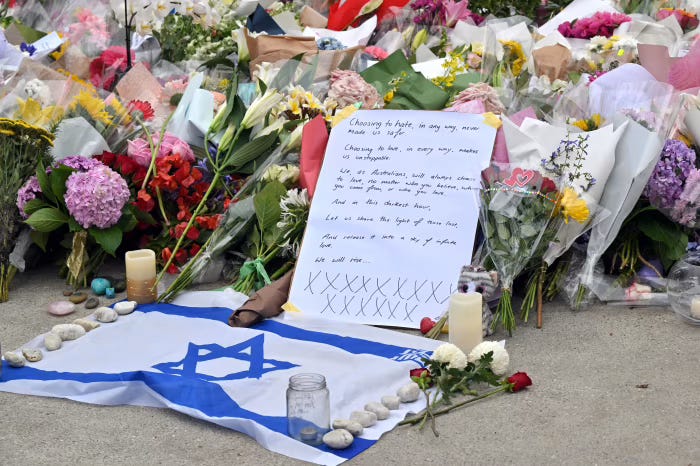
The attack at the Chabad ‘Chanukah by the Sea’ celebration on Gadigal, Bidjigal, and Birrabirragal land (Bondi Beach), during which 15 people were murdered, has triggered the unleashing of an intensified stage of what the Palestinian scholar Anna Younes calls the ‘war on antisemitism’ in so-called Australia. For more on the manifestations of this via the government’s Antisemitism Envoy’s Plan to Combat Antisemitism, which is in the aftermath of Bondi is being adopted by the government, read my post ‘War is War’.
As Houria Bouteldja wrote, it was important after the Bondi attack, to ‘respect the time of mourning - in other words to keep quiet - but also to allow the propagandising moment to pass. It is when the scavengers - who feed off their “moral advantage” during a great brouhaha - finally fall silent that it is time to speak.’
Bouteldja’s argument builds on the vital work she has carried out over the last ten years to expose the functioning of ‘state philosemitism’ and her 2017 book, Whites, Jews and Us, both of which I built on in my 2020 book, Why Race Still Matters. She also references the edited volume, Contre l'antisémitisme et ses instrumentalisations (Against Antisemitism and its Instrumentalisations). She makes a number of points in her post, dwelling on one in particular: ‘Antisemitism is growing among the Indigenous (read the formerly colonised and their descendants in the West), among whites, and at the centre of power.’ Her rationale is a good guide for thinking through the work being done by ‘antisemitism’ today, 27 months into the current phase of the genocide enacted by the Zionist Entity against Palestinians in Gaza, ‘ceasefire’ or none.
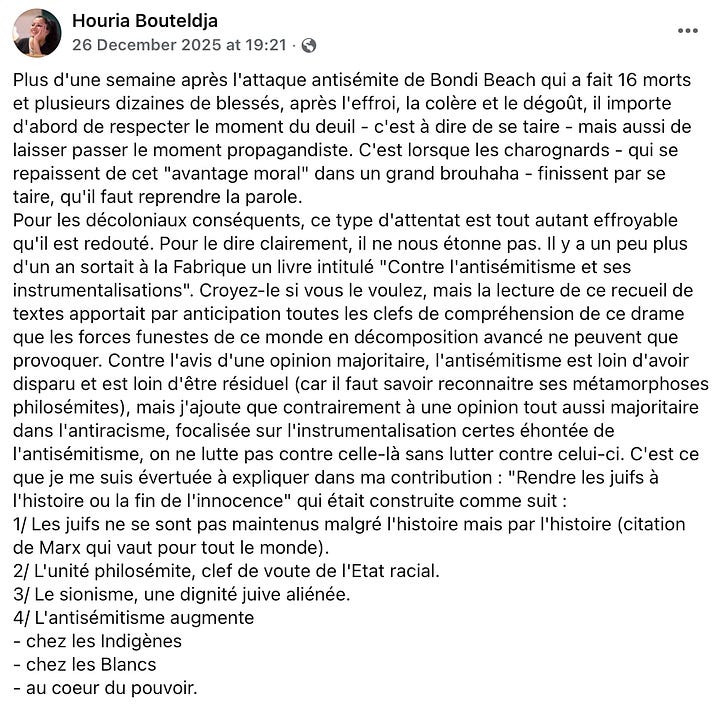
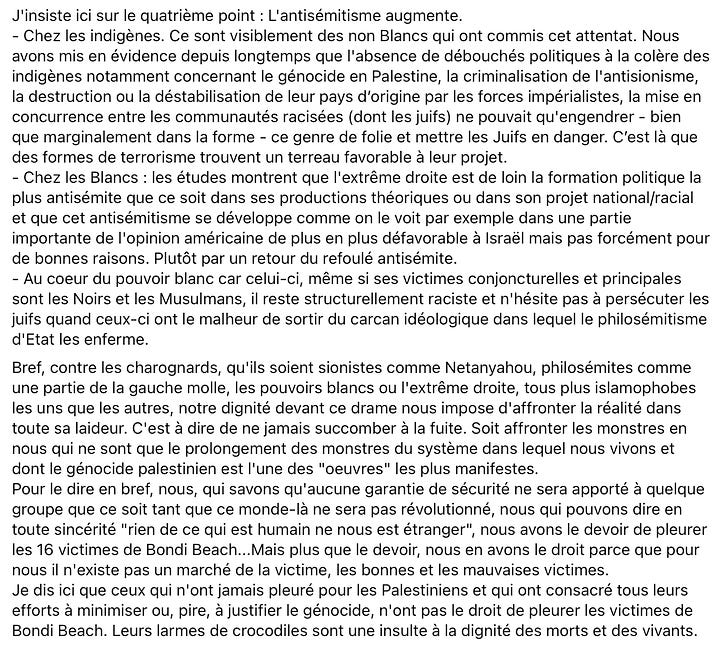
Bouteldja writes that there is no way to fight against antisemitism without fighting its instrumentalisation. In Why Race Still Matters, I wrote about the need to ‘decolonise antisemitism’, meaning to detach it from the exceptional status granted it following the Nazi genocide of the Jews and wielded by Zionism in tandem with western imperialism as a cover for racial colonialism and genocide and to read it in the context of European colonialism writ large. This point has become largely hegemonic within the Palestine movement. However, the emphasis placed on ‘weaponisation’, or in Bouteldja’s terms ‘instrumentalisation’, blurs the function of anti-antisemitism as what Dylan Rodríguez calls ‘lexical warfare’ or Anna Younes’ brilliant theorisation of the ‘war on antisemitism’. The challenge becomes how to take seriously the ‘philosemitic metamorphoses’ of antisemitism (Bouteldja) within a context in which antisemitism is used as a tool of what Charisse Burden-Stelly calls ‘counter subversive’ state power; as a weapon in a more generalised war waged by the state and elites against the people.
As should have become clear over the last two years+, the Zionist definition of antisemitism - words and actions against the Zionist Entity as the designated representative of all Jewish people - is used to criminalise Palestinians and all those who stand with them. Further, however, the measures put in place to curb opposition to genocide and Zionism both build on already existing technologies of domination targeting Black and Indigenous people since the onset of western colonisation, Communists and other left subversives, and Muslim people ramping up with the onslaught on their lives that is the global ‘war on terror’, and are extended from the Palestine movement today to anyone who resists state power. Burden-Stelly has argued that anti-antisemitism functions in a similar way to the ‘red scare’. Citing W.E.B. Du Bois’ naming of ‘witchwords’, she writes,
Our current witchwords include antisemitism, bastardized to mean any critique of Israel or Zionism; “DEI,” aimed at crushing any modicum of power, privilege, or access gained by minoritized people, with a particular focus on Black and transgender folks; “woke,” weaponized to discredit progressive politics and social programs; and “domestic terrorist” / “terrorist supporter”, which targets a range of militant protestors who challenge U.S. imperialism domestically and abroad, but especially those who reject cop cities and support Palestinian liberation.
These arguments cohere with those I make in The New Racial Regime: Recalibrations of White Supremacy. In it, I analyse not only how technologies of state and capitalist antiracism such as ‘diversity, equity and inclusion’ are being used to incriminate, repress and silence anti-genocide activists and but also how even the radical epistemologies developed originally by those made ‘vulnerable to premature death’ by the machine of racial capitalism can be manipulated to service imperialism. The primary example I turn to is the détournement of Indigeneity, decolonisation and self-determination for Zionist ends both by the invocation of ‘Jewish indigeneity’ to Palestine as a justification for the dispossession and attempted annihilation of an entire people, but also for the ramping up of the technologies of settler colonial dominance in so-called australia. Here, sitting alongside the right’s entrenched denial of the genocidalism of ‘white possessive’ rule and its ongoing material effects, as seen in the destruction and theft of sovereign Indigenous land and life, are ‘progressive’ declarations of recognition, which even go so far as to rhetorically support Indigenous self-determination, and in-so-doing establish the white colonial state as the only body capable of benevolently granting it. (My thinking on this, developed in the book’s fourth chapter, ‘Capturing Indigeneity, Colonising Decolonisation’ is indebted to analysis by Lorna Munro and Keiran Stewart-Assheton and Jasper Cohen-Hunter in Issue 3 of The Sunday Paper).
Even as activists for Palestine tip their hat to settler colonialism as it manifests here and there, much of the attempt to make sense of how the next stage of state repression is shaping up in the aftermath of Bondi has not given this sufficient consideration. Serious Indigenous thinkers and those for whom an internationalist anti-colonialism frames their thought have long drawn attention to the impossibility of treating Palestine as a singular issue. However, the majority rarely goes beyond the alliterative flourish of ‘from Gadigal to Gaza’. This can be seen in the frequent bemoaning of the lopsided application of the rule of law and media coverage and the hypocrisy of the outpouring of grief for the fifteen white victims at Bondi as opposed to the 100s of thousands of Zionism’s most recent victims in Gaza, as well as the lack of attention paid to Indigenous deaths in custody or violence against Muslim people, migrants and asylum seekers.
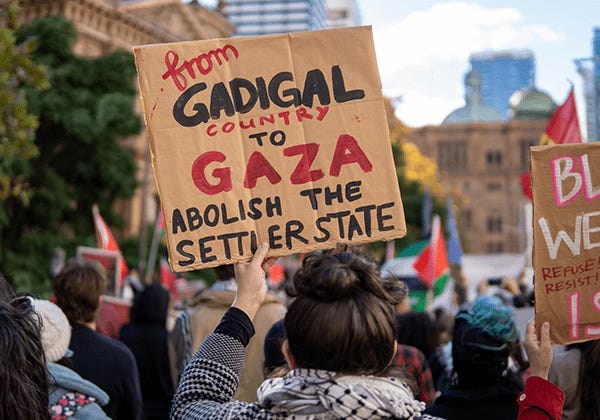
As I am wont to say, racism is hypocrisy; pointing it out is beside the point. Why would a settler colonial state grant anticolonialists the freedom to protest it, unless under tight constraints benefitting certain optics? When the media class draws attention to asylum seekers in detention or Indigenous people dying in custody it is because doing so runs no risk to its continuing existence. The tethering of the struggle for Palestinian resistance to the very survival of the West, both materially and - crucially - discursively, forms this entirely different approach. So long as elites in ‘australia’ do their best to portray Indigenous resistance here as moot (it is not) ‘Indigenous affairs’, as they are patronisingly named, will continue to be reported, in language however that never portends an end to the colonisation of these lands.
Yet, there is something being clung to in the incantation of questions posed to the unhearing powerful that is a clue to why resistance to ever-more repressive measures appears so weak. Omar Sakr, for example, asks ‘Why is it impossible for our media and political establishment to tell the truth whenever Israel is concerned?’ The answer appears to be something to do with the tethering of Zionism to Judaism making it impossible, per Sakr, for the media to ‘say that you can disagree with someone, that you can oppose them even, and that carrying out a massacre is still very obviously extremely wrong, illegal, dumb, and bad?’ However, this for me still detaches what the Palestinian sociologist Ihab Shalbak calls ‘mandatory Zionism’ from the longer durée political project from which it emerged and which it currently serves to maintain and extend: western hegemony. It is not so much that Zionism presents such a special case because of the looming history of the Shoah, making the media and the political class in the West beholden to the every whim of a genocidal project. It is rather that defence of the Zionist entity under the guise of ensuring ‘Jewish safety’ is logical from the perpective of a waning western hegemon. Defence of Zionists, even if it means ‘curtail[ing] our rights’ by banning protests, as the Premier of New South Wales Chris Minns has done, is made paramount, not because of foreign rule by Zionists or the power of the local ‘Jewish lobby’. Rather, the Bondi attack laid bare settler colonial rule which has always invoked ‘special measures’ to ensure settler dominance against Indigenous resistance and generalised it to a population with a potential, however partial, activated by the genocide in Palestine, to connect the dots and pose a threat to the business as usual of the racial colony (if only allowed to do so by ever-present movement marshalls).
In side-stepping these facts and over-focalising on antisemitism, we run the risk of recapitulating the very terms those in power have established as the only legitimate way to approach ‘the question of Palestine’; via Jews and antisemitism. Bouteldja claims that antisemitism has not gone away and that is in fact increasing. Quite simply, violence against Jews (still globally infinitesimal when disaggregated from the anti-zionist speech that the ‘war on antisemitism’ couches as violence against jews) will likely increase because the Zionist entity, the entirety of western governments and elites, as well as almost all the self-declared jewish representatives in the world have stated that Jews=Israel, leading a tiny minority to take matters into their own hands. In other words, stating the likely increase in antisemitic beliefs and actions means nothing in the absence of a deep analysis of the war on antisemitism.
The most interesting aspect of Bouteldja’s observation is that antisemitism is on the rise ‘at the centre of power’. I agree and see this as continuous with a centuries-long process that culminated in the establishment of the Zionist colony in Palestine by the imperial forces led by Britain. The creation of a state for Jews on the historic land of Palestine triggered the destruction of world Jewry and of Judaism and midwifed the emergence of Jewish supremacy as the language in which imperialism can be legitimately spoken. In Chapter 5 of The New Racial Regime, ‘Against Definitions’, I discus the role played by zionist usages of antisemitism for what Siddhant Issar and his co-writers call the ‘primitive accumulation of whiteness’.
The establishment of the Nazi genocide of the Jews as the crime to end all crimes rhetorically justifies the use of an ersatz jewishness to establish dominance over Palestinians while at the same time emptying it of the hateful contents of its diasporic manifestations. This in turn allows Zio-Jewishness to become the acceptable face of a whiteness challenged by Black resistance, over the last decade particularly, shielding the perpetrators of genocide from critique, let alone punishment, while justifying a turn against any semblance of redress for colonialism and racism’s victims past or present: Zio-jewishness as ‘all lives matter’. Relatedly, Matt Seriff-Cullick’s article in the latest edition of the Journal of Critical Zionist Studies, builds on my work in The New Racial Regime to show how the trope of ‘Black antisemitism’ ‘facilitates white supremacy’s disavowal of historical responsibility for antisemitism by casting Black Americans as Jews’ oppressors’ and argues that, ‘in recent years, Zionist actors have taken this trope a step further, to the point that all white people—not just Jews—are cast as the primary victims of racism.’
As I show in The New Racial Regime, the racial regime sows confusion, trading in contradiction and obfuscation, making it hard to trace, expose and attack. Still we must. One clear aspect of this facing activists in so-called Australia right now is that while NSW has banned protests for up to 3 months following the Bondi murders, Premier Chris Minns has declared that these bans would not affect Invasion Day protests on January 26. It remains to be seen what decisions will be taken by organisations such as Palestine Action Group whose weekly rally and march on Gadigal land has always sought police permission through a Form 1 with regards to the ban on protests. Certainly organisers of the Invasion Day protest on Gadigal Land, the Blak Caucus, will ensure Palestine is front and centre as it has always done. Nevertheless, the permission being granted to the 26 of January protest to go ahead is a clear attempt to sow division and to further cement an idea useful to those in power that it is foreign Zionists represented by ‘powerful’ local Jews, not the settler colonial governments of the Australian federation, that determine what can be protested. Taken together with the trope of ‘jewish indigeneity’ as a justification for Palestinian dispossession, Minns’ granting of permission to Invasion Day events adds fuel to that fire. This then turns the volume up on the popular antisemitism Bouteldja also notes rises as a function of the ‘war on antisemitism’ in the context of this phase of the Zionist genocide in Palestine.
The response to all of this, paradoxically it may feel, should not be to pay more attention to antisemitism. At the same time we must track the myriad manifestations of the ‘war on antisemitism’. Specifically, we do this by drawing attention to how the ‘war on antisemitism’ relativises all other forms of racism by giving outsize importance to antisemitic incidents - many of which in ‘australia’ have proven to have been hoaxes and the acts of criminals with motives other than attacking jews as jews - and restricts what can be designated racism to expressions of ‘hate’ and not the violence of the colonial system in its everyday manifestations. The understandable impulse of a Palestine movement under attack is to emphasise the relational nature of all racisms and to attempt to draw lines of solidarity between jews and Palestinians, jews and Indigenous people, jews and migrants, etc. However, it is the very framing of ‘Jews and [fill in the blank] that services the impression that violence against jews is the master key of all racism and moreover that this can be regarded as unchanged by zionism and zionist jews’ role in furthering western imperialism, colonialism and racism. To expose this means to be clear-eyed about the function of antisemitism in the current conjuncture, not to cling to narratives that freeze it in time, failing to see the continuing recalibrative processes undergone by racial regimes as we speak.
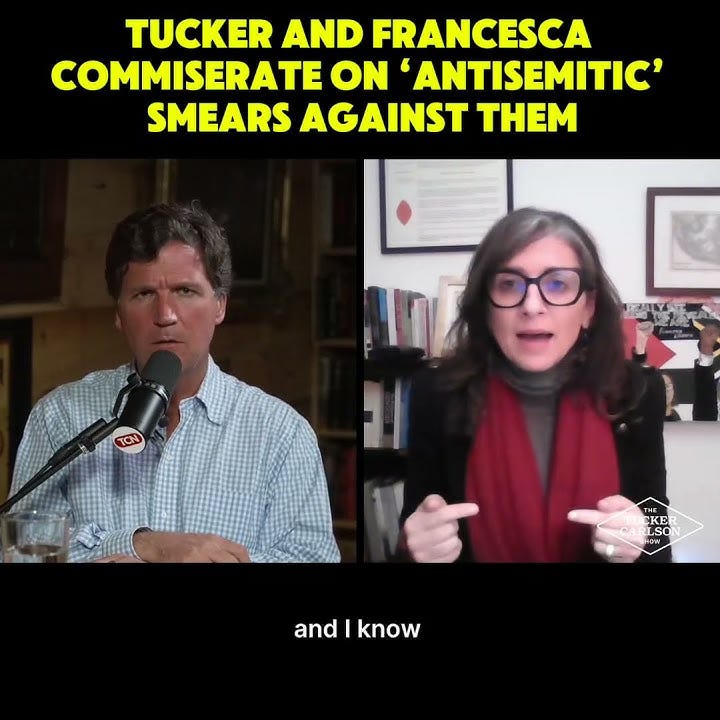
The current recalibration that can be observed is the fascist pivot to Palestine exemplified by Tucker Carlson or Marjorie Taylor-Greene which a sizeable number of (mainly white, but not only) people in the Palestine movement is falling prey to (see below Francesca Albanese’s widely acclaimed but deeply unprincipled appearance on Carlson’s podcast). We can expose the workings of the ‘war on antisemitism’, refuse to capitulate to mandatory zionism’s imposition of martial law for ‘jewish safety’ and centre the grinding on of state racism, settler colonialist expansion and US-zio imperial aggression without ceding any space to white supremacist, transphobes who hate jews because they believe we pull the levers of power.
As higher education workers in the colony begin to prepare for a new academic year, how to respond to what awaits us is of the utmost urgency. The dismantlement of full academic programmes and the firing of staff who have stood steadfast on Palestine is a harbinger of more to come for an elite emboldened by Bondi, moulding these murders to the measure of their ambitions for disestablishing the vague approximations of universities that still remain (sort of). As I observed in more general terms on December 23,
The grand majority of the Palestine movement in so-called Australia is not well prepared for what’s coming. That’s because it worked within a liberal framework - freedom of speech, rights, international law, equality - and failed to mount an anti-imperialist critique that rightly opposes the liberal order. It namechecked settler colonialism and resistance while failing to tie Intifada in Palestine to Indigenous resistance to ongoing colonial rule here in a way that would move beyond the rhetorical to the material, and cede power to sovereign Indigenous peoples on these lands. It bought into carceral ideas such as “hate crimes” permitting the division between “legitimate” and “illegitimate” means of protest and internally disciplining the “unruly” elements among it. Specifically it threw western Sydney under the bus. It tacitly permitted the acceptance of antisemitism as the master key of racism by politely requesting the inclusion alongside it of anti-Palestinian racism while downplaying Islamophobia as the linchpin of the global war of terror without which it is impossible to interpret the role of Zionism in it. It failed to understand the “war on antisemitism” as a counterinsurgent war continuing to employ the past its sell by date concept of weaponisation. In short, in Cedric Robinson’s terms, it continues to recalibrate the terms of order rather than attacking them.
How we come together to change course is a question of the utmost urgency.
No posts
Comments
Nothing yet. Say the first thing.
Sign in to join the conversation.