
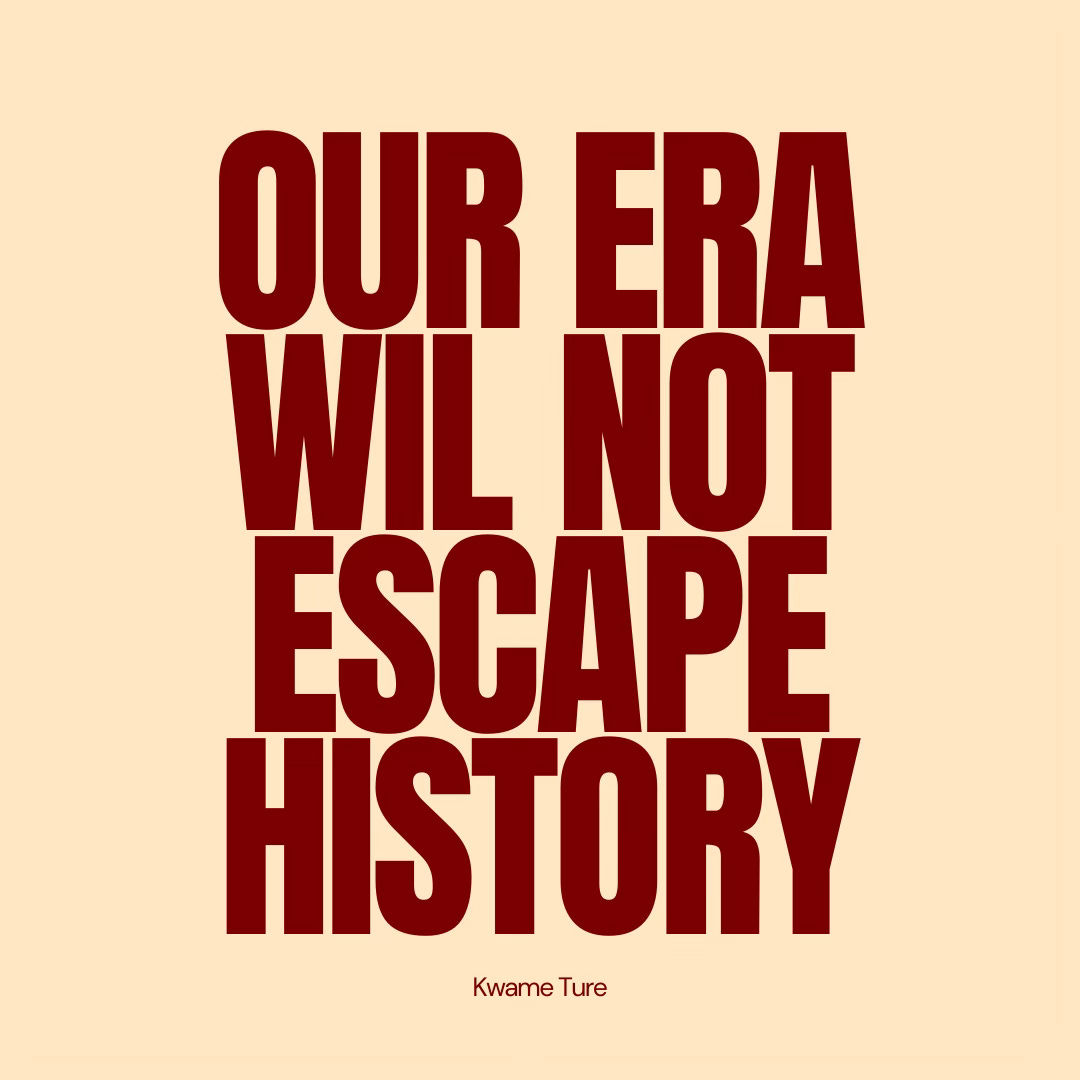
In The Pitfalls of Liberalism, Kwame Ture wrote.
“Many people want to know why, out of the entire white segment of society, we want to criticize the liberals. We have to criticize them because they represent the liaison between both groups, between the oppressed and the oppressor. The liberal tries to become an arbitrator, but he is incapable of solving the problems. He promises the oppressor that he can keep the oppressed under control; that he will stop them from becoming illegal (in this case illegal means violent). At the same time, he promises the oppressed that he will be able to alleviate their suffering — in due time. Historically, of course, we know this is impossible, and our era will not escape history.”
We too will not escape
We will not escape by capitulating to the silence demanded by those who expect patience while they flail.
We will not escape by refusing to see that short-term tactics devoid of a strategy for long-term change will - and have - walked us into a trap.
We will not escape because those occupying the role of representation will never bear the greatest risk.
The colonial government has passed the Combatting Antisemitism, Hate and Extremism (Criminal and Migration Laws) Bill.
The path to this was smoothed by liberals
In March 2025, I wrote that the Jewish Council of Australia, who had put out a joint statement on January 22 2025 with other liberal groups - Human Rights Watch, the Australian Federation of Islamic Councils, Australian National Imams Council, Human Rights Law Centre and Amnesty International - ‘on recent hate crimes in Australia’ should apologise.
Up to 14 incidents of ‘hate crimes’ targeting Jewish institutions and individuals, including what was described as a ‘terrorist threat’ – a caravan of explosives parked in the semi-rural suburb of Dural in Sydney - had been found to have been faked.
No apology was forthcoming.
Fast forward to January 2026
The Jewish Council of Australia now ‘urges pause on rushed and dangerous hate speech Bill’ and advocates ‘extensive consultation before moving forward.’ It also appeals that ‘rushing through sweeping criminal laws is not going to make Jews safer.’ And ended its statement with,
If the Government is serious about tackling antisemitism and racism, it should slow down and commit to an evidence-based, whole-of-society approach — including fully funding the Australian Human Rights Commission’s National Anti-Racism Framework.
The ‘hate crimes’ framework uses the carceral institutions established to control colonised and negatively racialised peoples - primarily on this continent, Indigenous people - to do so. Taken to its logical conclusion, this approach tacitly condones the state’s retaliation against those most affected by its racist institutions because these practices are always used to increase repression against them.
As I wrote in ‘Fighting Antisemitism Means Fighting State Power’, support for government action on ‘hate crimes’ will do little to enhance solidarity between Jews and other groups because it could justifiably be seen by Indigenous people, Muslims, and Black people as opening the door to more policing and punishment.
Making hate stand in for racism is carceral and it is Zionist. No organisation that says it is antiracist should be working within this framework.
As Director of the Institute for the Critical Study of Zionism and scholar, Emmaia Gelman has noted,
The idea of hate crimes itself comes out of Zionist work... The very brief history of what we call the hate crimes framework is that it emerges out of a moment of crisis in the late 70s, early 80s, of anti-Black racism where there’s white supremacist vigilantism... And law enforcement almost entirely refuses to respond. So the idea of hate crimes comes up as a way to legally force the state to address racist violence.
The ADL and the American Jewish Committee see this crisis as an opportunity. They attach their own interests to it... They’ve been frustrated by the fact that Israel is increasingly understood as a colonial, imperial project, including by Black civil rights leadership; and that European Jews in the US are no longer viewed as marginalized people who need a state of Israel to rescue them. They’re frustrated that it’s not only Palestinians, but now Black-led movements, the left, and to some extent US politicians who are saying no, this is colonialism.
So hate crimes law becomes a vehicle for asserting that US Jews are actually marginalized, in order to rekindle support for Israel. So the very genesis of the hate crimes framework is already kind of a cooptation of conversations about racism. It very materially takes the focus off of anti-Black violence, turns attention away from questions of who has power, and it takes state violence out of it entirely, right.
So that’s why hate crime statistics don’t measure police violence. And as it develops, it actually replaces our conception of racist violence, gendered violence, class violence. It becomes about just hostility toward someone who has a particular identity, without looking any more deeply at why they might be in conflict.”
It’s too late now. Yet liberals are still requesting the government’s ear, refusing to understand that the “hate crimes” framework is designed to break antiracist movements, not listen to them.
Mounting a principled critique of ‘hate crimes’ is in the too hard basket. So we revert to culturalism.
Furores over cultural boycotts is where Zionists want the movement to be stuck. When liberals see boycotting as a face-saving solution rather than “the floor, not the ceiling”, cultural boycotts have lost their power.
As Robert Knox discusses, a failure to distinguish between strategy and tactics drives a reformism that has already permitted the passage of a dangerous bill. He explains that ‘Strategy concerns finding methods to achieve long term, systemic aims, whereas tactics concerns finding methods to achieve short term conjunctural aims.’ Thus, advocating for “being strategic” for short-term gain is confusing strategy for tactics.
‘Being strategic’ (tactical) is proposed to be as prudential. But, if tactical interventions do not serve a long-term strategy they ‘might,’ Knox warns, ‘ultimately prove disadvantageous for a longer term goal.’
We must struggle against our own weaknesses
The ideological deficiency, not to say the total lack of ideology, within the national liberation movements — which is basically due to ignorance of the historical reality which these movements claim to transform — constitutes one of the greatest weaknesses of our struggle against imperialism, if not the greatest weakness of all... We would recall that every practice produces a theory, and that if it is true that a revolution can fail even though it be based on perfectly conceived theories, nobody has yet made a successful revolution without a revolutionary theory.
Trying everything and seeing what sticks is not a theory
Cooperating with the state in the hope of moving it in an antiracist directon is not a theory
Welcoming liberals and reformists trying to save face and calling it strategy is not a theory
Donning a moderate mask and shunning radicals is not a theory.
Avoiding the not well-spoken, the uncredentialed, the doesn’t live on a train line, the unfamous, the de facto criminalised is not a theory.
It is the people who change circumstances
We must find out what the people need and organise them around these needs.
What do the people most likely to experience the full weight of the state’s punishment machine urgently need today? let’s find out and do that.
Works Cited
Amílcar Cabral, The Weapon of Theory
Emmaia Gelman, “Hate” with Dylan Rodríguez
George Jackson, Blood in my Eye
Kwame Ture, The Pitfalls of Liberalism
Robert Knox, Strategy and Tactics
Yassir Morsi, Radical Skin, Moderate Masks
No posts
Comments
Nothing yet. Say the first thing.
Sign in to join the conversation.