
I don’t know about you, but if I see one more article claiming that ‘80% of transformations fail,’ I’ll scream.
I mean, fail by whose standards? Over what timeline?
Compared to what imagined ideal?
And most of all, who exactly decides what counts as failure?
The self-proclaimed LinkedIn ‘thought leader’ with pretty carousels and AI-written posts who never had to face down a group of socialist union leaders in a Prague basement?
Yes I know, that last bit is oddly specific. You can find the story in my book: The Transformation Code.
But here’s my point.
We’re all quick to say that transformations fail. I’ve done it more than once.
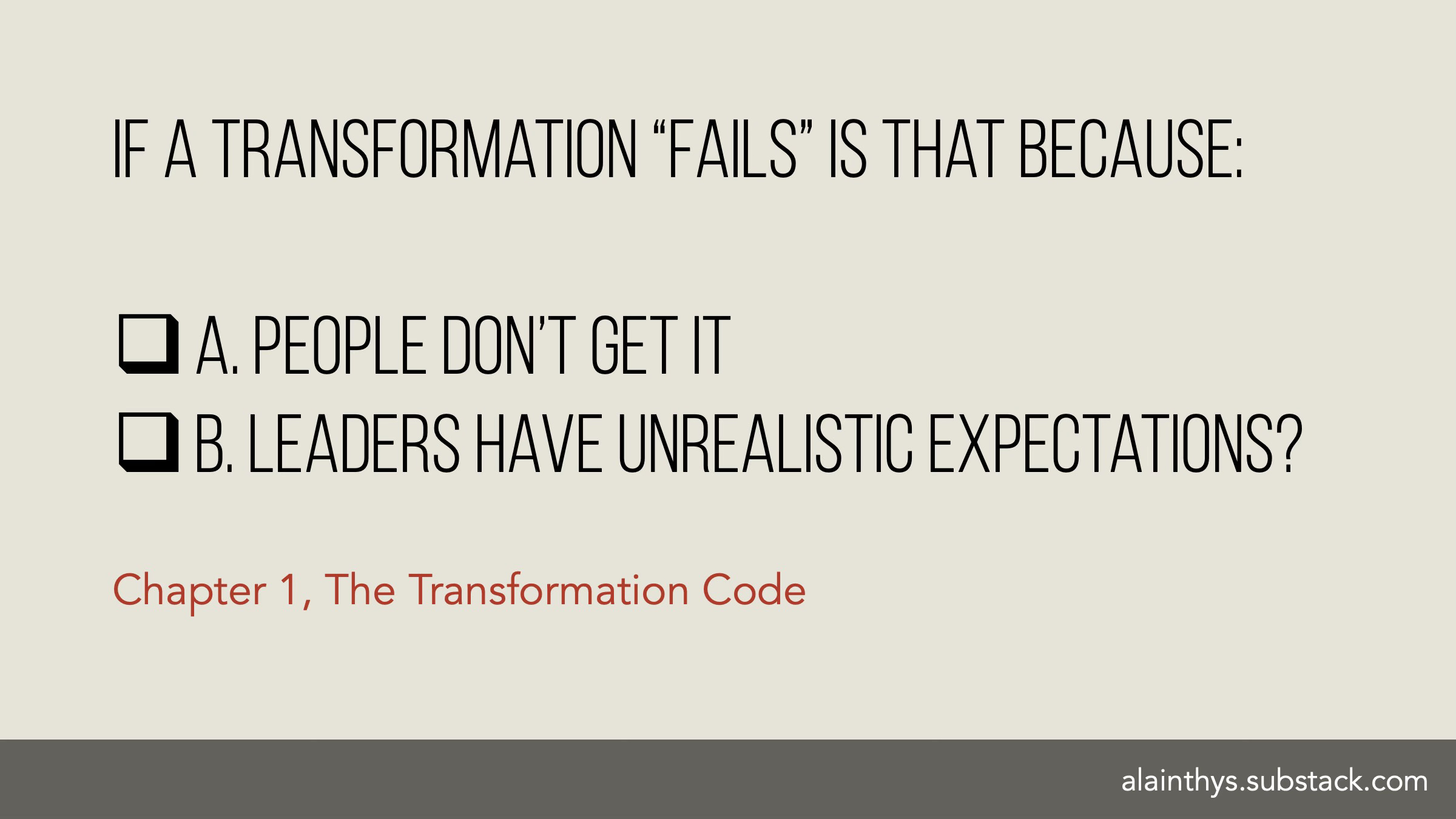
But isn’t reality more that we have unrealistic expectations about the speed, impact and direction of the change we want?
After all:
▶︎ “mindset change” doesn’t happen on demand.
▶︎ AI only delivers value after you’ve diligently cleaned your data, fixed your plumbing and got your people excited about it
▶︎ PowerPoint slides are fast to produce, yet processes and KPIs are slow to change
It doesn’t mean transformation is impossible, but that it’s both simple and hard.
Simple, because we do it all the time, all of us. As individuals, and organisations.
Hard, because it requires a clear set of ingredients to be present at the same time:
▶︎ Story: a clear new perspective on an existing reality
▶︎ Resonance: a signal that customers and teams actually want the proposed future
▶︎ Flow: a concerted effort to clear the 100 layers of friction (systems, KPIs and habits) that get in the way
So no, I disagree that 80% of transformations fail. I believe a significant portion is judged too early, against expectations that were unrealistic to begin with.
The moment I accepted that reality, my actual transformation work became both harder, and simpler.
How’s that for you?
Do you watch transformation emerge, or does your business still try to force it hard and fast? And get disappointed when it ‘fails’?
If the latter is the case, drop me a note. I’d love to chat.
Comments
Nothing yet. Say the first thing.
Sign in to join the conversation.