
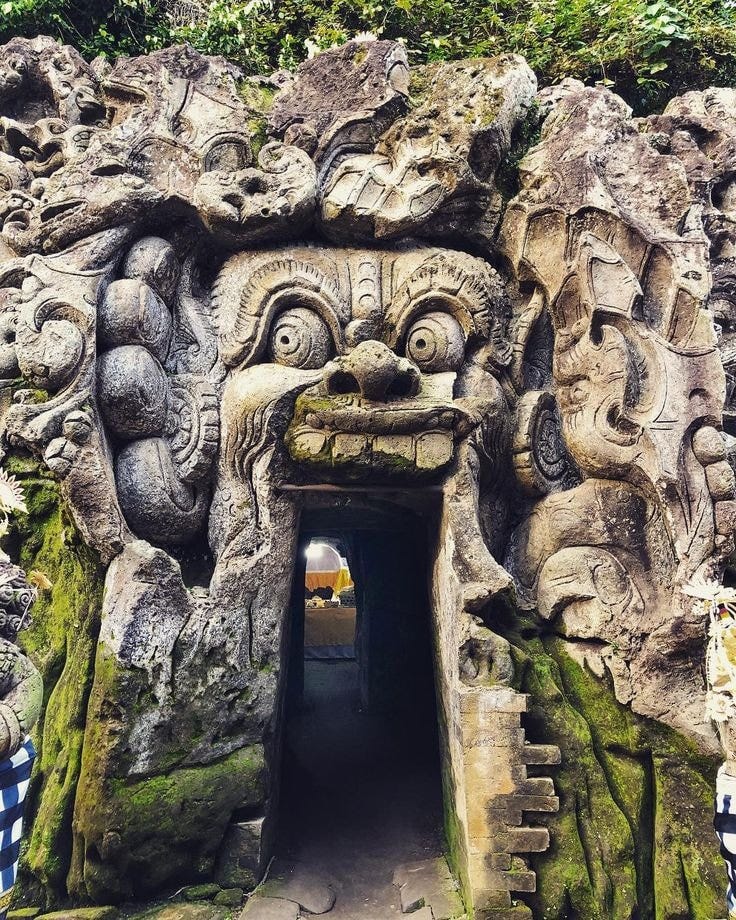
The entrance to Goa Gajah swallows you whole. You step into the cave through the gaping mouth of a carved face, its bulging eyes and wild flourishes meant to ward off evil spirits, or perhaps to remind you that every threshold worth crossing requires something of you.
Built sometime around the ninth to eleventh century near Ubud, Bali, the “Elephant Cave” was never home to elephants. What lived here instead were hermits and ascetics, Hindu and Buddhist practitioners side by side. They tucked themselves into the shallow meditation niches carved along the cave’s dim T-shaped corridor and sat in the dark in search of oneness. It was a sanctuary built for the long, unglamorous work of interior transformation — a place where you entered through the mouth of a monster and, if you sat long enough, came out changed.
But not the day we visited.
During our brief stint living in Bali, we did our best to visit some of the many holy sites around the island. Goa Gajah piqued my interest, but when we arrived it felt… flat.
For one thing, our kiddo was being a toddler in the midst of the terrible twos. For another, the jungle humidity was getting to all of us, permeating our very minds and making it hard to think, breathe, move. And for whatever reason we just didn’t feel any of the energy of the place. It was like it had all been used up.
We wandered into the caves and wondered how being held in the cool rock might have changed their experience of the divine. Lily wanted to explore the small pools in the complex, and we took pictures of the beautiful rock carvings. There were so many tourists around, though, that when I sat down to try and connect to the place, I could feel nothing but chaos. And I could see nothing but all the tourists holding their cell phones (and iPads) up in every direction to take pictures. The energy was far more chaotic than contemplative.
Disenchanted, we wandered. We were at the end of our visit, walking around the back of a small temple in a corner of the complex. There were no tourists back there because there was nothing to look at. The sun beat down. Lily and Ryan were lost in some kind of playtime several yards behind me. I caught the smell of incense but could not tell where it was coming from. Then, off to my right, I spotted a small set of steep steps carved into the rock wall. It wasn’t clear where it led but I took them out of curiosity. As soon as I was on the top step, I saw an older woman praying and tending a small temple altar to the left of the landing.
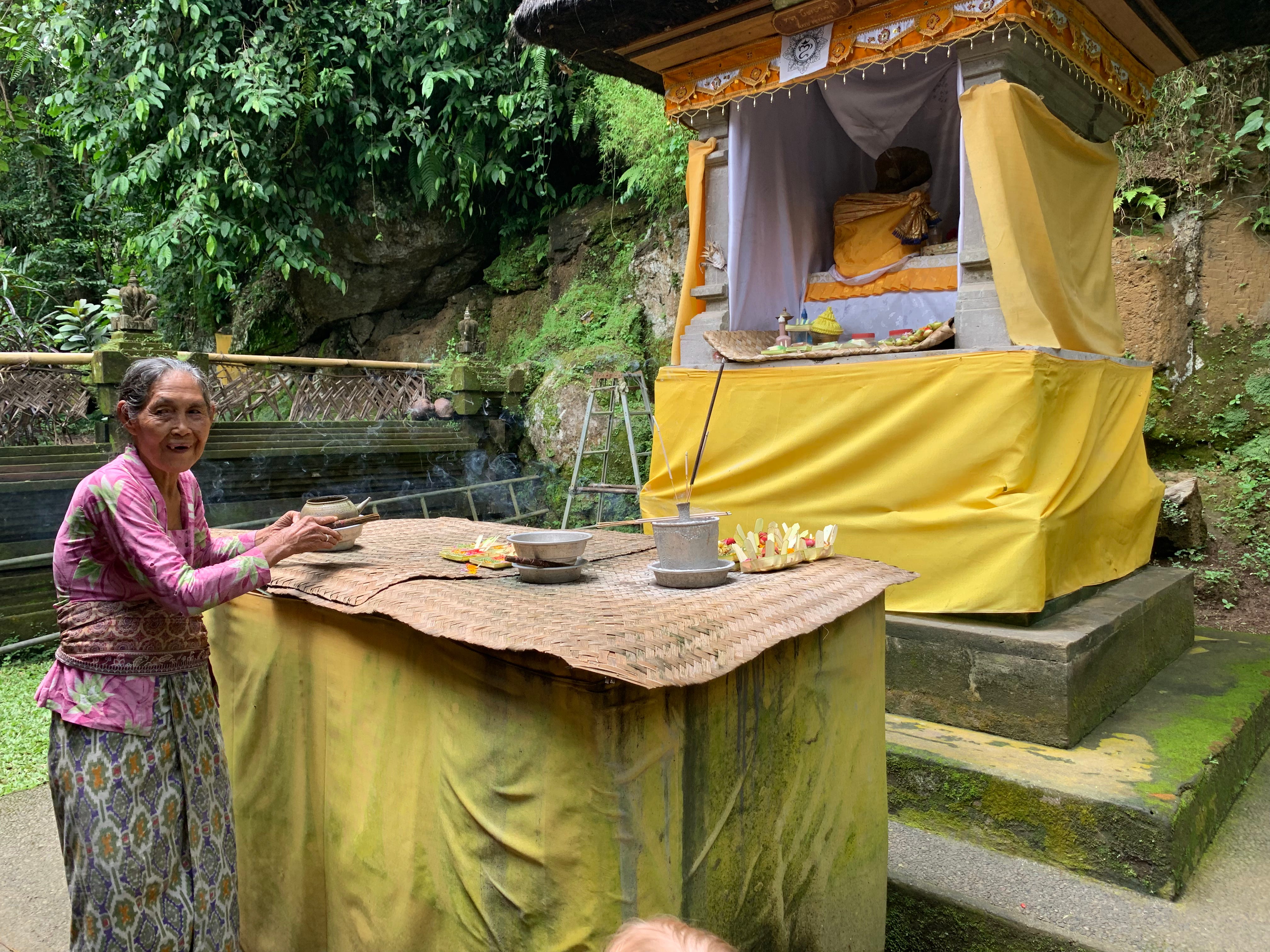
The protected altar was covered in yellow and orange cloth, with woven mats supporting offerings of rice, fruits, sweets, flowers, and incense. The woman tended several small bowls on a table in front of the altar.
The woman herself exuded kindness, patience. We did not speak the same language. I immediately thought I was intruding and made to leave, but she waved me over. At first I didn’t understand what she was asking me, and I was a little bedazzled by this vision. You couldn’t even see a hint of it from where I had stood just a few steps down. When I finally tuned in, I understood that she wanted to give me a blessing. She said words over me, pressing rice into my third eye, giving me good energy. Lily and Ryan soon followed in search of me and received her blessing. In one moment, she completely changed the tone and experience of our day.
Before we went back down the stairs I stood for a moment noticing the space — this was the one pocket in the holy site that held any sense of being tended, cared for. This was the one pocket in the entire complex that still felt as if you could touch the divine.
And I suspect it was because this is the one place that was being actively tended.
Places need tending, even if they are holy and sacred. Maybe especially if they are holy and sacred.
This is true of people, too.
A writing client of mine said to me once that she was “never one of those moisturized kids.” I asked her what she meant by that, intuiting that she didn’t mean that she was not well-coated in Aveeno. She said that it was a term in the Black community used to describe someone who was well taken care of. Someone whose parents cared enough, were emotionally available enough to make sure that you were “moisturized.” Ultimately, she was saying she was not well-tended.
You can tell when someone is tended to... and you can tell when they are not.
You can tell when a house has been abandoned, and when it is filled with life. Ideas need tending too. We’ve all had an idea take on a feeling of “stagnancy” because we haven’t touched it in too long. Did the idea actually go “bad”? No. But the idea went untended. Writers and creators need tending. They come to me tapped out and they lament about a lack of inspiration and an inability to write or move forward in their creative projects or work. They’re looking for burnout recovery. More often than not, they have used up every last ounce of energy and are now depleted and in disarray. The reasons it happens are so common that it’s not useful to talk about why. It’s more useful to say that in all cases, it leads back to the need to tend.
The art of tending is somewhat lost to us, because it is a quiet art. It’s not obvious, it’s not cookie-cutter, not one-size-fits-all. Just because one act of tending worked with a person or a place or creative work, doesn’t mean it will work again, or the same way with another person or place.
No matter what form it comes in, sacredness — aliveness, really — isn’t a permanent property of a place or a person or an idea. We treat it like it is. We assume the holy site stays holy, the relationship stays warm, the idea stays fresh and exciting, the creative fire stays lit, all on their own. But aliveness depletes when it’s only ever consumed.
Tending requires relationship, which in turn requires time and a deep listening for what’s actually needed. Then you have to be willing to give what’s needed — even if what’s needed isn’t easy to give, or isn’t practical, or takes time and trouble to execute.
I have a healing room in my house. I pray there every morning and night, and people come for healings. A lot of energy moves through this space; it’s a room that requires tending of the energy or things can go awry. And although I know this, I find myself resistant to doing it on some days. The floor needs to be swept, or the cobwebs need to be dusted, or the wine on the altar needs to be refreshed. Some part of me says “This is not the time,” or “I don’t have the energy right now.” Sometimes that’s true, but most of the time it is not.
There’s a selflessness to tending that has its own reward that isn’t a zero sum game. You don’t know what the reward will be, but it always shows up.
I think about that woman often, and how you couldn’t see her altar from three steps down. How the divine hadn’t left Goa Gajah; it had simply retreated to the one corner in which someone still showed up and prayed, made offerings, and remained to share blessings with the few other people who found her corner. I had come to the temple hoping it would give me something. She was the only one there giving something to it.
So now, when something in my life goes flat — an idea, a friendship, my own creative fire — I try to catch myself before I pronounce it dead. Usually it isn’t. Usually it’s just been waiting for someone to come tend it.
Maybe something of yours is waiting like that too.
This publication is supported by readers like you. If you like the writing, please share. If you feel you’d like to support the work, becoming a paid monthly subscriber is the best way to do so. Thank you for reading!
Comments
Nothing yet. Say the first thing.
Sign in to join the conversation.