
On April 30, 2026, Defense News published what it calls an investigation: Russian cargo airlines are using Algeria as a base for “secretive missions,” projecting Moscow’s power across Africa and Latin America. The headline is catchy. The flight-path map looks impressive. The satellite tracking data is real.
The problem is not the facts. It is what is done with them.
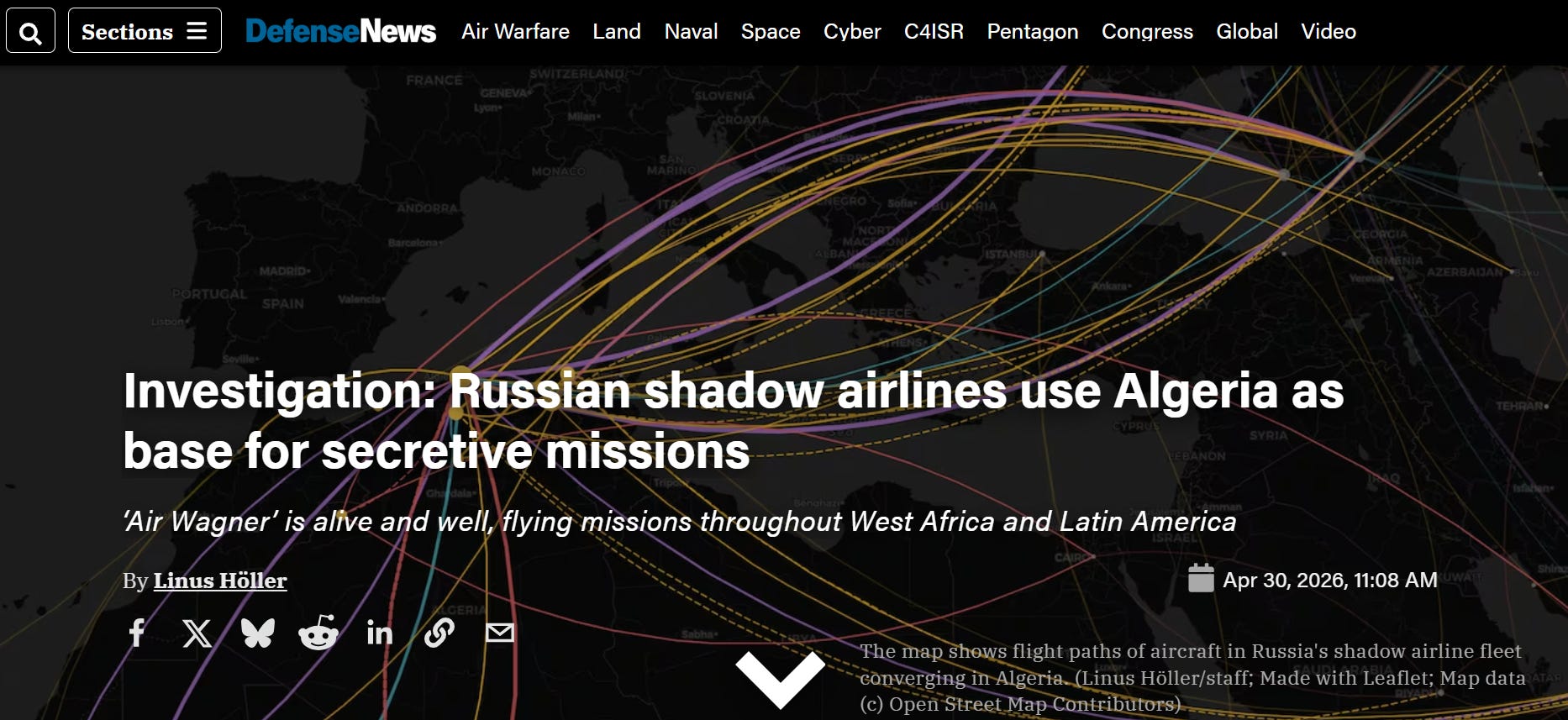
Read carefully, cross-referencing the technical data, the geopolitical facts the article omits, and the basic rules of investigative journalism, the piece leaves a fairly clear impression: a prosecution brief built in reverse. The conclusion came first. The facts were selected to confirm it.
The article counts 167 cargo flights between Russia and Algeria between March 2025 and April 2026. This figure is presented as the foundation of the accusation: Algeria has become “one of the key hubs in Moscow’s global freight network.”
But 167 flights over thirteen months between a country’s primary arms supplier and that country itself is exactly what you would expect. Algeria operates Su-57s, Su-35s, Su-30s, Yak-130s, and upwards of 250 Russian-made helicopters. It has run a fleet of Soviet then Russian-origin aircraft since independence. According to data from the Stockholm International Peace Research Institute, which the article itself cites, Algeria sourced 73% of its arms from Moscow between 2018 and 2022. Those aircraft need spare parts, technicians, maintenance equipment. Sometimes they need to be delivered.
What exactly is a cargo aircraft supposed to do, if not deliver what the buyer paid for to the buyer who paid for it?
The article quietly acknowledges this in a passage easy to miss: “At least some of the Russia-Algeria flights are likely linked to the flow of new-generation weaponry.” Likely. Some. Two qualifiers that, in any other journalistic context, would have killed the headline entirely.
*
The question the article never asks: how many cargo flights do Western countries, France, Germany, the United States, Qatar, make to their own clients in Africa, on routes that also stop in Algeria or elsewhere in North Africa? Nobody counts them, because nobody draws conclusions from them. In the context of this investigation, that is not neutrality. It is a double standard.
This is probably the most technically flawed part of the article.
The author notes that Russian cargo aircraft “disappear” from tracking radars after leaving Algiers heading south, while “other nearby aircraft remain visible.” He cites an anonymous source from the air freight sector describing this as “a known evasion technique deliberately employed by pilots.” The implication is clear: pilots are switching off their transponders to hide their destinations.
This interpretation ignores a technical reality that anyone following aviation already knows.
Tracking platforms like Flightradar24 run on a network of ADS-B ground receivers installed by volunteers and partners. Each receiver covers a radius of 250 to 450 kilometers. Coverage depends entirely on how dense that network is in any given area. In Algeria, owning and operating ADS-B receivers is strictly regulated or outright banned for private individuals. The result is mechanical: coverage of Algerian territory, and particularly the Sahara, is nearly nonexistent on these platforms. The thin slice of data that does exist comes from receivers in neighboring Mediterranean countries, Spain, Italy, Tunisia, Morocco, covering a narrow strip along the north of the country.
When an aircraft leaves Algiers heading south, it exits that strip quickly. It disappears from the screens. That is not concealment.
The aircraft that “remain visible” under the same conditions are flying within range of those coastal receivers. Those heading inland or toward the Sahel enter a structural blind zone. Flightradar24 regularly puts out calls for new volunteer hosts in Africa, explicitly acknowledging that “remote regions of the continent” are its biggest coverage gaps.
A journalist specializing in aviation should have known this before calling the phenomenon an evasion technique. An anonymous source from “the air freight sector” is not a technical authority on how ADS-B works.
The article lists with some solemnity the Algerian bases where these flights land: Oum El Bouaghi, Ain Oussera, Laghouat, Bechar, Annaba. These destinations are presented as further evidence of the suspicious nature of the operations.
Oum El Bouaghi is home to Su-30 squadrons. Ain Oussera is a maintenance and training center. Laghouat and Bechar serve similar logistical and operational functions for Russian-origin aircraft.
A cargo plane delivering Su-30 spare parts to the base where Su-30s are stationed is the most logical thing imaginable in any military in the world. That is the literal definition of military logistics. Nobody accuses Boeing of wrongdoing for sending technicians to USAF bases housing B-52s. Nobody finds it suspicious that Rafale parts go to bases where Rafales fly.
Taken to its logical conclusion, this reasoning would make every French maintenance flight to its own bases or African clients suspicious. Or every American delivery to a base in Germany. The rule seems to apply only to Algeria, and only in the direction that feeds the thesis.
A historical parallel makes the point well. During the Chad war in the 1980s, France was simultaneously selling Mirage F1s to Libya, which used those same aircraft to bomb areas where French soldiers were deployed under Operations Manta and Epervier, while providing contractual maintenance and technical support to the Libyan air force. Nobody ever called that French complicity with Gaddafi. It was arms commerce, with its contradictions and grey areas, as it has always been. Algeria receives spare parts for aircraft it legally purchased from a legal supplier, under a commercial relationship that predates the war in Ukraine by several decades. And this becomes a “clandestine freight network.”
This is the most serious claim in the article, and the one that holds up least under scrutiny.
The author establishes that some flights passing through Algiers continue on to Guinea, Niger, or other sub-Saharan destinations where Russian forces are active. He then concludes that Algiers serves as a “staging ground” for the logistics of Wagner and its successor, Africa Corps.
But between that transit fact and that conclusion sits a gap the article never fills. No documents. No agreements. No testimony from Algerian sources or anyone operating on the ground. No evidence of any coordination between Algerian authorities and Wagner.
That silence on evidence is all the more striking given what is actually known about Algeria’s real position toward Wagner.
In October 2024, when a joint Malian army and Africa Corps convoy moved dangerously close to the Algerian border at Tinzaouatine, Algiers did not look away. It deployed its own ground, aerial, and satellite surveillance, applied direct diplomatic pressure on Moscow, and secured the operation’s halt without a single shot fired. Mali, furious, accused Algeria of “terrorist propaganda” before the UN Security Council for publicly condemning a Wagner drone strike that killed 20 civilians. Relations between Algiers and Bamako deteriorated to the edge of diplomatic rupture.
That is not how a country behaves when it is serving as the logistics hub for the organization it is diplomatically pressing Russia to restrain.
The article mentions none of this. Not a word about Tinzaouatine. Not a word about the Algerian-Malian tensions rooted precisely in Algeria’s rejection of Wagner’s presence near its borders. These elements are absent not by accident. They are absent because including them would have made the thesis impossible to sustain.
This term deserves a pause, because it sits at the heart of the article’s narrative structure.
In logistics and aviation, a hub means organized, deliberate infrastructure: formal agreements, scheduled frequencies, a systemic function. Charles de Gaulle is a hub. Dubai is a hub. Atlanta is a hub.
Algiers is a stopover.
Algeria is a country of 2.4 million square kilometers, bordering seven states, with an airport network that makes it a geographically unavoidable transit point for any flight between Europe or Russia and sub-Saharan Africa. That is not a suspicious geopolitical coincidence. It is large-scale geometry. Geography, in simpler terms.
Military and cargo aircraft of many nationalities stop in Algeria. American, Qatari, German, Ukrainian. A Ukrainian Antonov-12 operated by Ukraine Air Alliance crashed near Tamanrasset in August 2014, flying from Glasgow, with technical stopovers at Ghardaia and Tamanrasset on its way to Malabo in Equatorial Guinea. Tamanrasset, a Saharan city 2,000 kilometers south of Algiers, is regularly used as a technical stopover by long-haul flights to Africa from any direction. If a Russian cargo plane transiting through Algiers makes Algeria a “Russian hub,” then a Ukrainian plane transiting through Tamanrasset made it a “Ukrainian hub.” Same logic. Same absurdity.
Algeria has not joined any of the Western sanctions against Russia. It was not required to. Those sanctions, American, European, British, Canadian, are unilateral or restricted multilateral instruments. They are not obligations under universal international law. No UN Security Council resolution imposes an embargo on arms deliveries to or from Russia. No ICAO convention prohibits a sovereign country from receiving air deliveries from its contractual supplier.
Algeria has operated a Soviet then Russian-origin combat fleet since 1962. It did not abandon it after February 2022, and it had no legal reason to. NATO members, Bulgaria and Poland until very recently, kept flying MiG-29s and Su-22s for years after the Ukraine invasion while waiting for their F-16 replacements. Nobody called Sofia or Warsaw a “Russian arms hub.”
The article does not raise this question. It does not, because doing so would dismantle the narrative frame it has built.
There is also a simpler, more immediate failure that precedes all the reasoning problems.
One of the first rules of investigative journalism, codified in every professional ethics code from the International Federation of Journalists to the American SPJ, is what lawyers call audi alteram partem: hear the other side. Before publishing serious accusations against a sovereign state, you give it the right to respond. Not a comment request sent 48 hours before publication. A real right of reply, with specific questions and a reasonable deadline.
The article mentions in a single line, right at the end, that “the Russian and Algerian governments did not respond in time for publication.” No Algerian official or legal entity is named specifically. No Algerian defense or geopolitics expert is consulted. No African researcher, no regional journalist on the ground gets a word in. The only expert sources are three Washington-based organizations, C4ADS, Future Frontlines, and Dallas Analytics, whose analyses are taken at face value, as though belonging to the American analytical ecosystem were itself a guarantee of objectivity.
In press terms, this article is not an investigation. It is a one-sided inquiry, using real data interpreted in one direction only, with no possible contradiction.
It would be easy to conclude that Defense News is acting in bad faith. That would probably be wrong. The publication is serious. Its Berlin correspondent has solid credentials. The OSINT data is real and the fieldwork is not negligible.
The problem, in my view, lies elsewhere, and it is frankly more interesting.
This kind of article reveals an analytical framework that no longer knows what to do with a country that belongs to neither of the two camps it recognizes. Algeria buys Russian because it has always bought Russian, because its engineers have mastered these systems for sixty years, because its bases are built around these aircraft, and because switching takes time and costs money. That is operational continuity, not ideology. It is also a concept the journalist seems unfamiliar with: national sovereignty.
But within this article’s framework, anything that is not explicitly pro-Western is treated as pro-Russian by default. Non-aligned Algeria fits no available box, so it gets forced into one.
The 167 flights the journalist finds suspicious do exist. The conclusion drawn from them, though, was decided well before anyone started counting.
This work takes time. Supporting it takes thirty seconds.
Paid subscription to fund in-depth analysis. Free subscription to stay in the loop. Share this with someone who should read it.
And if you want to understand how cheap weapons are rewriting the rules of modern warfare, In the Shadow of the Shahed was written for you. Kindle and paperback on Amazon.
Aucun post
Comments
Nothing yet. Say the first thing.
Sign in to join the conversation.