
It’s been spring-like weather this week here in Cambridge, and I enjoyed a brief outing this weekend past, travelling eastward to the Norfolk coast. Walking with my dog along the wide, almost empty and softly windblown beach of Wells-next-the-sea was such a treat.
I came home (reluctantly) to good news: that a book I’ve contributed a chapter to, From Darwin to Cornford: The Evolution of the Poet Frances Cornford, now has a publication date. It will be published by the academic publisher, Brill, on July 16, 2026 in the UK, and you can find out more details here. (Being an academic book, the price is rather eye-watering at the moment, but fingers crossed there will be a paperback version in due course.) Other contributing authors include Frances Spalding, Janet Browne, Eugene Paykel and , and I am honoured to be in such company.
Here’s what the book’s editors, Jane Firman and Peter Mabey, say about it:
‘This study presents the first sustained account of the life and work of the poet Frances Cornford (1886–1960). Scholars from across disciplines reveal her journey, as she navigated the scientific inheritance of her grandfather Charles Darwin, the patriarchal world of the University of Cambridge, and the demands of dominant poetry movements, through times of personal loss and depression. The volume brings renewed attention to Frances’s poetry from across her career, draws on previously-unseen manuscripts and photographs, and curates her memoir. Frances became a widely-read poet, winning the Queen’s Gold Medal for Poetry in 1959.’
The distinguished historian Peter Stansky, author of Julian Bell: From Bloomsbury to the Spanish Civil War (2012), has been kind enough to praise the book in advance.
‘A stellar group of highly accomplished authors has been assembled to write about Frances Cornford… This book will make her deservedly more recognised, as a wonderful poet; but it also provides important insights into English intellectual and literary “aristocracy”, through the study of her life as a Darwin, as a close friend of Rupert Brooke and the Neo-Pagan circle, and as Francis Cornford's wife. It is also an important personal story, sadly because of her periods of deep depression, more positively as she moves from atheism to deep religiosity.’
‘No omnibus heart’
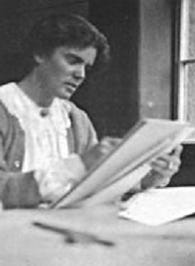
I’m honoured to have contributed a biographical chapter about Frances Cornford’s mother to the book. My chapter is called ‘“No omnibus heart”: Ellen Wordsworth Darwin (1856-1903)’ and it will throw light, I hope, on Ellen Wordsworth Darwin as a hard-working Cambridge lecturer of English literature, as well as a witty friend and warm and loving mother to Frances and her step-brother Bernard.
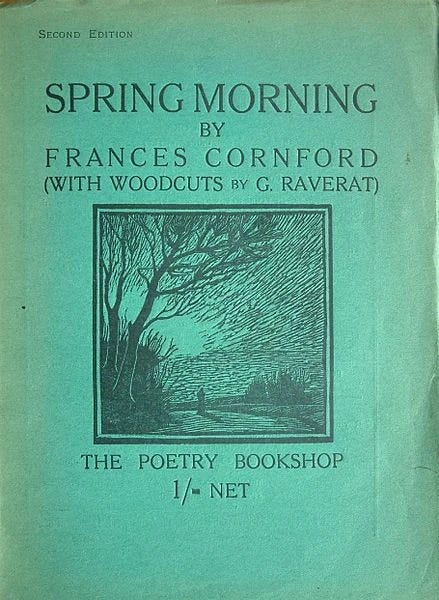
The threads that connected Frances and Ellen were many, including their shared love of poetry, their remarkable creative focus and the quirky verbal humour that they both enjoyed, and there’s no doubt in my mind that it was Ellen’s influence that helped to make Frances Cornford the remarkable poet she became. I’ve previously written about Ellen’s friendship with the poet Amy Levy here, and my post about Frances Cornford’s cousin Gwen Raverat, who illustrated her collection of poetry Spring Morning, first published in 1915, here.
It seems fitting, following my walk in the ‘wind-soft’ air on a Norfolk beach, to conclude with this poem by Frances Cornford. Thanks very much for reading, and I would love to hear about any poems about the sea, sailing or being by the coast that have stayed in your mind over the years.
The Coast: Norfolk
by Frances Cornford
As on the highway’s quiet edge
He mows the grass beside the hedge,
The old man has for company
The distant, grey, salt-smelling sea,
A poppied field, a cow and calf,
The finches on the telegraph.
Across his faded back a hone,
He slowly, slowly scythes alone
In silence of the wind-soft air,
With ladies’ bedstraw everywhere,
With whitened corn, and tarry poles,
And far-off gulls like risen souls.
Cambridge Ladies' Dining Society is a reader-supported publication. To receive new posts and support my work, consider becoming a free or paid subscriber.

Comments
Nothing yet. Say the first thing.
Sign in to join the conversation.