
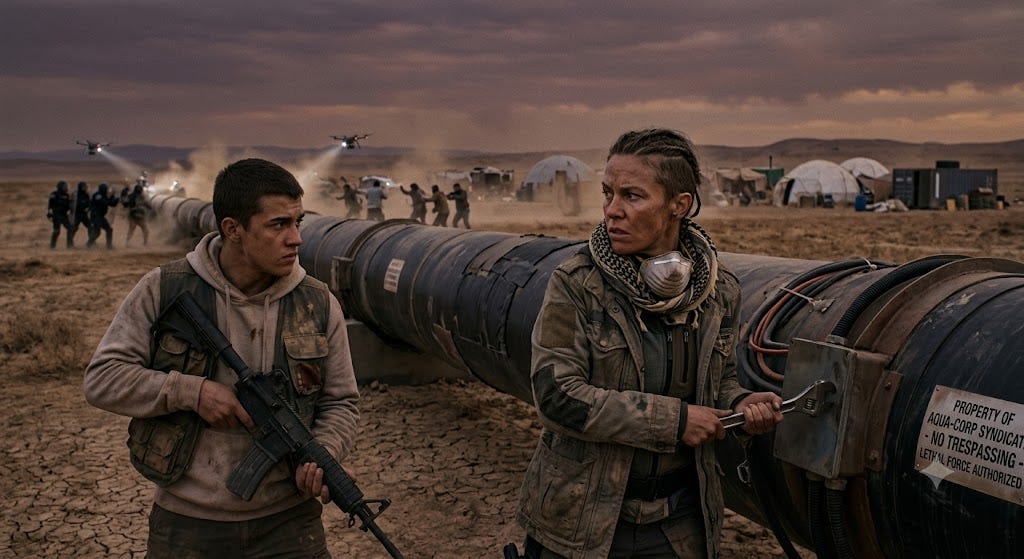
Ethiopia’s Grand Ethiopian Renaissance Dam went fully operational in September 2025, and this March, Ethiopia’s government announced three additional dams on the Blue Nile - Karadobi, Mandaya, and Beko Abo - projected to add another 5,700 megawatts on top of GERD’s 5,150. Egypt gets essentially all of its fresh water from the Nile and views the dam as an existential threat, not a rhetorical one; Egyptian officials have ruled out military action for now, but Cairo has been visibly expanding its military footprint and alliances across the Horn of Africa, and the dispute has become entangled with Red Sea security, the Sudanese civil war, and Somaliland’s status - a water dispute that’s stopped being just a water dispute and become the organizing axis of an entire region’s geopolitics. I think that’s the part that gets missed when this story does get covered: it’s filed under “Horn of Africa tensions” rather than under the actual root cause sitting underneath most of it.
The Nile is the clearest illustration of something the phrase “water wars” usually gets wrong: the water rarely starts the conflict on its own. It becomes the lever both sides realize they can pull, because water is the one resource where geography hands one country direct physical leverage over another’s survival - the upstream country building, the downstream country watching its water supply become someone else’s infrastructure project. Egypt’s dependence on the Nile isn’t collateral damage in this dispute. It’s the actual stake.
And then there’s the version of this that doesn’t involve any foreign government at all, which might be the most instructive one precisely because it shows this isn’t a problem of bad actors - it’s a problem of arithmetic. The Colorado River has lost 20% of its flow since 2000. Lake Powell sits at 25% of capacity. Lake Mead sits at 34%. The seven US states sharing the river blew through a federally imposed February 2026 deadline to agree on cuts, and the operating rules governing the whole system expire at the end of this year with no replacement in place. The dispute isn’t complicated to describe: every existing proposal asks the Lower Basin states to absorb the cuts while leaving the Upper Basin largely untouched, and Arizona’s governor has said flatly she won’t sign anything built that way. This is Arizona, California, Nevada, Colorado, Utah, Wyoming, and New Mexico - all wealthy, all democratic, all long-standing partners within the same country - and they still can’t agree on how to split a shrinking river, because the entire allocation system was built in 1922 on rainfall assumptions from an unusually wet decade that never repeated.
That’s the detail I keep coming back to across both of these: none of this required villainy. The 1922 Colorado River Compact wasn’t drafted maliciously - it was drafted using the best data available at the time, which turned out to be wrong in a way nobody involved could have caught. Ethiopia building a dam to bring electricity to a country where roughly half the population still lacks reliable power is not, on its own terms, an unreasonable thing for a government to want. Water conflict doesn’t need a mustache-twirling villain. It needs a fixed, shrinking, physically indivisible resource and more than one party with a real claim on it, which is precisely the condition a warming, more populous world is going to keep manufacturing in more places, not fewer.
I don’t think either of these disputes gets resolved cleanly, and I don’t think that’s a controversial prediction - it’s just what happens when a resource both sides need to survive can’t be manufactured, imported, or substituted the way most disputed resources eventually can be. What I do think is worth saying plainly is that “water wars” stopped being a speculative future-tense phrase for a think-tank report sometime in the last two years, and started being the accurate present-tense description of live disputes reshaping a fast-industrializing region and one of the wealthiest river basins on Earth. Neither is getting covered as the water story it actually is, because each one arrived wearing a different, more familiar headline first.
No posts
Comments
Nothing yet. Say the first thing.
Sign in to join the conversation.