
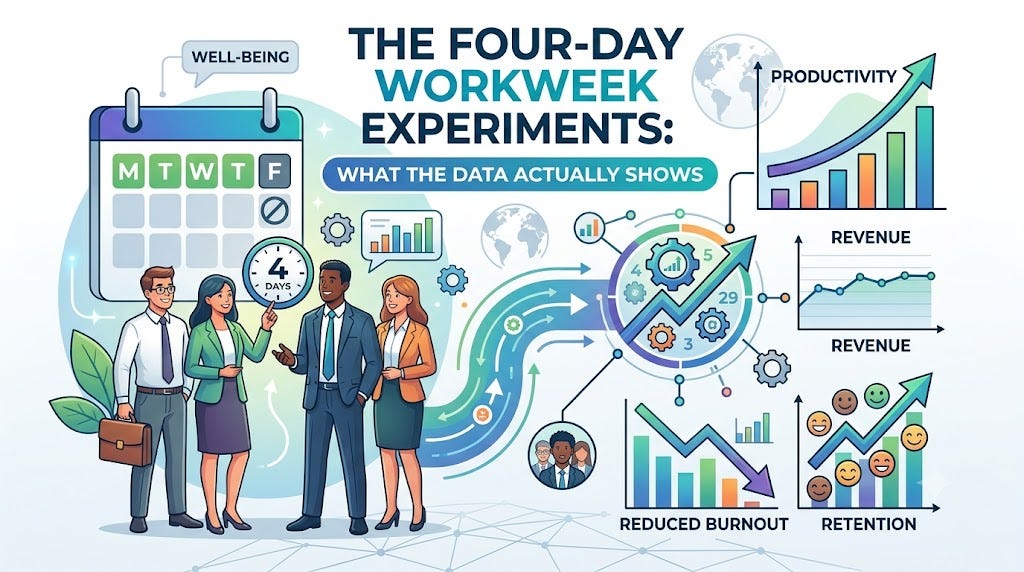
The largest controlled study of the four-day workweek ever run tracked 2,896 employees across 141 companies in six countries for six months, published in Nature Human Behaviour. The model most of them used has a specific, almost defiant shorthand: 100-80-100. A hundred percent of the pay, eighty percent of the hours, and a hard commitment to maintain a hundred percent of the output. Wellbeing improved across essentially every measure researchers tracked — stress, burnout, physical health, sleep, work-life balance. That’s not a marketing claim. That’s a peer-reviewed result, and it’s a big one.
The UK’s own pilot, run separately through 4 Day Week Global, produced numbers that read almost suspiciously good if you didn’t know the study design: burnout fell 71%, sick days dropped 65%, staff turnover fell 57%, self-reported stress dropped 39%, and company revenue actually rose 1.4% on average across the trial period. Ninety-two percent of participating companies kept the four-day model after the pilot ended, which is the number I find most persuasive in the whole dataset — not because it’s dramatic, but because it’s revealed preference. Companies that got worse results, or even flat ones, had every reason to quietly go back to five days once the study wrapped and the researchers stopped watching. Most didn’t.
I want to flag the obvious methodological wrinkle here before going further, because I think it matters more than most coverage of these trials admits: every company in these studies opted in voluntarily. A firm that signs up for a four-day-workweek pilot is, almost by definition, a firm that already suspected it had slack to cut — bloated meeting culture, low-value busywork, managers who’d rather test an efficiency hypothesis than defend the status quo. That’s a real form of selection bias, and it means these results tell you what happens at companies willing to try this, not necessarily what would happen if you mandated it across an economy that includes plenty of employers who’d never have volunteered in the first place.
Which is exactly why the government-mandated version happening right now in Japan is the more interesting experiment, precisely because it removes the self-selection. Tokyo shifted roughly 160,000 municipal government employees onto a four-day schedule starting in April 2025, with Osaka, Chiba, and Kanagawa prefectures following since. Nobody at the Tokyo metropolitan government chose to opt into this the way a startup founder chooses to run a pilot. It was policy, aimed squarely at Japan’s notoriously punishing overwork culture and a demographic crisis where the country badly needs to make work compatible with having children people actually want to raise. Iceland, further along this path than anywhere else, now has roughly 86% of its workforce with access to reduced hours in some form, following trials that started back in 2015 — which tells you that once this gets past the pilot stage and into ordinary policy, it tends to stick rather than reverse.
But it does reverse sometimes, and the failures are at least as instructive as the successes, because they cluster in a specific, predictable place. Magyar Telekom, Hungary’s telecom operator, ran a four-day pilot for a year and a half and then abandoned it, reporting the model simply didn’t deliver the results it needed. Morrisons and Asda, two major UK supermarket chains, both tried versions of compressed or reduced schedules and walked them back. Notice what these have in common: telecom infrastructure and grocery retail are not knowledge work. You cannot compress customer service call volume or in-person shopping hours the way you can compress a product team’s Tuesday standup. A software company can often find 20% of its week hiding in redundant meetings and low-priority Slack threads. A supermarket cashier’s job doesn’t have a hidden 20% of unnecessary customer interactions sitting around waiting to be cut.
That’s the honest shape of what the data actually shows, once you stop averaging the win-win headline across every industry: this works, genuinely and repeatedly, in office-based knowledge work with real slack in its schedule and managers willing to restructure how work gets done rather than just deleting a day and hoping. It has a mixed-to-poor record in frontline, shift-based, and customer-facing operational work, where the hours themselves are the product being sold, not a proxy for it. And it works best of all, based on the Microsoft Japan pilot that started this whole conversation back in 2019 — a 40% productivity jump from closing Fridays and halving meeting length — precisely in organizations whose existing five-day schedule was already carrying enormous inefficiency that had simply never been forced to justify itself.
None of that makes the four-day week a universal answer, and I think the coverage that treats every new pilot as fresh proof of a settled case is doing the idea a disservice, because the actual data supports something narrower and more useful: this is a genuinely well-evidenced fix for a specific, common disease — bloated, meeting-heavy, low-accountability office culture — and a mismatched one for jobs where the hours aren’t overhead, they’re the whole point. Knowing which category your own job falls into is worth more than any headline statistic in this piece.
No posts
Comments
Nothing yet. Say the first thing.
Sign in to join the conversation.