
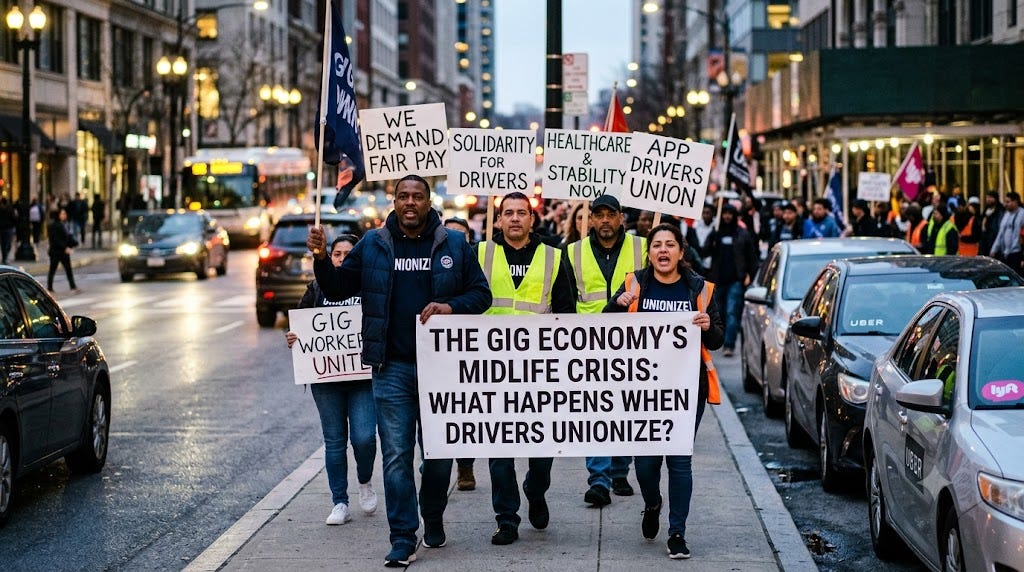
In May, roughly 70,000 Massachusetts rideshare drivers became the first gig workers in American history to win formal union certification. Not a petition. Not a strike that made the news for a week and faded. An actual, government-recognized bargaining unit, empowered to sit across a table from Uber and Lyft and negotiate pay, safety standards, and the rules around deactivation - the gig-economy equivalent of being fired, except historically with no appeal, no hearing, and often no explanation. California followed on January 1 of this year, extending the same right to roughly 800,000 drivers under a law Governor Newsom signed last fall. Illinois passed its own version in June, covering another 100,000. Three states, three different legislative vehicles, the same underlying shift: gig drivers are unionizing, right now, at a scale that stopped being a curiosity sometime in the last twelve months.
Here’s the detail that I think makes this genuinely novel rather than just “gig workers finally got a union, like everyone else eventually does”: these drivers are still independent contractors. Not employees. The Massachusetts law was explicit that collective bargaining rights and employment classification are two separate fights, and the union won the first one while leaving the second one exactly where it was. That’s a strange hybrid that doesn’t fit cleanly into either box labor law usually offers. Independent contractors, under federal antitrust law, generally can’t get together and jointly set prices with a company they all separately contract with - that’s the kind of coordination antitrust law exists to prevent among competing businesses. And workers who count as employees get the National Labor Relations Act’s bargaining protections automatically. Gig drivers were sitting in the one category federal law simply never anticipated: individually-contracted workers, functionally identical to employees in how much control the platform exercises over their day-to-day work, with none of the protections either box was built to offer.
States built a third door instead of forcing drivers through one of the existing two, and the mechanism is more interesting than the headline number of drivers covered. Massachusetts’s law includes something ordinary NLRA-governed unions don’t get: mandatory interest arbitration. Once a union is certified, the company and the union get six months to reach a contract. If they don’t, the dispute goes to binding arbitration rather than dragging on indefinitely the way first-contract fights under federal labor law notoriously do - it’s common for a newly certified union anywhere in the country to spend years without ever landing an actual first contract, because the law requires bargaining in good faith but sets no real deadline and no consequence for stalling. Massachusetts drivers built in the deadline and the consequence from day one. That’s not a small technical footnote. It’s arguably a better-designed piece of labor law than what covers most traditional employees in this country.
The backdrop making all of this necessary is worth remembering, because it’s easy to forget how settled this fight looked just a few years ago. California voters passed Proposition 22 in 2020, a ballot measure funded heavily by the platforms themselves, that locked gig drivers into contractor status in exchange for a modest earnings floor and some limited benefits. At the time, that looked like the platforms had permanently won the classification argument - contractor status, full stop, case closed. What’s happened since is that drivers and their organizers stopped trying to relitigate the classification question directly and instead built collective bargaining rights on top of contractor status rather than in place of it. It’s a workaround, and I mean that as a compliment: rather than spend another decade fighting a ballot-measure war the platforms are extremely well-funded to win, organizers found a legal structure that gets drivers a real seat at the table without requiring anyone to lose the classification fight first.
What actually changes for a driver once a contract exists is still mostly theoretical, since Massachusetts’s negotiations are just getting underway and nobody has a signed agreement yet to point to as proof of what this delivers in practice. But the leverage points on the table are the ones drivers have been naming for years: a floor under per-mile and per-minute pay that doesn’t quietly erode every time a platform adjusts its algorithm, real due process before an account gets deactivated rather than an automated email with no appeal, and some say over the safety standards platforms currently set unilaterally. None of that requires the platforms to reclassify a single driver as an employee, which is precisely why this model spread to three states with different politics faster than the classification fight ever did - it doesn’t ask either side to lose the argument they’d already dug in on.
I think the honest read on where this goes is that it becomes the template rather than the exception, specifically because it split a fight that had been genuinely stuck. Full employee status for gig workers has been law-suited, ballot-measured, and legislated over for the better part of a decade with no side landing a decisive, lasting win anywhere. A model that gives drivers a real union, a real deadline for a first contract, and real arbitration if talks stall - while leaving the contractor question alone - is the kind of unglamorous compromise that tends to actually spread, precisely because it lets both sides claim they didn’t lose. The gig economy’s founding promise was flexibility without the messiness of traditional labor relations. What’s emerging instead is flexibility with the messiness of traditional labor relations, just running through a side door nobody had built before three state legislatures decided to build it in the same eighteen-month window.
No posts
Comments
Nothing yet. Say the first thing.
Sign in to join the conversation.