
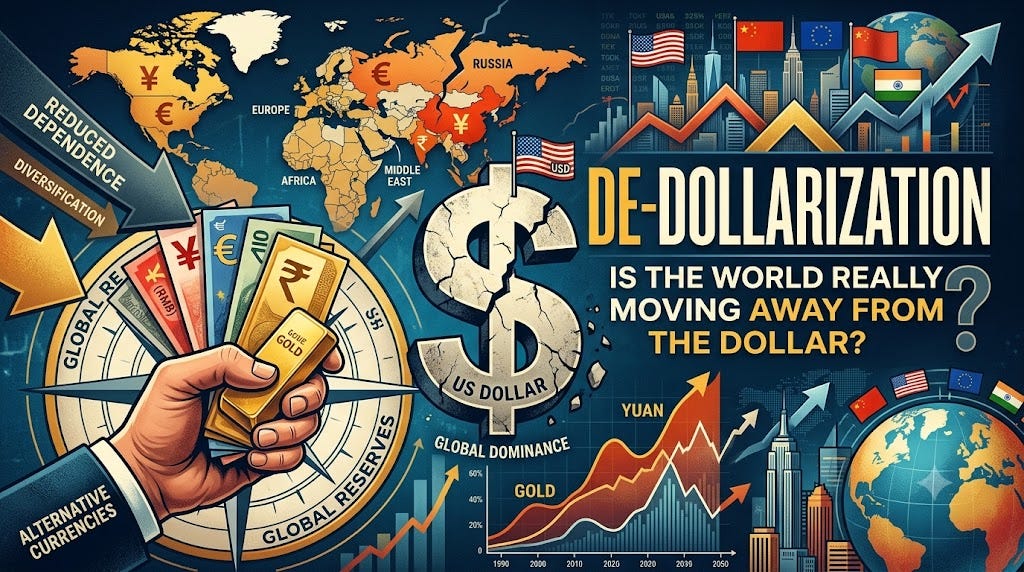
The dollar’s share of global foreign exchange reserves dropped below 57% last year for the first time since 1995, down from roughly 72% at the start of this century. That’s the number every de-dollarization headline leads with, and it’s real. Here’s the number those same headlines almost never include: roughly 92% of the most recent quarter’s decline came from currency valuation effects - the dollar itself weakening against other currencies, which mechanically shrinks its share of a reserve basket without any central bank actually selling a single dollar-denominated bond. Central banks, on net, barely touched their dollar holdings in the period that produced the scariest chart. The dollar didn’t get abandoned. It got a weaker exchange rate, and the math did the rest.
I think that distinction is the whole story, honestly, and almost nobody selling the de-dollarization narrative wants to sit with it, because it’s a much less exciting thesis than “the dollar is collapsing.” The actual, defensible claim is narrower and slower: the dollar’s decades-long dominance is eroding gradually, through real structural shifts happening mostly outside the headlines, while the loud, politically dramatic version of the story - a rival BRICS currency toppling the dollar outright - keeps getting announced and keeps failing to materialize.
Start with the part that’s genuinely real. Central banks bought more than 1,000 tonnes of gold in each of 2022, 2023, and 2024 - the heaviest sustained official gold buying since the 1950s - before that pace moderated to roughly 863 tonnes last year. BRICS-aligned nations now hold about 17.4% of global gold reserves, up from 11.2% just a few years ago. That’s not rhetoric. That’s central banks quietly building a hedge against a financial system where the dollar’s dominance also means exposure to US sanctions policy, which is precisely the lesson several governments drew from watching Russia’s reserves get frozen. Gold doesn’t get frozen by an executive order. That’s the actual, coherent logic driving the real portion of this trend, and it has nothing to do with any currency replacing the dollar - it’s diversification, not defection.
The payments infrastructure shift is real too, and more interesting than the gold story because it’s a genuinely new rail being built in parallel rather than a reserve reshuffling. China’s Cross-Border Interbank Payment System processed roughly $270 billion in a single recent month, connecting nearly 200 direct participants and over 1,500 indirect ones across more than 100 countries, and its average daily transaction value has been climbing sharply, up roughly 50% month over month in one recent stretch. That’s a genuine alternative settlement network gaining real usage, not a hypothetical one. And yet - the yuan itself, measured by SWIFT payment share, sits at just over 3% of global payments by value, in fifth place behind the dollar, euro, pound, and yen. Beijing’s own preferred framing puts the yuan third by a different measure that counts activity outside SWIFT entirely, which tells you something about how much this comes down to whose ruler you’re using. Either way, the actual number is small. A genuinely useful new pipe is being built. It is not yet carrying anything close to dollar-scale volume, and measured against the dollar’s roughly half of global SWIFT payment value, it isn’t close.
Now the part that’s mostly theater. A BRICS common currency was floated by Brazil’s president back in 2023, generated a wave of coverage, and has gone essentially nowhere since - not because the politics cooled, but because the economics were always closer to impossible than difficult. A shared currency across countries with wildly different inflation rates, capital controls, and trade balances requires the kind of institutional integration the eurozone spent decades building with far more aligned economies, and BRICS has shown no appetite for building anything like that machinery. What’s actually happened instead is member countries settling more bilateral trade in their own national currencies, rupee-for-rial, yuan-for-ruble, which is a real and meaningful shift in trade mechanics but is a completely different, much smaller claim than “a new reserve currency is coming.” The US response to the currency-that-isn’t-really-being-built has nonetheless been loud: a repeated threat of tariffs as high as 100% on BRICS members who move to challenge dollar dominance, aimed squarely at a project that, on the evidence, was never close to real. That’s two governments’ worth of political theater responding to each other, largely detached from the actual, boring, gradual reserve diversification quietly happening underneath both of their speeches.
So is the world moving away from the dollar? Yes, at the pace continents move - a few percentage points of reserve share over a quarter century, some gold accumulated as insurance, a payments rail being built that carries a small but growing fraction of global settlement. Is the dollar in any near-term danger of losing its position as the world’s dominant reserve and settlement currency? No, not remotely, and the data behind the scariest headlines mostly shows exchange-rate arithmetic rather than an exodus. Both of those sentences are true simultaneously, which is exactly the kind of nuanced, unsatisfying answer that doesn’t generate the clicks either the de-dollarization enthusiasts or the dollar triumphalists are chasing.
No posts
Comments
Nothing yet. Say the first thing.
Sign in to join the conversation.