
I get it. You’re a CEO, a business owner, maybe an entrepreneur looking to start your own company. You’re the one on top of the pyramid, the person in charge. When you talk, people listen. Or at least pretend to. But does that make you a leader? It depends. According to the research as well as my own experience, being a leader means more than giving orders. Leaders are forged in fire and have the scars to prove it.
Okay, that’s my opening. If you’re still reading, here’s my anecdotal lede. Actually, two of them. One from politics, the other from business.
VISIT MY SUBSTACK HOMEPAGE FOR MORE FREE ARTICLES >
The Cuban Missile Crisis
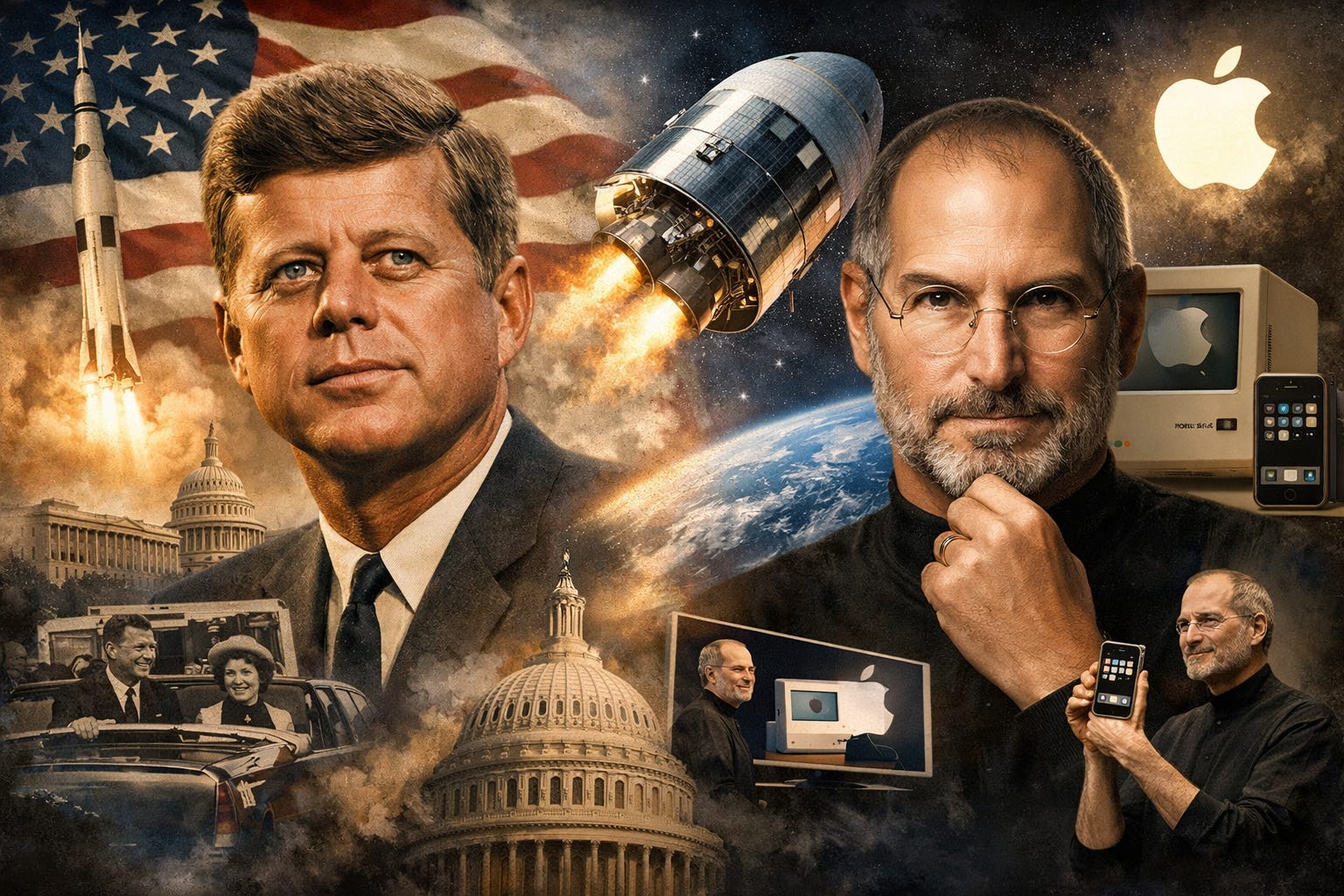
In October 1962, John F. Kennedy sat in the White House facing one of the most dangerous moments in modern history, the Cuban Missile Crisis. U.S. intelligence had confirmed that the Soviet Union was installing nuclear missiles in Cuba, just ninety miles off the coast of Florida. The implications were immediate and terrifying.
Inside the administration, there was no consensus. Military leaders pushed for an airstrike followed by a full invasion. Others argued for diplomacy, though no one could guarantee it would work. Every option carried enormous risk. An attack could trigger nuclear war. Doing nothing could signal weakness and allow the missiles to become operational.
Kennedy didn’t have the luxury of perfect information or unlimited time. He had to decide.
He chose a path that few initially supported. Instead of immediate military action, he ordered a naval “quarantine” of Cuba, a blockade designed to stop further missiles from arriving while opening a narrow window for negotiation. It was a calculated risk. If the Soviets challenged the blockade, the situation could escalate within hours.
For thirteen days, the world sat on edge. Behind the scenes, Kennedy managed conflicting advice, internal pressure, and the constant threat of escalation. Publicly, he addressed the nation with clarity and control, outlining the situation without inflaming panic. He didn’t pretend certainty. He made the decision and owned it.
In the end, the Soviets agreed to remove the missiles. The crisis ended without nuclear war.
Was it a perfect outcome? No. Concessions were made that weren’t publicly disclosed at the time. The risk had been enormous. But that’s the point. Leadership in that moment wasn’t about choosing a flawless path. It was about making a decision under pressure, accepting responsibility, and navigating through uncertainty without losing control.
The Return of Steve Jobs
Fast forward to 1997. Steve Jobs returned to Apple Inc., a company he had co-founded and then been forced out of years earlier. At the time of his return, Apple was in serious trouble. The company was losing money, its product line was bloated and confusing, and many analysts believed it was on the verge of collapse. Jobs walked into a situation that didn’t need incremental improvement. It needed decisive action.
One of his first moves was to radically simplify Apple’s product lineup. Dozens of products were cut. Entire projects were scrapped. Teams that had spent years working on certain initiatives saw their work eliminated almost overnight. It wasn’t popular, but it was necessary.
He also refocused the company around a clear vision. Fewer products, better design, tighter integration. That clarity led to the development of the iMac, and eventually to a string of products that would redefine not just Apple, but entire industries.
None of this happened because Jobs had a title. He had been CEO before and failed. What changed was how he led under pressure. He made the hard decisions quickly and he accepted the backlash that came with them. The result? Apple didn’t just survive. It became one of the most valuable companies in the world.
The Common Thread
Leadership shows up when the situation is unstable, when the information is incomplete, and when the consequences matter. It requires the ability to make decisions without certainty, to communicate clearly under pressure, and to accept responsibility for outcomes that can’t be fully controlled.
Kennedy didn’t have unanimous support when he chose the blockade. Jobs didn’t have universal agreement when he cut products and partnered with a rival. In both cases, waiting for perfect alignment would have made the situation worse. Instead, they acted.
And that action created direction. It gave people something to respond to, something to organize around, something to move forward with. It didn’t eliminate risk. What is did was replace paralysis with momentum.
What About You?
If you’re building something, running something, or stepping into a role where others depend on your decisions, these moments aren’t hypothetical. They’re coming. And when they do, you won’t always have the data you want. Or know with certainty that the decision you’re making is the right one.
That’s not a flaw in the process. That is the process.
The question isn’t whether you can avoid those moments. You can’t. The question is how you’ll respond when they arrive. Will you protect your position, or will you step into leadership and accept the weight that comes with it?
Because in the end, that’s the difference.
Comments
Nothing yet. Say the first thing.
Sign in to join the conversation.