
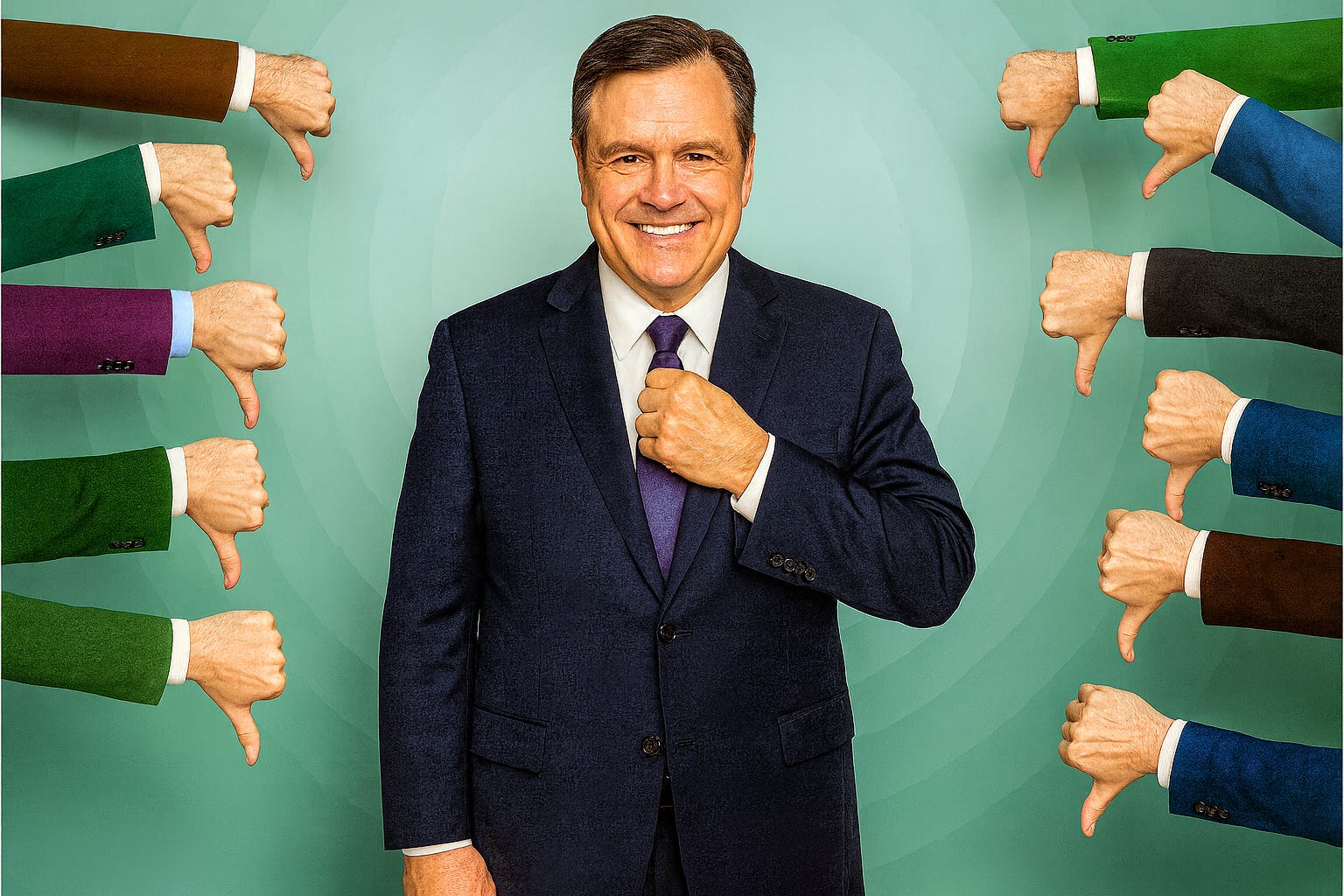
We’ve never had more leadership experts, and more disheartened employees.
Universities now offer hundreds of leadership degrees. Business schools have made leadership studies a cornerstone of their curricula. Executive coaching has become a multi-billion dollar industry. LinkedIn overflows with leadership content, TED talks about leadership rack up millions of views, and the leadership section in bookstores requires its own zip code.
VISIT MY SUBSTACK HOMEPAGE FOR MORE FREE ARTICLES >
Yet employee engagement has cratered to historic lows. According to Gallup’s 2024 State of the Global Workplace report, only 23% of employees worldwide are engaged at work. In the United States, often held up as the gold standard for workplace innovation, engagement sits at just 33%. These numbers represent a steady decline over the past several years, even as investment in leadership development has surged.
Something has gone profoundly wrong.
The Theater of Expertise
The leadership industry has become an elaborate performance, a theater of expertise divorced from the actual work of leading people. We’ve created a class of professional leadership gurus who study leadership, write about leadership, and teach leadership—but who have never actually led anyone through a crisis, never had to make a payroll, never faced the choice between profit and principle when their own livelihood hung in the balance.
The disconnect runs deeper than credentials. The entire framework of modern leadership studies rests on a fundamental misunderstanding of what leadership actually is. We’ve turned leadership into an abstract competency, a set of skills that can be learned in a classroom or acquired through a certification program. We’ve reduced it to frameworks and matrices, to emotional intelligence scores and 360-degree feedback reports.
Real leadership doesn’t work that way. Leadership emerges in the crucible of actual responsibility, when the decisions you make affect real people in real time. It’s forged through experience, through failure, through the humbling recognition that your choices have consequences you can’t always predict or control.
All Talk, But Little Action
The result is a leadership class that talks a good game but can’t execute. They know all the right buzzwords. They can quote Simon Sinek and Brené Brown. They’ve memorized the seven habits and the five dysfunctions. But when confronted with genuine leadership challenges—when they need to deliver hard feedback, make an unpopular but necessary decision, or stand up to pressure from above—they fold. They retreat to process, to consensus-building, to the very bureaucratic thinking that stifles the engagement they claim to want to foster.
This wouldn’t matter so much if the stakes were low. But disengaged employees represent more than just an HR metric. When people disconnect from their work, productivity suffers, innovation dies, and organizational culture becomes toxic. Disengaged workers do the minimum, protect themselves, and wait for opportunities to leave. They don’t speak up when they see problems, don’t volunteer extra effort, and don’t bring their full creativity and intelligence to their roles.
The human cost is even higher. Most people spend the majority of their waking hours at work. When that work feels meaningless, when they’re led by people who don’t inspire trust or confidence, when they’re treated as resources rather than human beings, it damages their wellbeing. The epidemic of burnout, anxiety, and depression in the American workplace isn’t separate from the crisis of leadership—it’s a direct consequence of it.
The Storm Ahead
These failures are about to get dramatically worse. We’re entering an era of profound uncertainty, where the confluence of artificial intelligence and accelerating globalization will create workforce challenges that today’s leaders are completely unprepared to handle.
The AI transformation isn’t coming—it’s already here, and it’s moving faster than most organizations can comprehend. Roles that seemed secure six months ago are being automated or fundamentally reimagined. The skills that took years to develop are becoming obsolete in months. Entire categories of work are disappearing while new ones emerge that require capabilities most workers don’t have and most training programs aren’t teaching.
This isn’t the familiar story of technology displacing manual labor. AI is coming for cognitive work, for the jobs that college-educated professionals thought were safe. It’s affecting writers, analysts, programmers, customer service representatives, and middle managers. The people who followed the rules, got the degrees, and built their careers on specialized expertise are watching that expertise lose value at breathtaking speed.
Leading through this transition requires more than the usual platitudes about change management and growth mindsets. It requires leaders who can have honest conversations about uncertainty, who can help people navigate the genuine fear and anxiety of economic disruption, who can make hard decisions about workforce restructuring while maintaining their humanity and their employees’ dignity.
Unprepared for the Moment
But the leadership class we’ve developed is spectacularly ill-equipped for this moment. They’ve been trained to optimize existing systems, not to guide people through fundamental transformations. They know how to run performance reviews and strategic planning sessions, not how to tell someone that the job they’ve done for twenty years won’t exist in two. They’ve learned to speak in corporate euphemisms about “organizational agility” and “talent optimization,” language designed to obscure rather than clarify what’s actually happening to real people’s lives.
Globalization compounds the challenge. The competition isn’t just the company across town anymore—it’s organizations operating in entirely different regulatory environments, with different cost structures, different cultural expectations about work. The old assumptions about career progression, about loyalty exchanged for stability, about the social contract between employers and employees—those assumptions are breaking down in real time.
Workers know this. They feel the ground shifting beneath them. They see the gap between what their leaders say about valuing people and what actually happens when the quarterly numbers miss expectations or when a new technology promises to cut costs. The disengagement we’re measuring now is a rational response to leadership that hasn’t earned trust and won’t be honest about what’s coming.
What’s needed now is a fundamentally different kind of leadership, grounded not in theory but in the brutal realities of technological disruption and global competition. Leaders who can face those realities themselves, who can communicate them clearly without sugarcoating or catastrophizing, who can make difficult decisions while genuinely caring about the people affected by those decisions. Leaders who understand that their job isn’t to pretend everything will be fine, but to help people find their footing in a landscape that’s fundamentally changing.
What Leadership Actually Requires
We know what good leadership actually looks like because we’ve all experienced it at some point. Good leaders create clarity about what matters and why. They make decisions and take responsibility for the outcomes. They protect their people from arbitrary demands and organizational chaos. They give honest feedback, even when it’s uncomfortable. They recognize good work and address poor performance. They show up consistently, especially during difficult times.
None of this requires a PhD in leadership studies. It requires character, judgment, and a genuine commitment to the people you’re responsible for. It requires the humility to admit when you’re wrong and the courage to do what’s right even when it’s not popular or easy. It requires staying present to the actual human beings in front of you rather than disappearing into abstraction and theory.
A Self-Perpetuating Machine
The flourishing of leadership studies alongside the collapse of employee engagement isn’t a paradox—it’s a symptom. We’ve created a self-referential industry that exists primarily to perpetuate itself, that mistakes the study of leadership for leadership itself, that confuses talking about inspiration with actually inspiring people.
Until we recognize this failure and demand something better, the disconnect will only widen. The leadership experts will continue producing frameworks and models while the people doing real work become increasingly alienated from that work. The crisis of engagement isn’t a problem that more leadership studies can solve. It’s a problem that leadership studies helped create. And as we move deeper into an age of disruption and uncertainty, the cost of this failure will only grow more severe.
Comments
Nothing yet. Say the first thing.
Sign in to join the conversation.