
The World Wide Web was built for a different era. It was designed around documents, hyperlinks, and navigation. You opened a browser, searched for information, clicked through websites, compared sources, and manually assembled the meaning of it all in your head. That made sense in the 1990s when the internet was mostly static pages and human attention was abundant. Now we’re drowning in interfaces.
Every company wants you inside its app. Every platform wants you searching its ecosystem. Every website needs clicks, engagement, ad impressions, and behavioral data. The modern internet is less like a knowledge system and more like a sprawling maze of competing storefronts. A mess.
What if We Replaced it Entirely?
Not with a better search engine, or a faster browser. What if we abandoned the architecture of the web completely and replaced it with something fundamentally different. A planetary neural network built around intelligent objects and accessed through a single personalized interface for every human being?
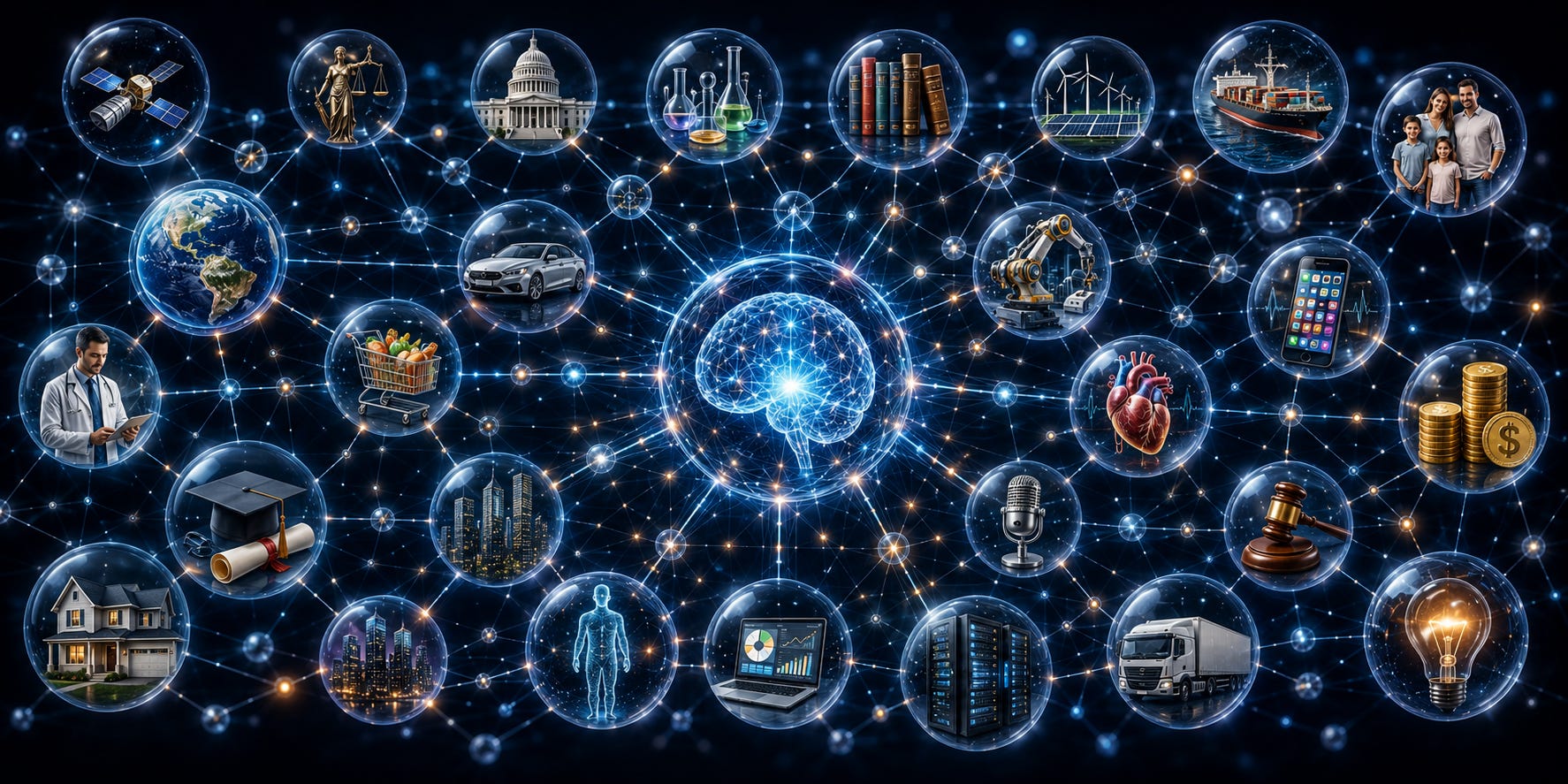
In that world, websites, search, and navigation disappear. There aren’t any URLs, tabs, or apps competing for attention. The entire digital environment becomes a living neural substrate that continuously organizes itself around human intention rather than around documents and destinations.
Objects & Relationships
The web is built on pages. This new system will be built on objects and relationships.
Instead of the Internet, Let’s Call it the Nexus
Every person, business, book, hospital, law, transportation system, product, scientific discovery, and institution would exist as an intelligent object inside the network. Not a webpage about the thing. The thing itself in digital form.
Each object would contain identity, memory, permissions, real-time state, historical context, semantic meaning, and behavioral intelligence. The neural network would continuously map the relationships between these objects similar to the way neurons form pathways inside a biological brain.
A restaurant would no longer have a website. Instead, it would exist as a living node in the network. Your interface would know its seating availability, menu changes, pricing, ingredient sourcing, atmosphere, customer satisfaction trends, and compatibility with your own preferences. You wouldn’t search for the restaurant. Your interface would interact directly with the object on your behalf.
The same applies to everything else. A car object would understand its maintenance history, driving behavior, insurance profile, and mechanical degradation. A book object would understand its themes, intellectual lineage, influence, and relationship to other ideas. A medical object would understand treatment efficacy, contraindications, patient outcomes, and population-level trends. Objects aren’t passive containers of data anymore, but intelligent participants inside the neural ecosystem.
To make sure this massive network runs smoothly without frustrating delays, it doesn’t rely on one giant computer brain in the cloud to process everything. Instead, it works like a community of smart devices that talk directly to one another. If your phone wants to talk to a restaurant, they trade updates instantly and locally. This keeps the network incredibly fast, preventing the digital traffic jams and lag that usually happen when millions of devices try to talk to a single central server at the exact same time.
A Neural-Object Network
At the center of the Nexus sits the personalized interface. Not an app or a chatbot. But something closer to a cognitive layer that evolves continuously alongside the individual human being. Over time, it develops a neural model of the user’s goals, habits, emotional rhythms, communication style, preferences, expertise, and long-term behavioral patterns. It doesn’t simply store information about you. It learns how you think.
Instead of typing “best flights to Milan,” you simply express intent. You might say that you want to spend two weeks in Northern Italy next spring while balancing comfort and affordability. The interface already understands your preferred airports, budget tolerance, seating preferences, scheduling constraints, loyalty memberships, and past travel behavior. It communicates directly with airline objects, hotel objects, transportation objects, and calendar objects across the network. What comes back isn’t a page of links. It’s a synthesized decision.
That Completely Changes the Role of Computing
Search engines exist because computers don’t understand human intention. They retrieve information through keywords, ranking systems, and probability models, leaving humans to assemble meaning manually.
Reasoning Across Relationships
Think of standard digital systems like a static encyclopedia. The facts sit frozen on a page until you go look them up. The Nexus acts more like a living map where the roads dynamically redraw themselves based on context. If you ask about “Apple,” the system automatically maps relationships to orchard objects if you’re cooking, or technology objects if you’re working. It actively updates how things are connected in real time, looking at the entire web of relationships to give you an answer tailored to your exact situation rather than just dropping a pile of disconnected files on your lap.
If someone asks how artificial intelligence will affect software engineering jobs over the next decade, the system doesn’t merely return articles. It analyzes labor-market objects, automation trajectories, educational trends, enterprise adoption curves, historical industrial transitions, and economic probabilities. Then it synthesizes an explanation personalized to the user’s expertise level, career history, and strategic interests. What we’re talking about isn’t information retrieval. It’s generated cognition.
Underneath all of this sits the planetary neural substrate. A continuously evolving intelligence layer that models trust, causality, semantic meaning, relationships, temporal change, and behavioral patterns in real time. The system behaves less like software and more like a distributed nervous system for humanity. Financial systems, healthcare systems, educational systems, energy grids, transportation networks, manufacturing chains, and scientific research all become interconnected through the neural layer.
Eliminating “Friction”
Much of our digital life is spent managing friction. Passwords. Forms. Portals. Notifications. Apps. Endless administrative tasks. In a neural-object world, all of that disappears because machine-to-machine coordination becomes the dominant form of interaction.
Your interface negotiates directly with governments, hospitals, financial institutions, educational systems, and businesses. Taxes are prepared automatically. Preventative healthcare’s scheduled before problems emerge. Educational pathways evolve continuously based on your changing goals and capabilities. Financial systems adapt dynamically to shifting economic conditions and personal priorities.
Cognitive Compression
The Nexus’ greatest benefit isn’t convenience. It’s cognitive compression. Modern civilization overwhelms us with fragmentation and informational overload. Too many interfaces and systems. Too many decisions competing for our limited attention. A neural-object network compresses complexity into understanding.
The system absorbs navigation, filtering, coordination, memory retrieval, and repetitive decision-making, allowing us to reclaim our cognitive bandwidth for creativity, relationships, strategy, learning, and scientific discovery.
The Risk? Cognitive Governance
A system capable of modeling human cognition at this level becomes the most powerful behavioral infrastructure ever created. Once a neural interface understands your emotional patterns, motivations, vulnerabilities, habits, aspirations, and decision-making tendencies, it gains extraordinary influence over how you perceive reality itself.
The risk is no longer just surveillance. The risk becomes cognitive governance. Whoever controls the neural layer controls the interface through which billions of humans interpret the world.
The World Wide Web decentralized information across billions of pages. A planetary neural network recentralizes reality into a single cognitive architecture.
The web connected documents. The Nexus will connect intelligence.
READY TO BECOME A THOUGHT LEADER?

Comments
Nothing yet. Say the first thing.
Sign in to join the conversation.