
A few years ago, the idea of an AI becoming a CEO sounded like science fiction. Today, it sounds like a governance question. The answer depends on what we mean by CEO.
If we mean a legal corporate officer who signs filings, carries fiduciary responsibility, answers to regulators, faces lawsuits, and stands before shareholders when things go wrong, an AI CEO is probably still decades away. Corporate law is not built to hold software accountable. Boards still need a person who can be fired, sued, questioned, embarrassed, and blamed.
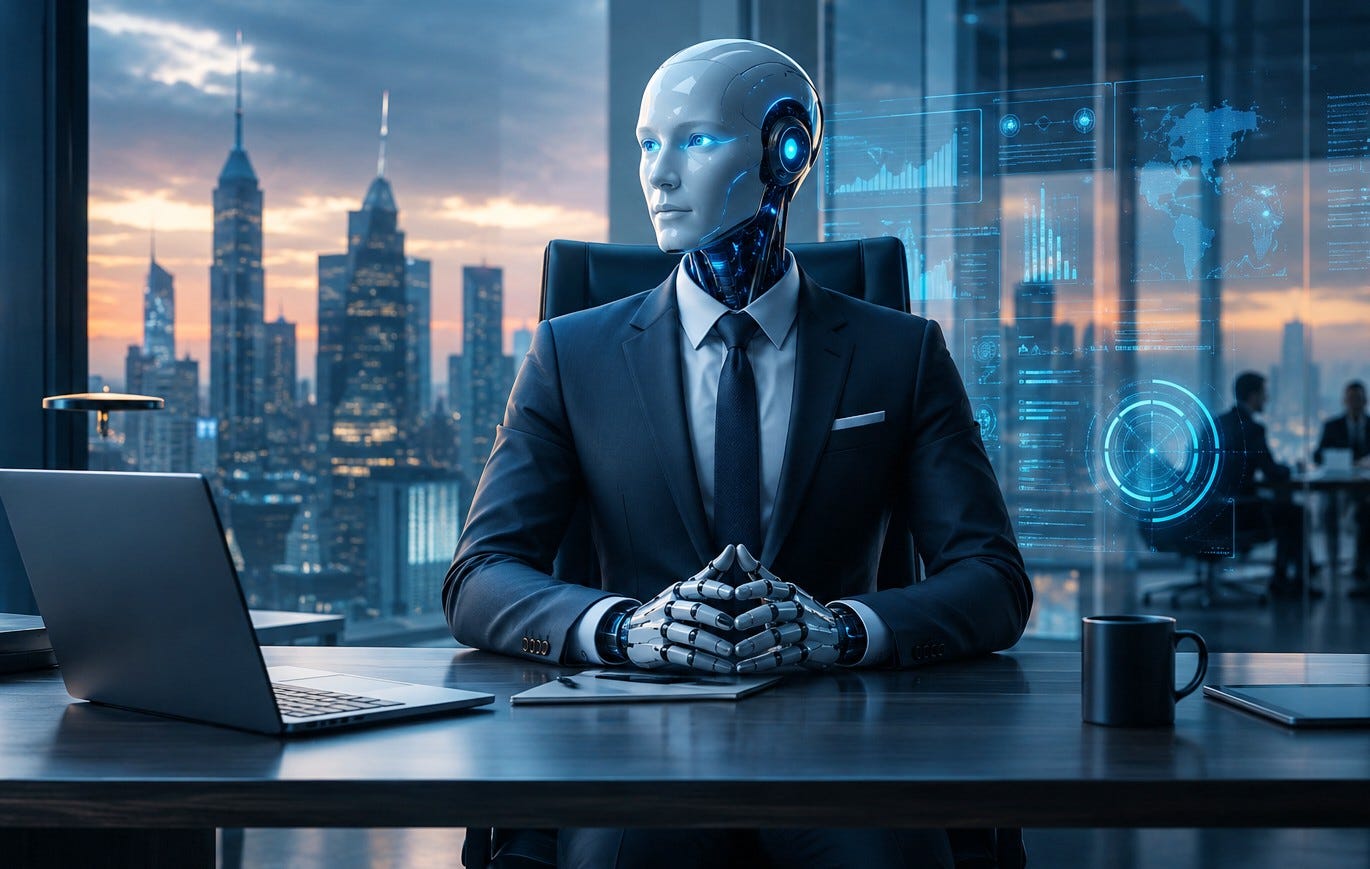
If we mean the system making most operational decisions inside a company, the timeline is much shorter. In that sense, I think the first real AI CEOs will appear within the next five years, especially in small companies, startups, and digitally native businesses.
The AI Trajectory
That prediction may sound aggressive, but it is consistent with where AI is heading. The important shift is that AI is no longer limited to answering questions. It is moving toward agents that can complete tasks, coordinate workflows, monitor performance, and act across software systems. Once AI can plan, execute, measure, revise, and communicate, it starts to move from assistant to operator.
That matters because a large part of the CEO role is information processing. CEOs review data, interpret markets, allocate resources, evaluate risks, communicate priorities, and make decisions under uncertainty. AI already performs parts of that work better than humans. It can analyze financial reports, customer complaints, sales trends, hiring needs, and operational bottlenecks at a speed no executive team can match.
The Harder Part is Judgment
A CEO is not just an optimizer. A CEO handles conflict, ambiguity, reputation, trust, culture, fear, and politics. When a product fails, when regulators arrive, when employees revolt, or when a major customer walks away, leadership becomes more than data analysis. It becomes human accountability under pressure.
That is where AI still falls short.
Dario Amodei, the CEO of Anthropic, has become one of the most forceful voices, warning that AI could automate large portions of white-collar work within the next several years. His perspective matters because Anthropic is one of the companies building frontier AI models, not an outside consulting firm speculating from the sidelines. When someone in his position warns that AI could reshape technology, finance, law, consulting, and entry-level knowledge work within one to five years, leaders should pay attention.
Demis Hassabis, the CEO of Google DeepMind, brings a different kind of credibility. He is not only leading one of the world’s most advanced AI research organizations, he is also a Nobel Prize winning scientist whose work has helped push AI into scientific discovery. Hassabis has suggested that artificial general intelligence could arrive around 2029. Whether that timeline proves right or too optimistic, it signals how quickly the people closest to the frontier believe the technology is moving.
The First AI CEO Won’t Look Like a Robot
It will look like a company where an AI system runs the operating rhythm. The AI reviews performance daily. It recommends hiring. It adjusts marketing spend. It evaluates product roadmaps. It flags cash flow risks. It generates board updates. It assigns priorities. It may even negotiate with vendors or customers through an avatar interface.
A human founder may still hold the title. A board may still require a person to sign documents. Yet the real executive function may increasingly belong to the AI.
This is where governance becomes the bottleneck. Gartner, one of the most influential technology research firms advising large enterprises, has warned that many companies may have to scale back autonomous AI agents because they lack proper controls. That tells us something important. The technology may move faster than the systems built to supervise it.
Accountability is the Last Human Moat
That moat may hold for a long time legally. Functionally, it is already narrowing.
My prediction is this: the first AI avatar to be called a CEO will arrive before 2030, probably in a small private company. The first AI system to effectively run a major company will take longer, likely sometime in the 2030s. The title may still belong to a human, but the work will increasingly be done by the machine.
The future CEO may not be replaced in one dramatic moment. The role may be hollowed out task by task until one day we realize the avatar has been running the meeting for years.
Comments
Nothing yet. Say the first thing.
Sign in to join the conversation.