
In The Land of The Free, scientists have started carrying burner phones for fear of being stopped at borders and having their devices searched, foreign-born college students are being deported for voicing political opinions that don’t fit with right-wing political priorities, and The Trump administration is gleefully withholding cash or defunding research into a wide variety of things that don’t align with their agenda.
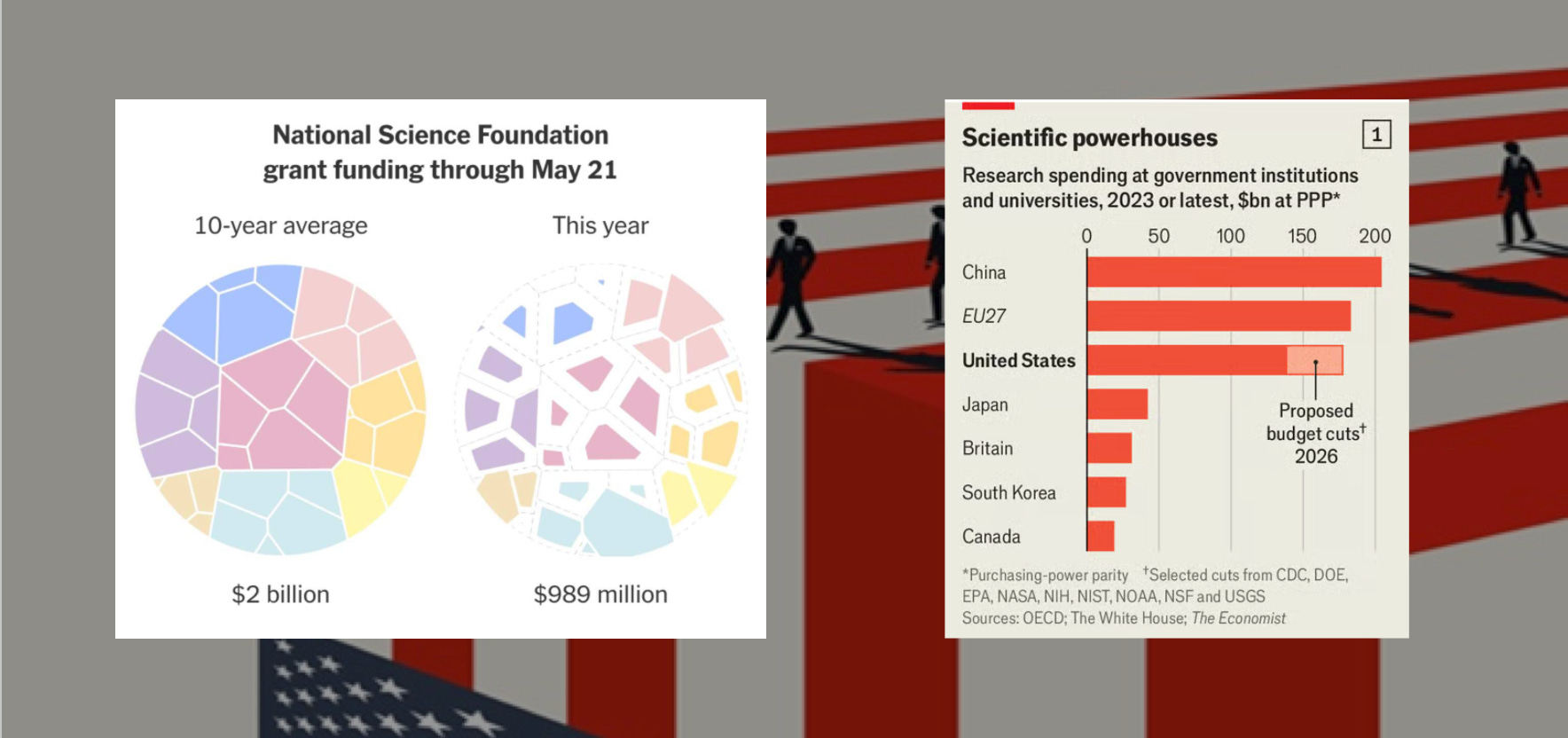
This includes things like slashing $11 billion from the budget of The Centre for Disease Control on Pandemic Research (which seems like a splendid idea on the heels of the worst Pandemic in more than a century)1. It also means severe budget cuts to agencies like The National Science Foundation, the National Institute of Health, and NASA, and in doing so defunding research into climate change, vaccines, and misinformation.
With this Moronic Inferno, the administration risks dismantling the research and technology apparatus that has made the USA an innovation superpower over the course of The American century. They are refashioning the country into a place that is hostile to the cause of science and intellectual enquiry, and it’s starting to have an effect.
You could call it The Big Beautiful Trump Talent Slump, but let’s try a more snappy name:
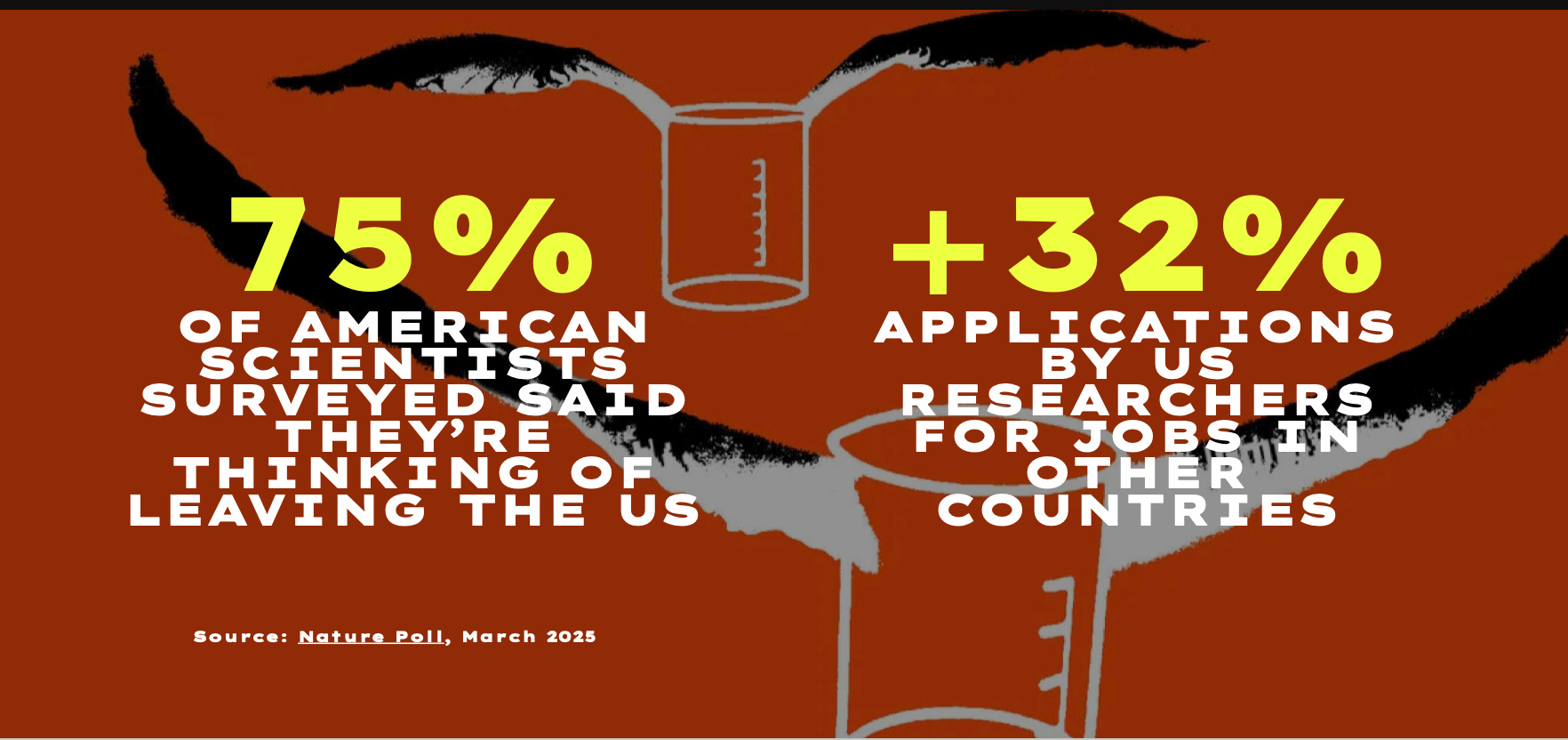
The upshot of all this interference and hostility is visible: a recent survey from Nature2 revealed that a lot of scientists are already searching for the exit:
Potential PHD candidates are already looking to other countries as destinations for a life of intellectual freedom, and it’s starting to show in audience interest in tech job adverts too.
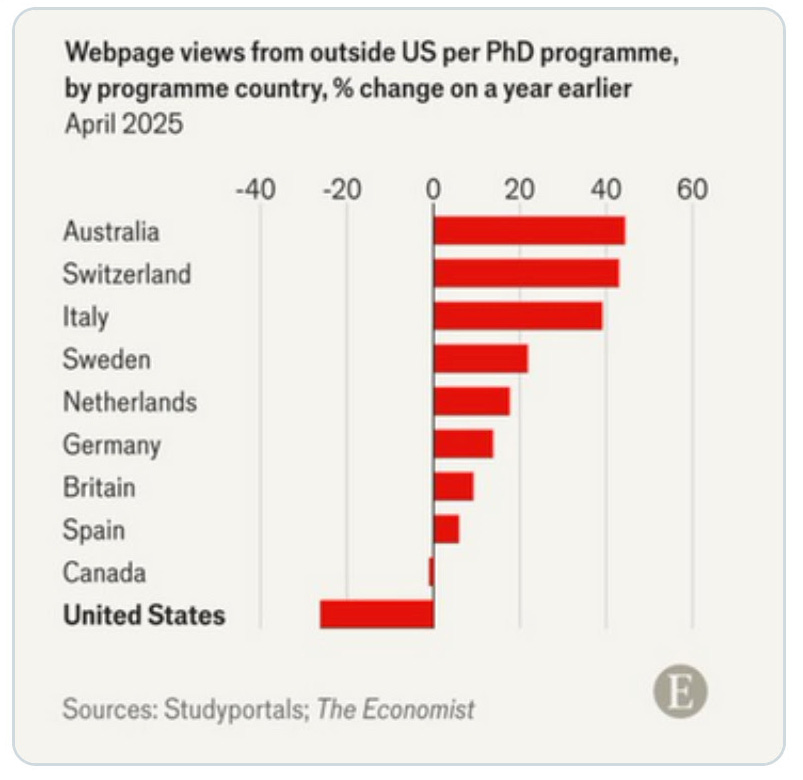
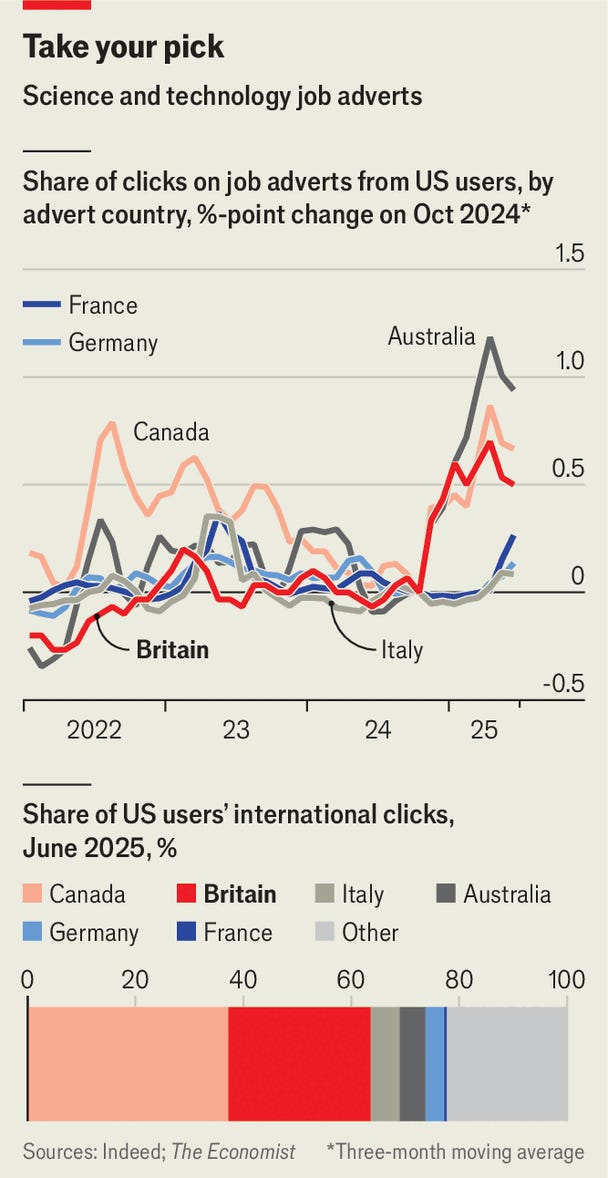
It makes sense that when you attack the people who have helped turn your nation into a technological and economic superpower, those people will look to leave, fast.
The last time this scale of talent exodus occurred was in the run-up to World War Two, when leading physicists and researchers like Albert Einstein, Nils Bohr, John Von Neumann, Enrico Fermi, Max Born, Leo Szilard, Edward Teller and various others found new homes in Britain and in America after fleeing Europe.
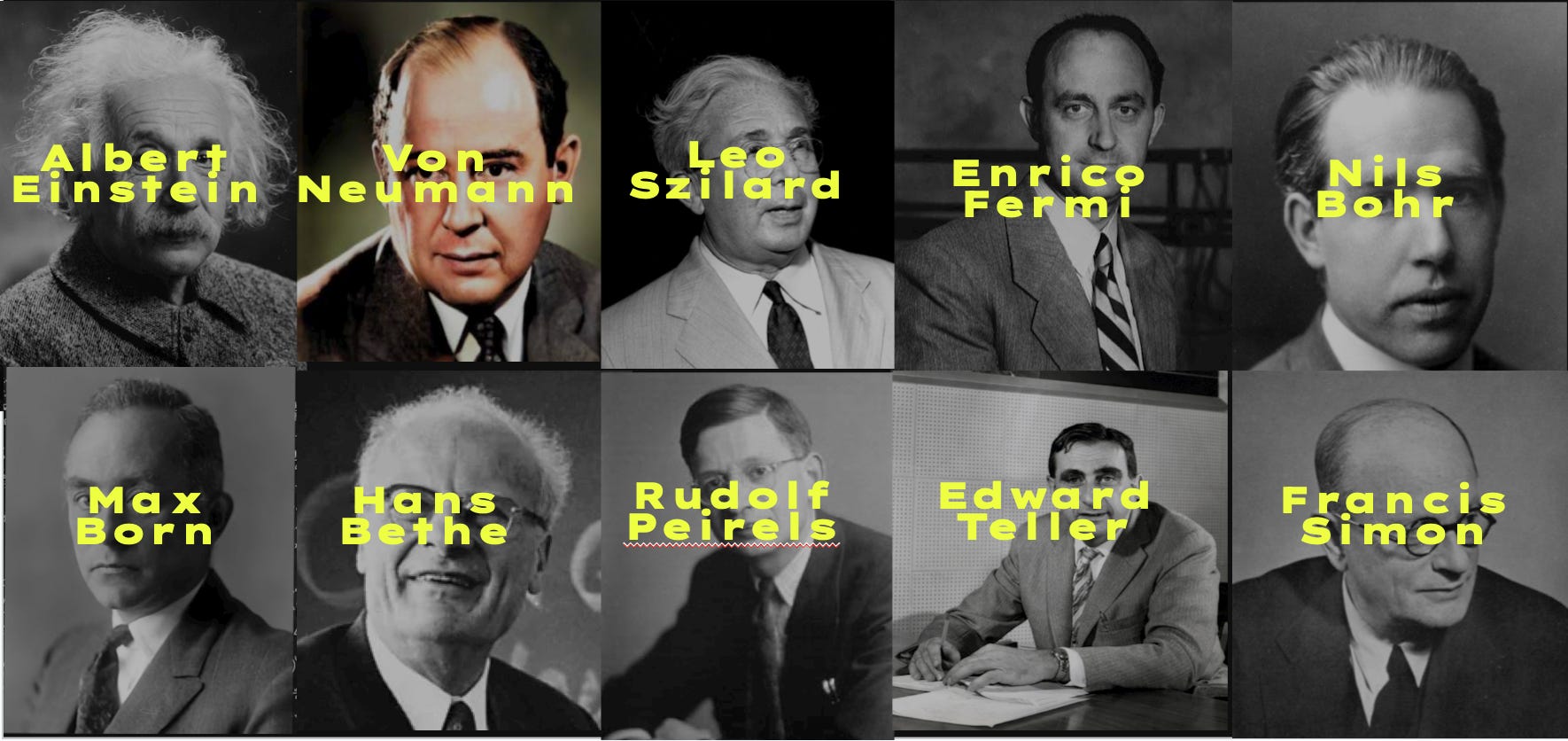
This transformed America from a scientific backwater to a superpower that was home to some of the leading lights of theoretical physics. It’s now happening in reverse, and whilst lots of countries could benefit from it, I believe that this talent should be coming to one destination in particular: my home, the United Kingdom.
The UK should be trying to become both sponsor and beneficiary of the knowledge these talented individuals bring, and aim to actively recruit the kind of minds that can generate ideas that will jolt our flagging productivity and enrich the intellectual and civic life of our nation. Also: we need these people!
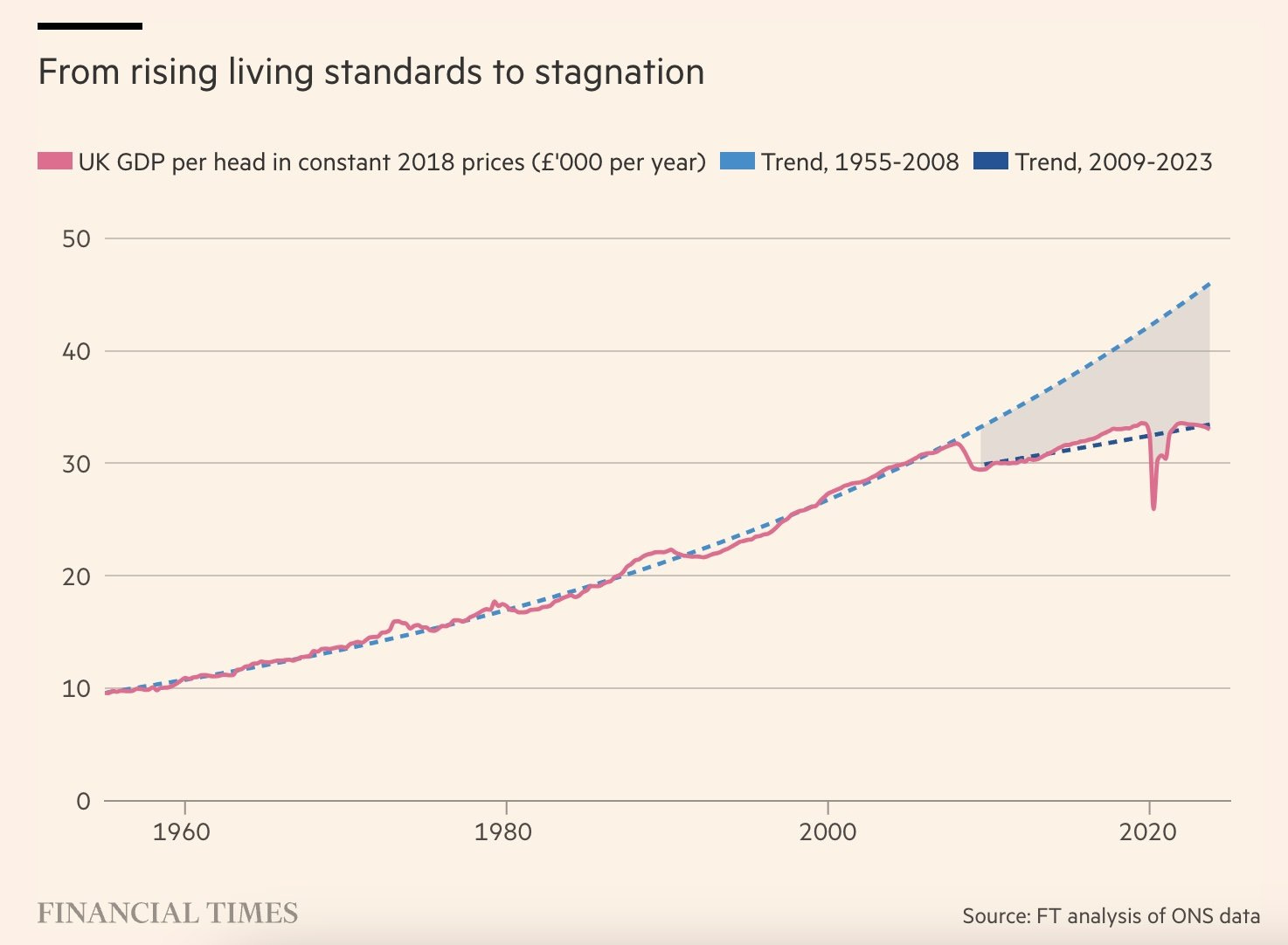
Our economy has stagnated for a decade, and there is a scientific economic surplus3 that comes with being a magnet for truly great minds and thinkers.
America’s got talent, Britain needs it, and some applied creativity could help us get it - but only if we act swiftly. Several European institutions and global players are already trying to capture this outflow of people4: whilst the UK government has created a global talent fund5 designed to provide a pathway to get the right minds here, mass communications are a massively under-rated lever for gaining an edge in attracting such a high-value audience whom every country on earth wants to choose them.
There are plenty of good reasons for leading American intellectuals and scientists to move to the UK, not least of which is the fact that many of their countrymen are already doing so. The talent exodus began in anticipation of the last election:
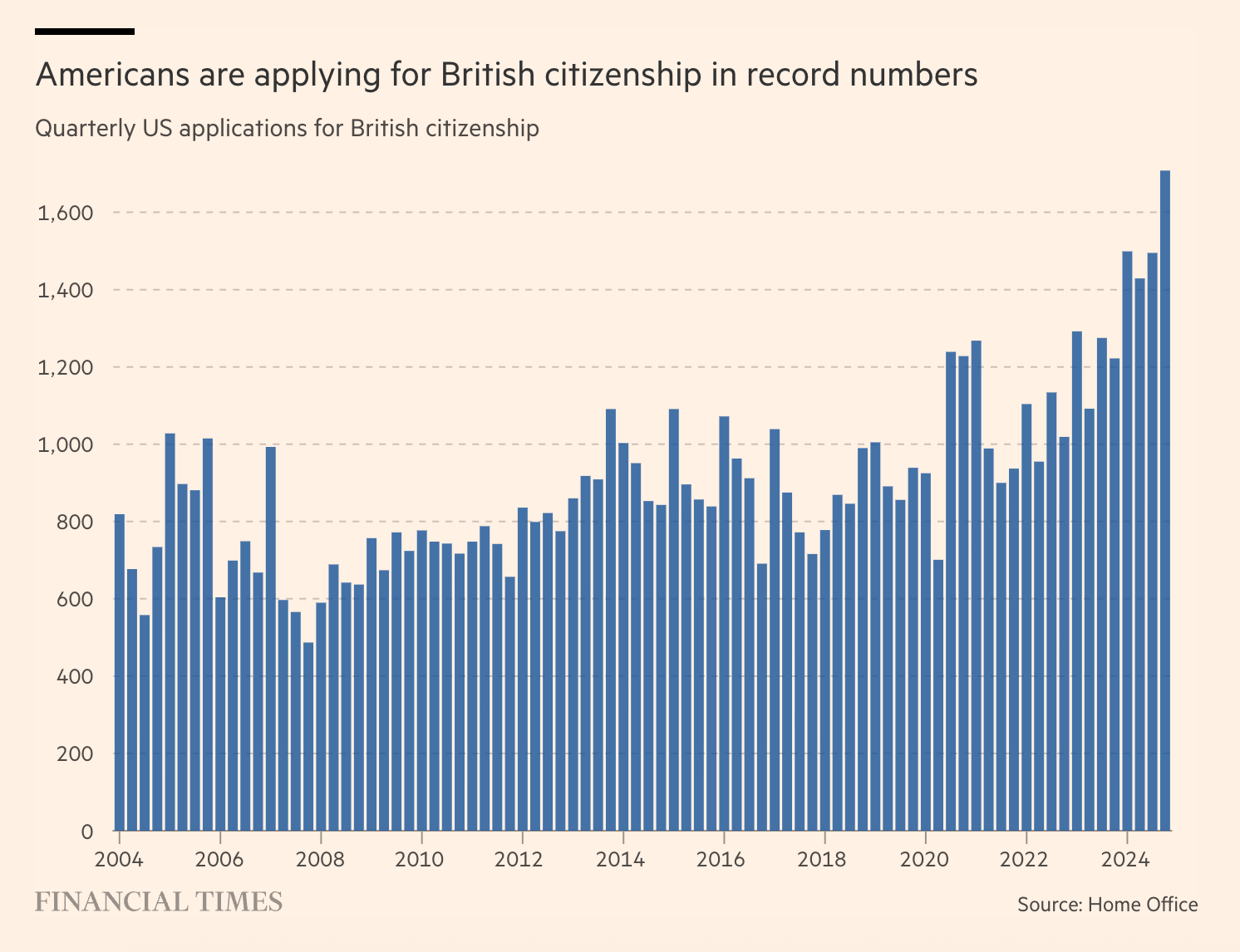
US applications for UK citizenship hit a record high last year at more than 6,100, a 26% increase from 2023. There was a 40% year-on-year rise during the final three months of the year, around the time of Trump’s re-election. About 6,680 American students applied for UK courses for the traditional deadline at the end of January this year, according to UCAS, the national universities admissions service, which marked a 12% increase compared with last year, and the highest number since records began in 20066. This is causing strange side-effects, not least of which is Americans starting to treat The Cotswolds as The Hamptons of England.
Beyond simply herding effects, the UK has a great deal to offer world-class talent who might once have chosen the US: a history of scientific enquiry and intellectual freedom, world-leading academic institutions, a strong funding and venture capital ecosystem, and our unique access to US, European and global markets - many of which have been highlighted by the former head of the UK’s Advanced Research and Invention Agency, Ilan Gur7.
However, above and beyond all of these rational appeals are the two killer reasons to choose the UK: a common language, and a once-similar culture of political moderation and intellectual liberty.
Or, as Americans prefer to call it: Freedom
The approach is simple: America used to be big into freedom. So let’s communicate to scientists that for people who want to work and think without interference, the UK is The Land of The Free.
We should be reminding people that the UK is a place where talented thinkers are free to study, create, research, invent, and to dream without political interference.
I also believe that whilst much of the cultural dialogue has been about how to recruit the sort of rockstar thinkers who might already be on the path to a Nobel Prize, putting out a clarion call about intellectual freedom will also appeal to more burgeoning minds and the next generation of talent.
So that’s the creative strategy - how could we do it?
There are a range of communications strategy approaches that could be deployed to make sure that this message reaches the right people, but it would need 3 key pillars:
Creative Communications - the UK should pursue active creative measures aimed at high-value US scientific leavers, which could be including but not limited to: contextual out-of-home or geotargeted creative messages near the right US campuses and research clusters, advertising in relevant publications and platforms that self-select for the right talent, and targeted influence messaging on social media using relevant spokespeople. If necessary a range of different creative messages and strategies could be tested to see what is most effective.
Think about these sort of ad-cum-intellectual puzzles designed to recruit bright minds in The Bay Area:

Or this sort of subtle, ‘if you know, you know’ recruitment advertising for Britain’s Secret Services:
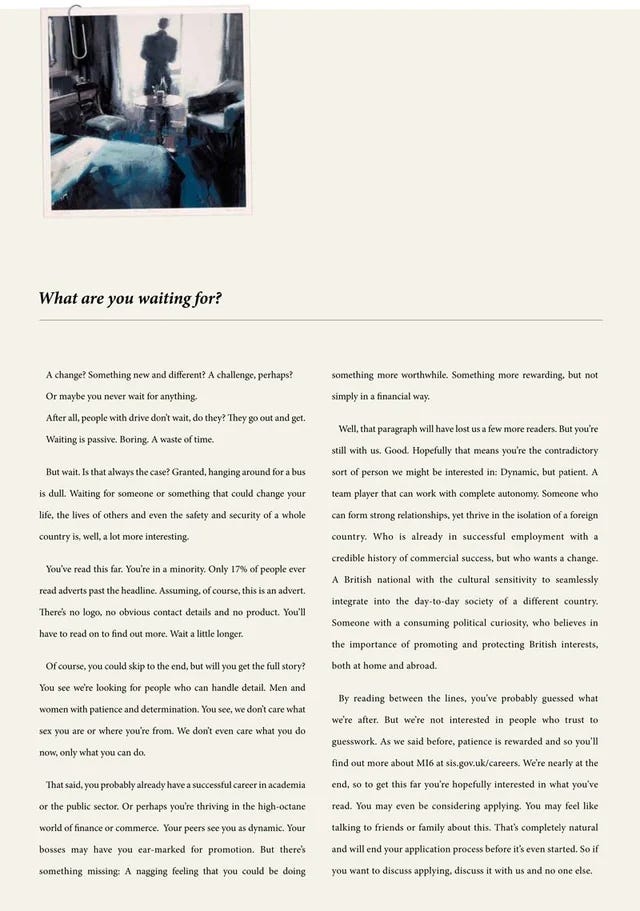
A First Point of Contact - a simple data collection/talent triage website to serve as a first point of contact to collect contact details and start a conversation before onward referral to the right organisation or university. The fact that we now have a fund designed to handle the financial machinery is great, but if one doesn’t exist already then a central repository for outreach would allow better matching and allocation of the right minds to the right places.
Client Partner - Before all of this, this approach requires a sponsor organisation - which could be an academic institution, entrepreneurial body, private sector organisation or some coalition of the willing combining all of the above - that might act as patron for such work and have the credibility to attract such talent. My belief is that this would be better accomplished outside any formal trade bodies or governmental institutions as there are clear political reasons why the British government might be hesitant to make official public overtures to American talent for fear of jeopardising trade deals, attracting tariff reprisals etc.
Now, dependent on whether you’re a believer in the power of creative influence or an utter cynic about such things, you may question what difference such things could possibly make. But if the UK can spend somewhere in the region of £20 million a year trying to convince people to visit us on holiday, surely we can invest in the off-chance that it might work to attract some of the smartest and most desirable citizens in the world?
If you are willing and able to make this real through contacts, funding, institutional connections or sheer force of will, please steal this idea or drop me a line.
https://www.gov.uk/government/news/leading-lights-of-uk-research-spearhead-search-for-worlds-best-talent
No posts
Comments
Nothing yet. Say the first thing.
Sign in to join the conversation.