
Leadership development programmes are everywhere and consume huge amounts of money. They promise transformation, equipping participants with the skills, insights, and networks to drive change. From corporate boardrooms to humanitarian organisations, in-house and cross-sector initiatives claim to shape the leaders of tomorrow. But do they?

Despite the proliferation of these programmes, there is surprisingly little evidence to confirm their impact. Do they actually enhance leadership capacities? Do they lead to better decision-making, collaboration, and organisational change? Without robust evaluation, we are left with assumptions rather than facts. That’s why evaluating leadership development programmes matters. This article explores how to do that well.
But before diving in, it helps to define what we mean by leadership development. As I outlined in an earlier article, leadership is not just about individual competencies; it involves relationships and collective action. The humanitarian sector, for instance, is full of challenges, from crisis response to funding constraints and decolonisation debates, contexts in which leadership is not merely about skills but about fostering reflective spaces, collaborating and influencing while being influenced.
To evaluate these programmes effectively, we must assess more than just participant satisfaction. We need to ask whether these programmes are grounded in robust theory and whether they lead to meaningful changes in leadership practice and team effectiveness.
To conceptualise what an approach to evaluation looks like, I suggest drawing on Outcome Mapping (OM). OM is a planning, monitoring, and evaluation methodology that places people and actors at the centre of change processes, defining outcomes as changes in stakeholder behaviour. It distinguishes between what a programme team can control (e.g. the planning and delivery of the programme), what it can influence (e.g. the attitudes and practices of participants), and what it can merely hope to affect (e.g. the teams, organisations and networks that participants are a part of and the client groups they wish to serve).
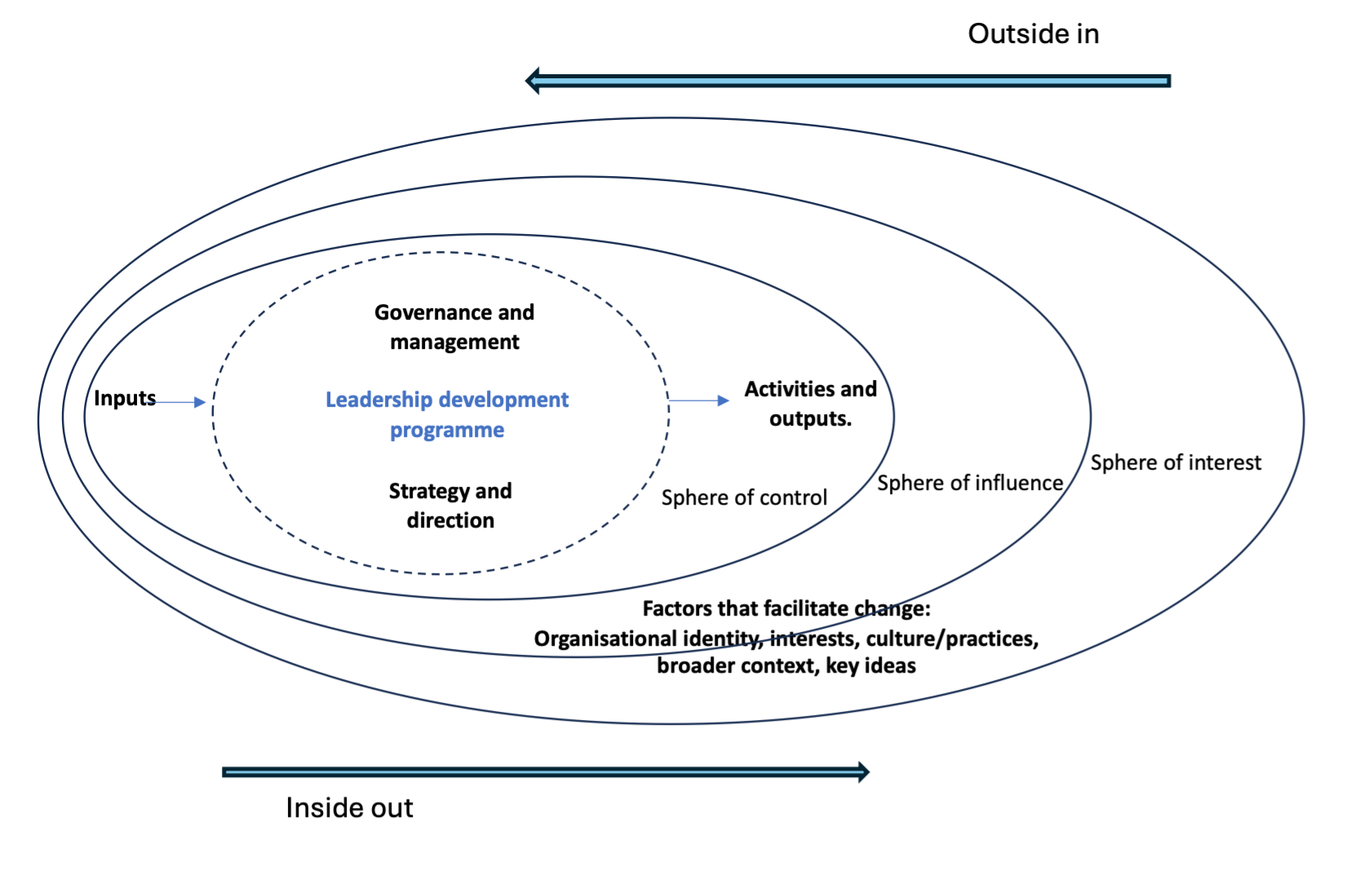
Overlaying this with a framework developed by the Overseas Development Institute for monitoring and evaluating policy research provides a structured approach. This framework delineates several activities within the programme’s sphere of control, including (see diagram above):
Inputs: examining resources such as time, budget, staffing, expert input, and stakeholder relationships. Were these inputs sufficient? How did they evolve over the programme’s duration?
Strategy: assessing the programme’s conceptualisation of leadership and the methods used to enhance leadership capacities. Was the programme designed appropriately for its objectives? Did it have an effective monitoring and learning framework?
Governance and management: investigating whether the leadership and management of the programme itself modelled behaviours participants could replicate. Often how you bring about change is the change you get. In addition, did the recruitment process select the right participants?
Activities and outputs: evaluating the quality of the programme’s offerings, such as coaching, webinars, and retreats. Were they appropriately tailored to participant needs? For example, did coaching sessions incorporate a psychosocial perspective? Did retreats provide space for meaningful reflection?
Beyond the sphere of control, the spheres influence and interest involves:
Outcomes: leadership does not exist in isolation; it is shaped by and shapes systems, relationships, and environments. Evaluation should assess not just individual competencies but also the relationships and group dynamics within teams and communities.
Given the complexity of leadership development, focusing solely on intended outcomes is insufficient. Leadership programmes often yield immediate knowledge shifts, but deeper changes in behaviours and relationships unfold over time. Therefore, evaluations should consider both intended and unintended outcomes as well as those that emerge in the short term and those that develop later within the timeframe of the evaluation.
Specific outcomes include:
Programme completion and immediate reactions: assessing participant completion rates, reasons for dropout, and initial responses to the programme.
Changes in individuals: examining shifts in knowledge, risk-taking, collaboration, and formal roles (e.g. promotions). This also includes changes in capacities such as sense making, practical judgement and reflexivity, embracing negative capability, working effectively in groups, engaging productively with power dynamics, persuading others through compelling narratives of change and empowering their peers.
Changes in relationships: investigating whether participants improve their ability to navigate differences, work creatively, and build healthier professional relationships.
Group and network dynamics: exploring broader impacts on teams, organisations, and networks, including shifts in organisational culture and downstream policy changes.
Evaluation needs to consider the range of external factors which enable and/or hinder programme success. These include:
Personal and professional circumstances: career stage, job transitions, personal crises, authority and available resources.
Workplace environment and networks: organisational support, access to on-the-job training, and leadership backing.
Country and regional contexts: social and political structures of power, cultural attitudes toward authority, discrimination, and legal structures.
Critical junctures: elections, leadership changes, crises, or major policy shifts.
Discourse and ideas: prevailing narratives about leadership and organisations and the roles and behaviours expected of leaders and their followers.
To assess impact, I propose combining what I call an ‘inside-out’ approach with one that takes an ‘outside-in’ approach:
Inside-out approach: develop a conventional theory of change, tracing progress from inputs and activities through to shifts in participants’ leadership practices and the teams they work with.
Outside-in approach: collect evidence of any changes that have occurred in participants' practices or within their organisations and then tracking back to explore contributory factors including the role of the programme.
The inside-out approach risks overstating the programme’s impact, while the outside-in approach risks understating it. A combination of both provides a balanced perspective.
But what does this mean in practice?
Taking an inside-out approach entails undertaking a review of existing data, including pre- and post-course surveys, reflective commentaries, course evaluations, and reports prepared by the programme delivery team. This might be followed by semi-structured interviews with programme delivery team members, coaches, experts, facilitators, and trainers to explore the strategy, governance, and activity elements of the conceptual framework. These interviews can also help understand the perceived effects of the course on participants and their relationships.
An outside-in approach entails drawing on a selection of the following:
An online survey with selected participants, featuring Likert scales and open-ended questions to capture the impact of the programme on their knowledge, qualities, practices, and relationships. Participants may also be asked to share stories or examples describing how the programme influenced them.
Follow-up semi-structured interviews with participants to delve deeper into their experiences and the programme’s effects on their behaviours and relationships.
Incorporating 360-degree feedback, with surveys and/or interviews conducted with participants’ line managers and/or colleagues to assess their performance within the organisation. However, acknowledging the potential biases and perceptions in such feedback, we suggest complementary approaches.
Learning conversations among specific cohorts of learners (in groups of 6-8) to discuss their experiences and observe how they have evolved.
Convening teams or colleagues of selected participants to discuss the programme's impact on team and organisational dynamics, potentially exploring live scenarios to assess the programme’s contributions.
Conducting Social Network Analysis (SNA) to evaluate changes in participants’ relationships, focusing on the expansion and strengthening of networks at various levels (peer/team, organisational, field, and collective leadership).
Writing up a small number of detailed case studies that integrate data from the methods listed above.
While attributing knowledge gains to a programme is straightforward, assessing deeper behavioural and relational changes is more complex. One possible method is using a control group of qualified but non-participating applicants. However, there is a risk of contamination, as control group members may experience similar influences. Instead, qualitative approaches can explore the programme’s unique contribution within the broader context of each participant’s development.
This would involve exploring how the leadership programme’s impact interacts with the broader mosaic of influences shaping participants’ leadership practices. Key questions might include:
How did the programme contribute to changes in outcomes?
Did particular components contribute more than others?
How did the programme's contribution compare to the effort and investment involved?
Did the leadership programme fill a specific niche or address a gap in participants' lives or careers that other influences did not?
This approach allows for a nuanced understanding of the programme’s unique role within the broader context of each participant’s development, ensuring that its contributions are assessed in relation to the multitude of factors at play.
If leadership development programmes are to fulfil their promise, they must be held to account. Evaluations should be transparent, rigorous, and rooted in the realities of leadership as it is practiced, not just as it is theorised.
So the next time you hear about a leadership development programme promising transformation, ask: How do you know it works? If they can’t answer, they might not be worth your time.
No posts
Comments
Nothing yet. Say the first thing.
Sign in to join the conversation.