
I woke up to a message from dearest Roshi. She’d sent me her essay, published July 4 — The Unfinished Vow.
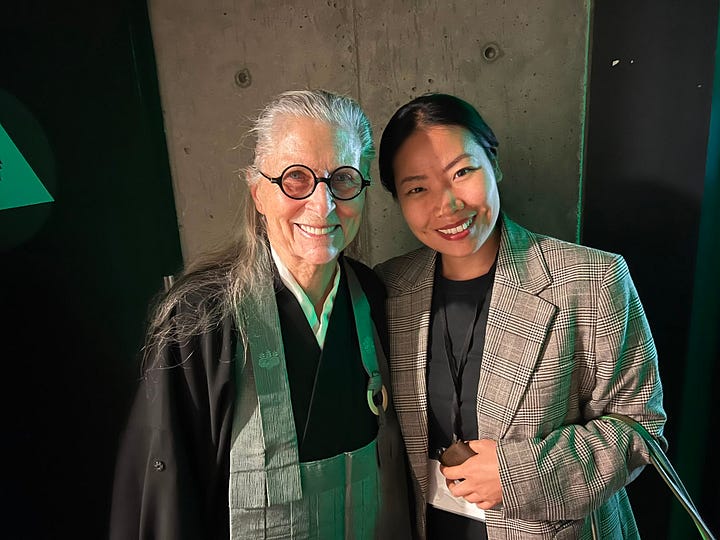
I met Roshi Joan Halifax in San Francisco in 2023. I already knew her work by reputation — decades of humanitarian relief, engaged Buddhism, leadership that never once separated itself from the world’s suffering. But meeting her was different. She walked onto that stage and her presence filled the room before she said a word — grounded, strong, and impossibly soft at the same time. She unfolded her papers and opened with: “I tried using AI for my script. It did a terrible job, so I’d rather be myself and be analogue.”
The room laughed. Then she spoke, and it wasn’t a performance of authenticity — it just was.
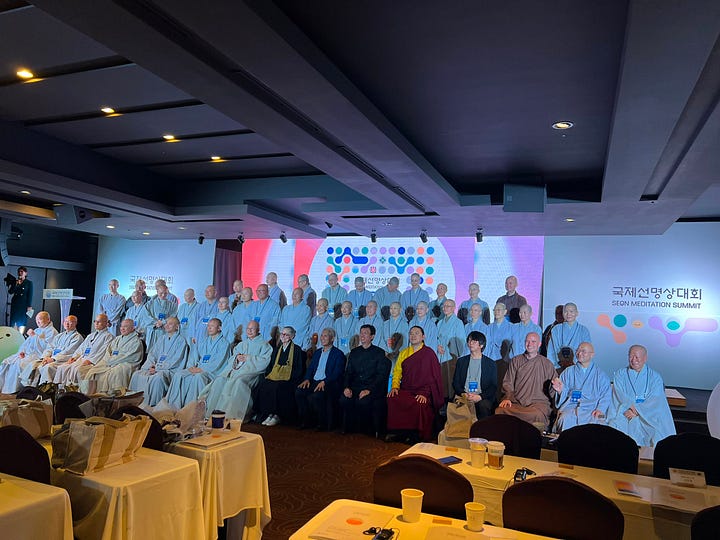
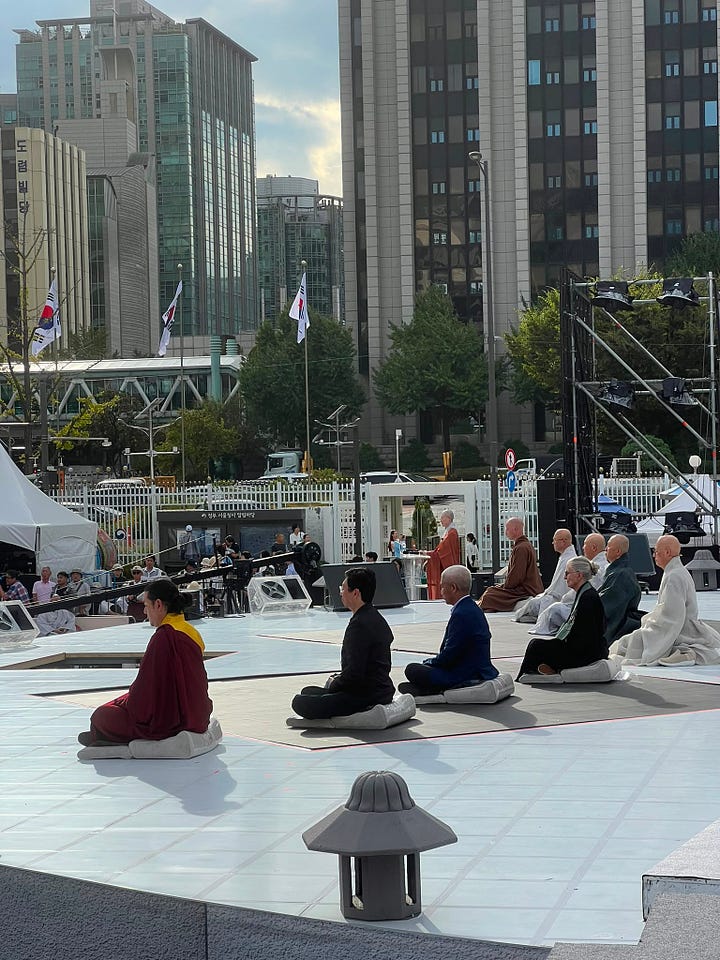
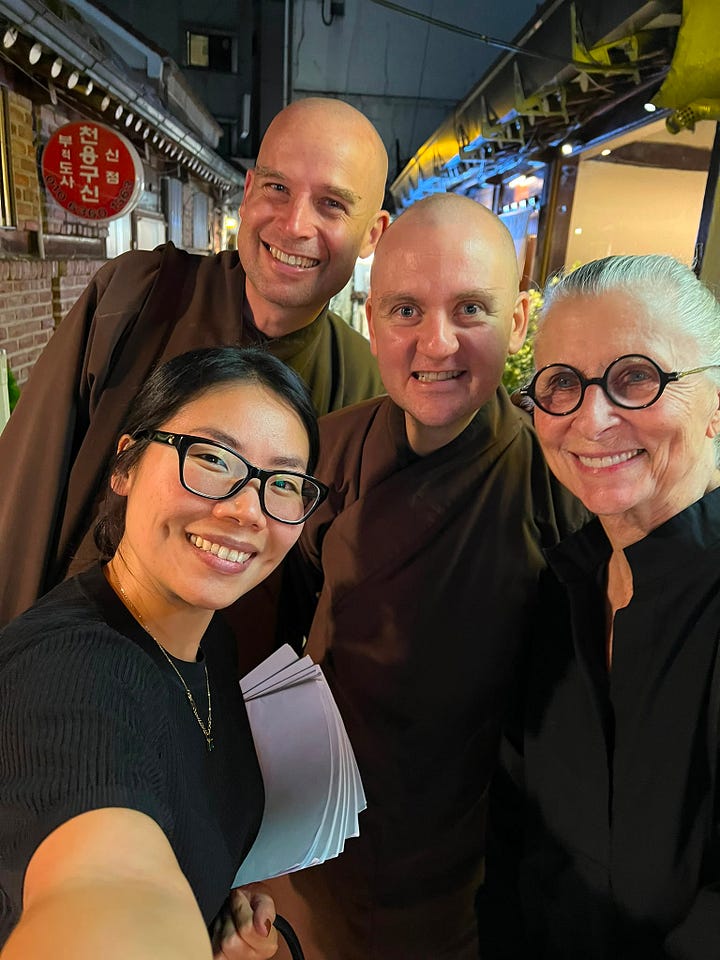
A year later, I met her again in South Korea, where we were organizing the first International Seon Meditation Summit hosted by the Jogye Order of Korean Buddhism. This time I got to be close to her in a smaller way — early coffee walks, breakfast at the hotel, ordinary conversation that kept sliding, gently, into the Buddha’s teaching, the way it does with people who’ve actually integrated it.
She is one of the great living teachers, and specifically as a woman who has lived through war, through generations, across continents, doing this work without flinching — she gives me something I can only call confidence. Not confidence that it will be easy. Confidence about where to walk, and how.
Roshi’s essay opens with an old story - a poet climbs a mountain to ask a monk who lived in a tree what the essence of the teaching is. The monk gives him the line every child already knows: don’t do evil, do good, purify your mind. The poet is almost insulted - a three-year-old could say that. And the monk answers him: “a three-year-old can say it. An eighty-year-old cannot practice it.”
I know exactly what he means. Under the strong sun, mid-bow, I wanted nothing more than to take that robe off, it doesn’t breathe, it doesn’t flow, and my body wanted air more than it wanted enlightenment. In a meeting, mid-disagreement, the “I’m right” arises exactly the way it did before I ever sat down to practice. Carrying rocks, sweeping the floor, cleaning the toilets every single morning, my mind still goes “ugh, this is hard.” Standing in front of a kitchen menu, “ooh, that looks so good”, same automatic, sense-based pull toward pleasant, same automatic recoil from unpleasant, whether I’m in a robe or in the clothes I’m wearing right now.
The robe didn’t remove any of that. What it did was hand me a sharper, more constant reminder not to act on it, not to feed the reaction with a response. And over years, the reaction does get thinner. Lighter. More subtle. But it may never disappear, and there is no ceremony where you get handed a certificate that says done. Roshi’s essay says it plainly: the eighty-year-old can’t master it because there’s nothing to master. Only this moment’s not-doing, and then the next one. I refrain now. Then I have to refrain again, ten seconds later, when the next thought shows up wearing a different face.
This is the part I keep coming back to: the choice is never between a hard life and an easy one. It’s the same small choice, over and over, all day: this breath, comfort or discomfort, ease or hard. The lotus doesn’t get to skip the mud and still bloom. The mud is the condition, not the obstacle. So the question was never how do I get out of the mud. It’s what do I keep choosing while I’m standing in it.
I felt that same choice, oddly, building a mindfulness tech startup during the pandemic. My co-founder and I were building an app and a whole platform with engineers, doing exactly the kind of “innovation” everyone said the mental health space needed. Every moment was negotiation and compromise to me: which yoga teachers to work with - no, she’s too commercial; what words to use - no, that’s too serious, too Buddhist, too academic; where to showcase our service - that’s a bit too traditional, no one will find us there; where the button should go; how to measure improvement; do we really need to quantify and qualify these elements, isn’t that against the essence of the Buddha’s teaching? Does this harm the essence of mindfulness? Industrializing and commercializing my value and philosophy in a modern way, without becoming commercial and materialistic, pretending to be cool yet not cool, was the most difficult part of all.
And the one thing I kept repeating, in almost every hard conversation, was: we have to be the team that never gives up on humanity (on the human experience) even while we’re the ones adapting all this tech, because what we are actually building and delivering is mindfulness. Funny how stubborn I was, resisting even getting an Apple Watch to understand the innovation and movement happening in health tech, to build this service. Part of me felt dragged, forced to be “techy,” against the human-driven values I was holding onto.
That tension wasn’t just mine. It’s the one this whole generation is negotiating, quietly, every day. We reach for AI to write the email, perform as our agents, plan the meal, hold the conversation we’re too tired to have, and each time, something small gets outsourced that used to be ours to carry. Attention. Patience. The discomfort of sitting with a hard question before answering it. None of this is evil, exactly. That’s what makes it slippery.
It’s not a single harmful act I can point to and refuse. It’s a thousand small conveniences, each one reasonable on its own, adding up to a mind that’s forgotten how to be with itself unassisted. Dogen’s teaching was never only about grand evils. It was about the moment nobody’s watching - the reflex, the shortcut, the thing you didn’t even notice you let a machine do for you, and eventually votes and consumption feeding the giant evils. That’s the mud my generation is standing in now: not war, not obvious cruelty, but a slow erosion of the muscle that makes us human in the first place - presence, friction, the willingness to not-know before we ask something else to know for us.
That sentence I repeatedly said to the startup team was its own small mud. It would have been easier to just chase the metrics, ship the feature, let the human part quietly thin out. I chose the harder thing instead, and I still do. It’s still my ethos. I will be the one in the room reminding people what it means to be human, while the machines get smarter and try to answer that question for us.
Share Wisdom in Motion: Letters & Dispatches on Peace & Wellbeing
I’m choosing it again right now, building the Mindful Impact Community Forum for October. Venue partnerships are harder to close than I expected; corporations that used to fund impact work have quietly stopped. (In hindsight, I heard all these corporates are busy racing AI, of course they are.) Wellness is more trending than it’s ever been, and somehow my way of presenting it isn’t landing the way the trend wants it to. It’s not flashy. It’s not the aesthetic. It’s just true. The easy choice would be to make it trendier, softer, more palatable. The hard one is to keep it honest and let it grow slower. No graduation there either. Just now. And now. And now.
The Buddha said to walk this path alone, like a lion unstartled by noise. That’s a beautiful image. It is also, I’ll be honest, a very hard way to live. The bodhisattva path isn’t a decision you make once. It’s a vow you keep making, no matter the obstacle, no matter how many times the world gives you reason to stop.
Some weeks I feel small. I watch the news and it’s still genocide, still corruption, still exploitation and violence, visible and invisible, obviously in Gaza and in so many places the cameras have already turned away from. I feel small, yet I still do what I can do, today, where I am. That, too, is mud. I don’t get to wait for it to clear before I choose.
People sometimes get upset and tell me: just talk about Buddhism. As if Buddhism were a subject you could keep clean by keeping it separate from capitalism, from business, from leadership, from grief, from the news. But that’s not Buddhism, that’s a museum exhibit of Buddhism. If your practice doesn’t touch how you run a meeting, negotiate a grant, or respond to a headline, it isn’t practice yet.
So I’ll keep talking about Buddhism with capitalism, with violence, with business, with leadership, with relationship. I’ll keep talking about Buddhism with tech, with innovation, with AI. Not refusing the tools. Refusing to let them decide, quietly, what parts of being human are no longer worth the effort.
Because that’s the whole of it. There is no other kind.
Thanks for reading Wisdom in Motion: Letters & Dispatches on Peace & Wellbeing! This post is public so feel free to share it.
No posts
Comments
Nothing yet. Say the first thing.
Sign in to join the conversation.