
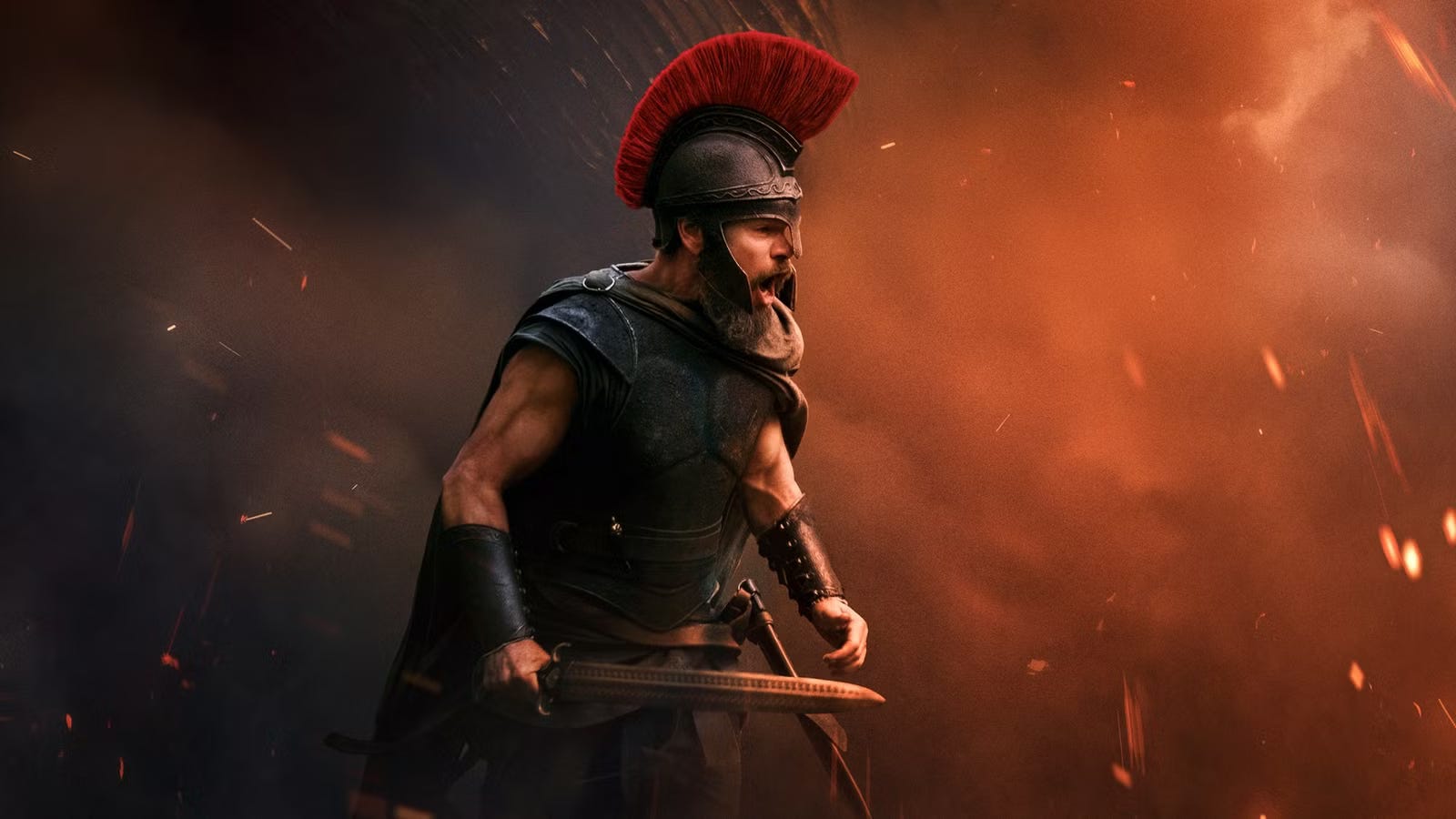
On leaving Christopher Nolan’s adaptation of The Odyssey, you are left wondering quite where this filmmaker can go next. The Odyssey truly feels like the picture he has spent the last twenty five years building towards. He could pack up the camera here and probably consider this a punctuation mark on his incredible career. He won’t, of course, but The Odyssey feels like a summation of sorts.
For one thing, all of his narrative tricks and distinctive visual ticks are apparent in how he tells this overlapping story of Odysseus, Troy, Ithaca and more. As he said to the Guardian:
“I’ve spent many years in hotel rooms like this talking about the non-linear structures of my film as if it was so radical, and then you go back to the oldest foundational literary text and it’s got an absolutely radical structure. It’s stories within stories, it’s flashbacks within flashbacks. And that immediately was exciting.”
The Odyssey feels the archetypal tale for Nolan. The story only he could truly portray with the epic, mythic scope he pulls off here.
Thanks for reading A. J. Black on Popular Culture! Subscribe for free to receive new posts and support my work.
Indeed, it might surprise some people to note, that The Odyssey most feels like a thematic bedfellow, if not sequel, to the climax of his Batman trilogy, The Dark Knight Rises. That too is the tale of an ageing hero destroyed by conflict (here Odysseus, played brilliantly by Matt Damon), with a young untrained protege (here his son, Telemachus) and an entire city (here, Ithaca) yearning for his return as vultures gather to consume what is left of civilisation. These two films feel the most directly connected in what they’re saying but The Odyssey also brings right up to date Nolan’s own thematic obsessions as a filmmaker since the beginning.
Principally, the idea of civilisation existing on the brink of destruction. Nolan’s Gotham stripped away the camp and colour to constantly, over all three Batman films, use the Caped Crusader as a mechanism to test the idea of whether society is worth saving. Ra’s al Ghul in Batman Begins didn’t believe it was. The Joker in The Dark Knight wanted to unleash anarchy to see the results. Bane and Talia al'Ghul in The Dark Knight Rises then sought to foment revolution against the gilded inequalities of the age. Nolan’s Dunkirk and Oppenheimer, both approaching the wartime era in different stylistic ways, nonetheless explore points in history of epochal change we almost didn’t survive.
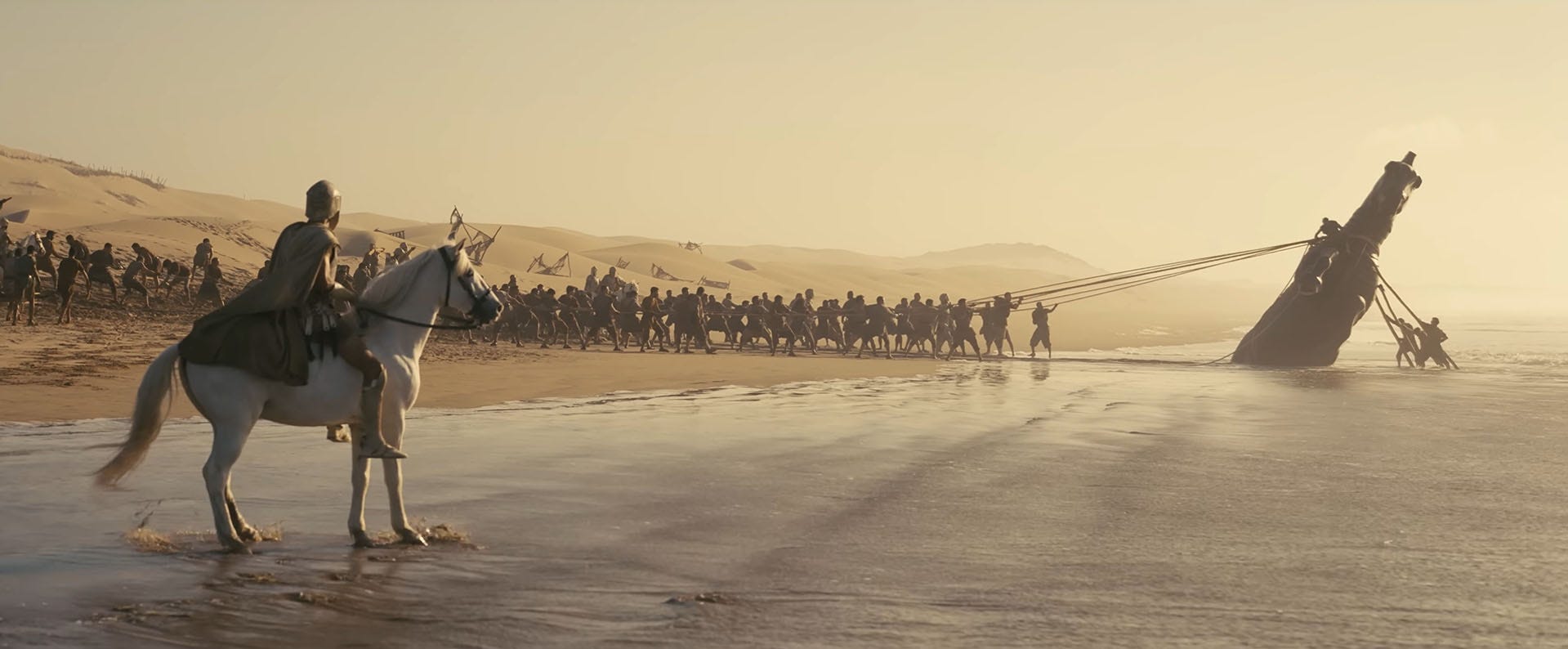
You can’t necessarily map every Nolan film onto this interpretation, but this is a director who has grown steadily more obsessed with trying to grapple with social and moray decay leading to the collapse of civilisation. That’s key to The Odyssey, which most people with knowledge of Greek myth might understandably remember principally for Odysseus’ decade-long journey encountering creatures such as the Cyclops or the Sirens (and Nolan makes great play with these aspects, which Film Stories writer Ryan Lambie accurately describes as cosmic horror). Really, however, Nolan’s take on Homer’s poem finds its centre in Zeus’ law.
Nolan loves a law. He loves a statute or a fixed tenet (see what I did there?) to arc his film around, whether it’s Murphy’s law in Interstellar or totems in Inception. Here, it’s the concept brought down by Greek civilisation’s polytheistic belief system that “no man should treat another as he himself wouldn’t want to be treated, lest he be a God himself.” The ‘golden rule’ in our society, of treating others as you wish to be treated. In the world of the ancients, Zeus serves as moral arbiter across civilisation by dint of fear. Never take your neighbour for granted as they might be stronger, or perhaps in Nolan’s ‘time of apparent magic’, be a literal God of Olympus who can smite you down.
The point being that even in this early civilisation, moral tenets exist in how man treats man (and it is a man’s world, as Anne Hathaway’s Penelope at one point justifiably rails against to her son). To break those is to defy Zeus. Yet Odysseus considers those tenets have been broken by the Trojan War, perhaps antiquity’s greatest historical battle near lost to time and myth. You know the story - the beautiful ‘face that launched a thousand ships’ Helen (Lupita Nyong’o here) ‘kidnapped’ by Trojan prince Paris, which leads her warlord brother-in-law Agamemnon (a terrifying, Darth Vader-like Benny Safdie) to launch an army against Troy to get her back. A siege. A man. A thought. A trick. A war. All that follows.
Nolan depicts Troy as a city entirely unprepared for what is described as “ten years of rage” flooding in once Odysseus in his Trojan Horse open the gates, savaged by the Greek force who kill a priestess of the God Athena (Zendaya, etherial as she pops up as a conscience guide for Odysseus throughout in the form of Athena) and slaughter thousands. And in witnessing such savagery, Odysseus is forever changed from a brilliant soldier and leader into a man troubled by the breaking of Zeus’ law, which he considers to be partly why Penelope and Ithaca are for decades bothered by ‘suitors’ who come to claim her hand, flagrantly plotting, killing and even kicking old dogs (if you didn’t hate them before, you do after how they treat poor old Argos.)
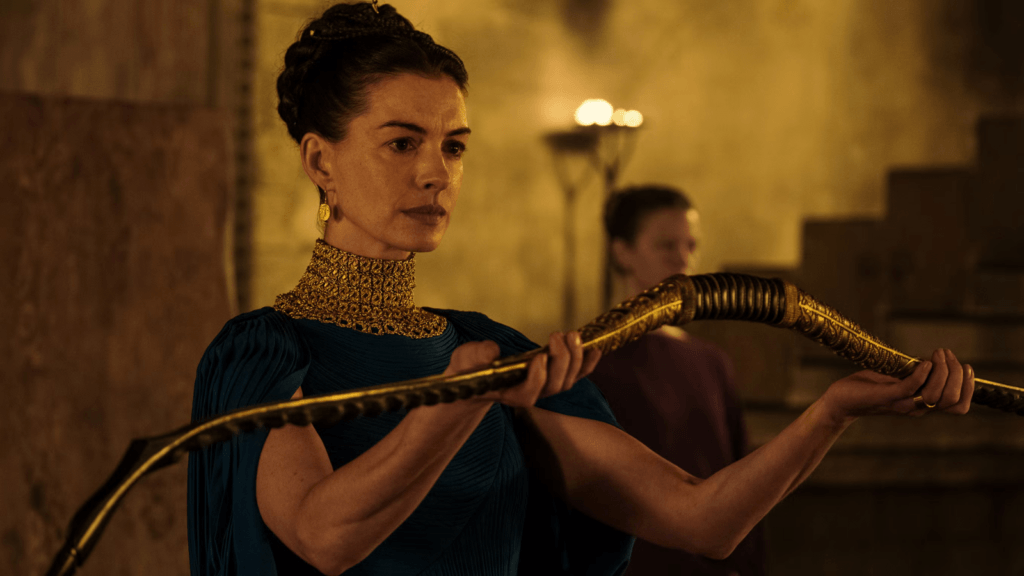
If Zeus’ law is broken, society then breaks down. Civilisation falls into anarchy. The strong begin to command the weak. It all falls apart. This, to me, is what Nolan is worried about and the parallels to Western civilisation are all too apparent currently. This was the case in The Dark Knight Rises after the economic crash, where in 2012 his ‘catwoman’, Selina Kyle (again Anne Hathaway), warned Bruce Wayne a storm was coming. “You and your friends better batten down the hatches, because when it hits, you're all gonna wonder how you ever thought you could live so large and leave so little for the rest of us.” Though Bane’s ‘revolution’ was a ruse for revenge, he capitalised on a Gotham where the rich were sitting pretty and the poor looked for hope in the form of a symbol.
It too was written over Oppenheimer, where Nolan reacted to the civilisational shock and panic of the Covid pandemic by telling the story of the man who created the atomic bomb and thereby established a Sword of Damocles that remains hovering over the world, ready to destroy it, to this very day. “I am become Death, Destroyer of Worlds” was the famed reference to to Bhagavad Gita attributed to J. Robert Oppenheimer, but Nolan could have Odysseus say something similar given his deep anxiety of what Troy wrought. He believes himself complicit in Agamemnon’s war breaking the world, breaking Zeus’ law, which in part sees him compartmentalise and allow the ‘good siren’ Calypso (Charlize Theron) to lull him into a waking sleep for years, a self-imposed exile from the life he left behind.
Here, again, Nolan draws a line back to The Dark Knight Rises. After Bane broke Bruce Wayne (literally) after the Joker’s machinations had helped destroy the symbol of Batman, and Bane threw him in the pit, Bruce had to spend months physically and mentally rebuilding himself, with the help of old mentors and sounding boards, until he was ready to return. John Leguizamo’s half blind Eumaeus could be one of the men Bruce finds in that pit, though he best maps onto Michael Caine’s Alfred as the unwavering servant who never loses faith. Calypso, albeit perhaps covering for her own desires, nonetheless is right in telling Odysseus he wasn’t ready to return and needed the years in peaceful exile with her to heal and repair until he was ready to remember.
Nolan’s films are also very attuned to the work of Joseph Campbell, and his landmark cultural anthropological study The Hero with a Thousand Faces (which I used as a basis for my own book, Myth-Building in Modern Media), which focus on the ‘Heroes Journey’. You can’t really get more archetypal around this than through Odysseus, whose entire narrative is based around facing trials in order to return home, but so many of Nolan’s films are about men trying to get back home. Cobb in Inception. Cooper in Interstellar. Various of the less characterised soldiers in Dunkirk. It’s a running theme about the power and draw of the homestead, whether a literal or figurative one, as a totemic pull for his protagonist.
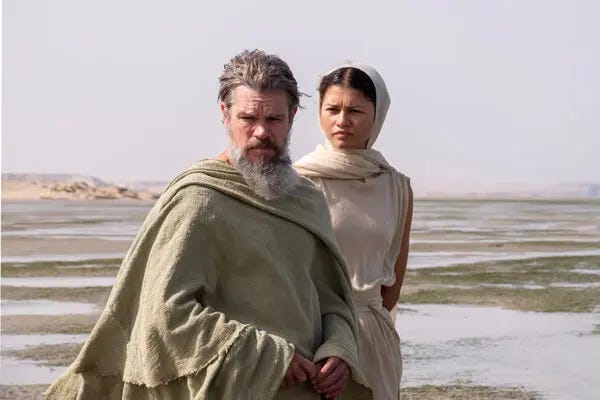
Bruce Wayne is no exception in The Dark Knight Rises and when he does return to Gotham, he mirrors Odysseus’s journey in The Odyssey. He does so in secret at first, working in the shadows with quiet allies, and eventually his own protege in Joseph Gordon-Levitt’s John Blake (aka Robin) who Telemachus (Tom Holland) maps onto very clearly. If Odysseus is strong, powerful and weathered (not to mention, frankly, a Greek myth John Wick), Telemachus is young, inexperienced and clearly not a warrior. Odysseus, much like Bruce, has no pretensions of returning as any kind of leader or King, hence why appears in the form of a beggar and follows Zeus’ law in his method of destroying the ‘suitors’, led by Robert Pattinson’s snivelling Antinous, who would come to drag Ithica’s civilisation into moral decay.
Antinous even at one point, taunting the beggar, asks if he is a God. These are men who don’t believe in a spiritual or moral law any more, laughing in the face of an old order Odysseus exemplifies. You can argue Batman’s determination to rid Gotham of those who would cause pain and suffering is a means of maintaining order, and this is something Nolan clearly believes in. Bane’s revolution against the elites might be tempting but it always masks something darker. We can see that in far-right nationalist populism sweeping the West as society faces existential challenges economically, socially, from climate, from AI. These are not people with answers but every time we open the door to them (as Penelope does her suitors) we invite the social contract, the democratic firmament, to break down further and further.
Nolan then anguishes about when the dam will break. Will it be a revolution? Will it be the dropping of an atomic bomb that destroys everything? Will it be a war that threatens civilisation? A constant underlying anxiety in The Odyssey is of the ‘sea people’, a mysterious race who in actual history have never been clearly identified but attacked Egypt and the eastern Mediterranean during the Late Bronze Age in 1200BC (roughly contemporaneous to the believed era of the Trojan War). Who they are doesn’t really matter. The civilisational threat is key. They could be AI. They could be climate. They could be fascism. Nolan fears we are opening doors we cannot close.
What Nolan has always believed in is a saviour, someone to uphold that moral fibre against the decay. Batman was that symbol. Odysseus serves the same purpose. He also believes in the power of love united against this darkness, and why he is drawn to endings where such saviours or heroes find peace and salvation through love. Cooper reuniting with his daughter in Interstellar. Cobb ‘maybe’ making it back to his kids in Inception. Bruce and Selina at the end of The Dark Knight Rises. The ending of The Odyssey is similar. Telemachus rises to become the new moral symbol as Odysseus and Penelope sail into exile, “chasing the escaping Sun.” Nolan can’t resist a romanticism in most of his endings.
Where his own odyssey exploring these anxieties goes next, who is to say. Though he crosses time periods, playing always with interpretations of time and structure, and indeed he flits between genres be they historical biopics to action thrillers or science-fiction, Nolan returns time and again to a similar thesis: we are breaking our world and we don’t have long left to fix it. He is a filmmaker who believes we can, but right now he feels this lies on the head of a pin that is a man. A strong man who can either save or break the world.
What we will hopefully see, as society shapes and forms around him, is an interpretation where Nolan believes in more than just a man, or an idea, or a symbol, but rather the power of society to heal and save itself.
If you enjoyed this piece, and you fancy ‘buying me a coffee’ to show it, you can hop over to Ko-fi and donate. Thanks if you do!
Thanks for reading A. J. Black on Popular Culture! Subscribe for free to receive new posts and support my work.
Comments
Nothing yet. Say the first thing.
Sign in to join the conversation.