
This is the fourth of a 10-part section by section analysis of Indiana Jones and the Last Crusade. You can find links to the other nine parts at the end of this piece.
—
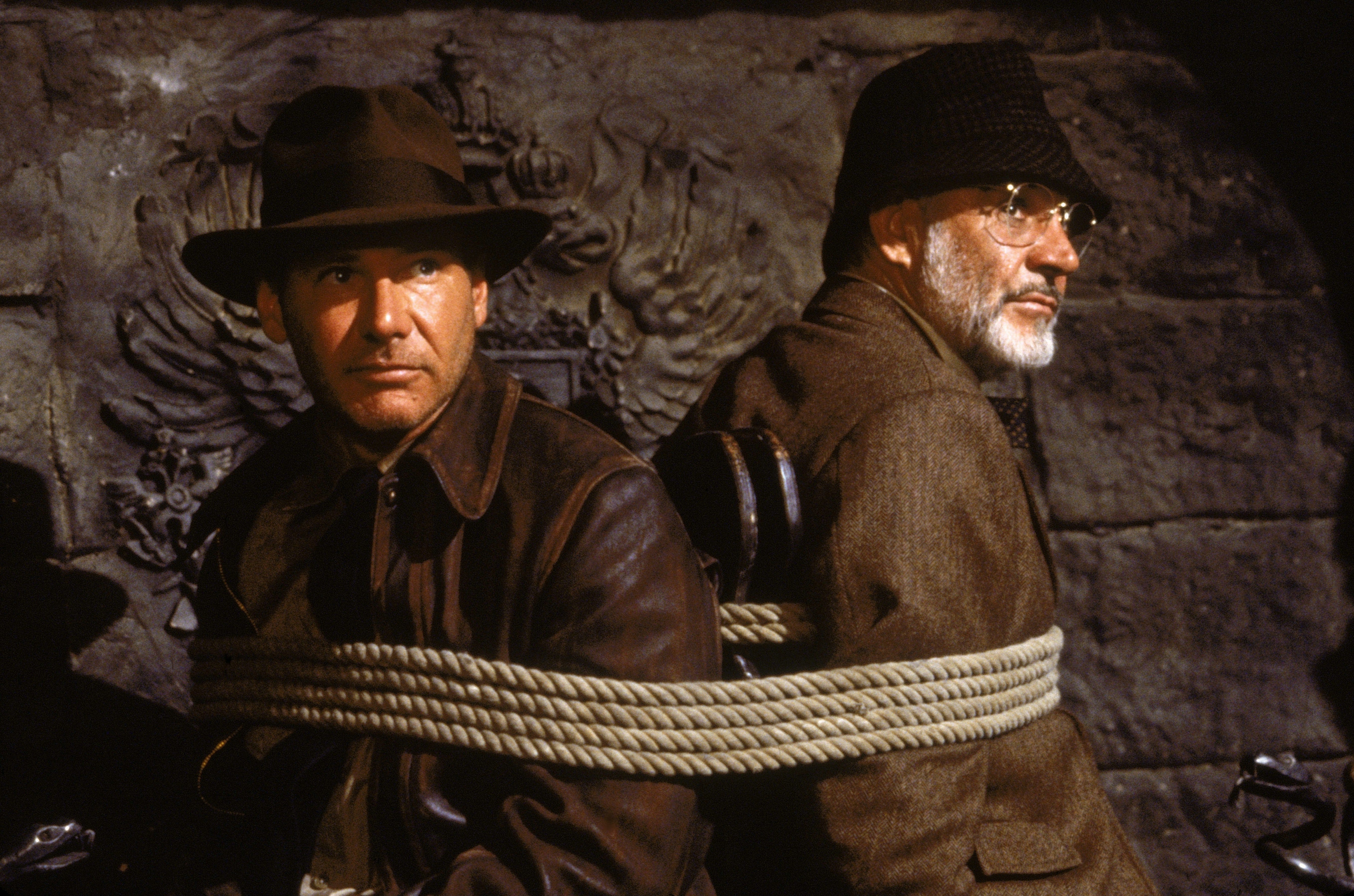
“Look what you did! I can’t believe what you just did!”
To understand this line is to appreciate just what a revelation Sean Connery playing Henry Jones Sr in Indiana Jones and the Last Crusade was.
While I’m no official authority on the man, I have written a book on Connery. He always was and always will be my favourite actor. And in writing that book, two things became clear. Connery might have been one of the most famous movie stars of the 20th century, thanks to being the iconic James Bond in no small part, but he had an incredibly patchy career when it came to the actual films he made. He had as many flops as he had hits. Sometimes he made terrible choices. Sometimes he experimented, sometimes he played it safe. He was always more varied and daring than anyone imagines.
Thanks for reading A. J. Black on Popular Culture! Subscribe for free to receive new posts and support my work.
The second thing was that Connery, be under no illusion, was a man’s man. He played men. They weren’t always swaggering heroes like Bond or charming mentors such as Sanchez in Highlander. Sometimes they were deeply troubled policeman such as in The Offence (I think his best performance), or men of God often in deep repose such as in The Name of the Rose. But they were always driven by a leading man masculinity, even when Connery dared to examine that (and he sometimes did). The older he got, indeed, the more he relied on the safety of playing a character a few degrees removed from Connery himself.
So when you consider that he agreed to take the role of Henry Jones. Sr, which initially is a complete rejection of these basic Connery constants, it stands as among the bravest roles of his career. Henry is immediately presented, breaking a (fake) Ming dynasty vase over the head of his son, as a buffoonish bookworm. He’s almost the Bond Girl in need of saving, the princess in the tower. Yet immediately, with a balance of child-like whimsy and charm, Connery makes the role his own. His chemistry with Harrison Ford (only just over 10 years his junior in real life) is off the charts fantastic straight away.
Cycling back briefly, before we get into their escape from Castle Brunwald, it is worth considering the final scene in Venice before we move to the new Germanic set piece of the story. Indy and Elsa find their rooms have been ransacked—in similar fashion to Henry’s home—looking for the Grail diary that Indy has kept from Elsa. Picking up from their introduction to each other, Spielberg then indulges in some flirtatious arguing that leads to sex. You sense the scene is shooting for Indy and Marion Ravenwood levels of sparky repertoire but what you get isn’t even really as good as Indy and Willie Scott in Pangkot Palace.
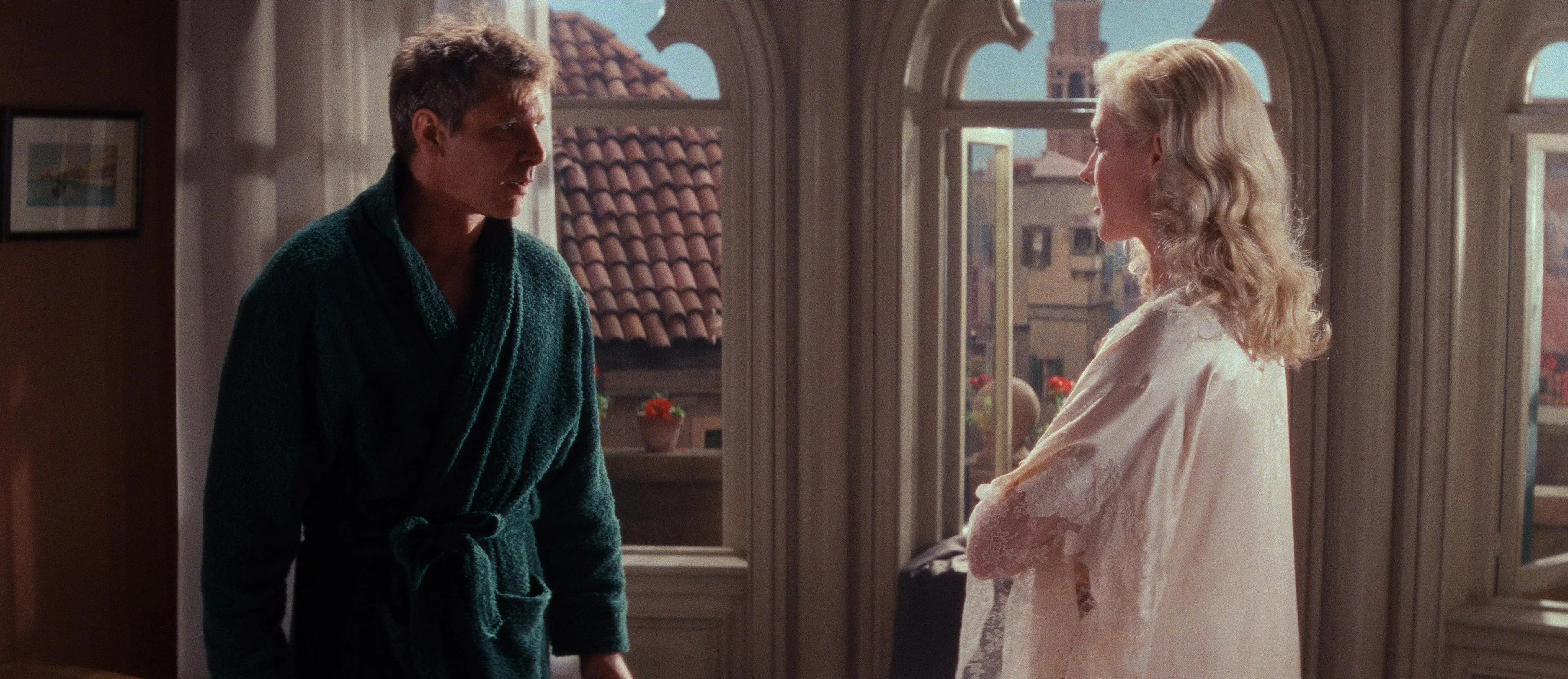
That scene in Temple of Doom was played for laughs as a horny Willie mistakes Indy’s interest in figuring out a secret passageway for allure toward her, after a furious row. There is an attempt to provide some levity—”I don’t like fast women”—but frankly the Indy and Elsa dynamic becomes more interesting when she becomes an antagonist and the film switches to Indy and Henry as the partnership. Last Crusade would never have sustained Indy and Elsa together for an entire film.
Now I’ve always wondered if this sequence on the Austrian/German border is something of a nod to an earlier, intended plan for the opening set piece of the film. Chris Columbus, later director of Home Alone amongst many other well-known pictures, wrote a draft for a third film in 1985 which would have been set in Scotland and saw Indy in battling the venomous ghost of Baron Seamus Seagrove III in his baronial seat. I remember ahead of Indiana Jones and the Dial of Destiny, when rumours of Indy hunting Excalibur were everywhere and Ford shooting in north east England, people speculated if this sequence had been revived.
After all, Indy poses as Scottish Lord, Clarence McDonald (with a shocking Scots brogue from Ford) and wants to see Baron Blunwald. “If you are a Scottish Lord, then I am Mickey Mouse!” shouts the ill-tempered butler, and you don’t blame him.
I’ve always felt though that Indy battling a ghost might have been a step too far. Sure, the Ark had some flying demon things. Kingdom of the Crystal Skull has some interdimensional beings and Dial of Destiny ends up throwing in time travel, so Indy is no stranger to the paranormal. The ghost Baron sequence struck me as too Ghostbusters, however, for Indy (which must have been on Columbus’ mind in the mid-80s), and could have ended up more like Neil Jordan’s High Spirits (1988) than anything else, so I’m glad it was nixed. But maybe Blunwald and this sequence was an attempt to throw a touch of old European Gothic into the world of Indy.
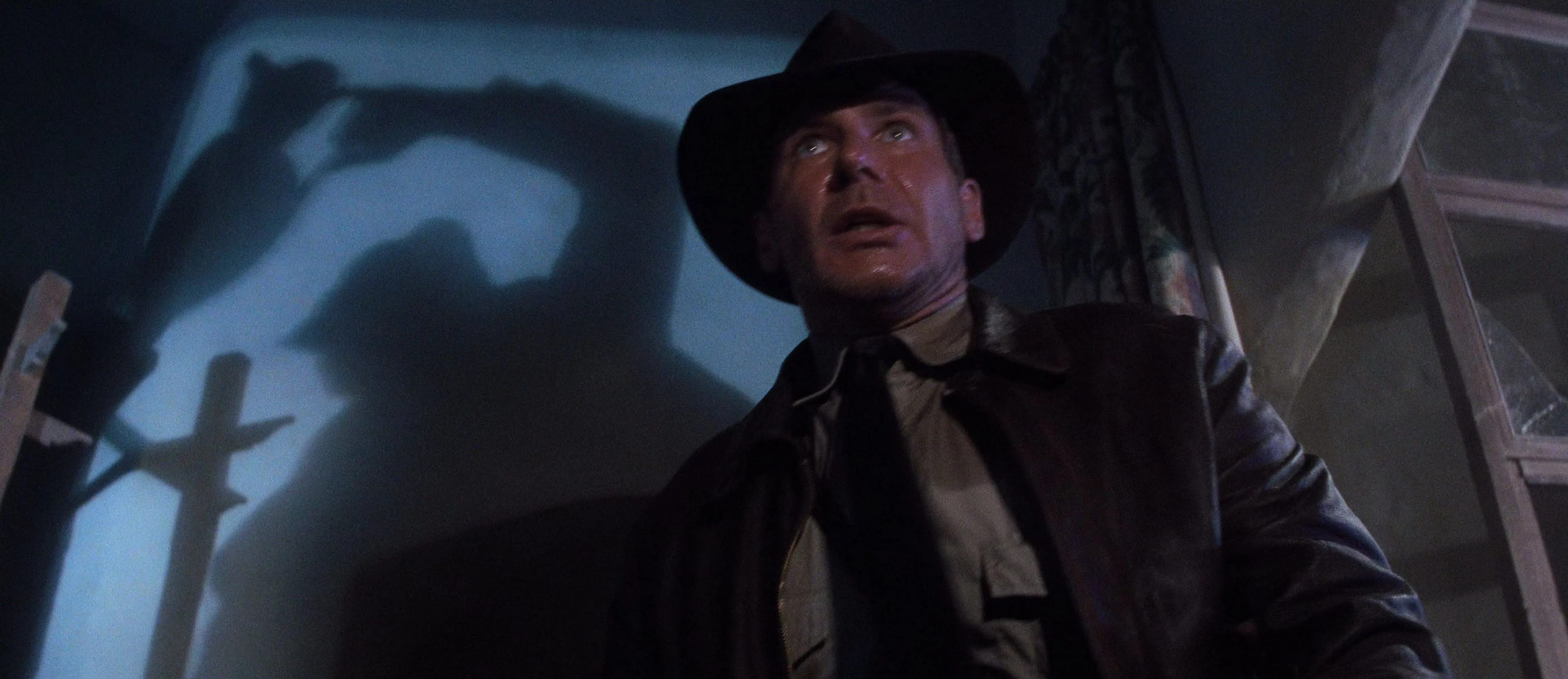
Anyway, back to Henry, and just a moment to appreciate the way we finally see the character visually. Indy enters the room and Spielberg casts Henry as a shadow, indulging his appreciation of classic German Expressionism in this Nosferatu-esque setting, who moves toward Indy with the vase in his hand. After smashing it over his head, as John Williams’ score escalates with danger—hoping the audience will suspect some villain is on him (and bear in mind we don’t yet know the Nazis are involved here)—we see Connery enter frame. Sean bloody Connery. What a reveal! What an entrance with the immortal “…Junior?!”, immediately calling back to the prologue which teed up this whole scene beautifully. It’s one of the great character entrances in cinema.
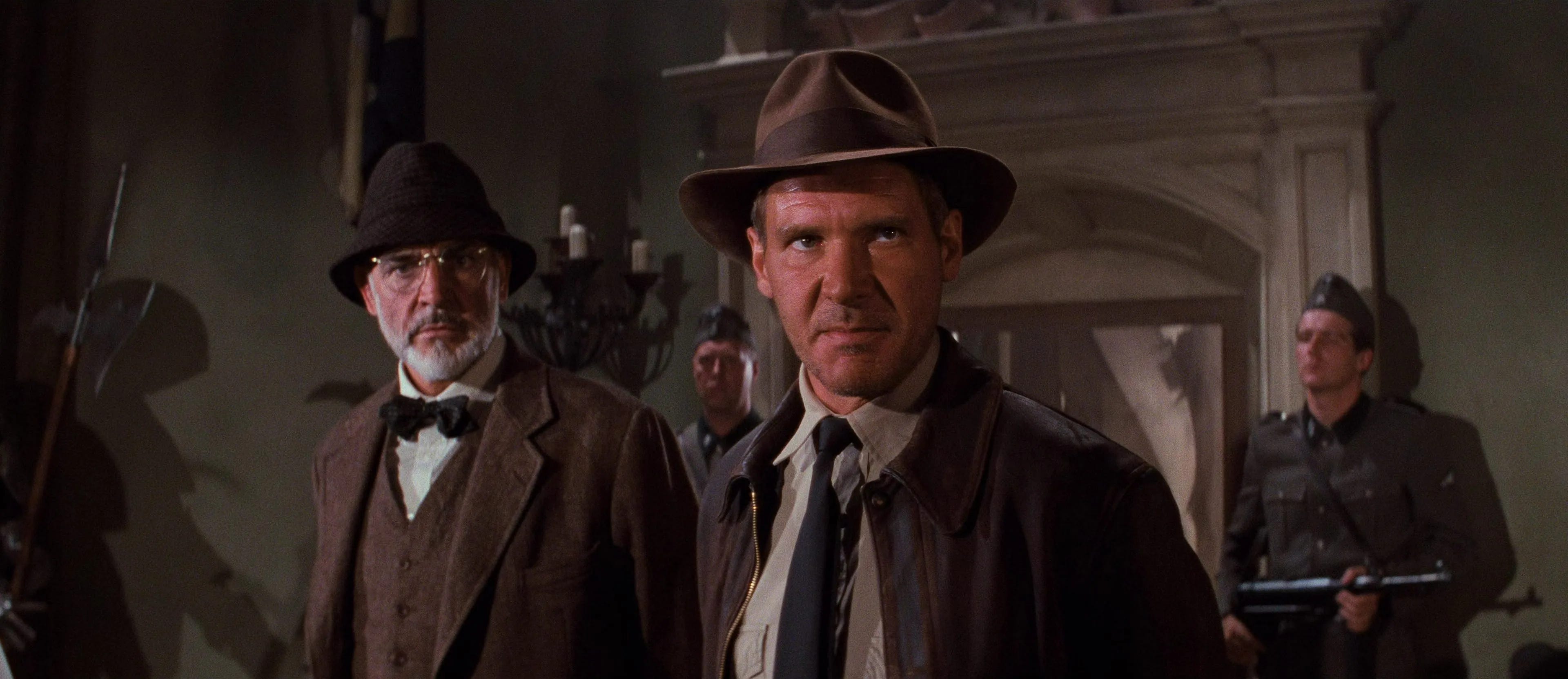
I love the reflexive response of Indy when in front of his father, standing to attention with a “Yes, sir!” While it tracks with the relationship we saw in the prologue, highlighting too how Indy has never really grown up around Henry, the patrician idea he has of his father seems at odds with the reality. Maybe Henry grew more buffoonish as he further entered his Grail-obsessed bubble, as Indy went the opposite way and developed into the warrior archaeologist he is. You certainly feel as the film develops that Indy’s character starts to draw out maybe the man Henry really was in his youth. More on that in future pieces.
What we get here is, possibly, the most iconic sequence in Last Crusade. The breakout of Indy and Henry, their capture by the Nazis and their ultimate escape on motorbike and side car. Everything about this works beautifully. The dialogue crackles. The performances glisten. The comic timing is immaculate. “How did you know she was a Nazi?” (indeed famously, Connery ad libbed the “she talks in her sleep” line, which Spielberg loved so much he kept it in - we’ll come back to this in a moment). This sequence quite expertly establishes the bickering, exasperated dynamic between Indy and Henry while keeping the plot moving at crackling pace.
Spielberg also does a good job of establishing the Nazis again as rather pantomime, cackling villains. Take the moment Indy and Henry rotate in the fireplace and see the Nazi comms room. So much fun, with John Williams’ music full on whimsical in his (stunning) orchestral work. Granted, Michael Byrne’s Nazi officer Vogel is a nasty piece of work, and Elsa too—once unmasked—very much fits the mould of the Mata Hari spy figure, classical and not to be trusted. Tapping again into the Bondian aspects, Walter Donovan’s reveal is full on Bond villain, practically swirling around Blofeld style in front of a fireplace. Ta da! All he needed was a cat on his lap.
The dynamic between Indy, Elsa and Henry fascinates, especially given the unexpected complexity around it stems from Connery’s ad lib. We are clued into the fact Elsa slept with Henry before Indy—”I was the next man”—and this is an example of how, if anyone else had played Henry, this reveal would never have worked. Gregory Peck was initially courted, and he I think would have done a great job with many of these Henry-aspects, but can you imagine him hooking with Alison Doody at nearly 60 years old? No chance. Connery? He could still do that at 70. It’s where our awareness of Connery as an actor, as one of the masculine sex symbols of the late 20th century, helps sell the bookish Henry as a red-blooded male underneath the tweed and silly hat.
Quite unlike Marcus Brody, packed off earlier to Iskenderun to get a head start on the lost city of Alexandretta. Indy’s bluff to Donovan and the Nazis about him is a glorious moment, with a great push in from Spielberg: “Brody’s got friends in every town and village from here to the Sudan. He speaks a dozen languages, knows every local custom. He’ll blend in. Disappear. You’ll never see him again. With any luck, he’s got the Grail already.” Cut to Brody bumbling through a Middle Eastern town, the exact opposite as described, before being kidnapped by Nazis in a van. Even Sallah rests his head against a wall, watching it drive off, with the resigned look of a man who knows this wouldn’t have happened to Indy!
Point is, Last Crusade is constantly in these scenes drawing both parallels and differences between Indy and the men he grew up with. As the film has played with our expectations so far around pre-existing tropes from previous Indiana Jones films, Spielberg’s movie now enjoys examining Indy’s character through Henry and Marcus. The more bumbling they are, the more oddly irascible Indy gets, perhaps suggesting Indy—as a father—wouldn’t be much different to his own at that age. All of this is rendered subtly behind the adventure and fun of the script, but it is always there.
And as Indy and Henry escape, and the film takes a remarkable brief right turn that is worth looking at in its own right, these parallels only grow more acute as both Indy and Henry begin to change each other…
—
Indiana Jones and the Last Crusade
Pt 6 - Papers, Please!
Pt 7 - The Pen is Mightier Than the Sword
Pt 8 - The Canyon of the Crescent Moon
Pt 9 - That’s the Cup of a Carpenter
If you enjoyed this piece, and you fancy ‘buying me a coffee’ to show it, you can hop over to Ko-fi and donate. Thanks if you do!
Thanks for reading A. J. Black on Popular Culture! Subscribe for free to receive new posts and support my work.
Comments
Nothing yet. Say the first thing.
Sign in to join the conversation.