
Trailers are an art form unto themselves and over the years have evolved in Hollywood from the growling tones of the Voiceover Guy (the late Don LaFontaine) intoning “in a world…” all the way through to the stylistic modern form where every trailer shows you bits from the trailer which is showing you bits from the film. A trailer for the trailer, of sorts.
Indeed, anyone who regularly goes to the cinema or engages with trailers, will instinctively understand the structure of how they present movies to us in most cases. There’s usually a needle drop. There are key lines. There will be the moment the music cuts off, a character delivers a line, and then the music kicks back in. And at the end, you’ll get the climax, the title reveal, and then probably a jaunty or ‘cool’ final moment to take you out ahead of an announcement of when the film is coming.
Some of these holding to that tried and tested formula work really well and draw you in enough to make you show up. Others are terrible, repeating the past glories of better films and putting you right off (the trailer for Eli Roth’s Borderlands is a perfect example for me). Yet Hollywood clearly feels this formula works in terms of box office, because only filmmakers like Christopher Nolan get to do it differently, having input on how their latest films are teased. You have to be an auteur to beat the formula now.
Or, just maybe, a trailer for a horror movie. They are definitely starting to march to the beat of their own drum in the last few years. The first of the 28 Years Later sequels, for example, presented what might be the greatest trailer—period—for years, eschewing the standard formula to give us the haunting rendition of ‘Boots’ as it built up the sense of a world that Danny Boyle’s film would, in the end, tonally wrong foot us over. It was a great trailer because it sold you a film you desperately wanted to see, but when it turned out to be a different film, you never felt cheated. It had done its job.
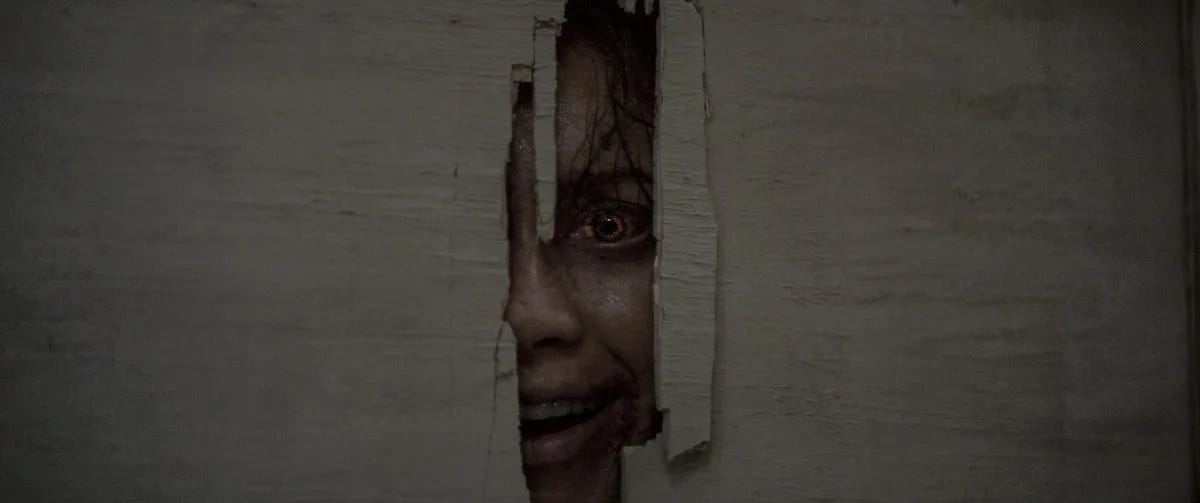
If horror has established that it might have the space to improvise in how it draws audiences in, take several recent examples that seem to point toward an entirely new teaser trailer trend for this sub-genre: the out of context scene.
The André Øvredal chiller, Passenger, begins with two people driving at night through a dark forest as a legend tells us on screen that “last year, over 100 million people took road trips” (you wonder if this is global or just the States, incidentally), one of whom then gets out to urinate up a tree at the side of road. Could be any of us so far. He hears the car horn beeping and on return, the other person in the gone and the legend returns “15,400 of them were never seen again” (a terrifying statistic). The other person then crashes through the windscreen and the terrified guy speeds off.
As he drives, he sees the same image of a man on the side of the road watching him again and again and again as he drives past, caught in some kind of loop, before the man is right next to him and screams at us—in the driver’s POV—at which point the footage cuts off. This formed the first half of a longer, standard second trailer, but for the first trailer this was it. No indication of plot, or setting, or anything conventional. Just a man in a suddenly horrifying situation, haunted by some kind of roadside spectre, the ‘passenger’ perhaps of the title. As a hook for Passenger itself, it’s enormously effective, even if box office receipts for the film didn’t end up bearing that out.
Not that Passenger did poorly, few horror films do these days, but when you compare it now to the new benchmark, Curry Barker’s Obsession, everything underachieves. That has very quickly consumed popular culture this summer and romped to an enormous global box office cume, even stealing The Blair Witch Project’s almost three-decade crown as a low budget monster hit. The teaser trailer, again ahead of a more conventional second one, took a similar approach in how it presented the central horror of the film without the need to give us too much detail.
We see the protagonist, Bear, in his car at night calling seemingly a helpline and asking if he can alter a wish. We see a flash of ‘One Wish Willow’, perhaps the company he is calling, and a very disinterested male, almost stoner voice on the end, asks if he wants to cancel. Bear doesn’t, he just wants to alter it, asking if what he’s experiencing is real. “Is her love real?” The man tells him that just because he asked for it, doesn’t make it less real. A non-answer. The title then cuts in. No horror. No jump scares (though I’d argue the jarring cuts to the wish packaging are creepy). No plot, again. Just mood. The sense that all is not well and, like in Passenger, we are in the middle of a situation rapidly declining.
The horror of the Obsession trailer points, if anything, to the bureaucracy underscoring what this man is going through. The helpline guy effectively suggests he read the small print on the back of the box when Bear asks if the wish can be altered. “We don’t really do that” he says. Much as other strands of capitalism does, you are locked into terms and conditions that, if you don’t read (and who ever does?), can come back to bite you. Throw in how this engages then with the feelings Bear is experiencing; how anxious he is at what appear to be positive feelings that might not be real or right; and the apparent paranormality of a wish come true, then the Obsession teaser leaves you with a mountain of questions.
A recurring structural theme to these teasers, then, is the sense of throwing us into a scenario rather than building to a plot revelation or obvious scare. The film might end up being fine, but the trailer for Insidious: Out of the Further, is an example of a more conventional horror set up and, conversely, it’s far less memorable a snapshot.
One final example of a teaser that establishes a scenario and mood in one is Evil Dead Burn, the sequel to Evil Dead Rise which has, to an extent, polarised audiences. If the Passenger trailer builds suspense and the Obsession teaser suggests an idea, the Evil Dead Burn teaser depicts an onslaught. A woman, inside a big old Gothic house, in the midst of an attack. She’s bleeding, disoriented, and then a fight crashes in, another guy being brutally attacked and thrown about by a hulking beast of a man smashing the house to pieces as she tries to get out of the way.
What’s great about this teaser is that, to an even lesser degree than the previous two, it throws you deep into the terror of the situation with an almost documentarian feel. She could be in a war zone, dodging bodies and furniture and brickwork and bodies slamming around her, as something violent and presumably evil swirls around her. She manages to hide behind a cabinet and the title appears on screen next to her, almost invading the scenario, before it cuts out. You are left shaken, disturbed, and wondering about the context. If you know the Evil Dead franchise, you may have some inkling of tone but if not, the eventual film may come as a surprise.
All of these teasers give way to longer trailers that give us more but they do enough to tantalise and draw audiences in. Horror is providing a space unlike almost any other genre to hook an audience with out of context scenarios that deliver a terrifying moment, or idea, or set piece to whet our appetite. It feels like a growing trend. As horror continues to be among the most lucrative, and certainly the most innovative, genres today in film, it could well be a trend that only continues to grow and grow.
If you enjoyed this piece, and you fancy ‘buying me a coffee’ to show it, you can hop over to Ko-fi and donate. Thanks if you do!
No posts
Comments
Nothing yet. Say the first thing.
Sign in to join the conversation.